
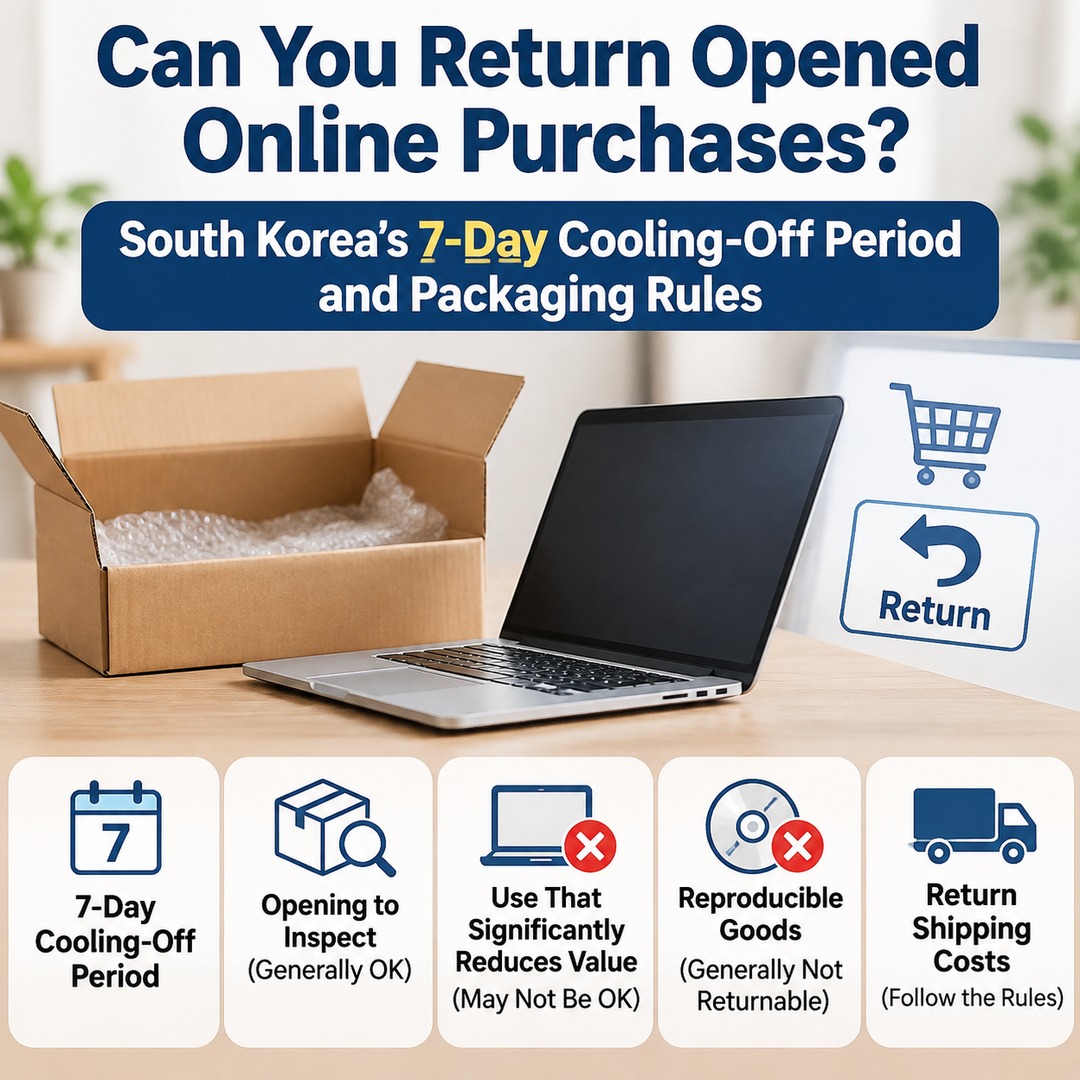
If an online seller refuses a refund simply because you opened the delivery box after purchasing a laptop or electronic device, that does not automatically mean you have lost your right to return it. Under South Korea’s Electronic Commerce Act, opening packaging to inspect the contents is generally not grounds for restricting withdrawal from a purchase. The key questions are whether the product’s value has significantly decreased through actual use and whether the product falls under a statutory exception.
For a change-of-mind return, consumers generally have a statutory withdrawal period of seven days. However, exceptions may apply if the product has been used or damaged, or if packaging for reproducible goods has been opened.
Can a Seller Refuse a Return Within Seven Days Just Because You Opened the Delivery Box?
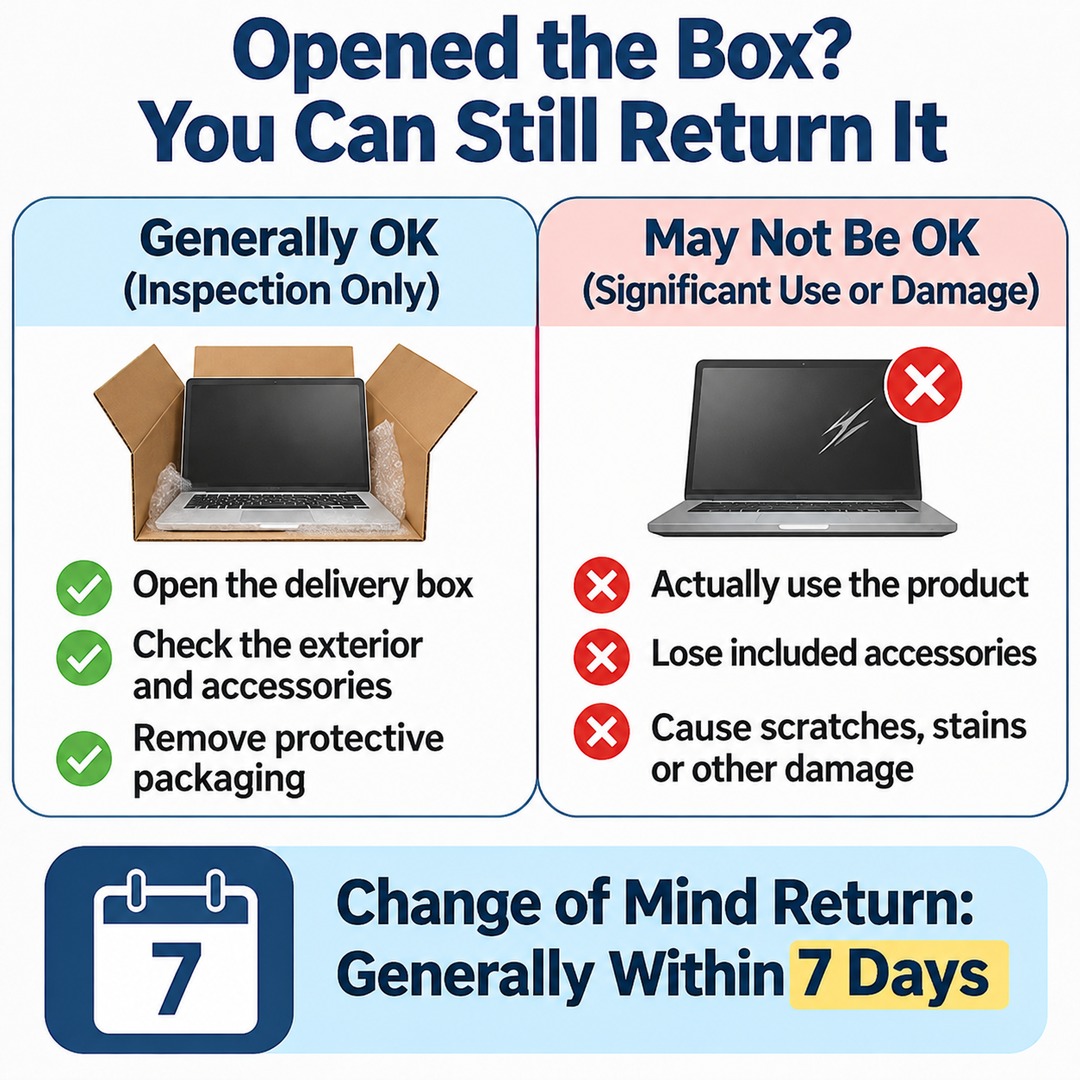
A seller cannot automatically refuse a return simply because you opened the delivery box or product packaging. South Korea’s Electronic Commerce Act excludes damage to packaging for the purpose of inspecting a product from the general restrictions on withdrawal based on damage.
The important distinction is between opening a package and using the product.
Opening the delivery box to inspect the product
Checking the product's exterior and included accessories
Removing protective packaging to examine the product
These actions alone do not establish that the product's value has significantly decreased.
The situation may be different if you actually used the product, lost included accessories, or caused scratches, stains, or other damage to the item itself.
In a consumer dispute resolution case published by the Korea Consumer Agency, the removal of adhesive tape attached to a product box and the subsequent opening of the box were not considered sufficient grounds to conclude that the product's value had been damaged. In that case, the business accepted the return request and refunded the purchase price.
When Does the Seven-Day Online Purchase Return Period Begin?
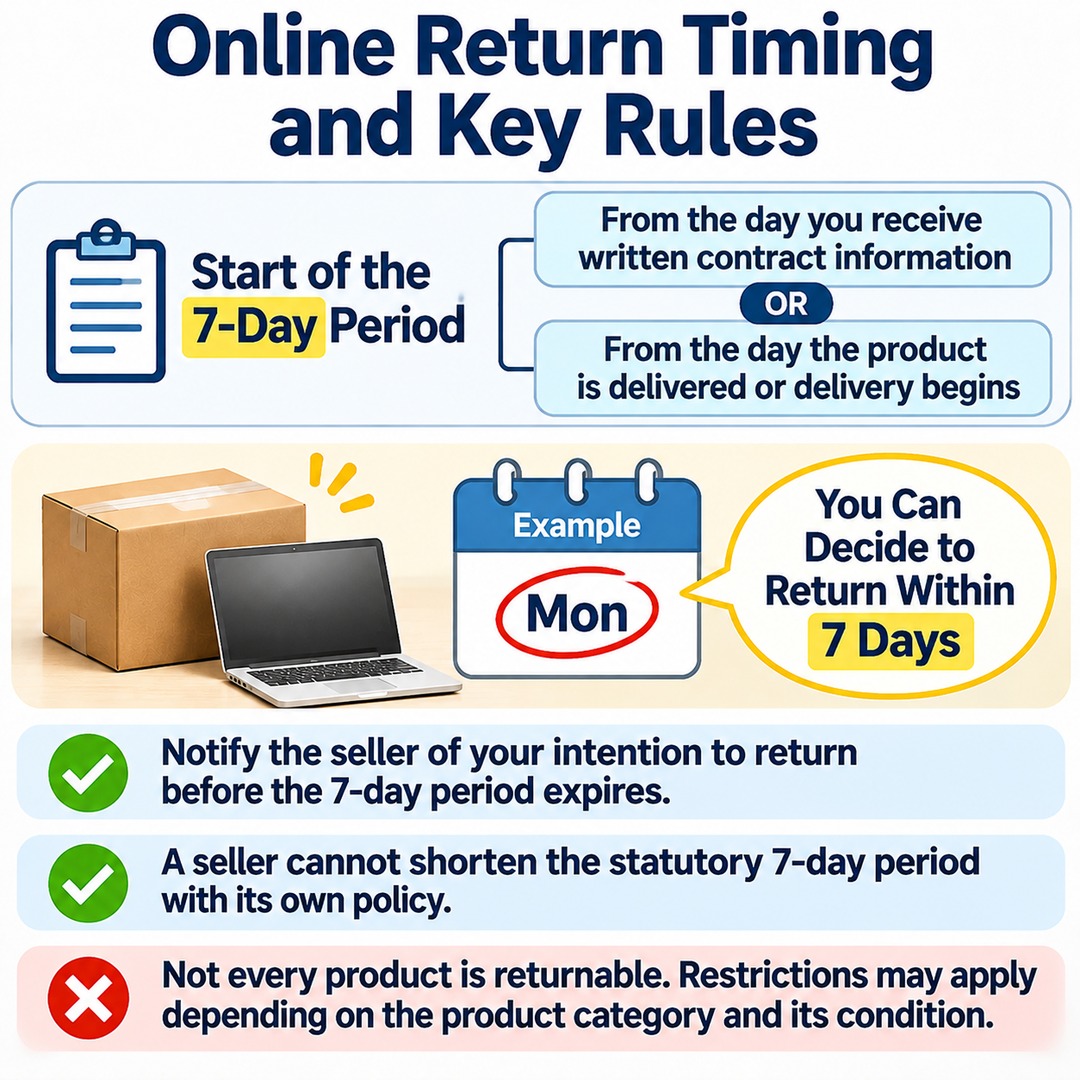
For a standard change-of-mind withdrawal, the seven-day period generally begins on the day the consumer receives written information about the contract. If the product is delivered later than that written information, the period is calculated from the day the product is delivered or delivery begins.
For physical goods delivered to your home, it is practical to keep track of the date you receive the item.
For example, if your product arrives on Monday, you do not need to wait until Wednesday to decide whether to return it. If you inspect the product and decide to return it, notify the seller of your intention to withdraw from the purchase before the statutory seven-day period expires.
A seller cannot reduce your statutory rights by imposing a shorter return period in its own shopping mall policy or by claiming that the seven-day period must be counted from the day of receipt in a way that overrides the statutory rules.
However, not every product can be returned simply because you change your mind. Statutory restrictions may apply depending on the product category and its condition after opening or use.
How Much of a Laptop or Electronic Device Can You Unbox?
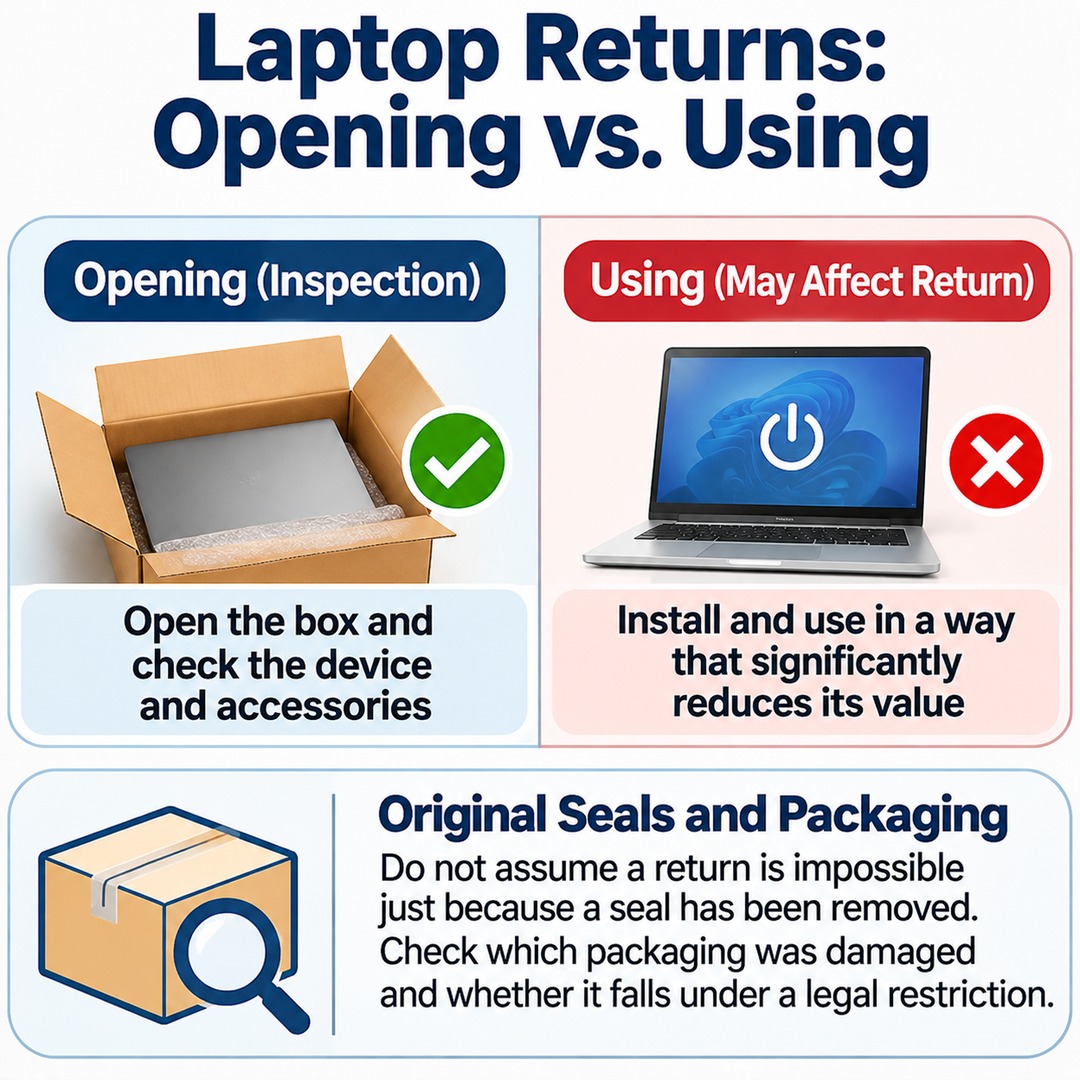
For laptops and electronic devices, it is important to distinguish between opening the packaging and actually using the product. Opening the shipping box to inspect the device and its accessories is not the same as installing and using the product in a way that significantly reduces its value.
How the condition of an opened or used product affects return eligibility
| Condition | Withdrawal assessment |
|---|---|
| Delivery box opened | Opening alone is not grounds for restricting a return |
| Product exterior inspected | Generally permitted when done to examine the contents |
| Accessories inspected | Depends on whether anything is missing or damaged |
| Device powered on and actually used | Requires consideration of whether the product's value has decreased |
| Main device damaged or stained | A restriction may apply depending on consumer responsibility and the extent of damage |
| Packaging seal on reproducible goods opened | May qualify as a statutory restriction |
In particular, you should not assume that simply turning on a laptop automatically makes it ineligible for return in every situation. The extent of actual use, the product's condition, any reduction in value, and the applicable statutory exceptions must all be considered.
The same principle applies to original seals and manufacturer packaging. Rather than automatically concluding that a return is impossible because a seal has been removed, determine which packaging was damaged and whether the action falls within a legally recognized restriction on withdrawal.
Are There Products That Cannot Be Returned After Their Packaging Is Opened?
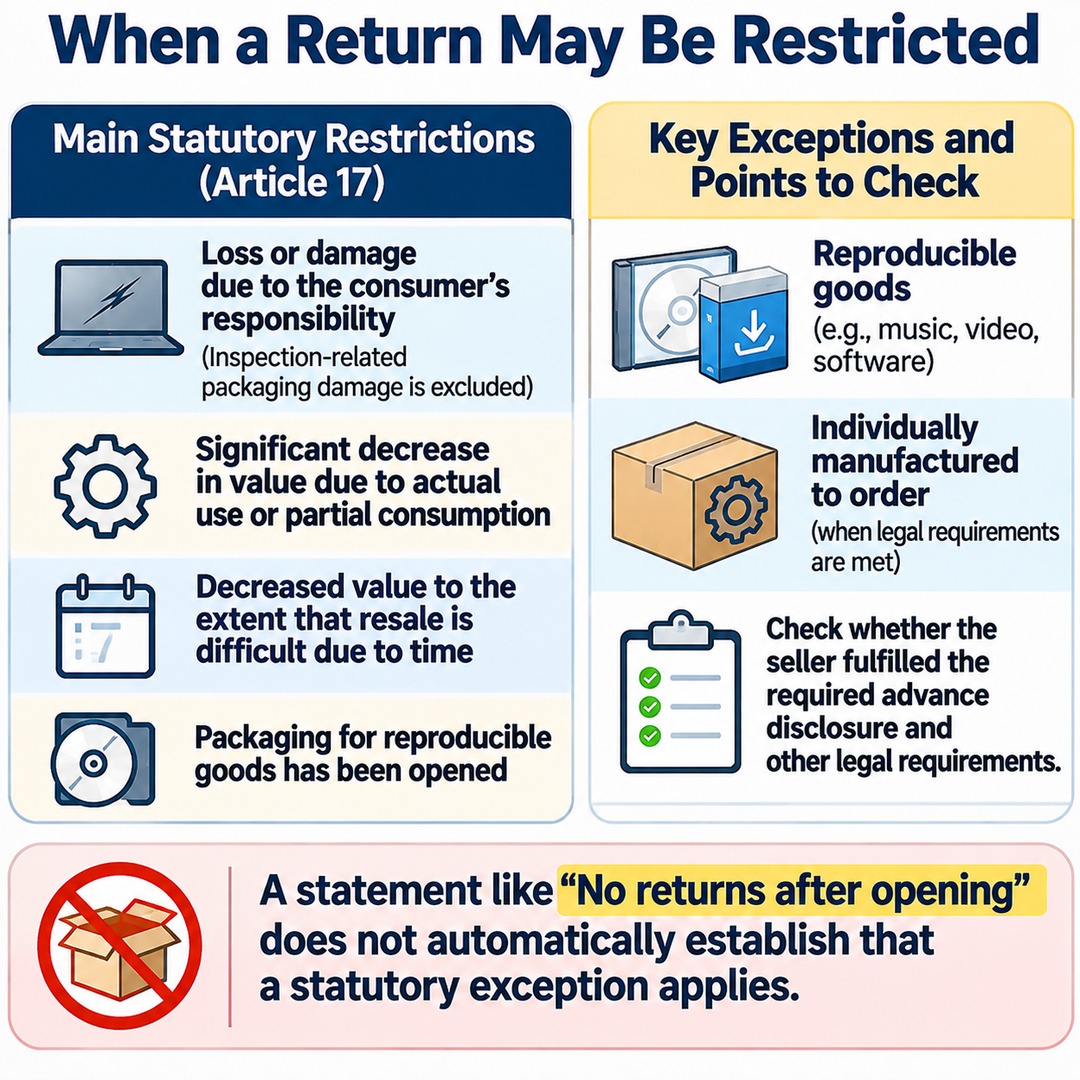
For certain products, damage to the packaging itself may restrict the right to withdraw from a purchase. One major exception concerns reproducible goods. Products individually manufactured to order may also qualify for restrictions if the separate statutory requirements are satisfied.
The main restrictions set out in Article 17 of South Korea’s Electronic Commerce Act include the following:
1. The product has been lost or damaged due to the consumer's responsibility. However, packaging damage caused by opening the product to inspect its contents is excluded.
2. The product's value has significantly decreased because it was actually used or partially consumed.
3. The product's value has decreased to the extent that resale has become difficult due to the passage of time.
4. Packaging for a product that can be reproduced has been damaged.
5. The provision of digital content or another product or service covered by a statutory exception has already begun.
Reproducible goods should be distinguished from ordinary laptop or household appliance packaging. Products such as music recordings, video media, and software may be subject to separate restrictions when their packaging is opened.
Furthermore, if a seller seeks to restrict withdrawal because of reduced value resulting from use or the passage of time, you should check whether the seller fulfilled the advance disclosure and other requirements prescribed by law. A statement on a product page saying simply "No returns after opening" does not automatically establish that a statutory exception applies.
Do Return Shipping Costs Differ Between Change-of-Mind Returns and Defective Products?
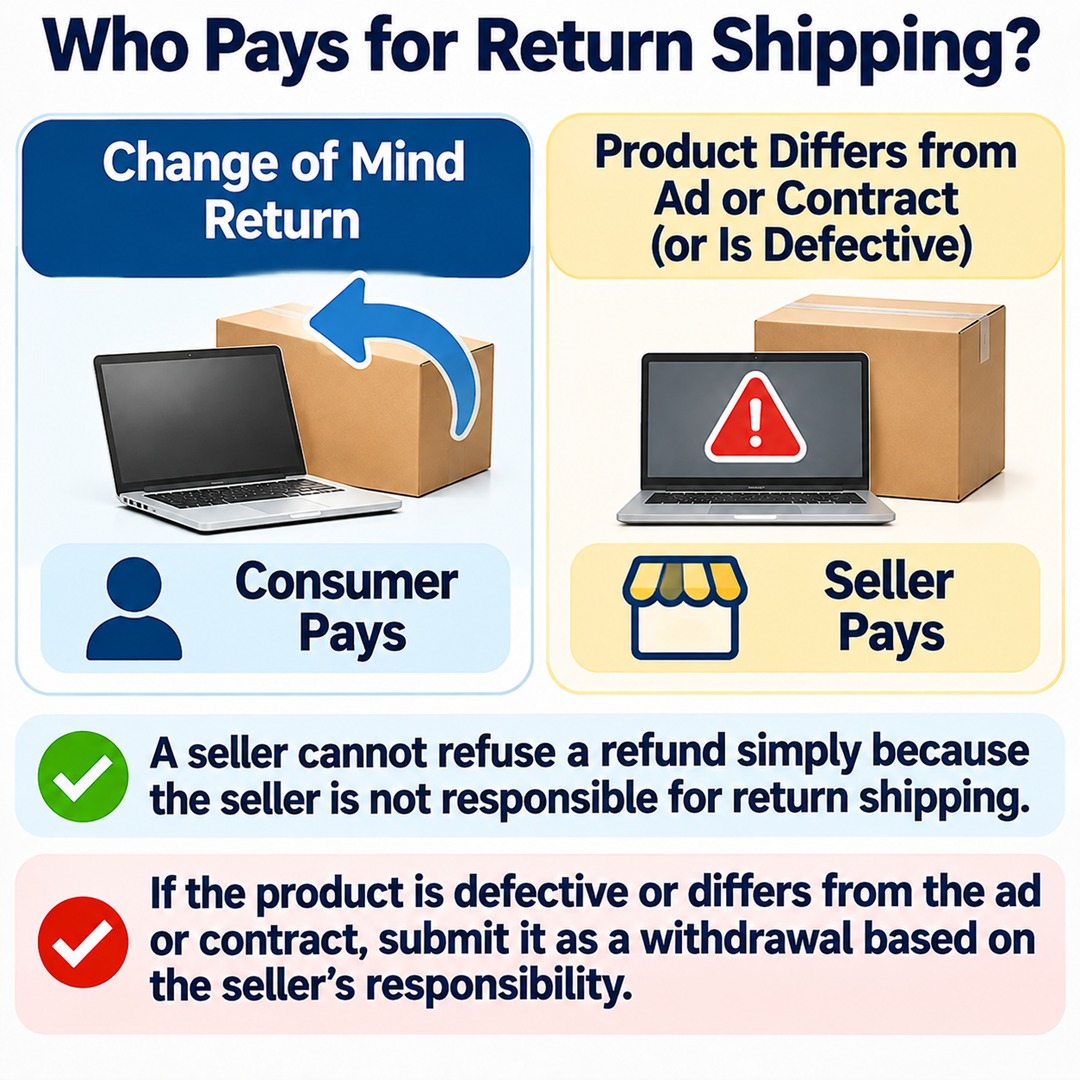
Who pays for return shipping depends on the reason for the return. When a consumer changes their mind, the consumer generally pays the return shipping costs. However, if the product differs from its advertisement or the terms of the contract, the seller is responsible for those costs.
| Reason for return | Return shipping costs |
|---|---|
| Change of mind or dissatisfaction with color or design | Consumer pays |
| Different product delivered from the one ordered | Seller pays |
| Product differs from its advertising | Seller pays |
| Contract not fulfilled as agreed | Seller pays |
For a change-of-mind withdrawal, a seller cannot refuse the refund itself simply because the seller is not responsible for return shipping. If the statutory requirements for withdrawal are met, the general rule is that the consumer pays the return costs.
If the product is defective or differs from the advertised or contracted specifications, it is important not to classify the request as an ordinary change-of-mind return. Instead, submit it as a withdrawal based on the seller's responsibility. This helps avoid confusion about who must pay the shipping costs.
What Should You Do If a Seller Refuses a Refund Because the Product Was Opened?
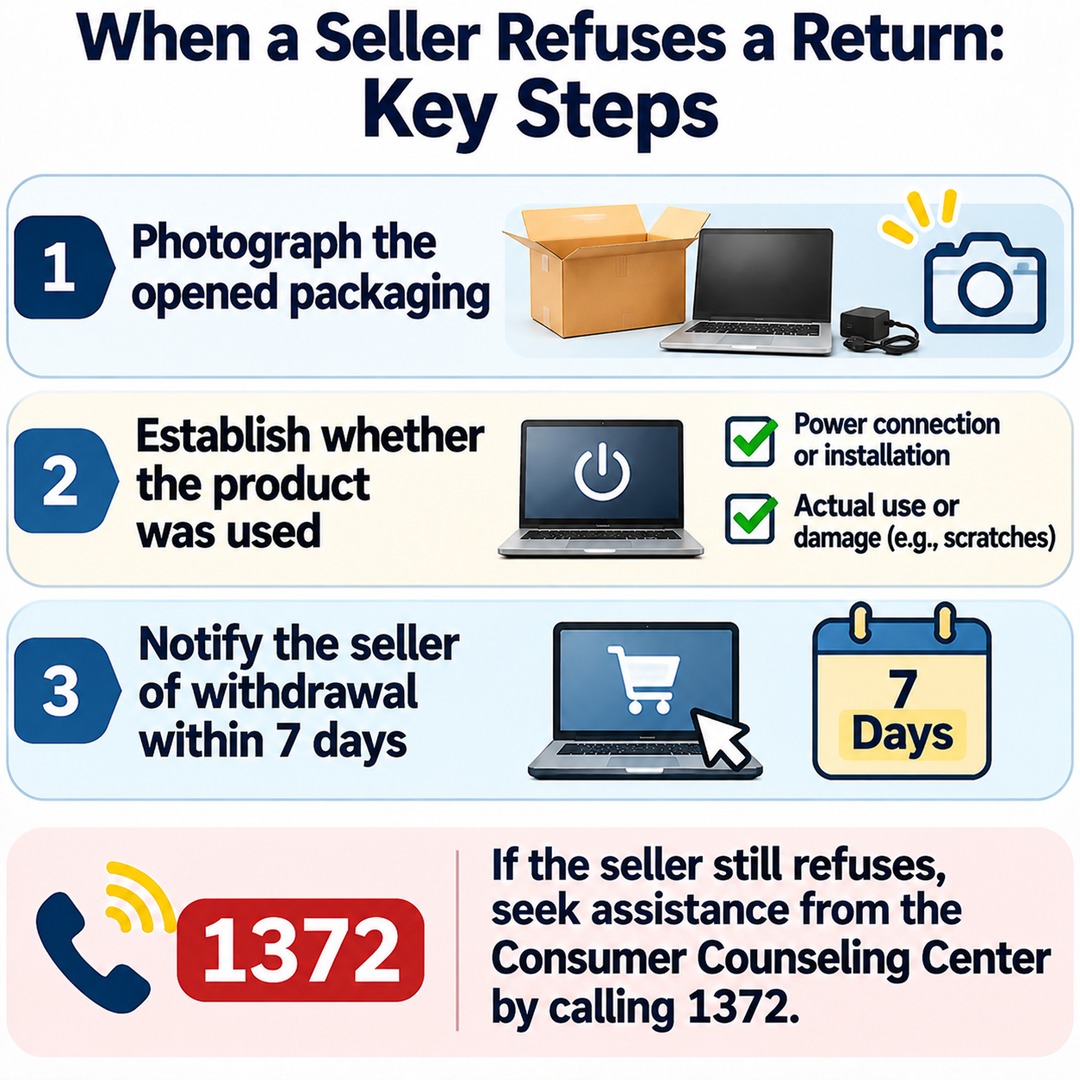
If a seller refuses your return, it is better to document the product's condition and your intention to withdraw from the purchase rather than arguing only about whether the package was opened.
You can take the following steps:
1. Photograph the opened packaging: Take photos and videos of the delivery box, product packaging, main device, accessories, and seals.
2. Establish whether the product was used: Distinguish between connecting the power, installing the product, actually using it, and any scratches or stains that may have occurred.
3. Notify the seller of withdrawal within seven days: Submit your return request through the shopping mall's return system or contact customer service in a way that creates a written record.
4. Request the specific reason for refusal: Ask the seller to identify the statutory restriction they are relying on and explain exactly how the product's value has decreased.
5. Keep supporting evidence: Save your order details, product listing, seller responses, return request records, and delivery-related documents.
If the seller continues to refuse the return, you can seek assistance from South Korea's Consumer Counseling Center by calling 1372. When requesting advice, provide the product category, why you opened the packaging, whether you actually used the product, the date you requested the return, and the seller's stated reason for refusing it.
The key in a return dispute is not to conceal the fact that you opened the package. Instead, objectively demonstrate what you opened, how far you went in inspecting the product, why you opened it, and what condition the product remained in.
When Will You Receive Your Refund After Sending the Product Back?
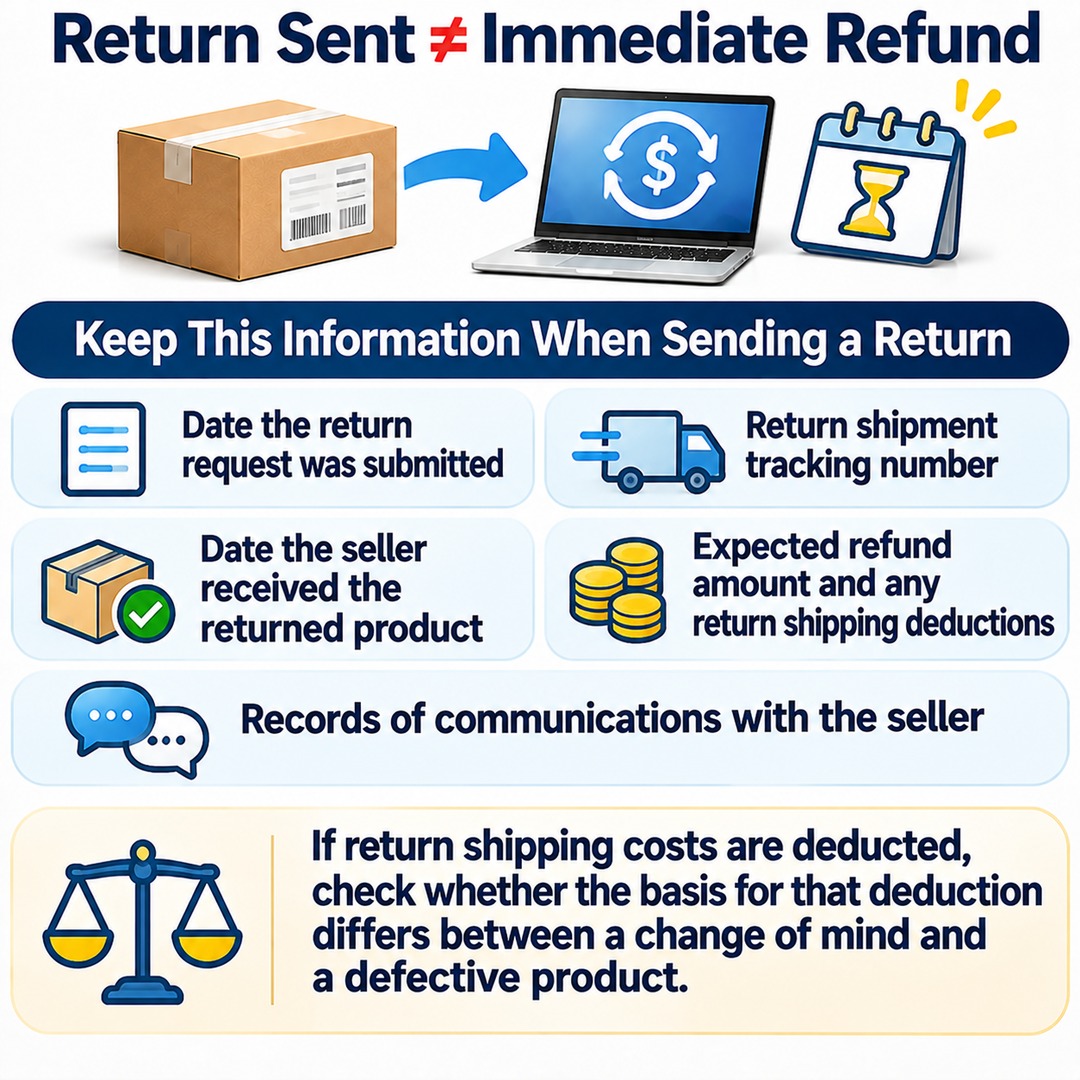
Sending a product back does not mean the refund will be completed immediately. Under Article 18 of South Korea’s Electronic Commerce Act, the seller must follow the statutory refund procedure based on the returned product.
It is advisable to keep the following information when sending a return:
Date the return request was submitted
Return shipment tracking number
Date the seller received the returned product
Expected refund amount and any return shipping deductions
Records of communications with the seller
If return shipping costs are deducted from the refund, check whether the basis for that deduction differs depending on whether the return is due to a change of mind or a defective product.
Frequently Asked Questions
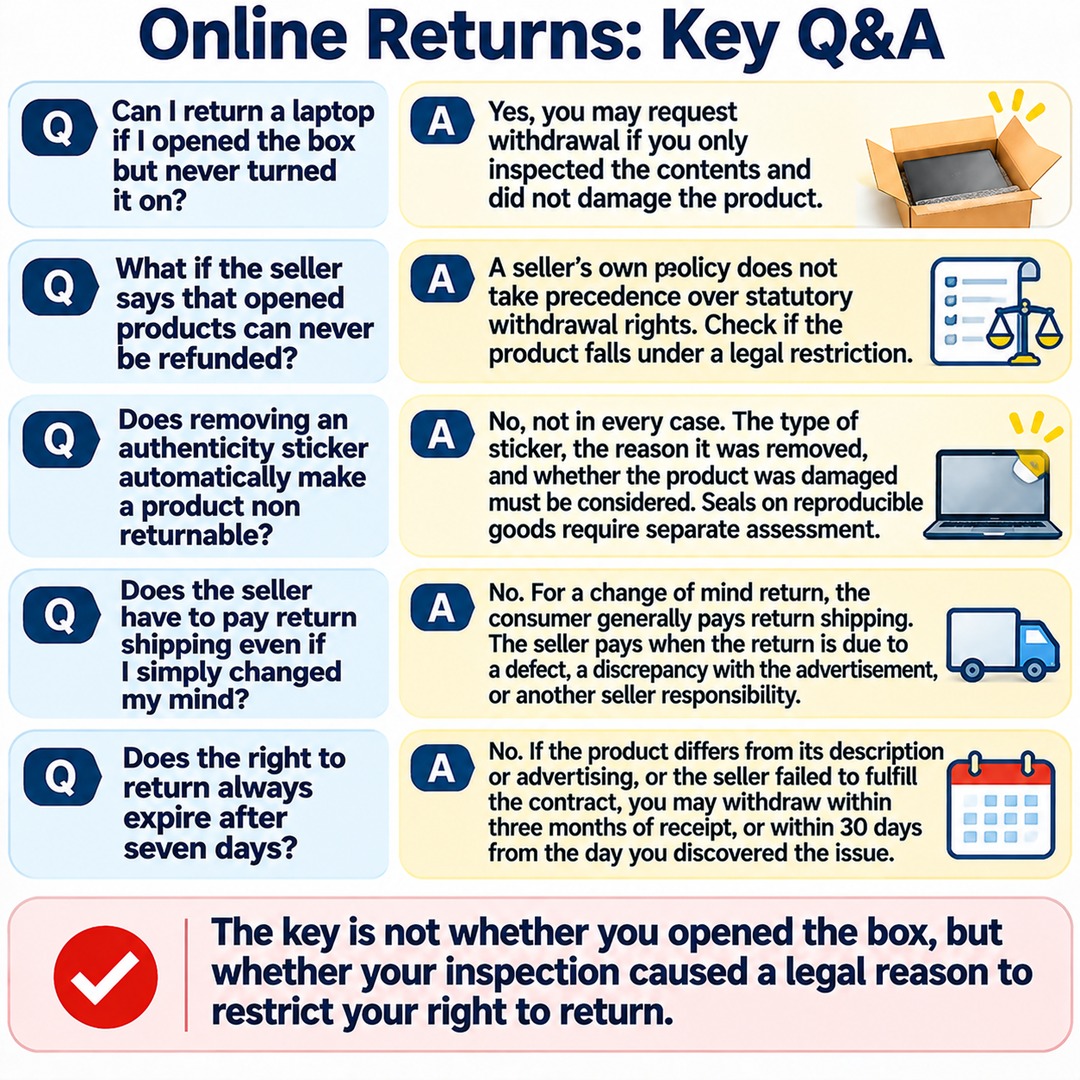
Q. Can I return a laptop if I opened the box but never turned it on?
If you opened the packaging to inspect the contents and did not damage the product, you may request withdrawal from the purchase. However, the specific condition of the product, including its accessories and seals, may affect the individual assessment.
Q. What if the seller says that opened products can never be refunded?
A seller's own policy does not take precedence over statutory withdrawal rights. You should check whether the product actually falls under one of the legal restrictions.
Q. Does removing an authenticity sticker automatically make a product non-returnable?
No, not in every case. The type of sticker, the reason it was removed, and whether the product itself was damaged must be considered separately. Seals on reproducible goods and packaging that directly affects product value require separate assessment.
Q. Does the seller have to pay return shipping even if I simply changed my mind?
No. For an ordinary change-of-mind withdrawal, the consumer generally pays the return shipping costs. The seller pays when the return is due to a product defect, a discrepancy with the advertisement, or another matter for which the seller is responsible.
Q. Does the right to return a product always expire after seven days?
No. If the product differs from its description or advertising, or the seller has failed to fulfill the contract as agreed, the consumer may withdraw from the purchase within three months of receiving the product, or within 30 days from the day the consumer discovered or could reasonably have discovered the discrepancy.
The most important factor in online shopping returns is not whether you opened the box, but whether your inspection caused a legally recognized reason to restrict withdrawal from the purchase. Before giving up on a refund for an opened laptop or electronic device, check the delivery date, whether the product was actually used, and its current condition.