To reduce window condensation during winter, you need to manage more than just indoor humidity. Ventilation, heating, and the surface temperature around windows all play a role. Use a hygrometer to monitor humidity, remove moisture after cooking and showering, and promptly wipe and dry any water that collects on windows.
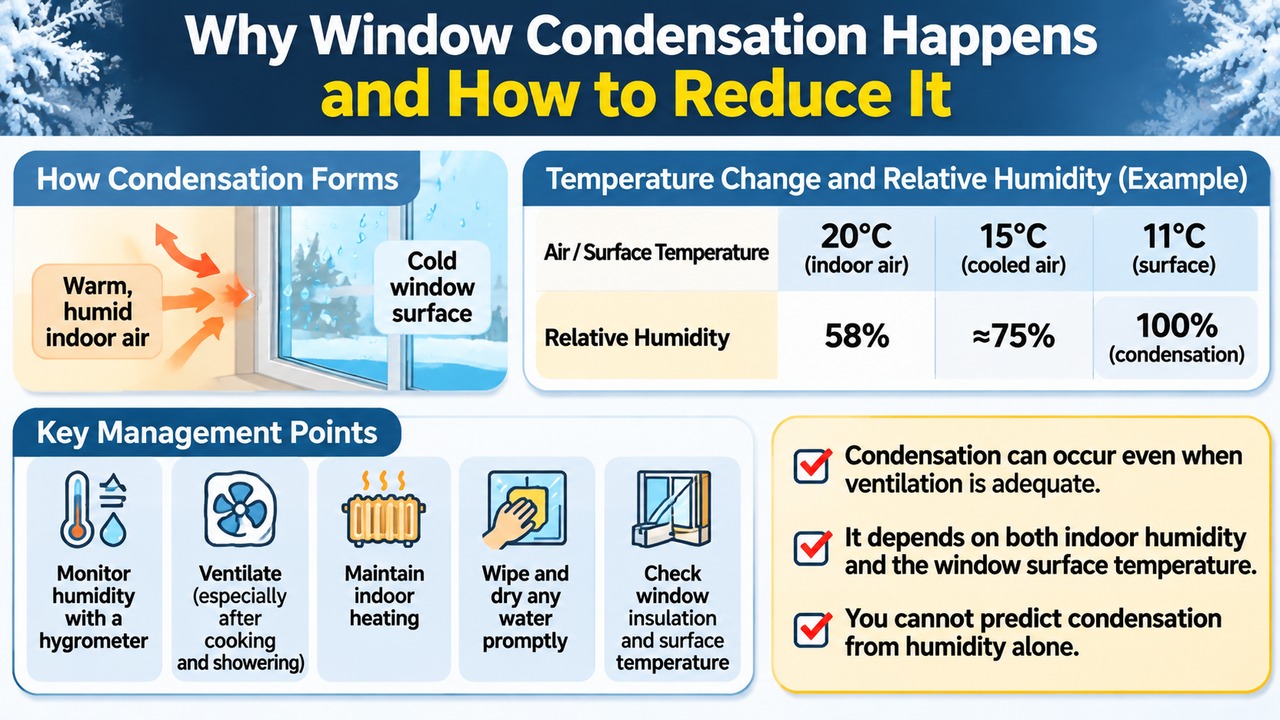
Water droplets on windows do not necessarily mean that ventilation is inadequate. Condensation occurs when water vapor in indoor air meets a cold glass surface and turns into liquid water. This means you need to consider both indoor humidity and window surface temperature.
Why Do Water Droplets Form on Windows?
Condensation occurs when warm, humid indoor air comes into contact with cold windows or walls. As the air cools, it may no longer be able to retain all its water vapor, causing tiny droplets to form on the surface.
Even when indoor temperatures are the same, the amount of condensation can vary depending on window insulation and the temperature of exterior-facing walls.
For example, if indoor air is at 20°C with a relative humidity of 58%, cooling that air to 15°C raises its relative humidity to approximately 75%. If the surface temperature drops further to 11°C, relative humidity can reach 100%, allowing water droplets to form.
Therefore, you cannot reliably predict condensation based on the hygrometer reading alone. It is important to consider indoor humidity alongside the temperature conditions of the glass, window frames, and exterior wall corners.
What Is the Ideal Indoor Humidity Level During Winter?
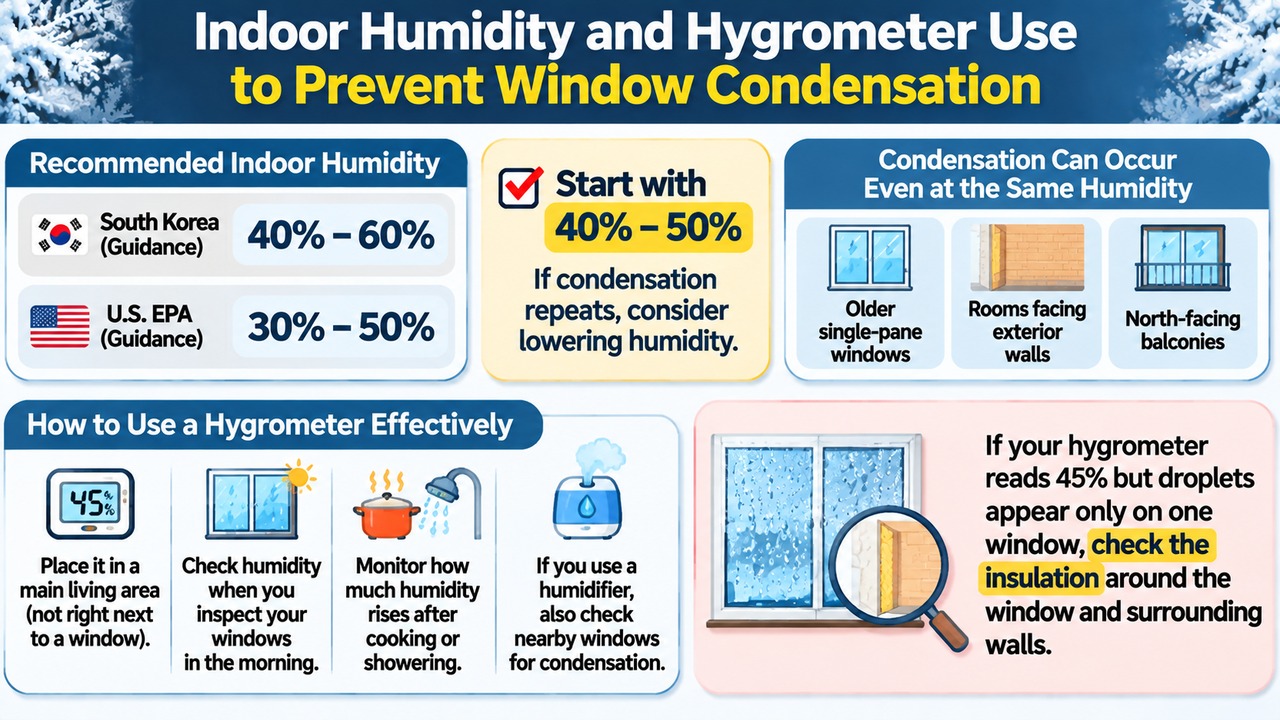
Start by maintaining indoor relative humidity between 40% and 50%, while monitoring your windows for condensation. South Korea's domestic environmental health guidance recommends 40%–60% as a general comfortable indoor humidity range. However, if condensation repeatedly occurs in your home, it may be better to lower humidity rather than maintain levels near the upper end of that range.
The U.S. Environmental Protection Agency also recommends an indoor relative humidity range of 30%–50% and advises taking precautions against mold in damp environments.
The important point is that 50% is not an absolute standard that applies equally to every home. Condensation can occur at the same humidity level in spaces with cold surfaces, such as rooms with older single-pane windows, rooms facing exterior walls, and north-facing balconies.
How to use a hygrometer effectively:
Place it in a room where people spend most of their time, rather than directly beside a window.
Check the humidity when you inspect your windows in the morning.
Monitor how much humidity rises after cooking or showering.
If you use a humidifier, also check the windows nearby for condensation.
If your hygrometer reads 45% but droplets appear heavily on only one particular window, check the insulation around the window and surrounding walls instead of focusing exclusively on lowering indoor humidity.
How Often Should You Ventilate Your Home in Winter?
You should ventilate your home several times a day, even during winter. Rather than leaving windows open continuously in cold weather, it is more practical to ventilate when moisture generated by everyday activities needs to be removed.
South Korea's domestic environmental health guidance recommends natural ventilation three times a day, in the morning and afternoon. Residential guidance for apartment buildings also recommends ventilation two to three times daily and regular operation of mechanical ventilation systems.
Pay particular attention to ventilation in the following situations:
After waking up: Replace the air in bedrooms that have remained closed overnight.
While cooking: Run the kitchen range hood and open a window for ventilation after cooking.
After showering: Keep the bathroom door closed and run the exhaust fan to prevent water vapor from spreading into other rooms.
After drying laundry indoors: Ventilate to prevent moisture evaporating from wet clothes from remaining inside the home.
It is better not to switch off the bathroom exhaust fan immediately after showering. Residential guidance for apartment buildings recommends keeping the bathroom door closed and running the exhaust fan for at least 20 minutes after showering.
Image placement: An everyday ventilation diagram showing winter indoor ventilation and kitchen and bathroom exhaust systems.
If Condensation Keeps Returning, Identify Where Moisture Is Being Generated
Simply wiping water droplets from windows is unlikely to solve recurring condensation. You also need to examine everyday activities that continuously introduce moisture into your home and areas where that moisture cannot escape effectively.
| Source of Indoor Moisture | Management Method |
|---|---|
| Kitchen | Run the range hood while cooking and ventilate afterward. |
| Bathroom | Run the exhaust fan while showering and continue exhausting moisture afterward. |
| Indoor laundry-drying area | Ensure adequate ventilation and air circulation. |
| Around humidifiers | Check for window condensation and adjust humidifier use. |
| Balcony | Keep ventilation openings clear and avoid excessive storage. |
Avoid hanging large amounts of laundry close together near windows. As clothes dry, moisture moves into the indoor air. If ventilation is inadequate, that moisture can collect on windows and cold exterior walls.
Furniture placement also matters. Air circulation may be restricted behind wardrobes and storage cabinets placed directly against exterior walls. Leave a small gap between furniture and the wall, and periodically open cabinet doors to ventilate the interior.
How Should You Remove Water Droplets from Windows?
If condensation appears, first remove the moisture and thoroughly dry the surrounding area. Leaving water pooled in window tracks can damage nearby finishing materials or encourage mold growth.
Follow these steps:
1. Wipe water droplets from the glass with a dry towel or absorbent cloth.
2. Remove any standing water from window tracks and corners.
3. Thoroughly dry wet areas using a fan or similar method.
4. Manage indoor moisture through ventilation or by using a dehumidifier.
5. Check the same areas the following day to see whether condensation has returned.
If mold has already developed, do not stop at wiping the visible surface. You also need to address the source of the moisture. If contamination has spread beneath wallpaper or inside window frames, surface cleaning alone may not be sufficient.
If Condensation Persists Despite Lower Humidity, Inspect Your Windows and Walls
If you have reduced indoor humidity and improved ventilation but droplets continue to appear in specific locations, inspect the windows and building structure.
Identifying where condensation occurs can help determine what to check:
Water droplets cover the entire window: Check both indoor humidity and the temperature of the glass surface.
Condensation is concentrated in window-frame corners: Inspect cold areas around the frames and check for standing water.
Stains appear on wallpaper beside a window: Check moisture levels and insulation around the exterior wall and wall surface.
Mold develops behind furniture: Check air circulation between the furniture and wall, as well as for possible water leaks.
Condensation repeatedly occurs in only one room: Compare that room's heating conditions and ventilation paths with those of other rooms.
In particular, if droplets appear between the panes of glass rather than on the indoor-facing surface, the issue should be assessed as a window-system problem rather than ordinary indoor surface condensation.
If water continues entering around the window frame, or a wall becomes wet even when it has not rained, do not automatically assume that poor insulation is responsible. Check for possible water leaks as well.
Winter Condensation Management: Check These Three Things Every Day
You do not need to perform complicated inspections every day. Checking morning humidity, ventilation, and moisture remaining around window frames can help you identify changes in your indoor environment.
Have you checked the indoor humidity level in the morning?
Have you removed moisture generated by cooking and showering?
Have you wiped and dried water droplets on windows and window frames?
Is there adequate airflow around furniture placed against exterior walls?
Does condensation continue to appear on a particular window even after ventilation?
Winter condensation is not always a problem that can be solved simply by lowering the number on a hygrometer. You need to reduce moisture generated indoors, remove it through ventilation, and maintain airflow around cold windows and walls.