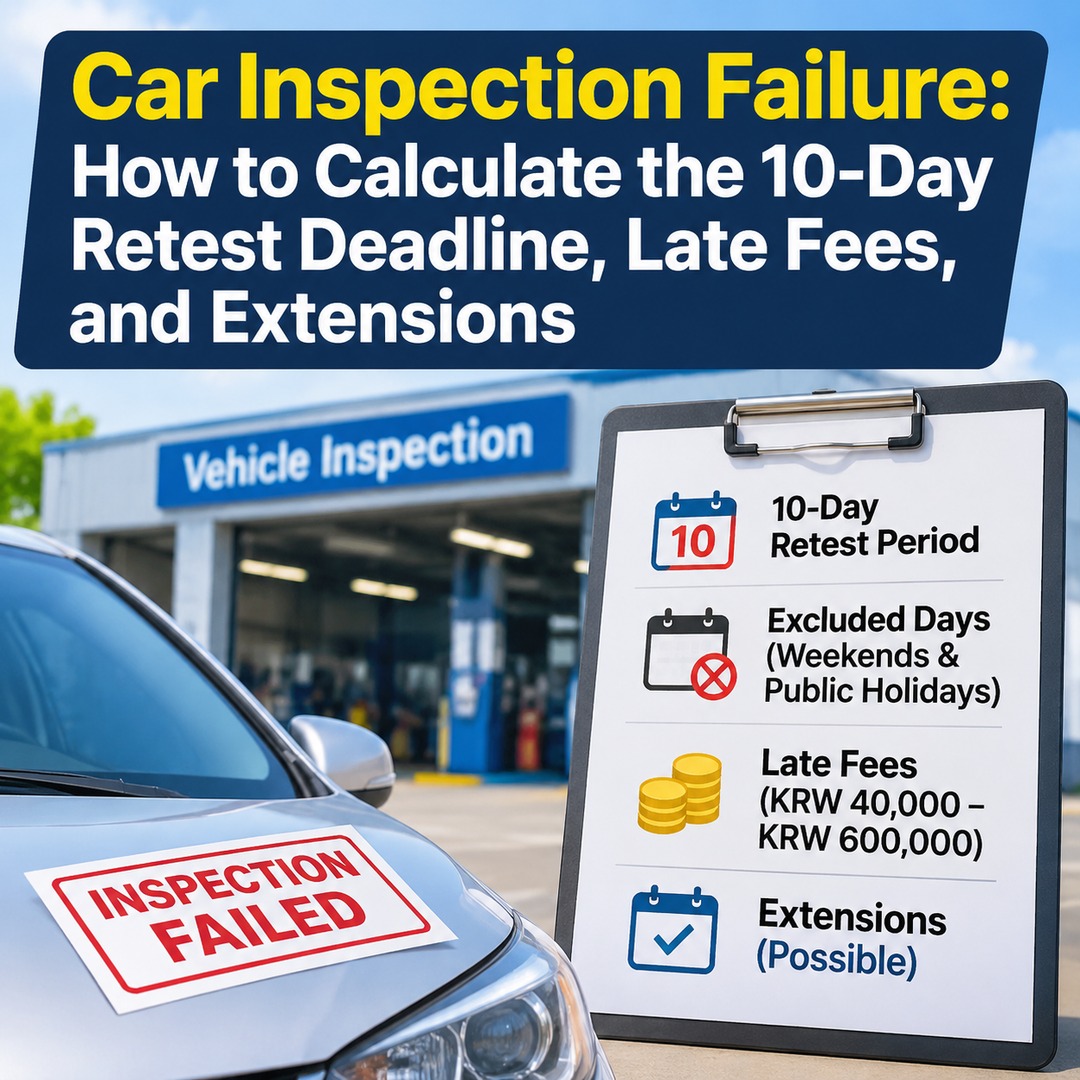
If your vehicle receives a failing result in a regular or comprehensive vehicle inspection in South Korea, the first thing to check is the retest deadline. In general, the retest period is within 10 days after the inspection period expires, and it cannot be extended at your discretion. However, exceptions may apply depending on when the inspection was requested and the reason for the failure. In certain cases, the 10-day period is calculated from the date the Vehicle Comprehensive Diagnosis Certificate was issued. You should also account for legislative changes in 2026 concerning which days are excluded from the calculation.
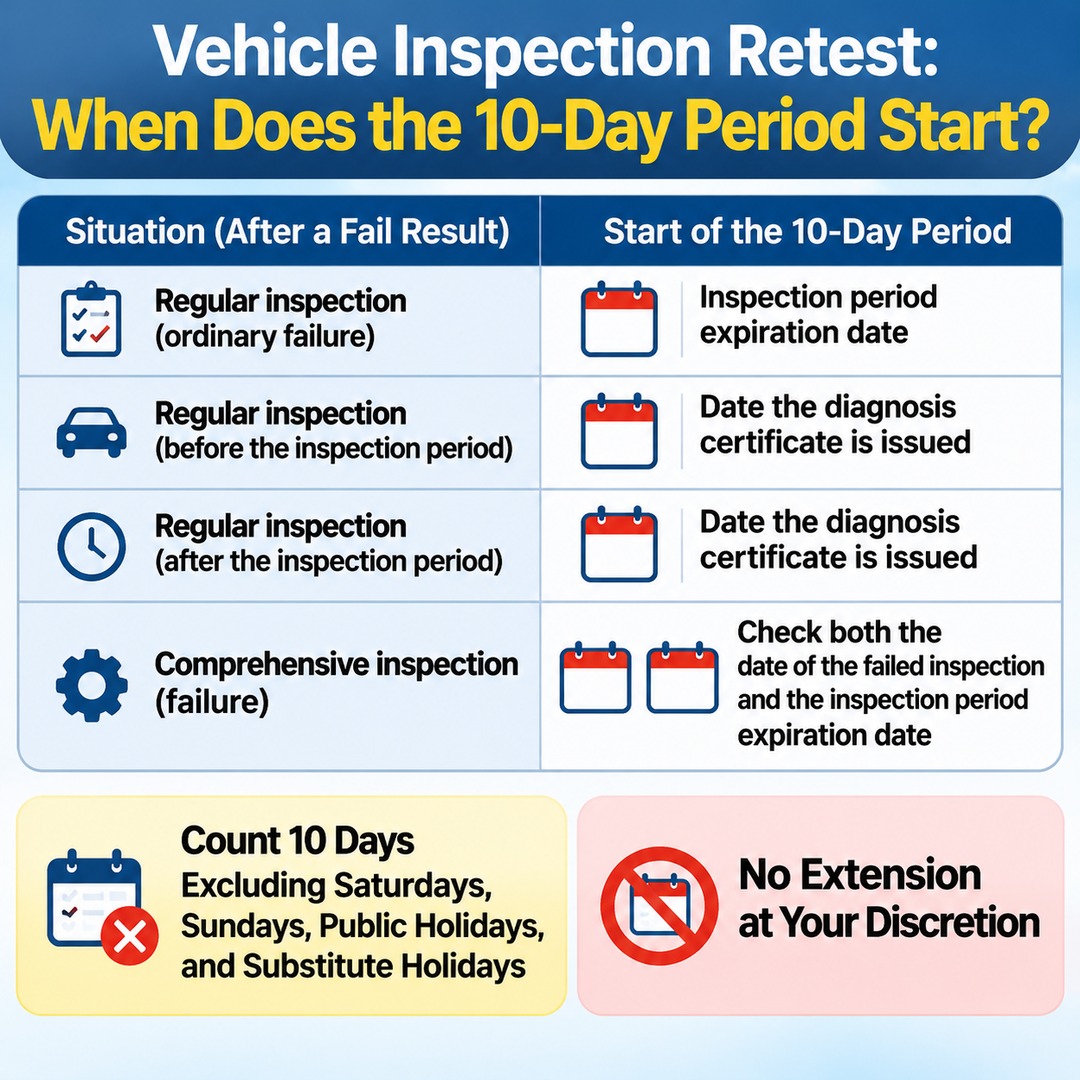
The most important point is that the 10 days are not automatically counted from the date you receive your failure notice. The deadline can vary depending on the type of inspection and when you initially applied. Check both the Vehicle Comprehensive Diagnosis Certificate and your vehicle's inspection-period expiration date.
How Is the 10-Day Vehicle Retest Period Calculated?
The 10-day period does not simply mean 10 consecutive calendar days. Certain rules exclude Saturdays, Sundays, public holidays, and substitute holidays. The applicable legal provisions and starting dates also differ between regular and comprehensive vehicle inspections.
If Your Vehicle Fails a Regular Inspection
For an ordinary failure in a regular vehicle inspection, the retest period is generally calculated based on the expiration date of the vehicle inspection period.
The calculation changes in the following two situations:
You applied for the regular inspection before the inspection period began.
You applied for the regular inspection after the inspection period had already expired.
In either situation, the retest must be completed within 10 days from the date the Vehicle Comprehensive Diagnosis Certificate was issued, rather than from the inspection-period expiration date.
The same 10-day period, calculated from the certificate's issue date, also applies if the vehicle fails because a speed-limiting device is missing or improperly installed, or because its exhaust emissions exceed the applicable standards for in-use vehicle regular inspections.
Comprehensive Inspections Have Slightly Different Starting Dates
For comprehensive inspections, the retest period depends on the reason for the failure and when the initial inspection was requested.
| Comprehensive inspection situation | Retest period |
|---|---|
| Applied for within the inspection period; failed on ordinary inspection items | From the failure date until 10 days after the inspection period expires |
| Failed due to a speed-limiting device issue | 10 days from the failure date |
| Failed to meet exhaust emissions inspection standards | 10 days from the failure date |
| Applied for before or after the inspection period | 10 days from the failure date |
Overlooking these differences can lead to an incorrect calculation of the actual deadline.
In particular, if a vehicle fails a comprehensive inspection on an ordinary inspection item, you must check both the date of the initial failed inspection and the inspection-period expiration date.
What Changed in the Calculation of Retest Periods in 2026?
When calculating the 10-day retest period, you must also check which days are excluded under the rules applicable to each type of inspection.
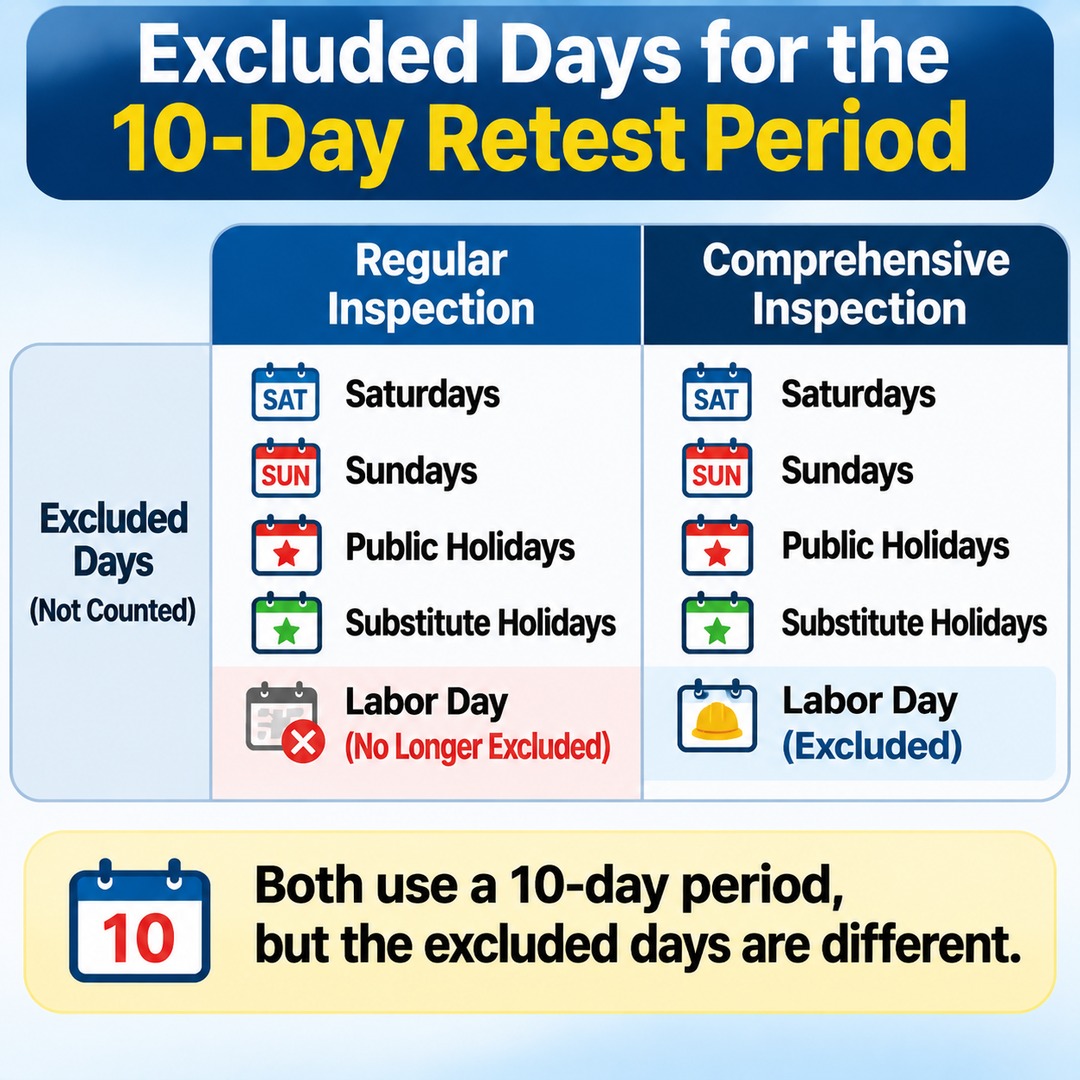
Article 81(2) of the Enforcement Rule of the Motor Vehicle Management Act provides that Saturdays, Sundays, public holidays, and substitute holidays are excluded when calculating the retest period for regular inspections.
There is one important change to be aware of.
An amendment dated September 15, 2026, removed Labor Day from the list of excluded days for regular inspection retest periods. Accordingly, as of November 2026, Labor Day is no longer treated as a separately excluded day when calculating regular inspection retest periods.
By contrast, Article 7(2) of the Rules on the Implementation of Comprehensive Vehicle Inspections explicitly includes Labor Day among the excluded days.
In other words, both types of inspection use a 10-day period, but you should not assume that their rules for excluding non-working days are identical.
| Category | Regular inspection | Comprehensive inspection |
|---|---|---|
| Saturdays and Sundays | Excluded | Excluded |
| Public holidays and substitute holidays | Excluded | Excluded |
| Labor Day | Exclusion provision removed | Excluded |
To avoid errors, it is safest to provide the inspection center with the certificate issue date and inspection-period expiration date and ask it to confirm the actual deadline.
How Much Is the Fine for Missing the Retest Deadline?
If you do not apply for a retest within the permitted period, or if you apply but fail to obtain a passing result within the prescribed period, the inspection is treated as not having been completed.
For comprehensive inspections, this is explicitly stated in Article 7(7) of the relevant rules. The Korea Transportation Safety Authority also explains that a regular inspection is treated as not having been completed once its retest period expires.
This may subsequently result in a late inspection penalty.
Penalties for Failing to Complete a Regular or Comprehensive Vehicle Inspection in South Korea
| Inspection delay | Penalty |
|---|---|
| Within 30 days | Basic penalty amount |
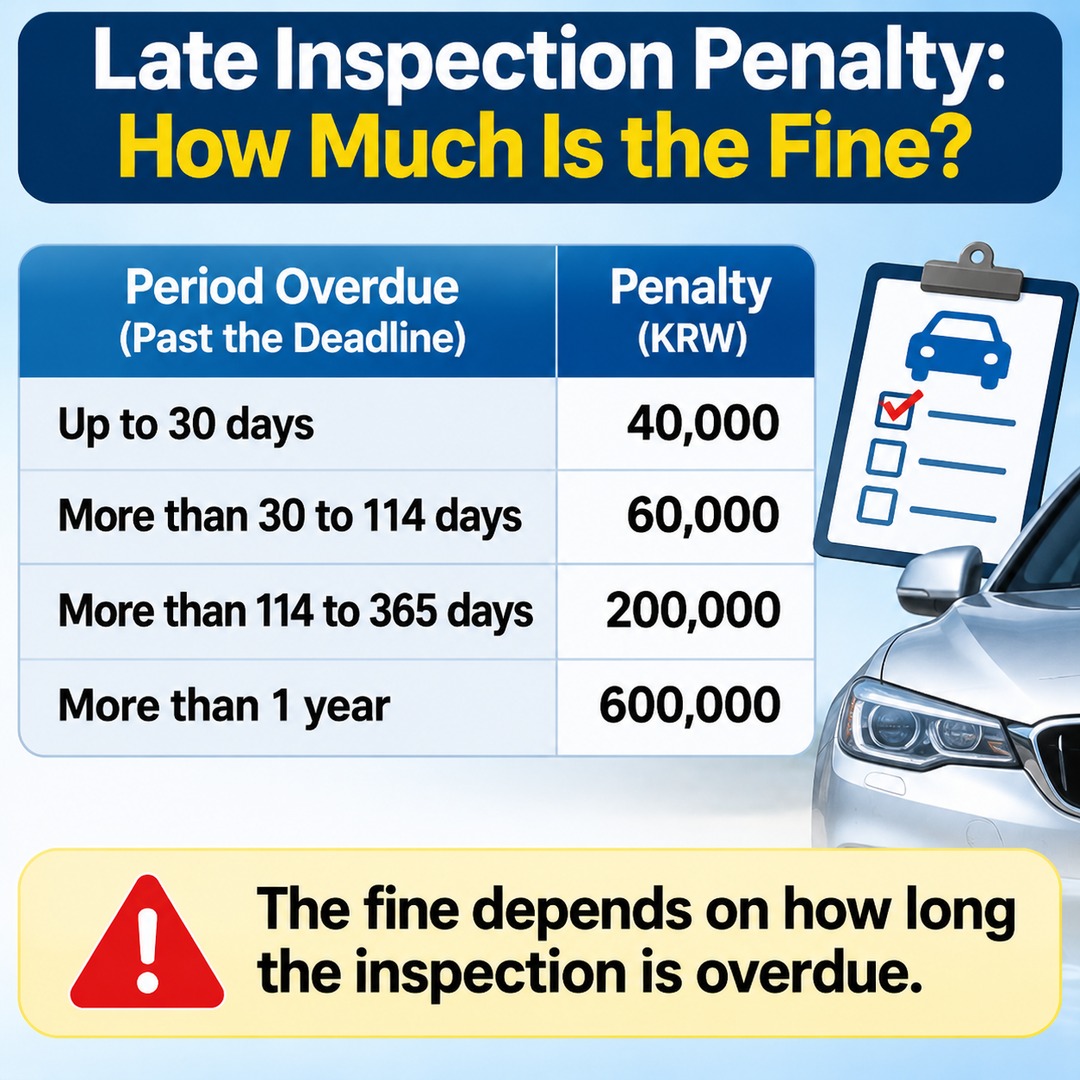
| More than 31 days and up to 114 days | KRW 40,000 + KRW 20,000 for every additional 3-day period starting on day 31 |
| 115 days or more | Subject to the applicable penalty provisions |
These penalties are based on Table 2 of the Enforcement Decree of the Motor Vehicle Management Act. The actual penalty and calculation of the delay period should be confirmed with the relevant local government.
An important point is that missing the retest deadline does not automatically result in a KRW 600,000 fine. The amount varies depending on how long the inspection has been overdue.
The local government responsible for the vehicle's registration jurisdiction handles penalty assessments and payments. Simply completing a retest at an inspection center does not automatically resolve any outstanding penalty issue.
Where Should You Take a Vehicle That Failed Its Inspection?
As a general rule, you must present the vehicle and its Vehicle Comprehensive Diagnosis Certificate to the original vehicle inspection agent or designated vehicle maintenance business that conducted the initial inspection.
A retest does not normally involve repeating every inspection item from the beginning. Instead, it focuses on the items that received a failing result.
The process is as follows:
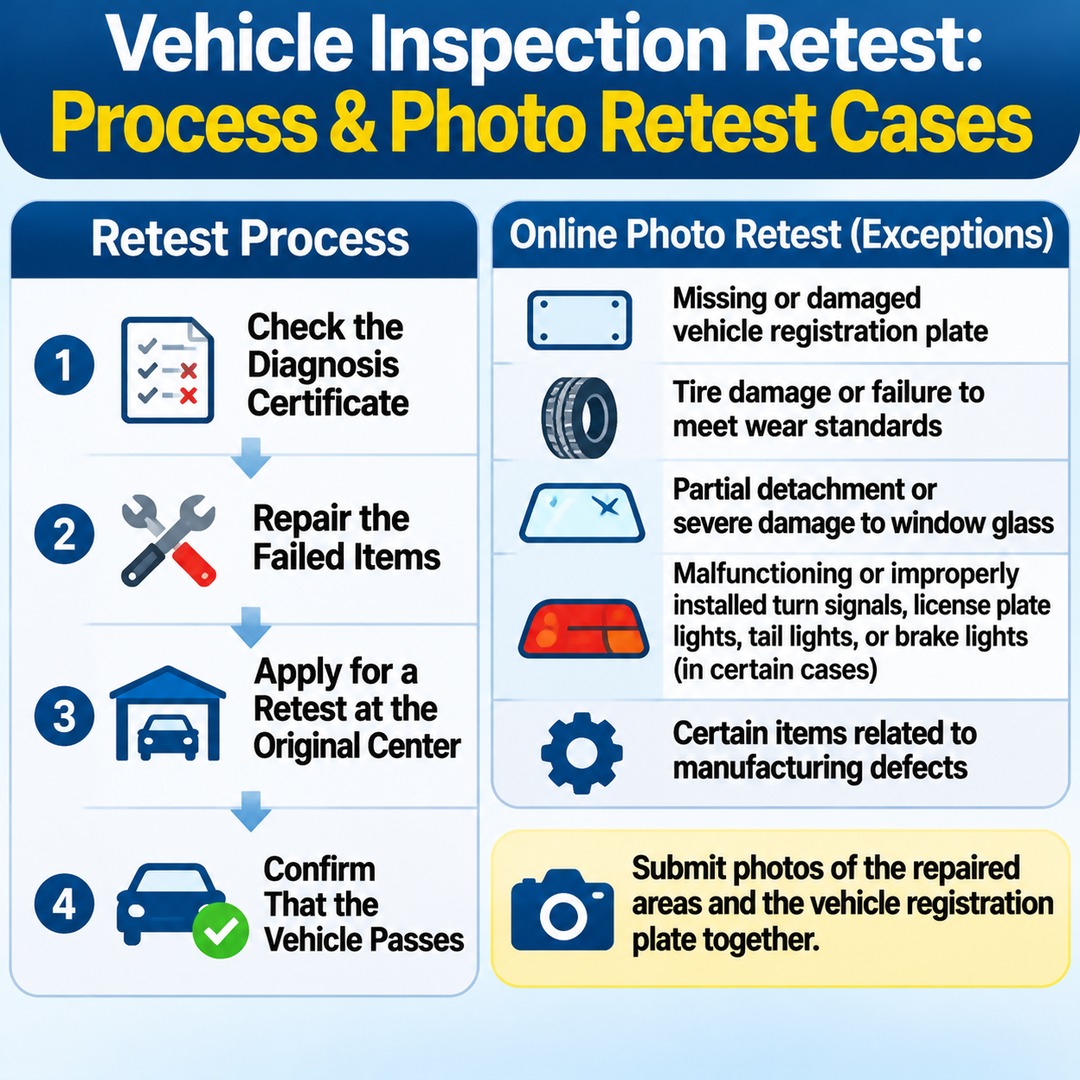
1. Check the Vehicle Comprehensive Diagnosis Certificate. Identify the failed items and the applicable retest deadline.
2. Repair the failed items. Fix the problems listed on the certificate and restore any affected parts or devices to proper working condition.
3. Apply for a retest at the original inspection center. Present the vehicle and diagnosis certificate to request the retest.
4. Confirm that the vehicle passes. You must obtain a passing result within the retest period. If the vehicle passes within that period, it is recognized as having undergone the inspection on the date the diagnosis certificate was issued.
For certain failed items, an online retest using photographs is permitted as an exception.
Examples include:
A missing or damaged vehicle registration plate
Tire damage or failure to meet tire wear standards
Partial detachment or severe damage to window glass
Malfunctioning or improperly installed turn signals, license plate lights, tail lights, or brake lights in certain cases
Certain items related to manufacturing defects
Even in these cases, you must submit photographs showing the repaired areas listed on the diagnosis certificate and the vehicle registration plate together in an overall view. Additional evidence may be requested if the photographs are insufficient to determine whether the vehicle meets the requirements.
Not every vehicle that fails an inspection is eligible for a photographic retest.
Can You Extend the Retest Period?
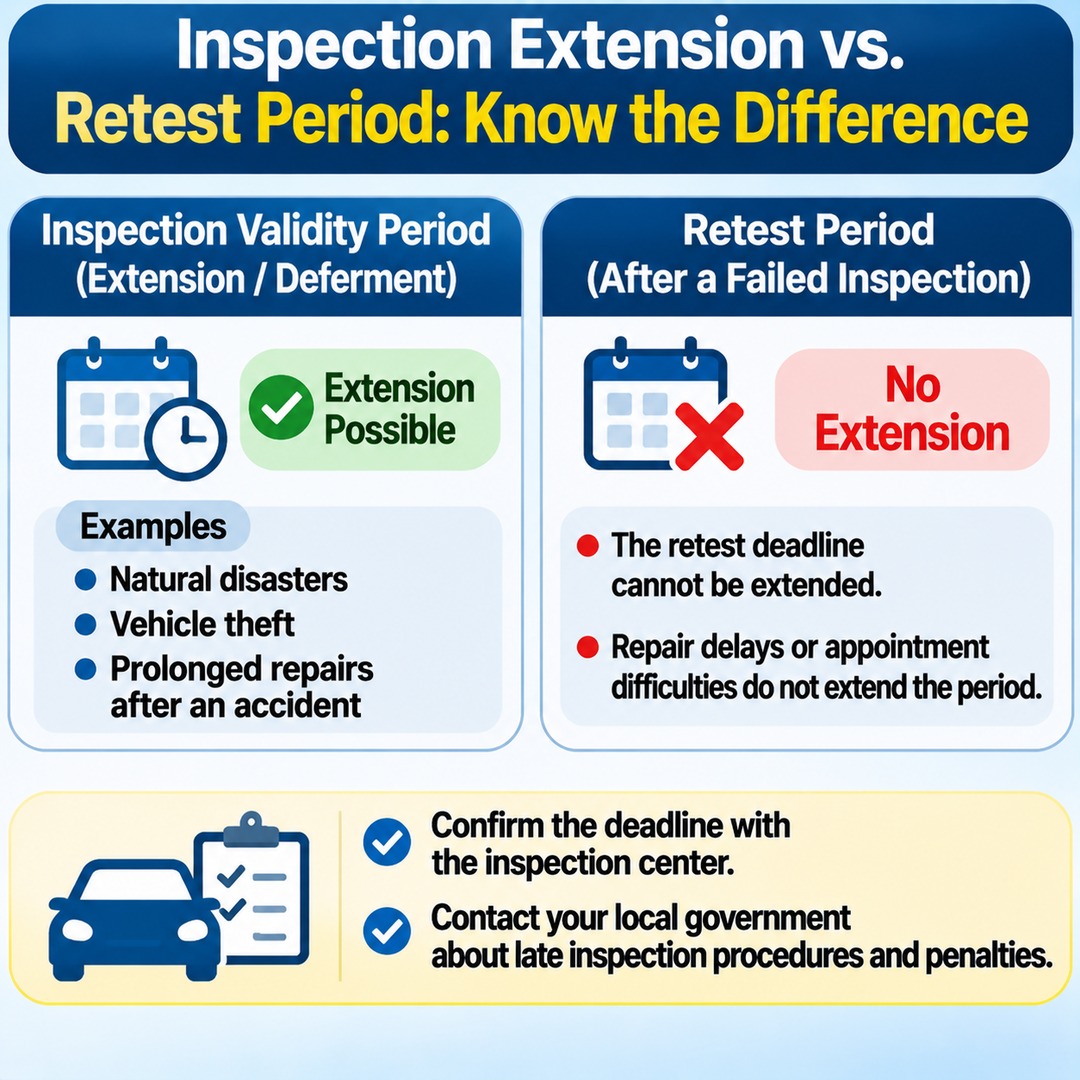
The retest period following an ordinary inspection failure cannot be extended. Delays in repairs or difficulty obtaining an appointment do not automatically extend the deadline.
However, it is important to distinguish between two separate procedures.
An extension or deferment of the inspection validity period is different from an extension of the retest period following a failed inspection.
Article 43(4) of the Motor Vehicle Management Act and Article 75 of its Enforcement Rule allow the inspection validity period to be extended or an inspection to be deferred under certain circumstances, such as natural disasters, vehicle theft, or prolonged repairs resulting from an accident.
Comprehensive inspections also have separate extension and deferment procedures under Article 10 of the relevant rules.
However, these provisions do not mean that a vehicle's retest period can be extended in the same way after it has already received a failing inspection result.
If your retest deadline is approaching, first ask the inspection center to confirm the deadline stated on your diagnosis certificate. You should also contact the local government responsible for your vehicle to ask about late inspection procedures and any applicable penalties.
What Should You Do If Your Retest Period Has Already Expired?
Even if the deadline has passed, you should avoid delaying the inspection any further.
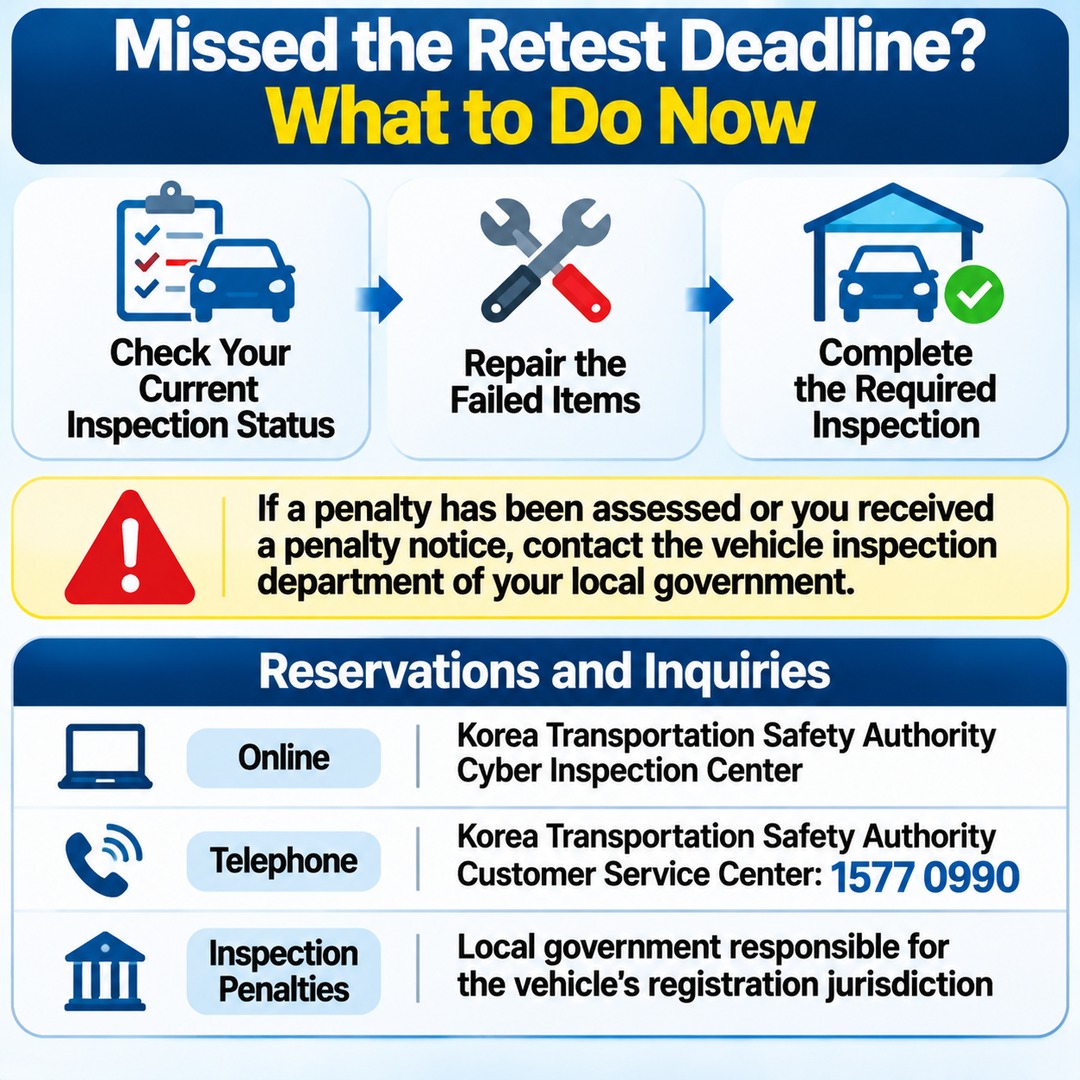
First, contact a vehicle inspection center to check your vehicle's current inspection status and determine which type of inspection you need to apply for again. Then repair the failed items and complete the required inspection.
If a penalty has already been assessed or you have received a penalty notice, contact the vehicle inspection department of the city, county, or district office responsible for your vehicle's registration jurisdiction.
You can use the following channels for vehicle inspection reservations and inquiries:
Online: Korea Transportation Safety Authority Cyber Inspection Center
Telephone: Korea Transportation Safety Authority Customer Service Center, 1577-0990
Inspection penalties: Local government responsible for the vehicle's registration jurisdiction
How to Check Your Vehicle's Actual Retest Deadline
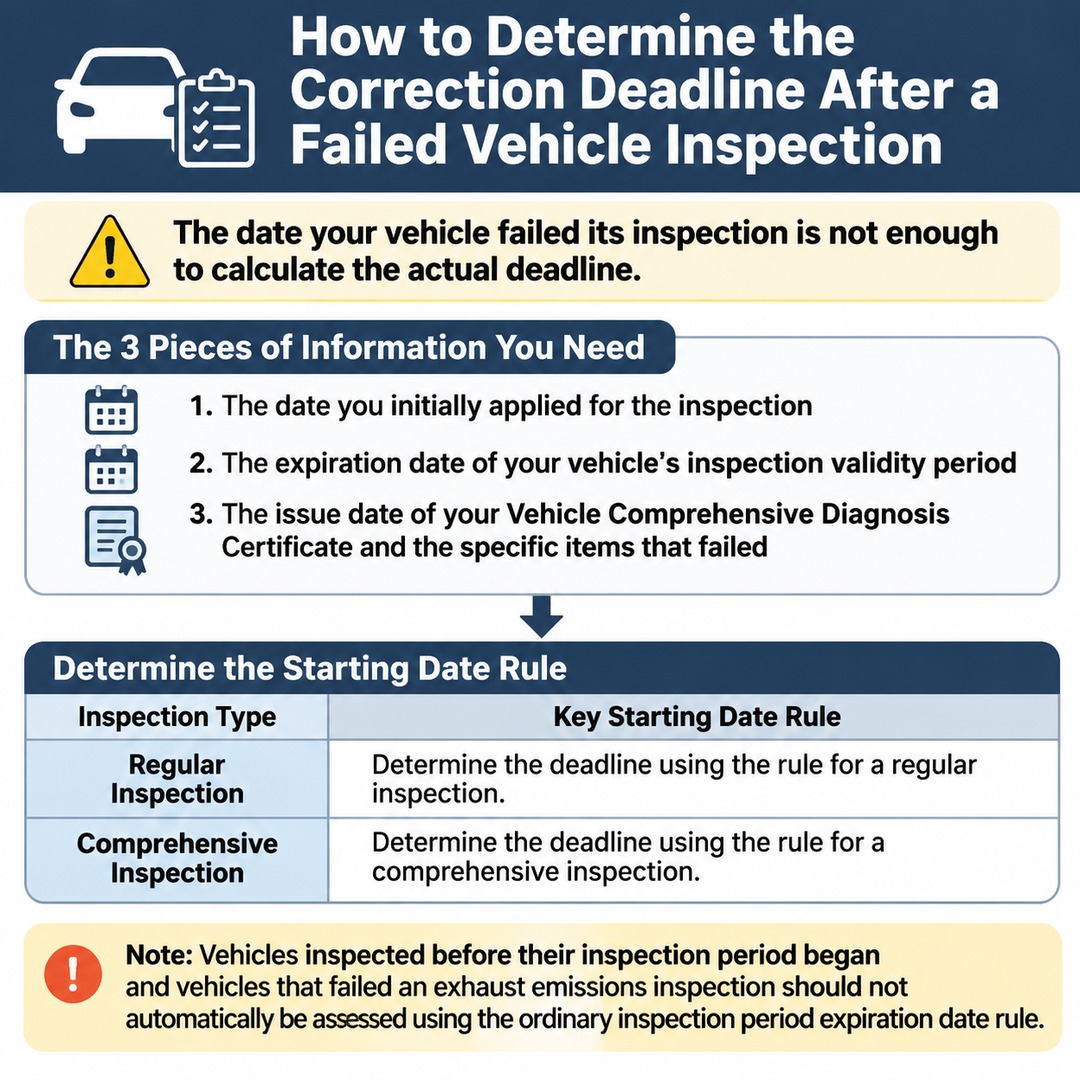
Knowing only the date your vehicle failed its inspection is not enough to calculate the actual deadline.
You need the following three pieces of information:
1. The date you initially applied for the inspection
2. The expiration date of your vehicle's inspection validity period
3. The issue date of your Vehicle Comprehensive Diagnosis Certificate and the specific items that failed
With this information, you can determine which starting-date rule applies based on whether your vehicle underwent a regular or comprehensive inspection.
In particular, vehicles inspected before their inspection period began and vehicles that failed an exhaust emissions inspection should not automatically be assessed using the ordinary inspection-period expiration-date rule.