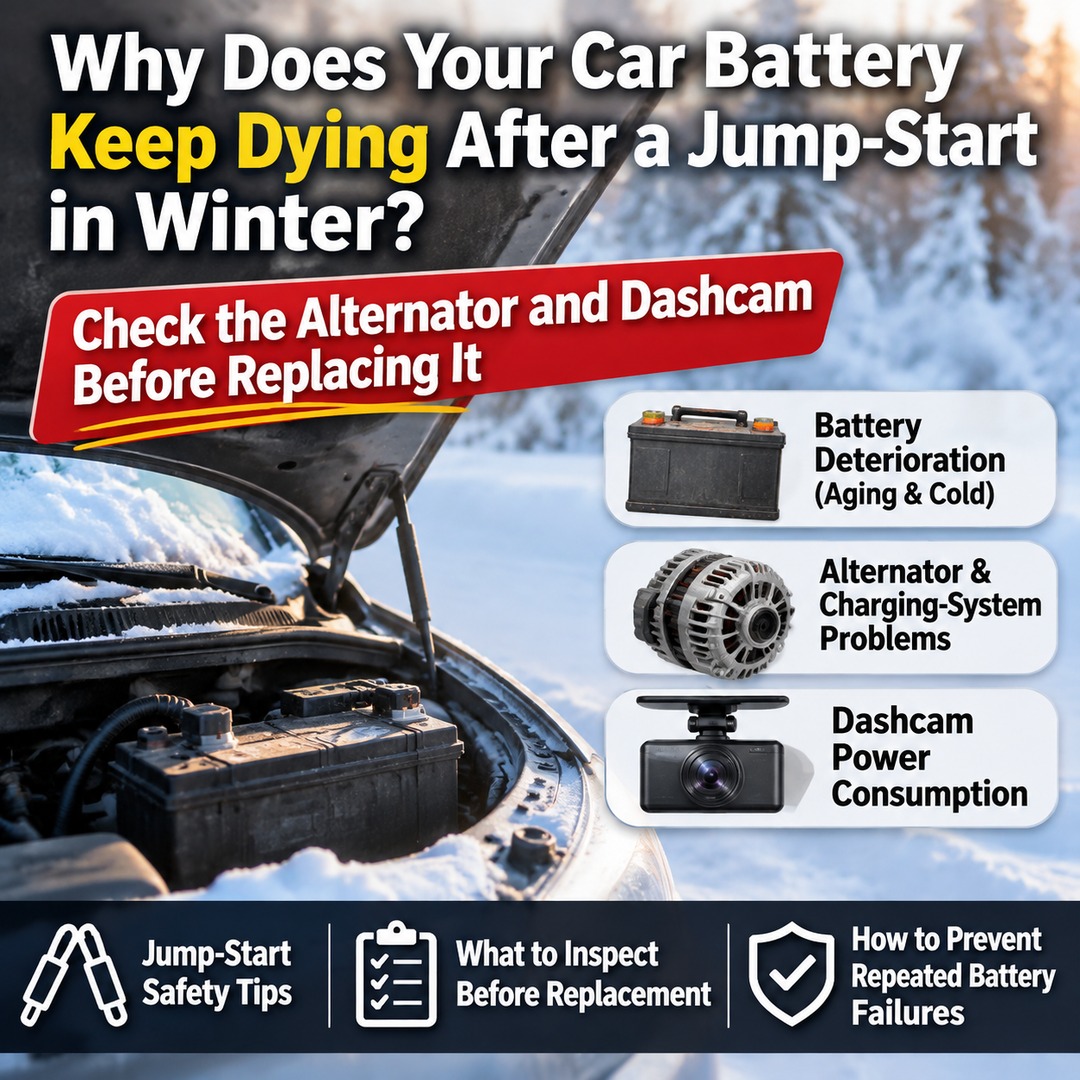
If your car starts after a jump-start in winter but the battery dies again, simply replacing the battery may not solve the problem. You need to distinguish between battery deterioration, alternator or charging-system problems, and power consumption from a dashcam connected to a constant power supply. A jump-start is an emergency measure to get the engine running, not a repair that resolves the underlying cause of the discharge.
In particular, the inspection approach differs depending on whether the engine will not restart immediately after a jump-start or whether the car starts normally, is driven, and then fails to start after being parked overnight. Rather than automatically installing a new battery, it is better to check the battery condition, charging system, and power consumption while parked in that order.
Why Does a Car Battery Die Again After a Jump-Start?
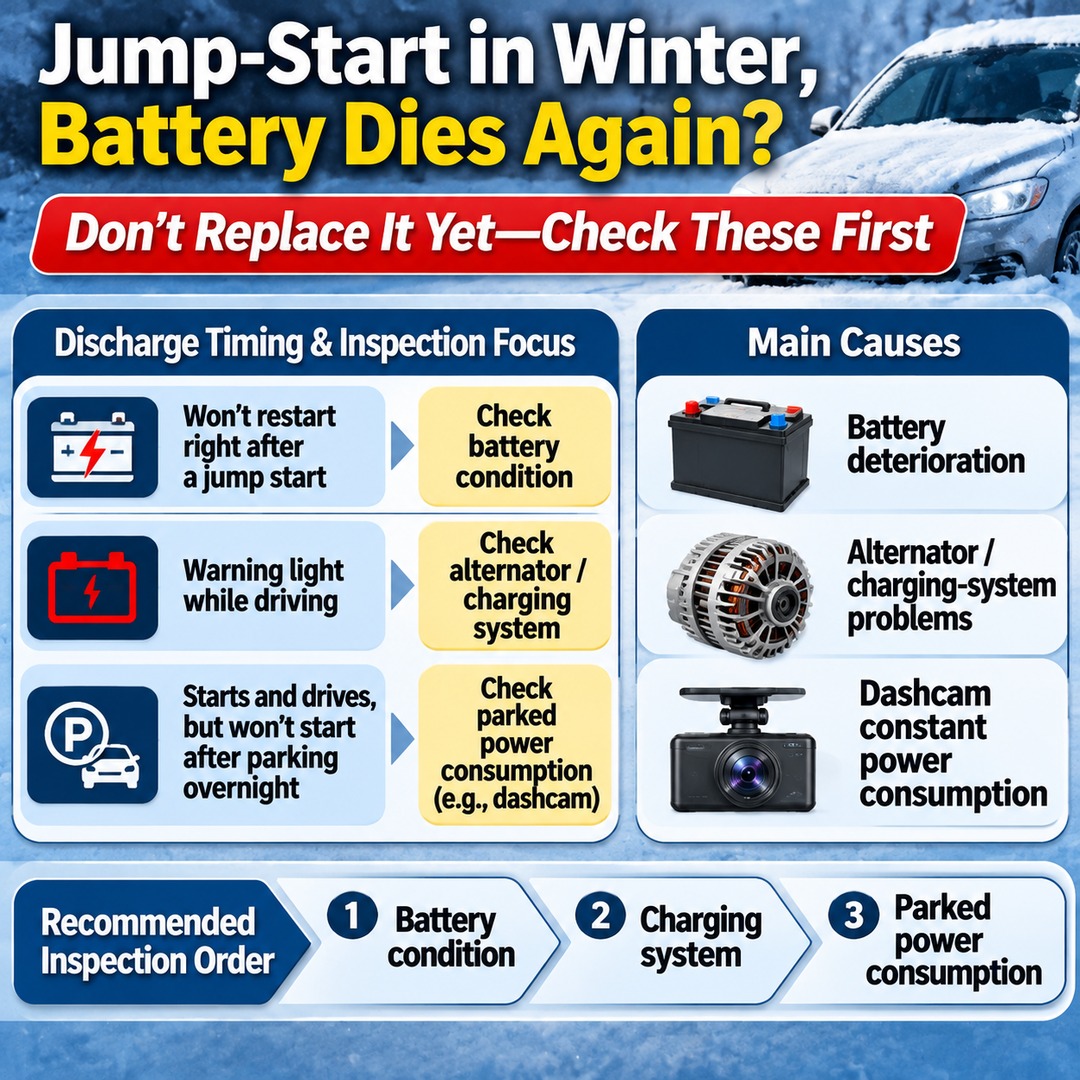
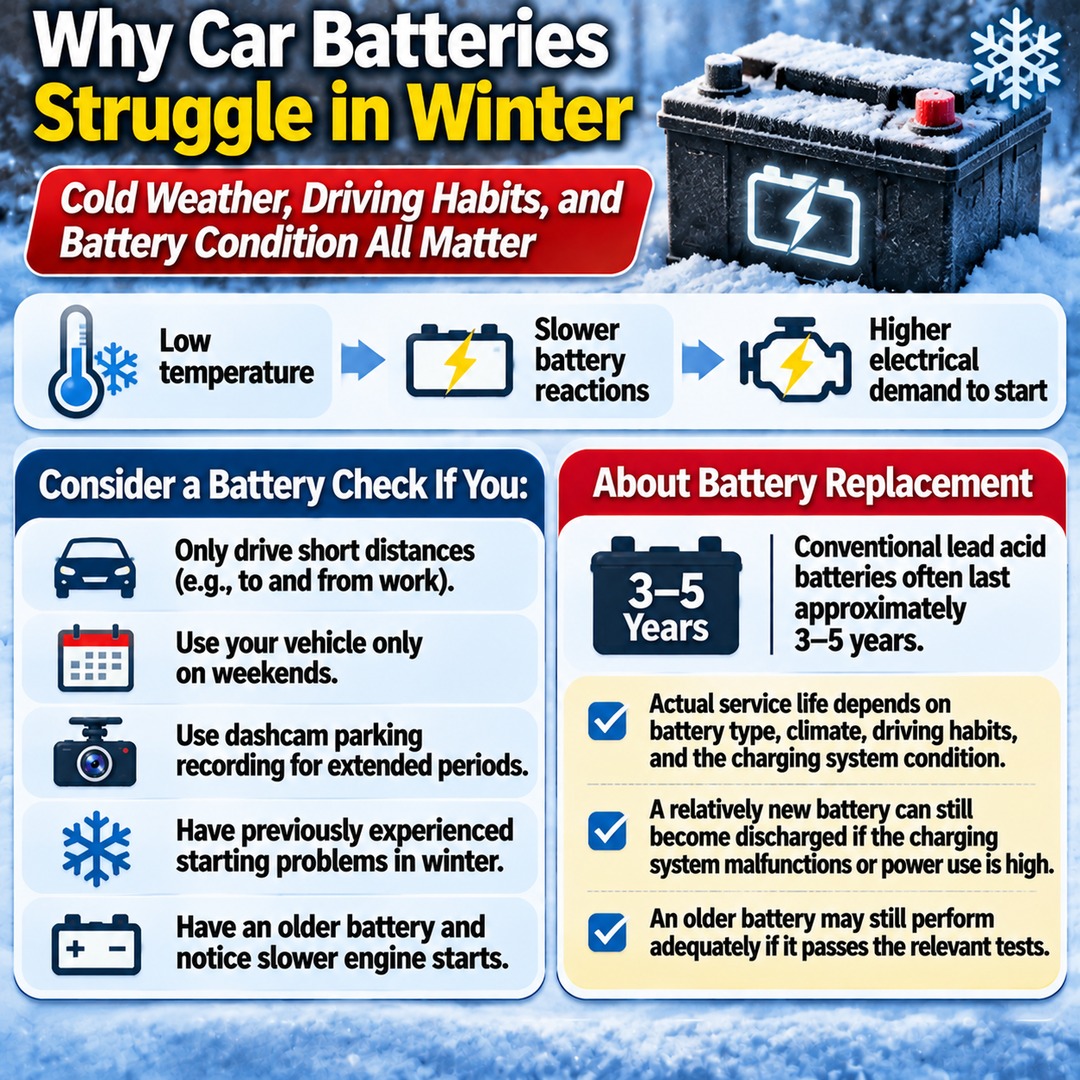
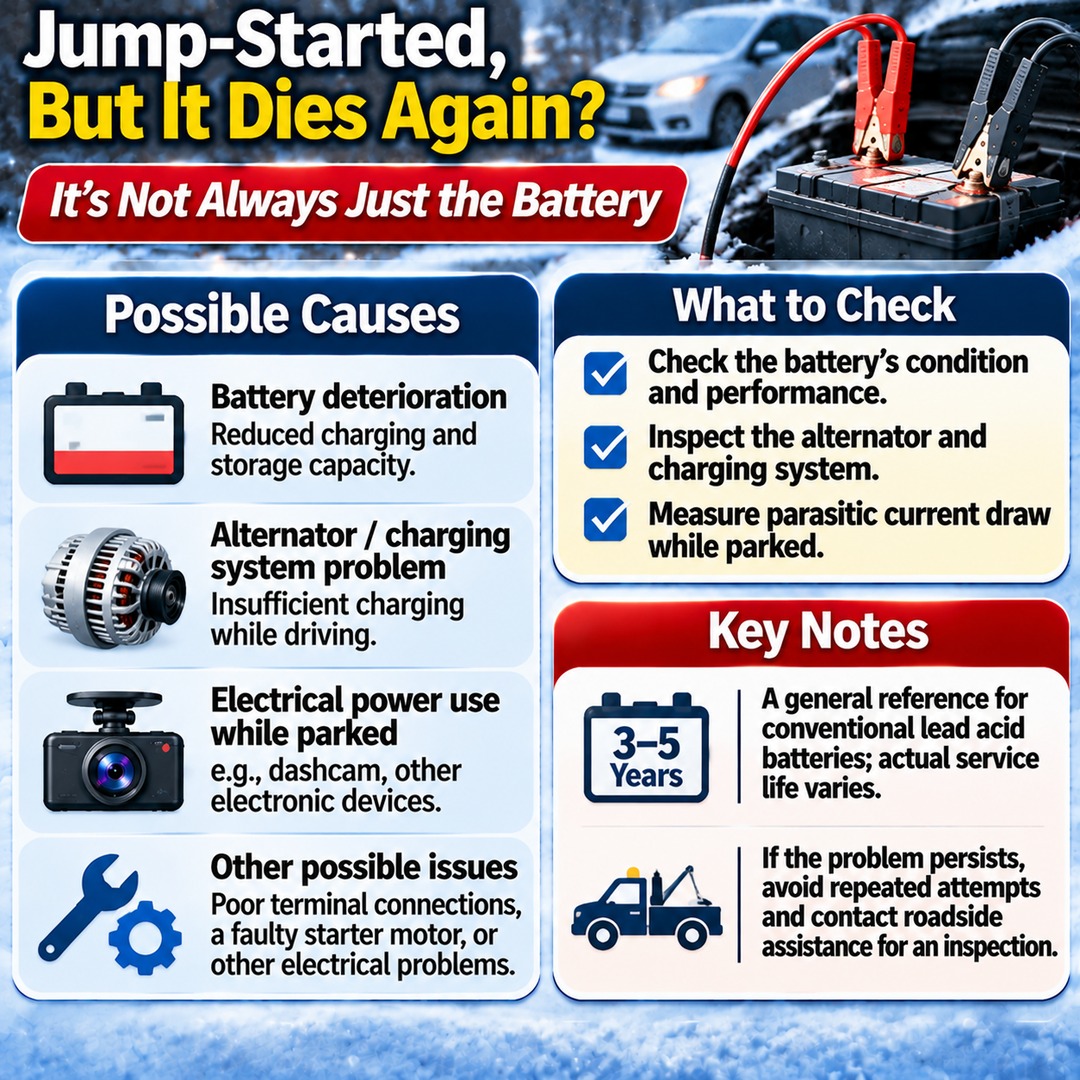
Repeated battery discharge after a jump-start generally falls into three categories: reduced battery charging and storage capacity, insufficient charging while driving, and excessive power consumption while parked. Cold weather slows the battery's chemical reactions and increases the electrical demand required to start the engine, making problems with an already weakened battery more noticeable.
Common causes include:
Battery deterioration: The battery can no longer store enough electricity or supply the power needed to start the engine, even after charging.
Alternator or charging-system problems: The battery does not receive sufficient electrical power while the engine is running.
Dashcam constant-power connection: The dashcam continues consuming electricity while the vehicle is parked, reducing the remaining battery charge.
Repeated short trips: The battery does not have enough time to recover the electricity used during engine starts before the vehicle is parked again.
Wiring or electrical-device problems: Interior lights, trunk lights, relays, and aftermarket electronic devices may continue drawing power even when the vehicle appears to be switched off.
The timing of the discharge is particularly important. Determining whether the vehicle fails to restart immediately after a jump-start, whether a warning light appears while driving, or whether the battery dies only after being parked overnight can help narrow down the inspection.
What If the Engine Will Not Restart Immediately After a Jump-Start?
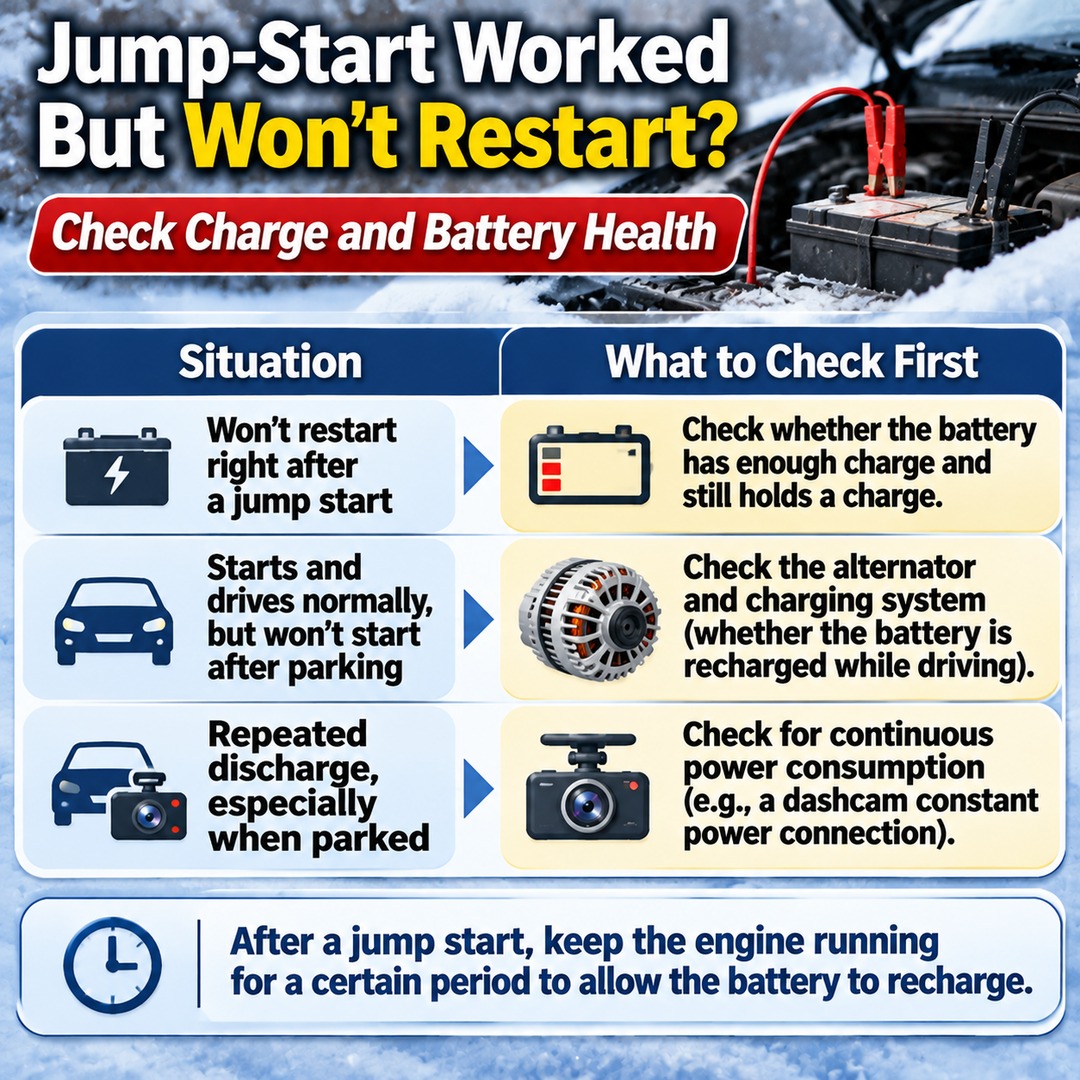
If you switch off the engine immediately after a jump-start and cannot start it again, check whether the battery has received sufficient charge or whether its ability to hold a charge has deteriorated.
Kia owner's manuals instruct drivers to keep the engine running for a certain period after a jump-start. They also explain that if the engine is not kept running long enough, or if the 12V battery is severely discharged, the vehicle may not restart after the engine is switched off.
The important point is that getting the engine started immediately after a jump-start does not mean the battery has been properly recharged.
A jump-start uses an external power source to get the engine running. Whether the discharged battery has received sufficient charge and still has the ability to store electricity must be checked separately.
The following situations can help distinguish what to inspect first:
| Situation | First item to check |
|---|---|
| The engine will not restart after being switched off immediately following a jump-start | Battery charge level and condition |
| Battery warning light comes on while driving after a jump-start | Alternator and charging system |
| Battery is dead the morning after driving and parking | Battery condition and power consumption while parked |
| A new battery repeatedly goes flat | Parasitic current draw and charging system |
| Engine starts slowly only on cold mornings | Battery condition and the effects of low temperatures |
This table is intended to distinguish inspection priorities, not to provide a definitive diagnosis. The same symptoms can have multiple causes, so the actual test results must also be considered.
How Can You Tell Whether the Battery or Alternator Is the Problem?
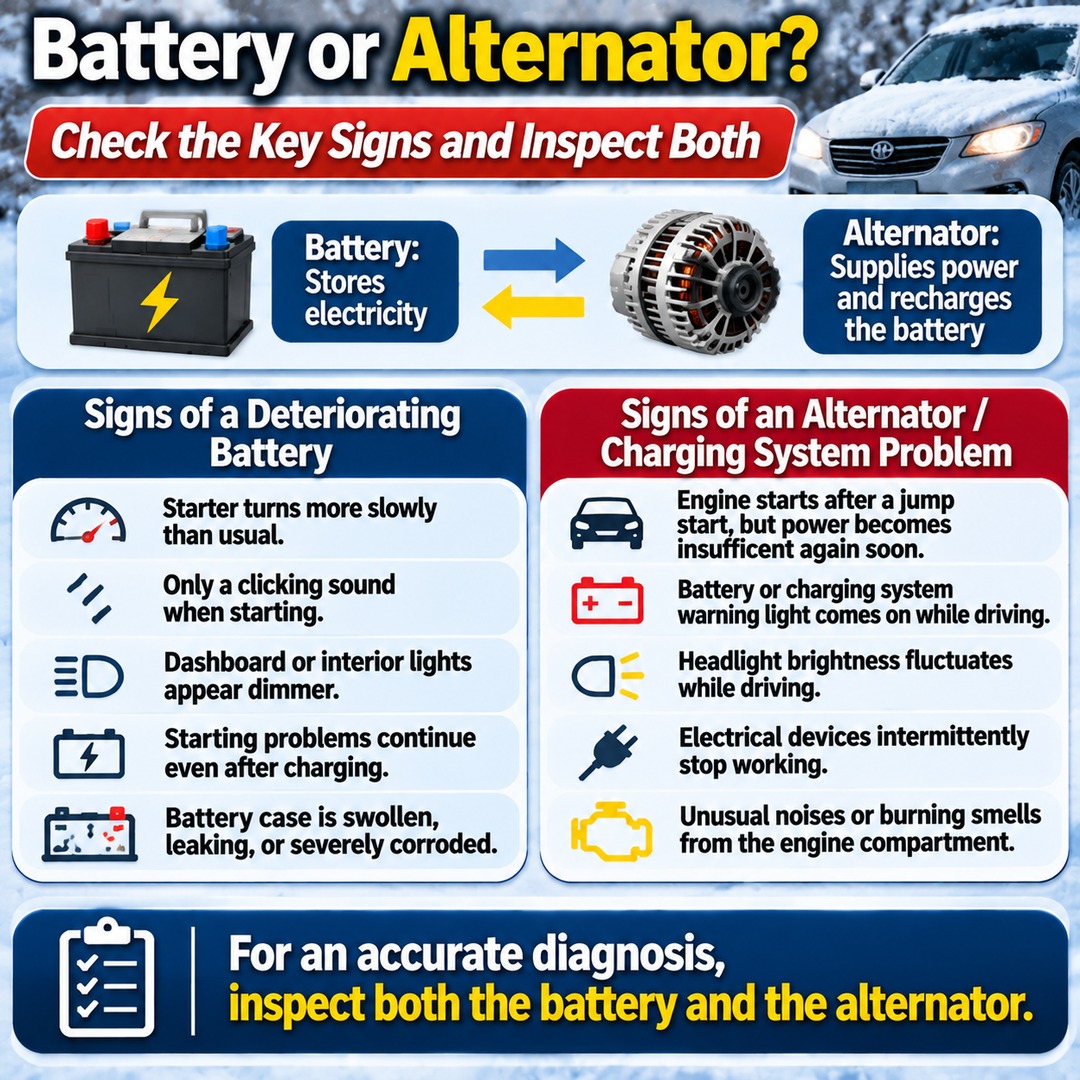
The battery stores electricity, while the alternator supplies electrical power to the vehicle and recharges the battery while the engine is running. Because these components work together, a discharged battery alone does not establish which component has failed.
Signs that may indicate a deteriorating battery
The starter motor turns more slowly than usual.
You hear only a clicking sound when trying to start the engine.
The dashboard or interior lights appear dimmer than usual.
Starting problems continue even after charging the battery.
The battery case is swollen, leaking, or severely corroded.
If these symptoms appear, the battery should be tested not only for its charge level but also for its ability to supply the power required to start the engine.
Signs that may indicate an alternator or charging-system problem
The engine starts after a jump-start, but electrical power becomes insufficient again soon afterward.
The battery or charging-system warning light comes on while driving.
Headlight brightness fluctuates while the vehicle is moving.
Electrical devices intermittently stop working.
Unusual noises or burning smells come from the engine compartment.
If the alternator is malfunctioning, insufficient charging may continue even after a new battery is installed.
Conversely, even if the alternator is working properly, an internally deteriorated battery may no longer be able to store enough electricity.
For an accurate diagnosis, both the battery and the alternator and charging system should be inspected.
Can a Dashcam's Constant-Power Connection Cause Winter Battery Discharge?
A dashcam connected to a constant power supply uses battery electricity while the vehicle is parked. It should therefore be checked whenever repeated battery discharge occurs.
Even when the vehicle is switched off, a dashcam may continue consuming electricity if its parking-recording function is active. The vehicle's door-locking system, security devices, and electronic control units also use some electricity. In a vehicle with a weakened battery, extended parking can therefore leave insufficient power to start the engine.
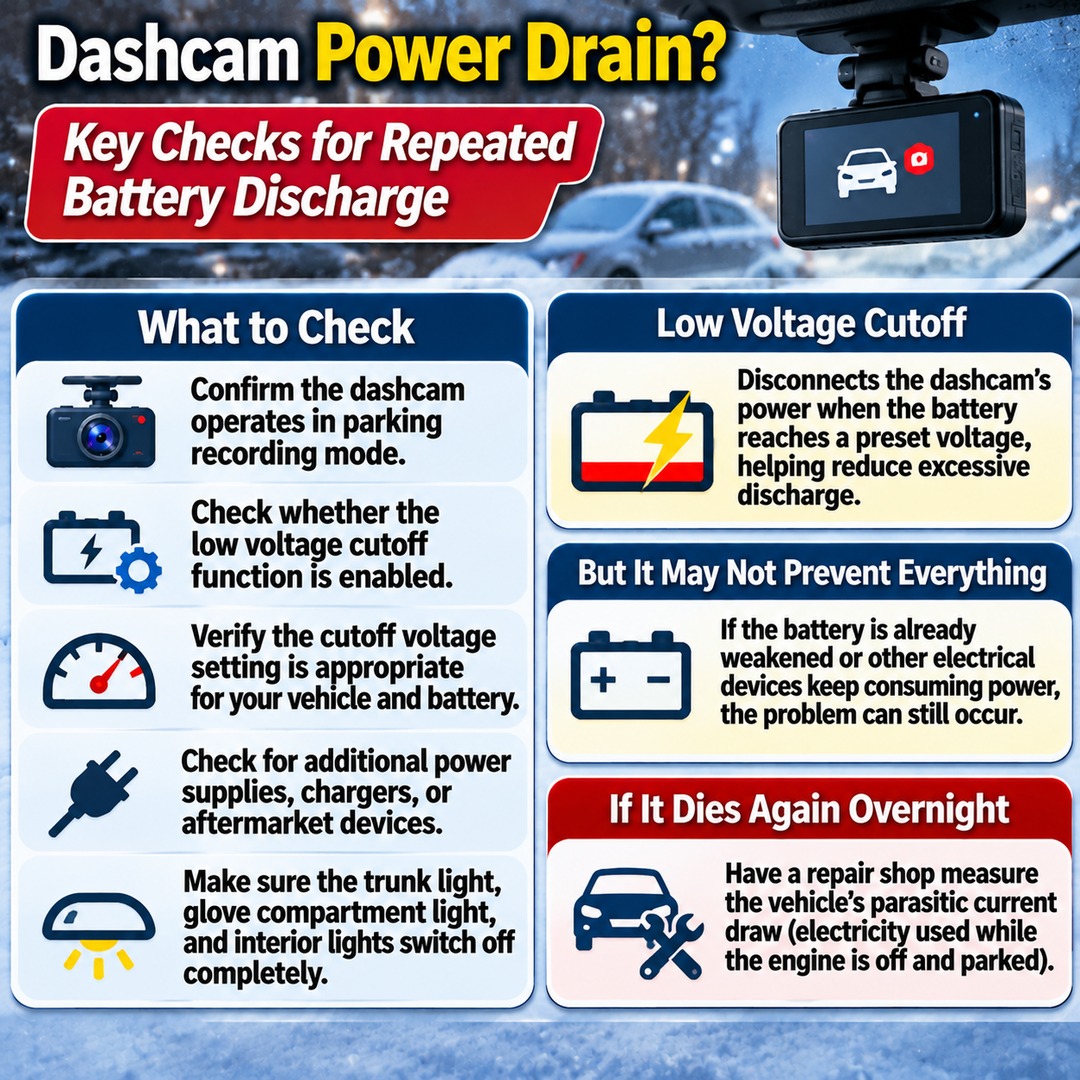
Pay particular attention to the following:
1. Check whether the dashcam continues operating in parking-recording mode.
2. Check whether its low-voltage cutoff function is enabled.
3. Make sure the cutoff voltage setting is appropriate for the vehicle and battery operating conditions.
4. Check for additional power supplies, chargers, or aftermarket electronic devices.
5. Make sure the trunk light, glove compartment light, and interior lights switch off completely.
A dashcam's low-voltage cutoff function disconnects its power supply when the battery reaches a preset voltage, helping reduce excessive battery discharge. However, this function cannot prevent every type of battery discharge.
If the vehicle battery is already in poor condition or other electrical devices continue consuming power, the problem may persist even when the cutoff function is enabled.
If a fully charged battery becomes discharged again overnight, it is better to have a repair shop measure the vehicle's parasitic current draw rather than simply changing the dashcam settings.
Parasitic current draw refers to the electricity consumed by a vehicle's electrical devices while the engine is off and the vehicle is parked. Since normal standby current varies by vehicle, a fault should not be diagnosed using one universal numerical threshold.
Why Can a Battery That Worked Fine Suddenly Fail in Winter?
Low temperatures slow down the battery's electrochemical reactions and increase the electrical demand required to start the engine. An aging battery that causes no noticeable problems in normal weather may not provide sufficient starting power when temperatures drop significantly.
Repeated short trips and extended periods of parking can increase the risk of discharge further.
It is particularly advisable to inspect the battery in advance if you:
Drive only short distances to and from work, spending little time on the road.
Use your vehicle only on weekends.
Use dashcam parking recording for extended periods.
Have previously experienced starting problems during winter.
Have an older battery and notice that the engine starts more slowly.
Battery replacement should not be determined solely by how long the battery has been in use. Conventional lead-acid automotive batteries often last approximately 3–5 years, but actual service life depends on battery type, climate, driving habits, and charging-system condition.
Even a relatively new battery can become discharged if the charging system malfunctions or excessive electrical power is consumed. Conversely, an older battery may still perform adequately if it passes the relevant tests.
What Should You Check Before Replacing the Battery?
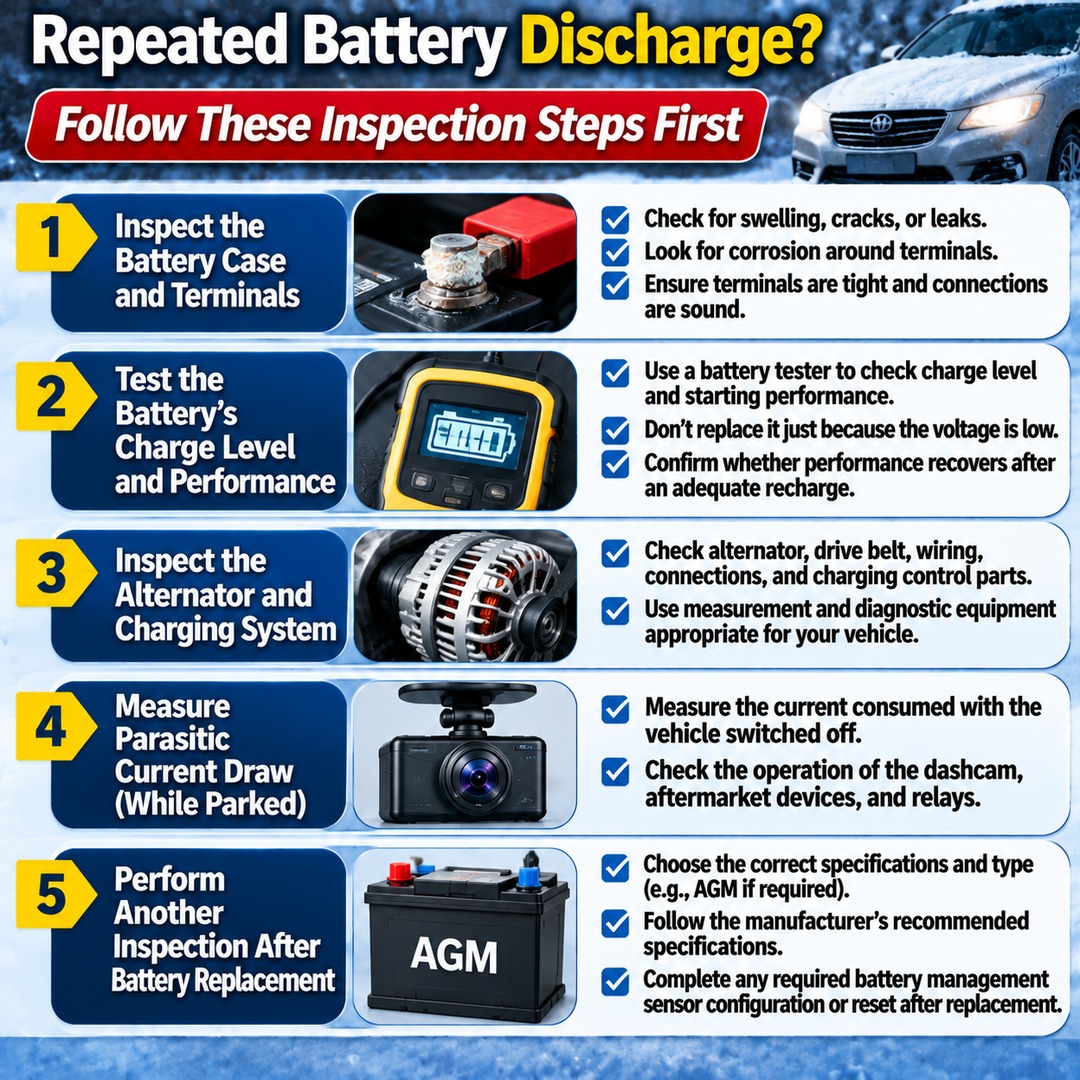
If repeated battery discharge occurs, it is advisable to follow these inspection steps before installing a replacement battery.
1. Inspect the battery case and terminals
Check whether the battery case is swollen, cracked, or leaking, and whether corrosion has developed around the terminals. Loose terminals or poor electrical connections can also interfere with the power supply.
Do not attempt a jump-start if the battery is frozen or damaged.
2. Test the battery's charge level and performance
Use a battery tester to check the charge level and the battery's ability to supply the power required for starting.
Do not decide to replace the battery simply because its voltage is low. Check whether its performance recovers after it has been adequately recharged.
If the test shows that the battery cannot properly store electrical charge or supply sufficient starting power, replacement should be considered.
3. Inspect the alternator and charging system
Check whether the battery charging system operates properly while the engine is running.
The inspection should cover not only the alternator but also the drive belt, wiring, connections, and charging control components.
Modern vehicles use different charging-control systems, so alternator failure should not be diagnosed using a single voltage reading. It is better to use measurement standards and diagnostic equipment appropriate for the specific vehicle model.
4. Measure parasitic current draw while parked
If the battery and charging system show no problems but the battery still dies after parking, measure the current consumed while the vehicle is switched off.
Checking the operating status of the dashcam, aftermarket navigation systems, additional electronic devices, and relays can help identify the cause.
5. Perform another inspection after battery replacement
If testing confirms that replacement is necessary, choose a battery with the correct specifications and type for the vehicle.
Vehicles requiring a specific specification, such as an AGM battery, should not be switched arbitrarily to a conventional battery. Check the manufacturer's recommended specifications. If the vehicle requires battery-management sensor configuration or a reset procedure, make sure the relevant work is completed after replacement.
Can You Switch Off the Engine Immediately After a Car Battery Jump-Start?
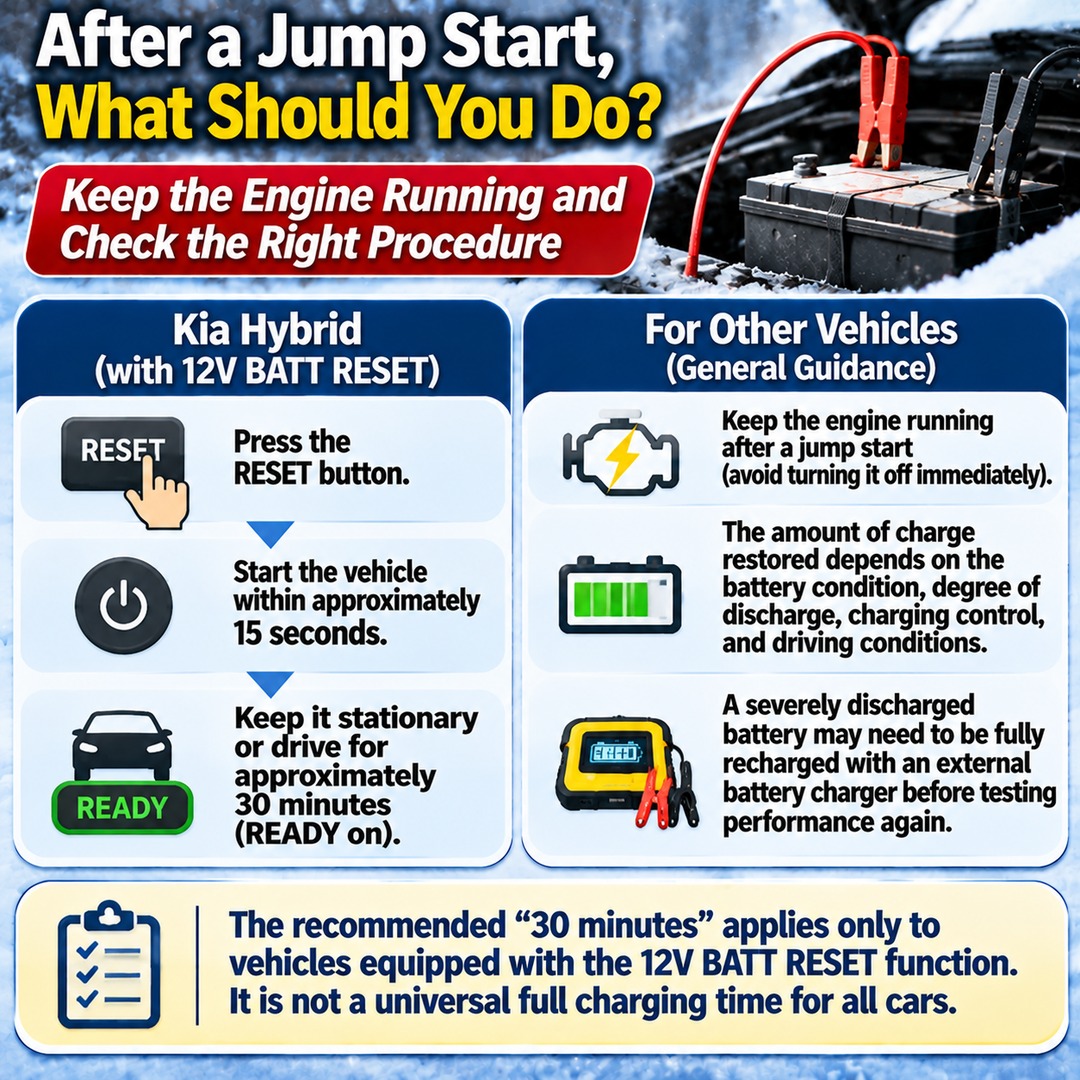
If possible, avoid switching off the engine immediately after a jump-start. The battery may recharge while the engine remains running, but the amount of time the engine runs does not guarantee that the battery will become fully charged.
Some Kia hybrid vehicles are equipped with a 12V BATT RESET function. The owner's manuals for vehicles equipped with this feature provide a specific jump-start procedure. They instruct drivers to press the RESET button, start the vehicle within approximately 15 seconds, and keep it stationary or drive for approximately 30 minutes while the READY indicator remains illuminated.
This 30-minute recommendation applies to vehicles equipped with that particular function. It is not a universal full-charging time for all cars.
For conventional vehicles as well, the amount of charge restored depends on the extent of battery discharge, battery condition, alternator charging control, and driving conditions. A severely discharged battery may need to be fully recharged using an external battery charger before its performance is tested again.
If you have previously managed to start your vehicle with a jump-start but are unsure whether the battery needs replacing, these checks can help determine the next step.
Essential Safety Precautions When Jump-Starting a Car
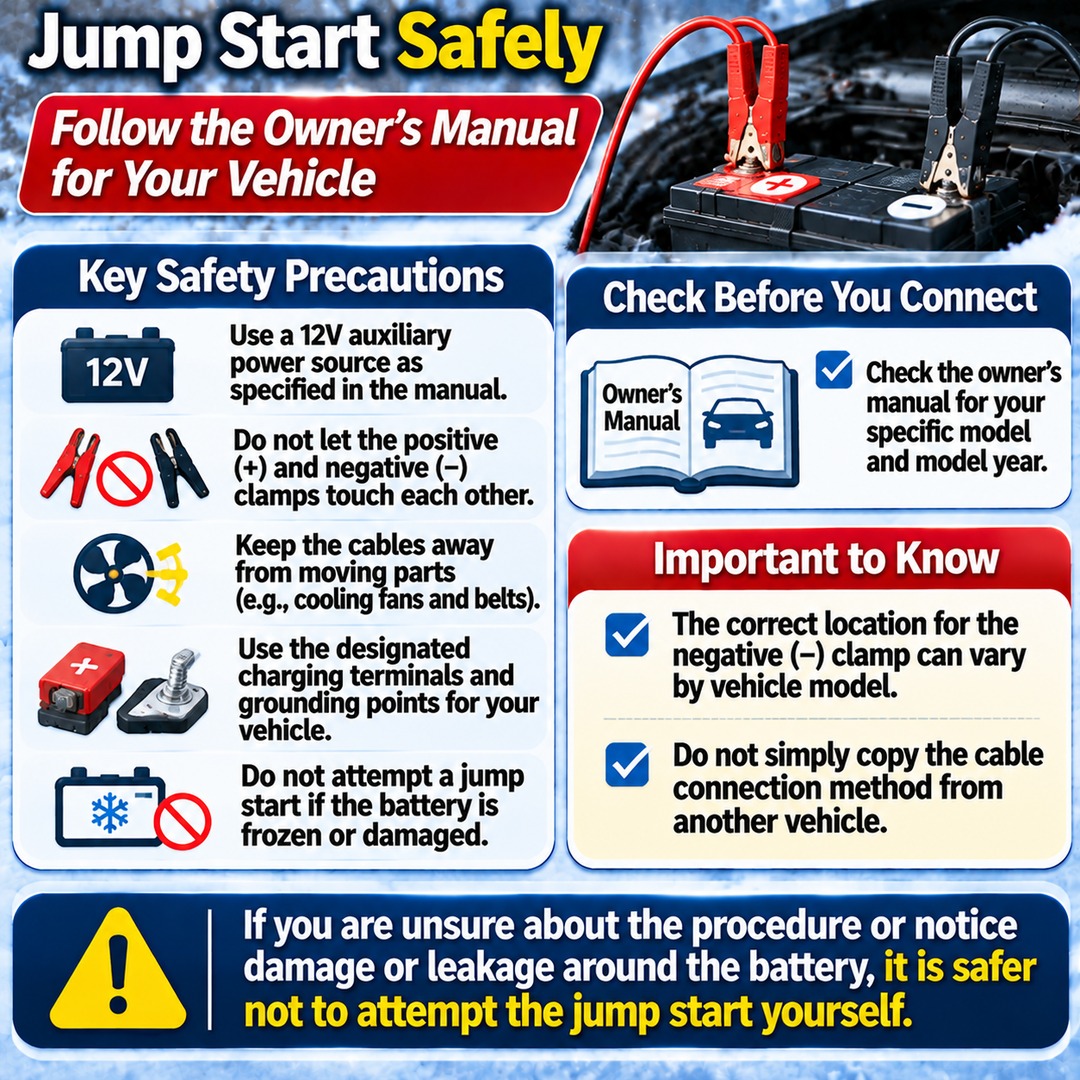
Incorrectly connecting jumper cables can cause battery rupture or explosion and damage electrical equipment. Jump-start terminals and grounding points vary by vehicle, so you should not apply a generic connection method found online to every car.
The main safety precautions emphasized in Hyundai and Kia owner's manuals include:
Use a 12V auxiliary power source as specified in the vehicle's owner's manual.
Do not allow the positive (+) and negative (-) clamps to touch each other.
Keep the cables away from moving components such as cooling fans and belts.
Use the designated charging terminals and grounding points specified for the vehicle.
Do not attempt a jump-start if the battery is frozen or damaged.
If you are unsure about the connection points or procedure, contact roadside assistance or a qualified repair professional.
In particular, the correct location for the negative clamp can vary by vehicle model.
Some Hyundai owner's manuals instruct drivers to use the designated engine-compartment jump-start terminal first. If a separate battery connection is required, they may specify grounding the cable to an unpainted metal part of the vehicle body away from the battery.
Kia also designates dedicated grounding points or separate charging terminals on certain models. Therefore, do not simply copy the cable-connection arrangement shown for another vehicle. Check the owner's manual for your specific model and model year.
If you are unfamiliar with jump-starting or notice damage or leakage around the battery, it is safer not to attempt the procedure yourself.
Frequently Asked Questions About Repeated Battery Discharge After a Jump-Start
Will driving for 30 minutes after a jump-start fully recharge the battery?
Not necessarily. The amount of charge restored depends on the extent of battery discharge, battery age and condition, charging-system performance, and driving conditions. A severely discharged battery may require separate charging and a performance test.
Why does my new battery keep dying?
The alternator or charging system may be malfunctioning, or electrical devices may be consuming excessive power while the vehicle is parked. Since the problem may not be limited to the battery itself, both the charging system and parasitic current draw should be inspected.
Will turning off my dashcam solve repeated battery discharge?
If the dashcam is the cause, turning it off can help reduce power consumption. However, if the problem is caused by battery deterioration, alternator failure, or power consumption from other electrical devices, the battery may continue to discharge even when the dashcam is switched off.
How often should I replace my car battery?
Approximately 3–5 years is a general reference range for conventional lead-acid batteries. However, service life varies depending on vehicle operating conditions and battery type. Actual performance test results should take priority over battery age alone.
What should I do if the engine still will not start after a jump-start?
In addition to the battery, possible causes include poor terminal connections, a faulty starter motor, or other electrical-system problems. Rather than repeatedly attempting to start the engine or changing cable connections yourself, contact roadside assistance and have the vehicle inspected.