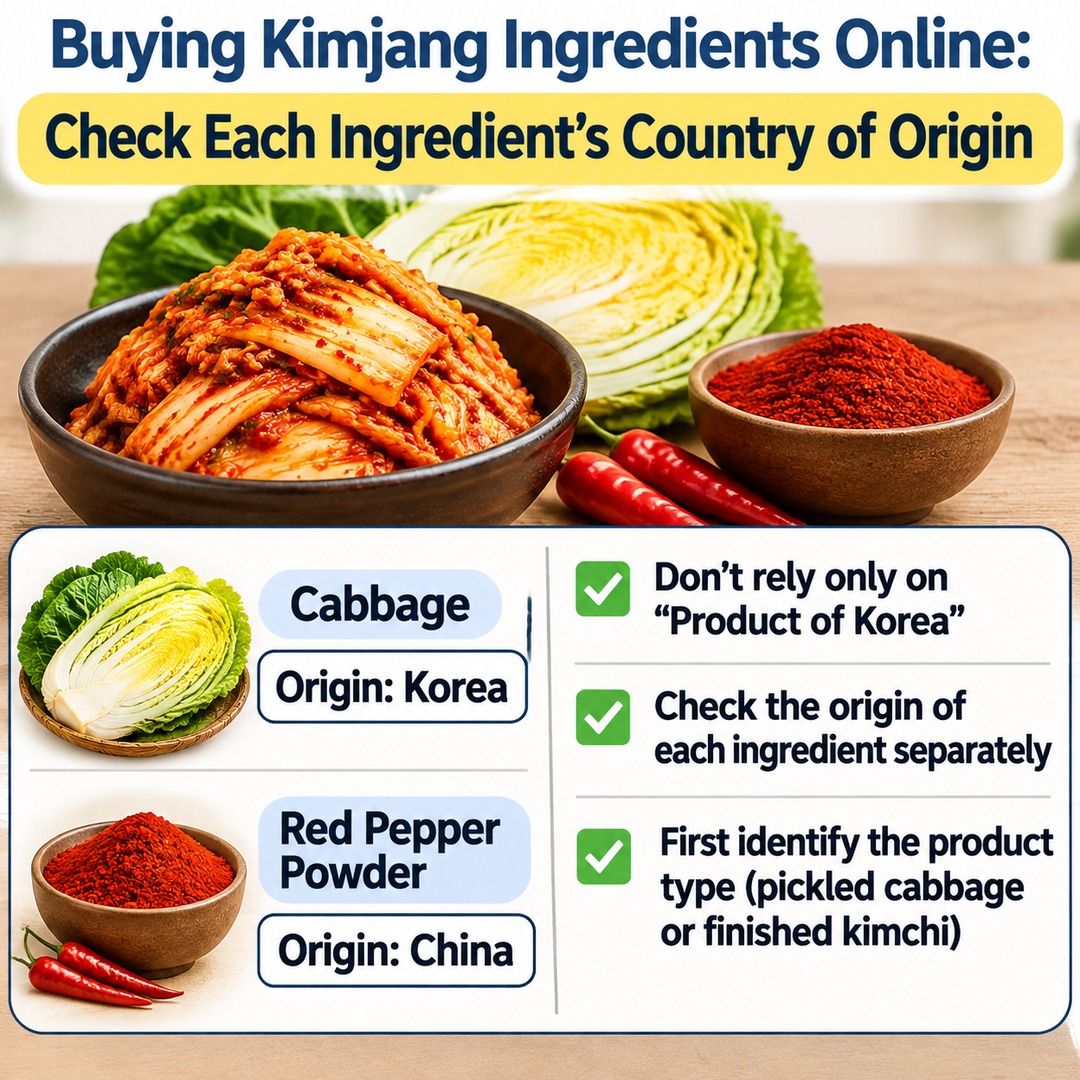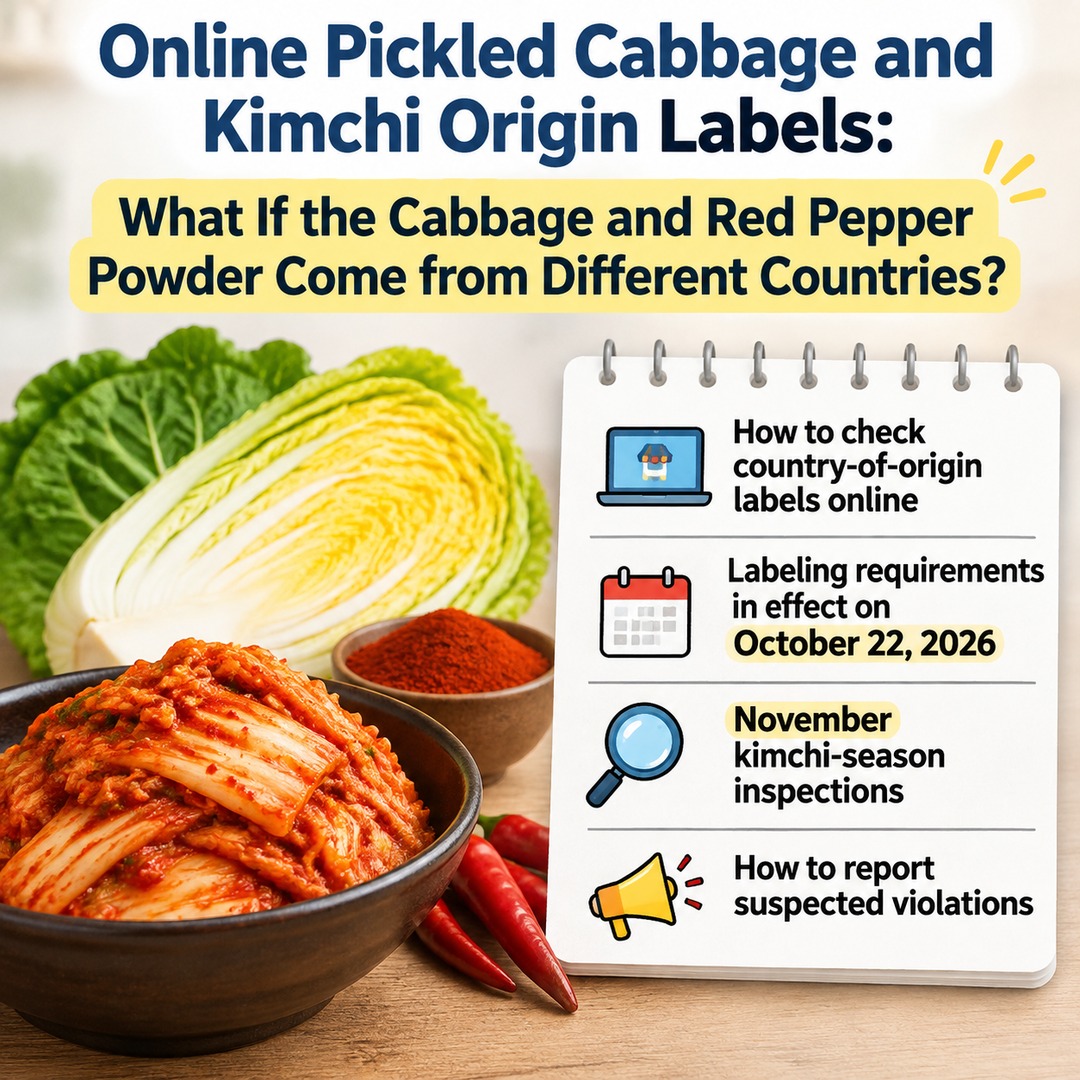
When buying pickled cabbage or napa cabbage kimchi for kimjang (Korea's traditional winter kimchi-making season) online, checking only the words “Product of Korea” in the product name is not enough. The cabbage and red pepper powder may come from different countries, so you should check the country-of-origin information for each ingredient separately. From October 22, 2026, online marketplace intermediaries in South Korea have been required to notify sellers of country-of-origin labeling requirements. From November 4 through December 4, inspections are also being conducted on pickled cabbage, napa cabbage kimchi, red pepper powder, and other related products.
When ordering kimjang ingredients, what matters is not simply whether a product is described as Korean, but where each ingredient was actually produced. Pickled cabbage and finished kimchi are subject to different origin-labeling criteria, so first identify which type of product you are buying.
What Changed Under South Korea's Online Origin Labeling System on October 22?
The existing country-of-origin labeling obligations for sellers have not been abolished or transferred entirely to online platforms. Sellers must still comply with the labeling requirements applicable to their products.
Online marketplace intermediaries must provide information about these requirements through one of the following methods:
Permanently displaying relevant information on the online mall's initial screen or notice board and informing users where to find it.
Providing a separate information page that registered sellers can access.
Sending individual notices by email, text message, other electronic documents, or written correspondence.
Platforms that fail to inform their registered sellers of the country-of-origin labeling requirements may face administrative fines based on the number of violations.
| Number of violations | Administrative fine for the platform |
|---|---|
| First violation | KRW 1 million |
| Second violation | KRW 2 million |
| Third or subsequent violation | KRW 4 million |
Consumers should understand one important distinction: the platform's notification obligation means that it must inform registered sellers about the applicable origin-labeling requirements. It does not mean that the platform directly guarantees the country of origin of every product consumers purchase.
What Should You Check on an Online Listing for Pickled Cabbage?
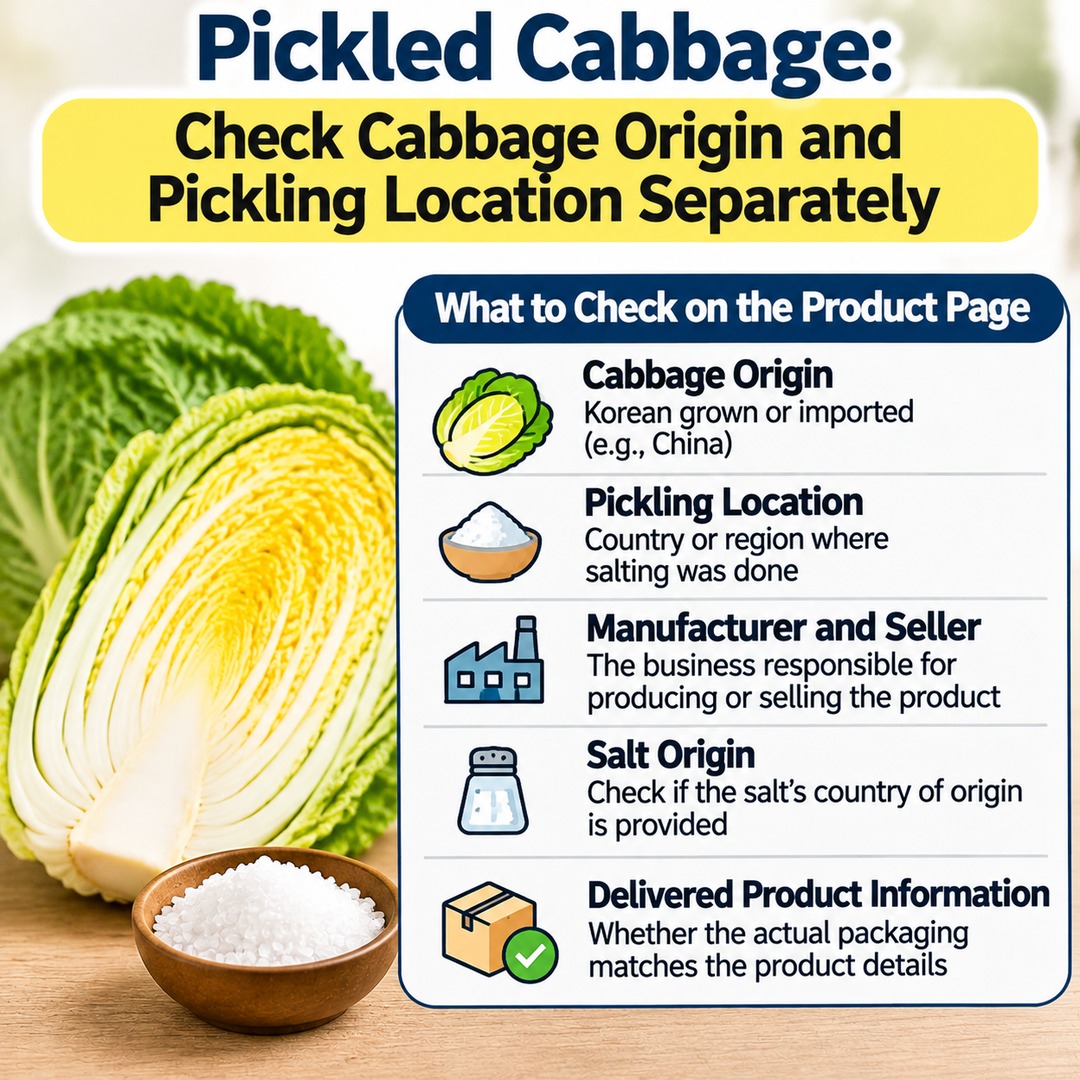
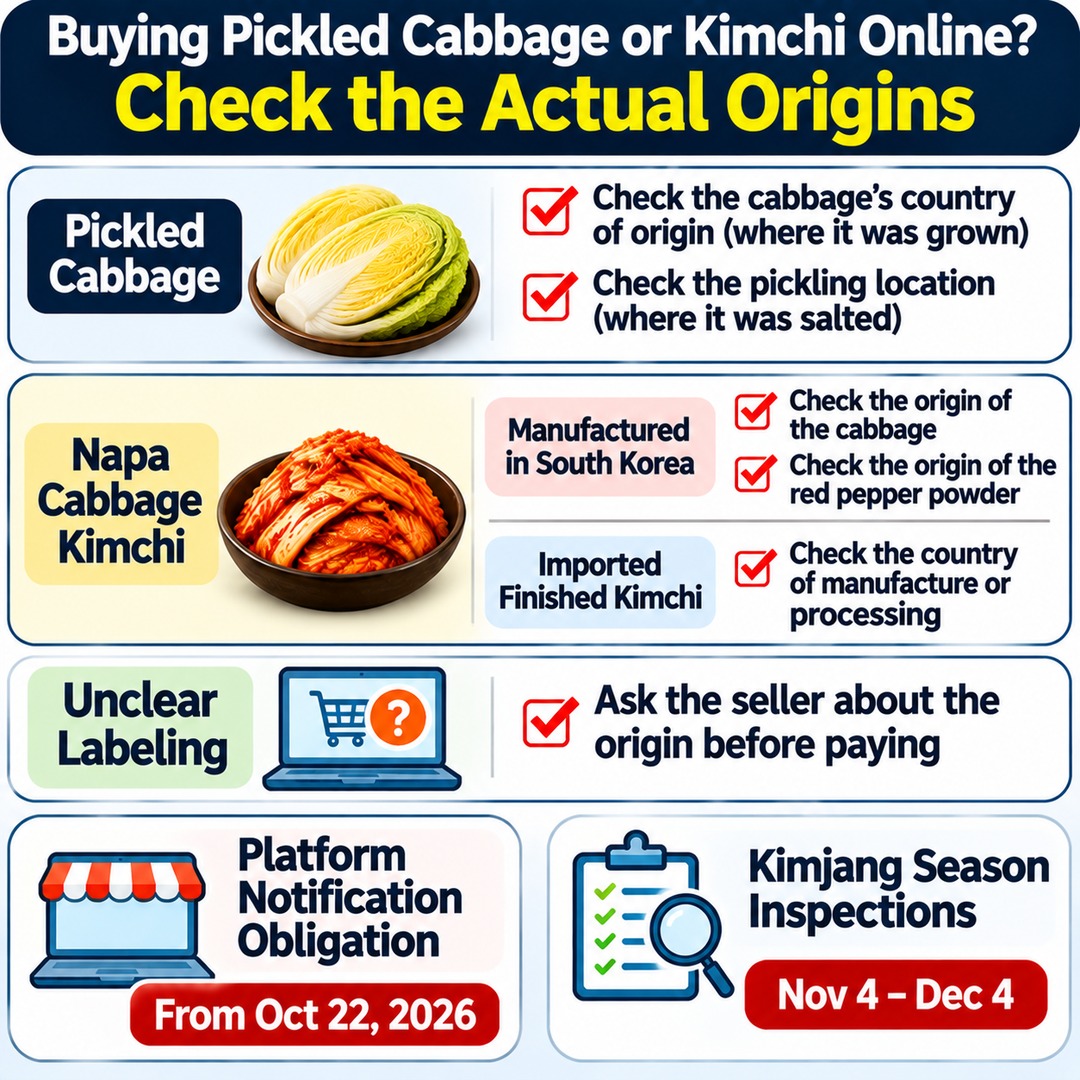
For pickled cabbage, distinguish between the country where the cabbage was grown and the location where it was salted. The fact that cabbage was salted in South Korea does not automatically mean that the cabbage itself was grown there.
Check the following information on the product details page:
Cabbage origin: Whether the cabbage is Korean-grown or imported, such as from China.
Pickling location: The country or region where the actual salting process took place.
Manufacturer and seller: The business responsible for producing or selling the product.
Salt origin: Check separately if country-of-origin information for the salt is provided.
Delivered product information: Whether the actual packaging matches the product information shown when you placed the order.
In particular, “Korean-origin pickled cabbage” and “pickled cabbage manufactured in South Korea” do not mean the same thing.
For example, if Chinese-grown cabbage is salted in South Korea, its country of origin does not change to South Korea. If a product description identifies only the pickling location but does not clearly state where the cabbage was grown, it is safer to ask the seller directly.
For online mail-order sales in South Korea, country-of-origin information must be presented in a way that allows consumers to identify it on the product display page. It may appear near the product name or price, or in a separate information window, but consumers must be able to identify the origin when viewing the product.
Check the Origins of Cabbage and Red Pepper Powder Separately in Kimchi
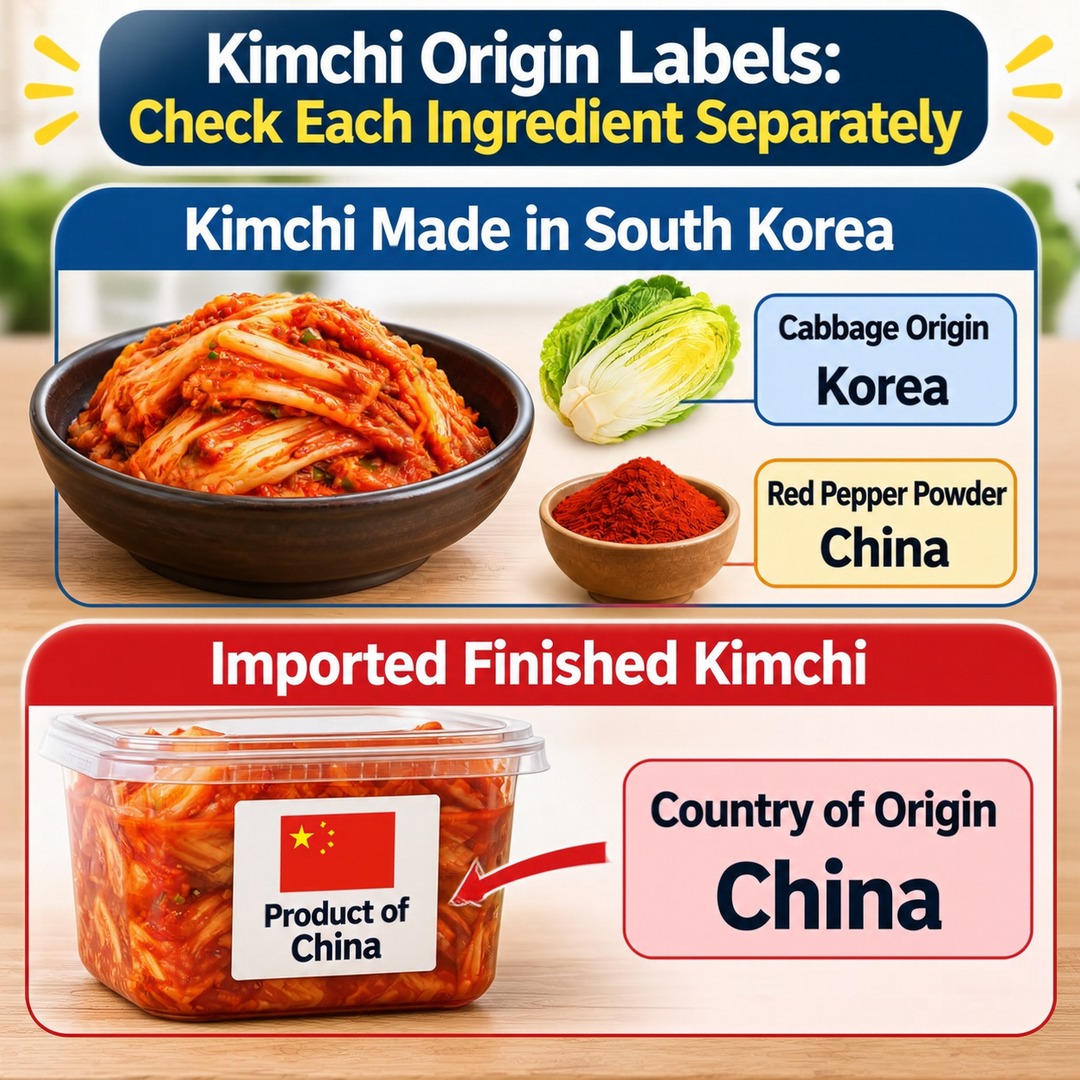
For napa cabbage kimchi manufactured in South Korea, it is important to distinguish between the origins of the cabbage and the red pepper powder. When red pepper powder is used, the two ingredients may come from different countries, so check each one separately.
For example, the following combinations are possible:
| Ingredient | Example of origin labeling |
|---|---|
| Korean-grown cabbage | Chinese red pepper powder |
| Chinese-grown cabbage | Korean red pepper powder |
| Korean-grown cabbage | Korean red pepper powder |
One important point when interpreting kimchi origin labels is that using Korean-grown cabbage does not mean that every ingredient in the kimchi is Korean-grown.
In particular, even if a product is described as “napa cabbage kimchi made with Korean cabbage,” you should not assume that the red pepper powder is also Korean.
For napa cabbage kimchi made without red pepper powder, the applicable labeling criteria focus on the origin of the cabbage.
How Is Finished Kimchi Manufactured in China Classified?
Imported finished kimchi is subject to different origin-labeling criteria from kimchi manufactured in South Korea.
When napa cabbage kimchi manufactured or processed abroad is imported and sold in South Korea, its country of origin is identified as the country where the kimchi was manufactured or processed.
For example, finished kimchi manufactured in China is labeled as a product of China.
Therefore, when buying kimchi online, distinguish between these two cases:
Kimchi manufactured in South Korea: Check the origins of cabbage, red pepper powder, and other ingredients subject to origin-labeling requirements.
Finished kimchi manufactured abroad and imported: Check the country where the finished product was manufactured or processed.
Understanding this distinction can help prevent mistakes when judging the origin of finished kimchi based only on the origin of its cabbage.
Intensive Inspections of Kimjang Ingredients: November 4–December 4
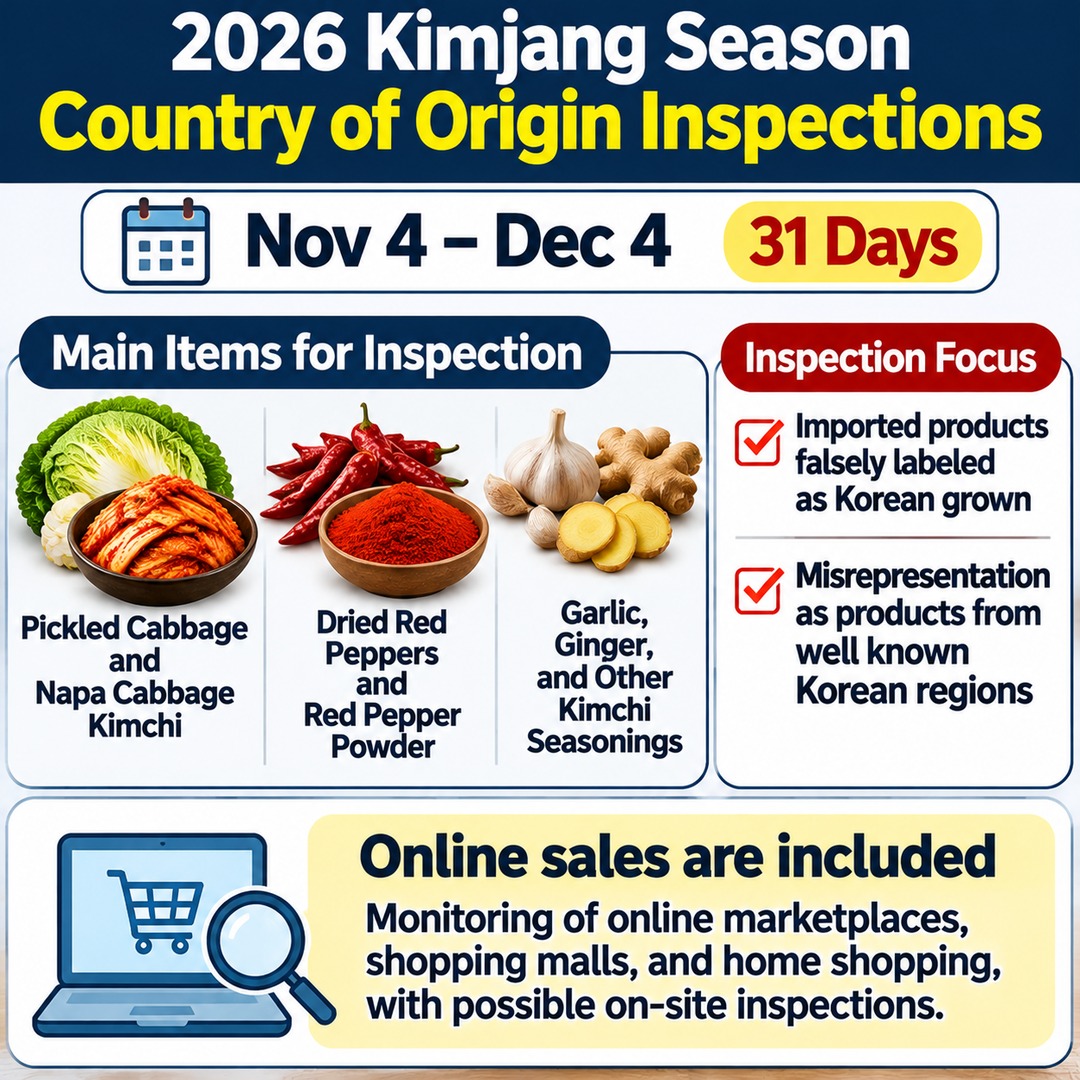
South Korea's 2026 kimjang-season country-of-origin inspections are scheduled to run for 31 days, from November 4 through December 4.
The inspections cover major agricultural products and processed foods used for kimjang, including:
Pickled cabbage and napa cabbage kimchi.
Dried red peppers and red pepper powder.
Garlic, ginger, and other kimchi seasonings.
A major focus is the sale of imported agricultural products falsely labeled as Korean-grown, or the misrepresentation of products as coming from well-known Korean production regions.
Online sales are also included in the inspection program. The National Agricultural Products Quality Management Service (NAQS) plans to use its cyber-investigation team to monitor online marketplace intermediary websites, shopping malls, and home-shopping channels. Businesses suspected of violations may be subject to on-site inspections.
This means that country-of-origin checks apply not only to kimjang ingredients purchased at physical stores but also to pickled cabbage and kimchi ordered online.
What Are the Penalties for False Country-of-Origin Labeling?
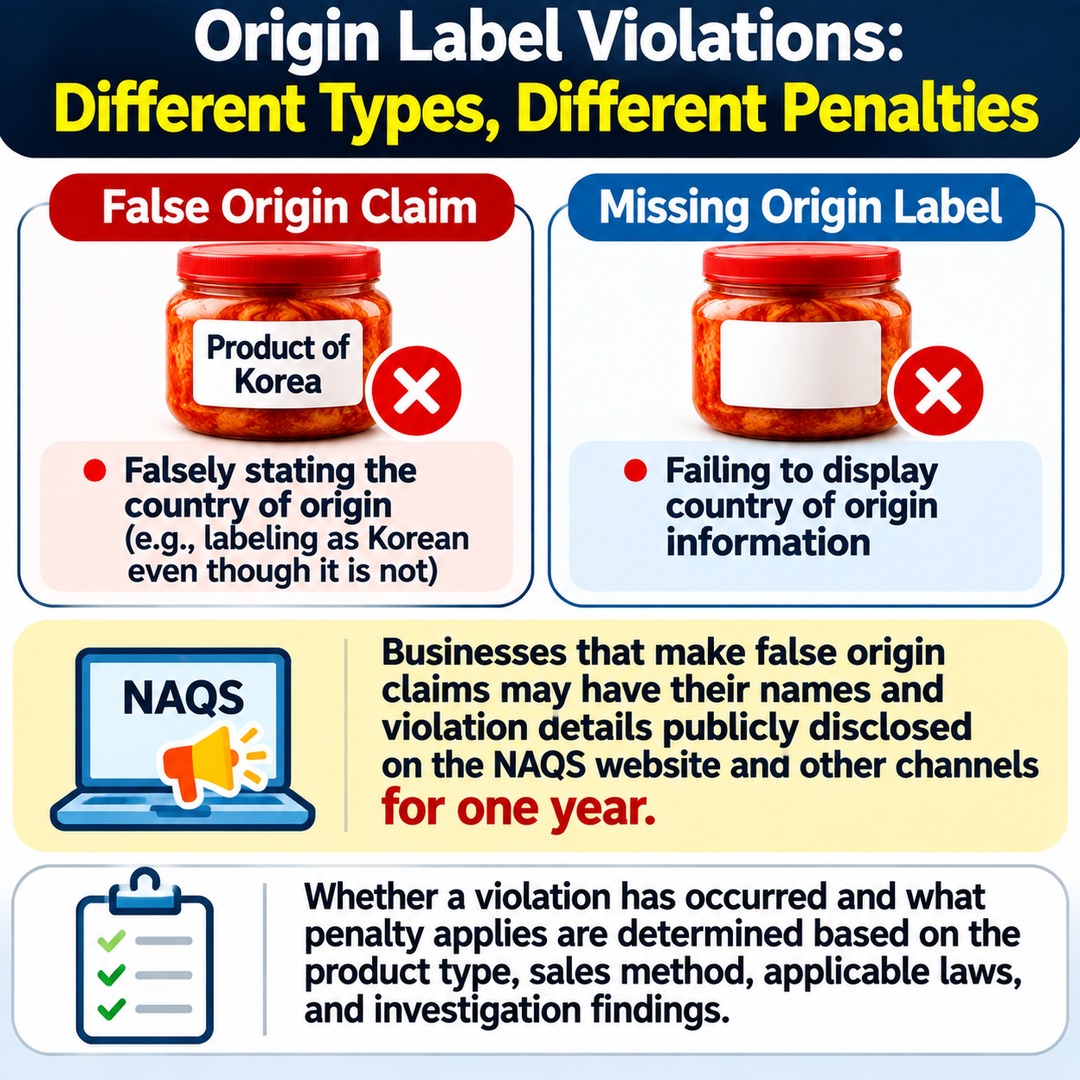
Selling products with falsely stated origins and failing to display origin information are treated as different violations.
| Type of violation | Penalty |
|---|---|
| Falsely stating the country of origin | Imprisonment for up to 7 years or a fine of up to KRW 100 million |
| Failing to display the country of origin | Administrative fine of up to KRW 10 million |
| Platform's failure to notify sellers of origin-labeling requirements | Administrative fine of up to KRW 4 million, depending on the number of violations |
Businesses caught making false origin claims may have their names and violation details publicly disclosed on the NAQS website and other relevant channels for one year.
It is important to distinguish between failing to display origin information and falsely stating an origin. A product with missing origin information and a product falsely labeled as Korean are not classified as the same type of violation.
Whether a violation has occurred and what penalty applies are determined according to the product type, sales method, applicable laws, and investigation findings.
Where Can You Report Missing or Suspicious Origin Labels?
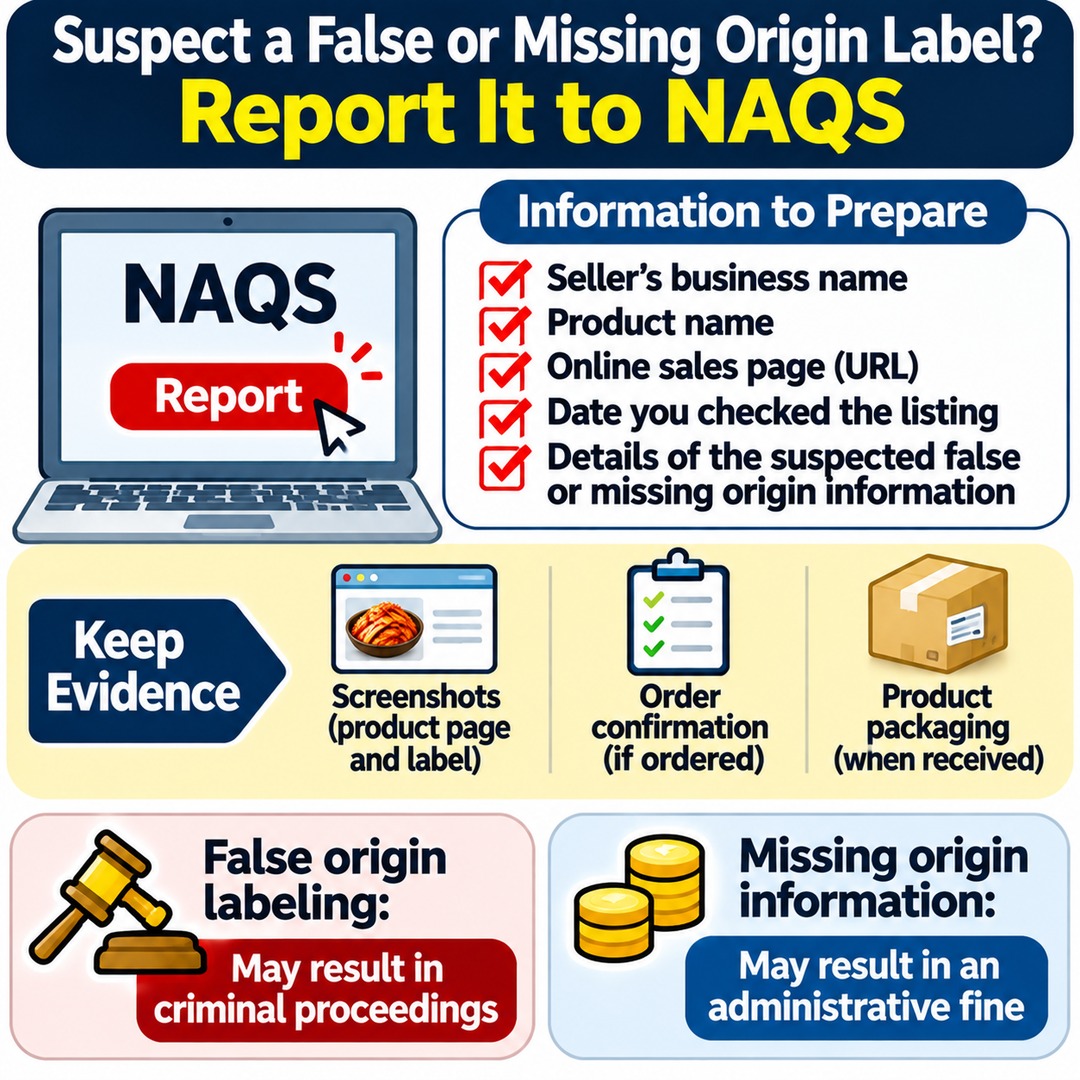
If an online product has no country-of-origin label, or you suspect that the stated origin differs from the actual origin, you can report it to the National Agricultural Products Quality Management Service (NAQS).
Reporting suspected illegal distribution of agricultural and livestock products
You can use the NAQS electronic civil service portal to submit a report about suspected illegal distribution of agricultural and livestock products.
When making a report, prepare specific information such as:
The seller's business name.
The product name.
The online sales page.
The date you checked the listing.
Details of the suspected false or missing origin information.
It is also advisable to take screenshots of the product details page and the country-of-origin label. If you placed an order, keep the order confirmation and the packaging of the product you actually received.
After receiving a report, NAQS officials may inspect the physical product and relevant business records and collect necessary evidence. False origin labeling may result in criminal proceedings, while failure to display origin information may result in an administrative fine.
Three Things to Check Before Ordering Kimjang Ingredients
When buying pickled cabbage or kimchi online, prioritize the country of origin of each ingredient and the actual product information rather than relying on the product name alone.
1. Pickled cabbage: Distinguish between the country where the cabbage was grown and the location where it was salted.
2. Napa cabbage kimchi: For products manufactured in South Korea, check the origins of the cabbage and red pepper powder separately. For imported finished kimchi, check the country where it was manufactured or processed.
3. Products with unclear labeling: Ask the seller about the origin before paying. If you suspect false labeling, save screenshots and submit a report.
The system introduced on October 22, 2026, strengthens online platforms' responsibility to inform registered sellers of origin-labeling requirements. The intensive inspections running from November 4 through December 4 are a separate measure targeting origin-labeling violations involving kimjang ingredients.
It is important not to confuse these two measures. When purchasing kimjang ingredients, checking the specific origins of the cabbage and red pepper powder is a more reliable starting point than relying on the single word “Korean.”