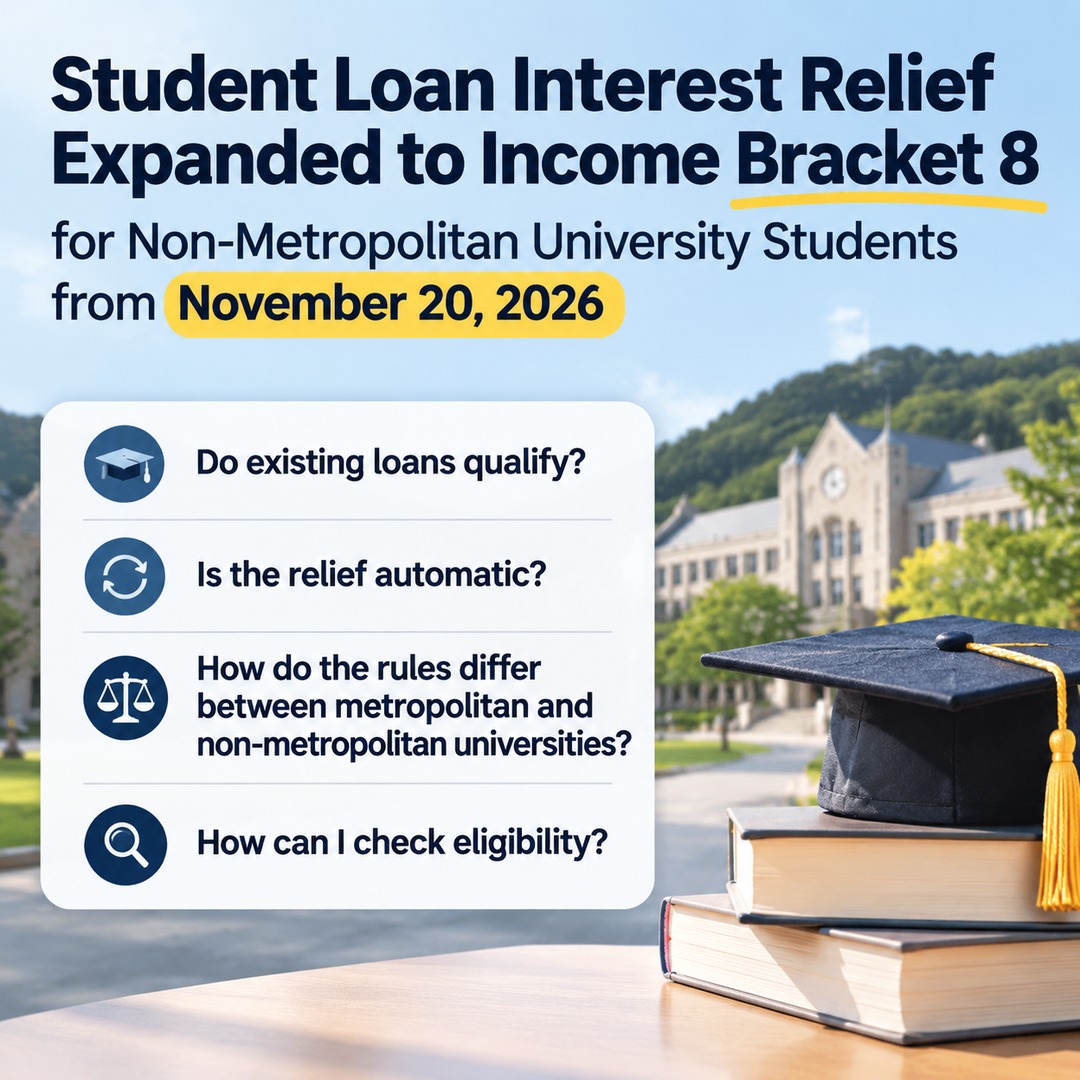
How Will Student Loan Interest Relief Eligibility Change from November 20?
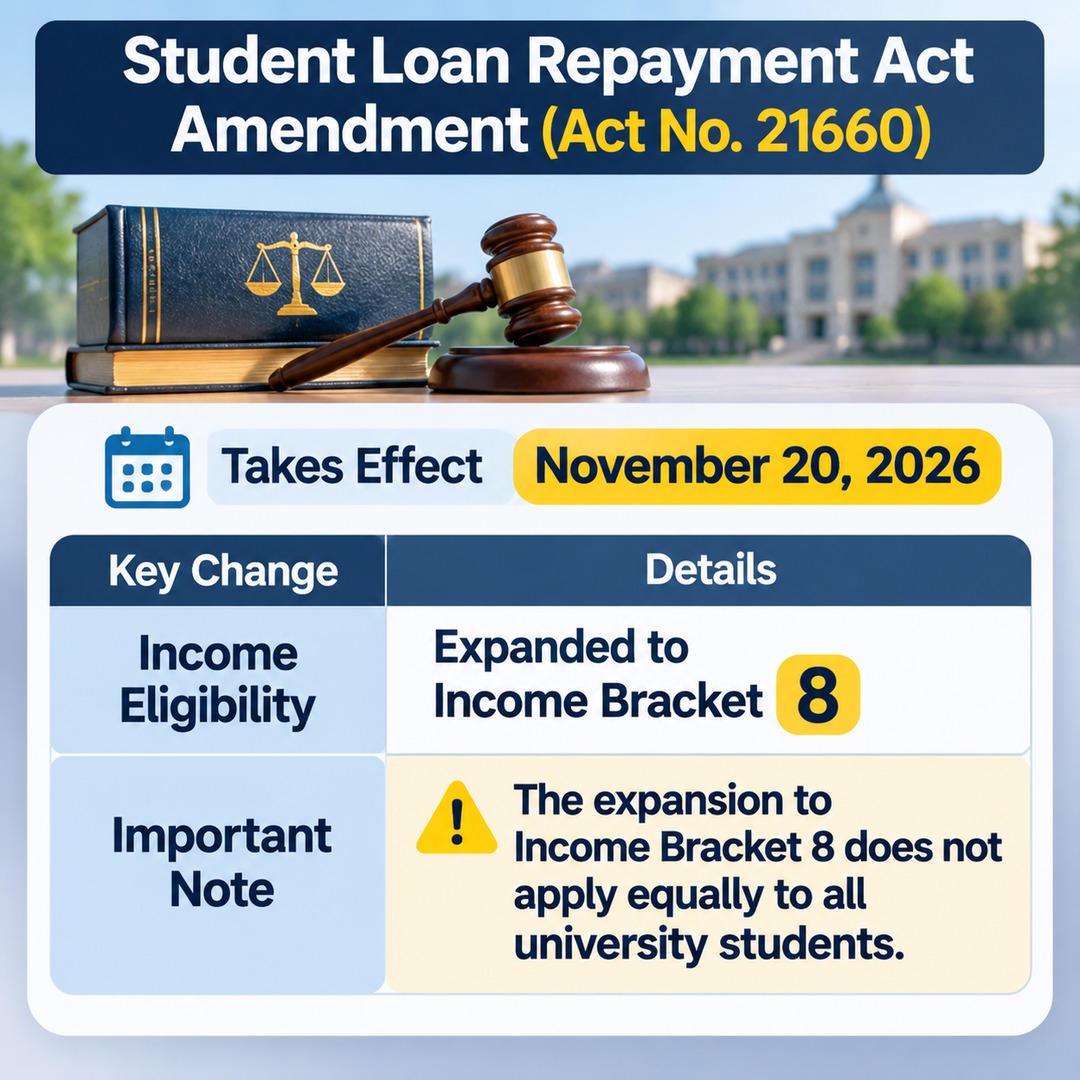
This change follows an amendment to Korea's Special Act on the Repayment of Student Loans After Employment. The amendment, designated Act No. 21660, takes effect on November 20, 2026.
The changes can be summarized as follows:
| Category | Eligibility Criteria |
|---|---|
| Previous income threshold | At or below 130% of median household income |
| Previous student financial aid income bracket | Bracket 6 or below |
| Expanded threshold for non-metropolitan universities | At or below 200% of median household income |
| Expanded student financial aid income bracket | Bracket 8 or below |
| Effective date | November 20, 2026 |
An important point is that the expansion to income bracket 8 does not apply equally to all university students.
Are Interest Relief Rules Different for Metropolitan and Non-Metropolitan University Students?
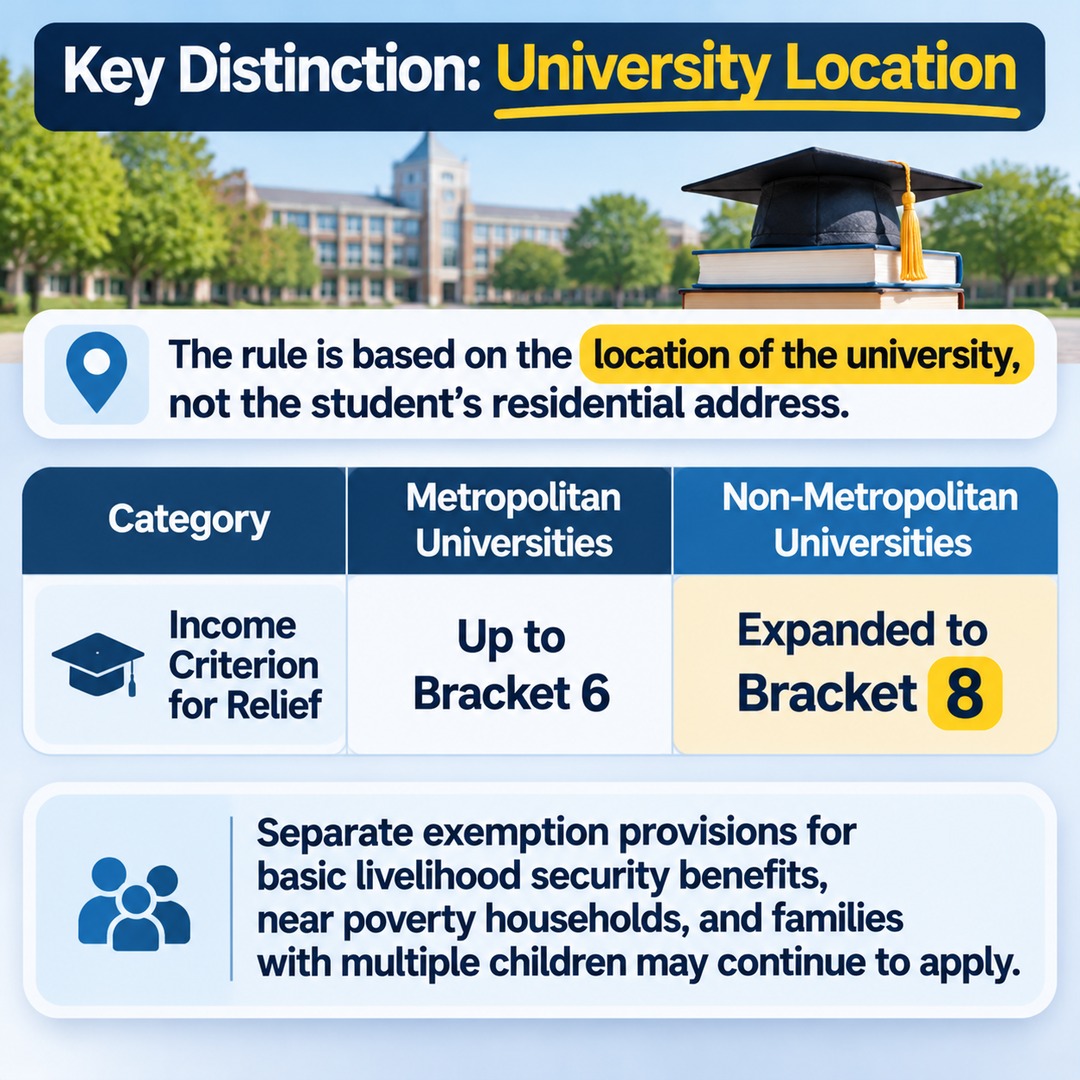
Yes. The most important distinction under the expanded rules is the location of the university, not the student's registered residential address.
The distinction can be illustrated as follows:
| University Location | Student Financial Aid Income Bracket | Treatment Under the Expanded Criteria |
|---|---|---|
| Non-metropolitan | Bracket 5 | Within the expanded threshold |
| Non-metropolitan | Bracket 6 | Within the expanded threshold |
| Non-metropolitan | Bracket 7 | Newly included under the expansion |
| Non-metropolitan | Bracket 8 | Newly included under the expansion |
This table compares the newly expanded income criteria for non-metropolitan universities. Separate existing exemption provisions for recipients of basic livelihood security benefits, near-poverty households, and families with multiple children may continue to apply independently.
Do Existing Student Loans Also Qualify for Interest Relief?
Students who have already taken out Income-Contingent Student Loans may also qualify under the expanded rules.
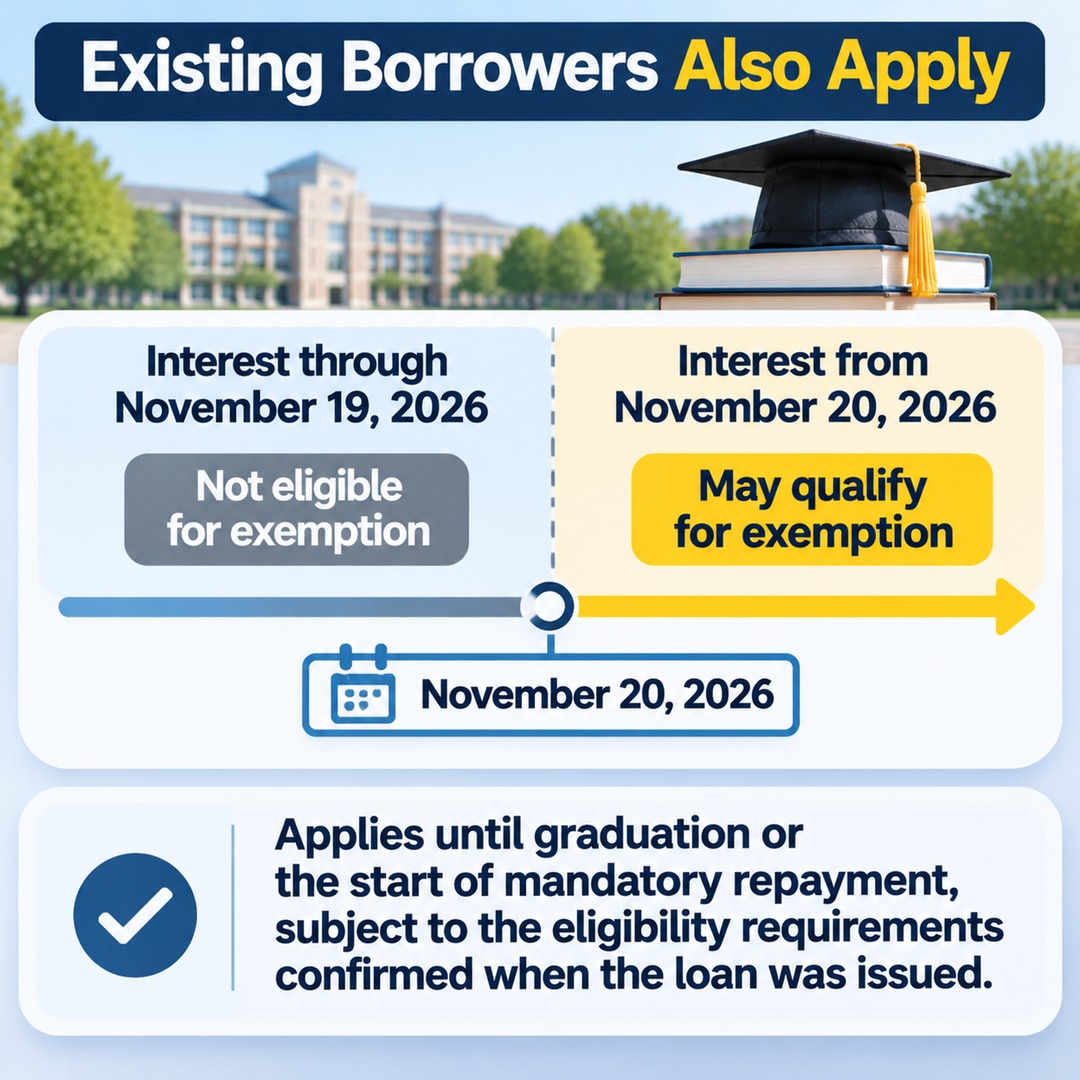
The new policy includes existing borrowers, but the interest relief begins on November 20, 2026.
For example, suppose a student received a loan during the first semester of 2026 and met the requirements for a non-metropolitan university student in income bracket 8 or below, based on the eligibility information confirmed when the loan was issued. The treatment would be as follows:
Interest accrued through November 19, 2026: Not eligible for exemption under this expansion.
Interest accrued from November 20, 2026 onward: May qualify for exemption.
In other words, the outstanding loan principal will not be canceled, and interest that has already accrued will not be retroactively waived in full.
Instead, interest accrued from the effective date onward will be exempted under the expanded criteria.
The interest relief is structured to apply until graduation or the commencement of mandatory repayment. However, actual eligibility depends on whether the borrower meets the relevant requirements, including the eligibility information and student financial aid income bracket confirmed when the loan was issued.
Will Interest Relief Be Applied Automatically Without a Separate Application?
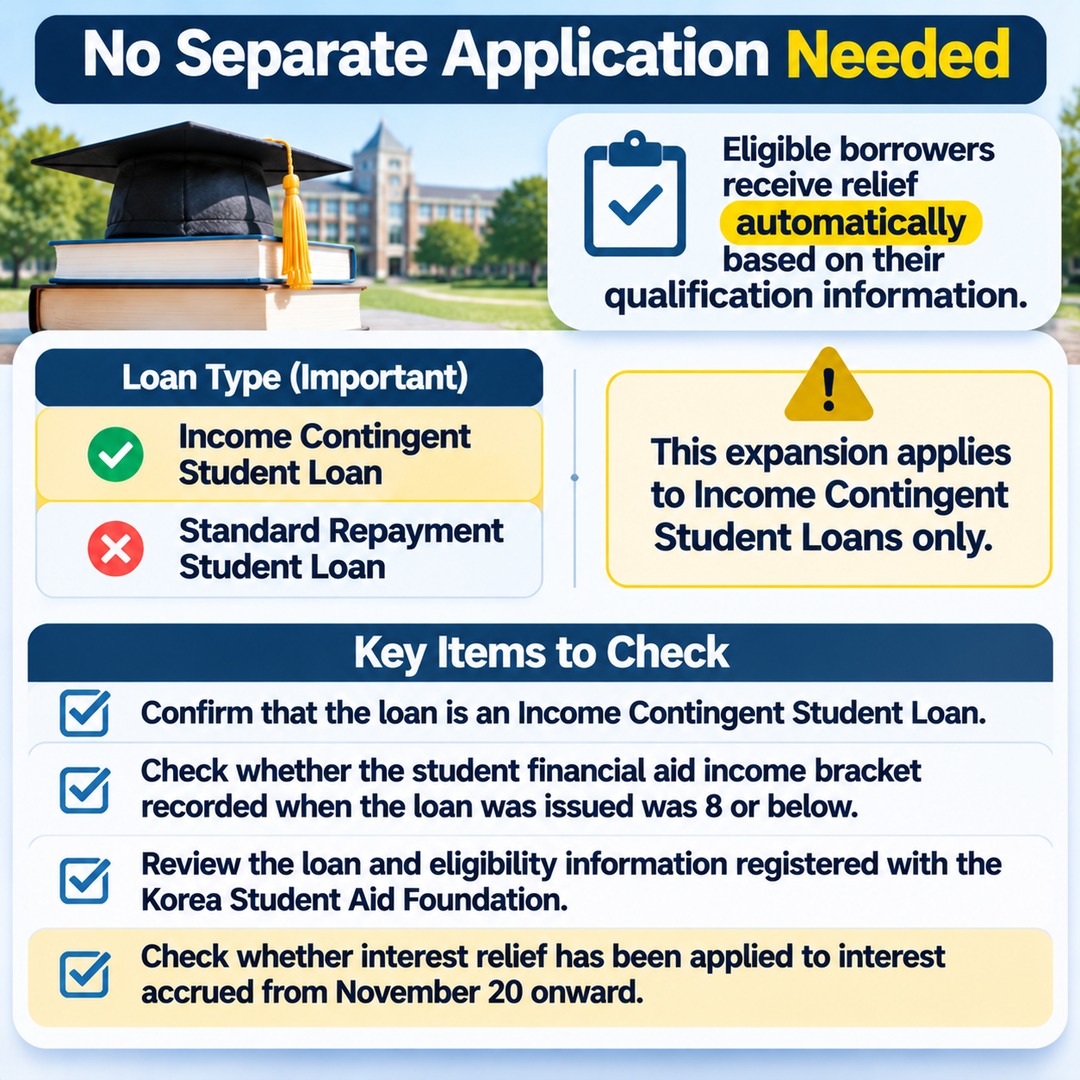
The expansion will operate under a system in which eligible borrowers receive relief based on their qualifications, rather than having to submit a separate interest exemption application.
The Korea Student Aid Foundation has explained that it will move away from the previous application-based approach and provide interest relief using eligible borrowers' existing qualification information, without requiring a separate application procedure.
Therefore, non-metropolitan university students in income bracket 8 or below do not need to submit a separate application form specifically to receive the interest exemption.
However, automatic application does not mean that every existing student loan will automatically receive an exemption regardless of eligibility.
According to the Korea Student Aid Foundation's guidance, eligibility information confirmed when the loan was issued and the student's financial aid income bracket are important factors in determining eligibility.
The following items should be checked:
1. Confirm that the loan is an Income-Contingent Student Loan.
2. Check whether the student financial aid income bracket recorded when the loan was issued was 8 or below.
4. Review the loan and eligibility information registered with the Korea Student Aid Foundation.
5. Check whether interest relief has been applied to interest accrued from November 20 onward.
In particular, Income-Contingent Student Loans and Standard Repayment Student Loans are different loan products and must not be confused. This expansion concerns Income-Contingent Student Loans.
How Can You Check Whether You Are in Student Financial Aid Income Bracket 8?
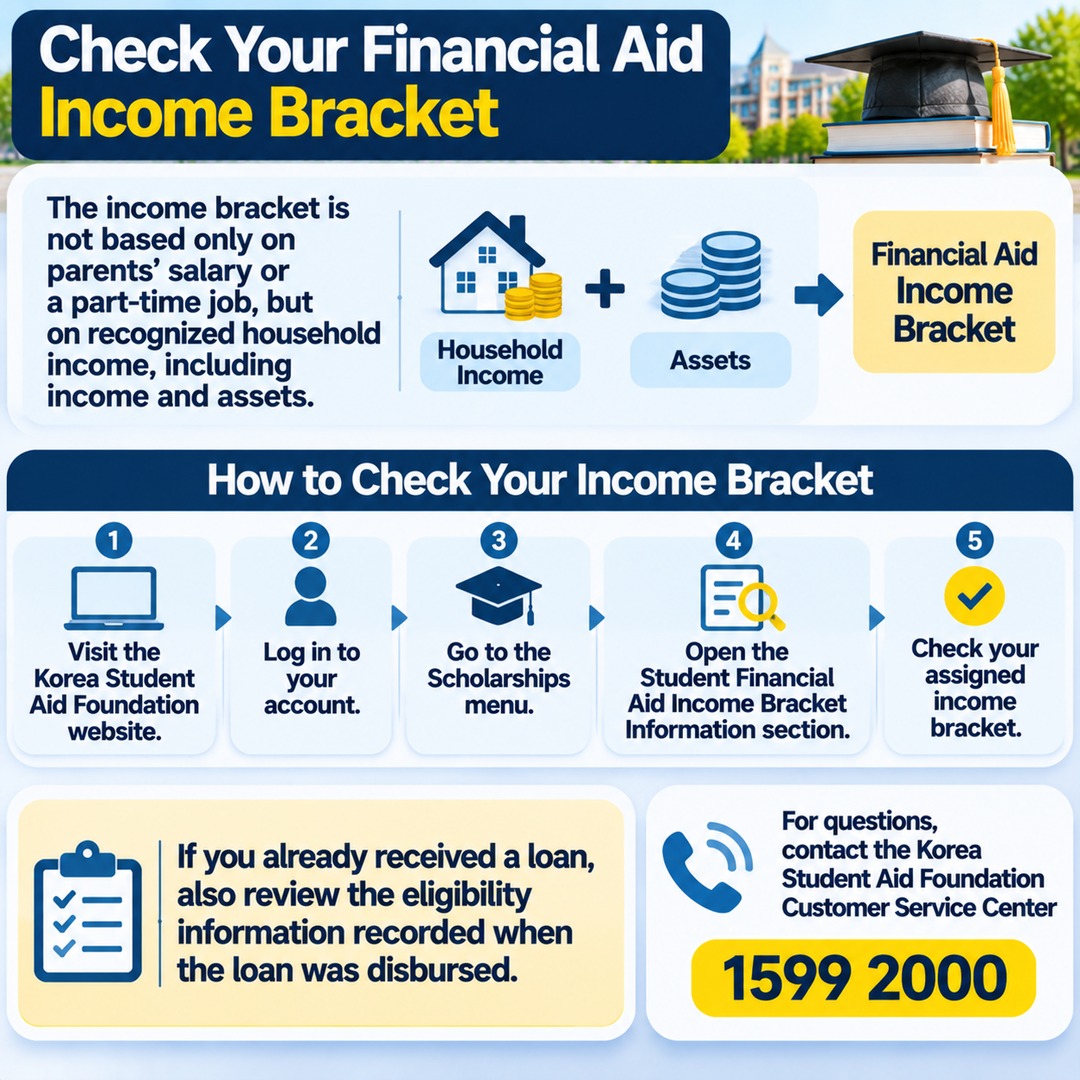
A student's financial aid income bracket is not determined solely by their parents' monthly salary or the student's part-time job income.
It is calculated using recognized household income, which takes household income and assets into account.
Students can check their financial aid income bracket through the Korea Student Aid Foundation website.
Follow these steps:
Visit the Korea Student Aid Foundation website.
Log in to your account.
Go to the Scholarships menu.
Open the Student Financial Aid Income Bracket Information section.
Check your assigned income bracket.
Students who have already received a loan should not rely only on the income bracket currently displayed. They should also review the eligibility information recorded when the loan was actually disbursed.
This is because the expanded interest relief policy identifies eligibility information confirmed at the time of borrowing as an important basis for determining qualification.
If your income bracket is 8 or below but your exemption status remains unclear, you can contact the Korea Student Aid Foundation customer service center at 1599-2000 to ask whether the rules apply to your specific loan.
Three Important Distinctions Students Should Understand
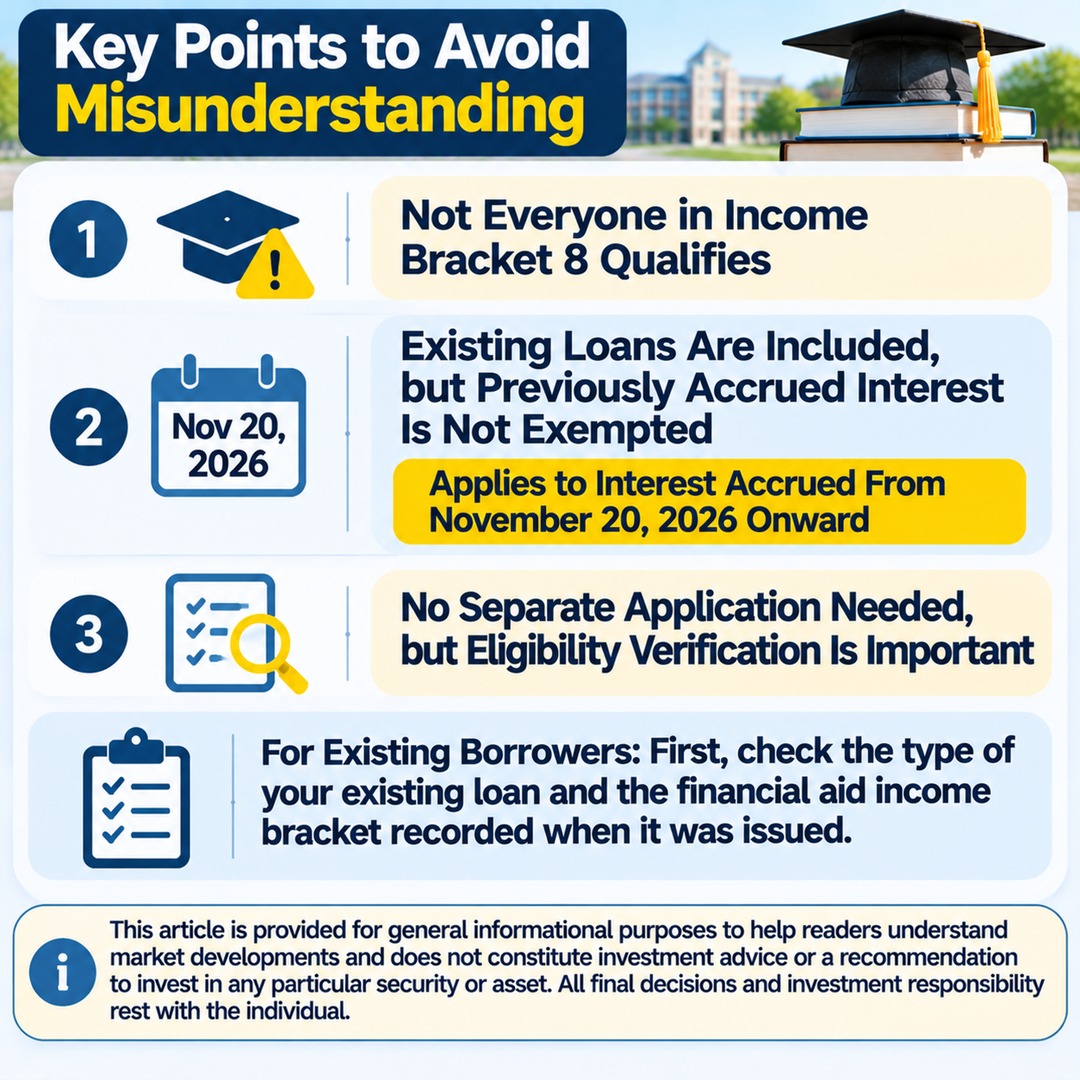
There are three points that are particularly easy to misunderstand when interpreting this policy.
First, not everyone in income bracket 8 qualifies.
Second, existing loans are included, but previously accrued interest is not exempted.
For existing borrowers, the expanded criteria apply to interest accrued from November 20, 2026 onward.
Third, a separate application is unnecessary, but eligibility verification remains important.
Relief is processed using information about eligible borrowers without requiring a separate application. However, borrowers must satisfy the requirements, including the university's location and student financial aid income bracket recorded when the loan was issued.
For students who already have student loans, the first step is not to apply for a new loan but to check the type of their existing loan and the student financial aid income bracket recorded when it was issued.
※ This article is provided for general informational purposes to help readers understand market developments and does not constitute investment advice or a recommendation to invest in any particular security or asset. All final decisions and investment responsibility rest with the individual.