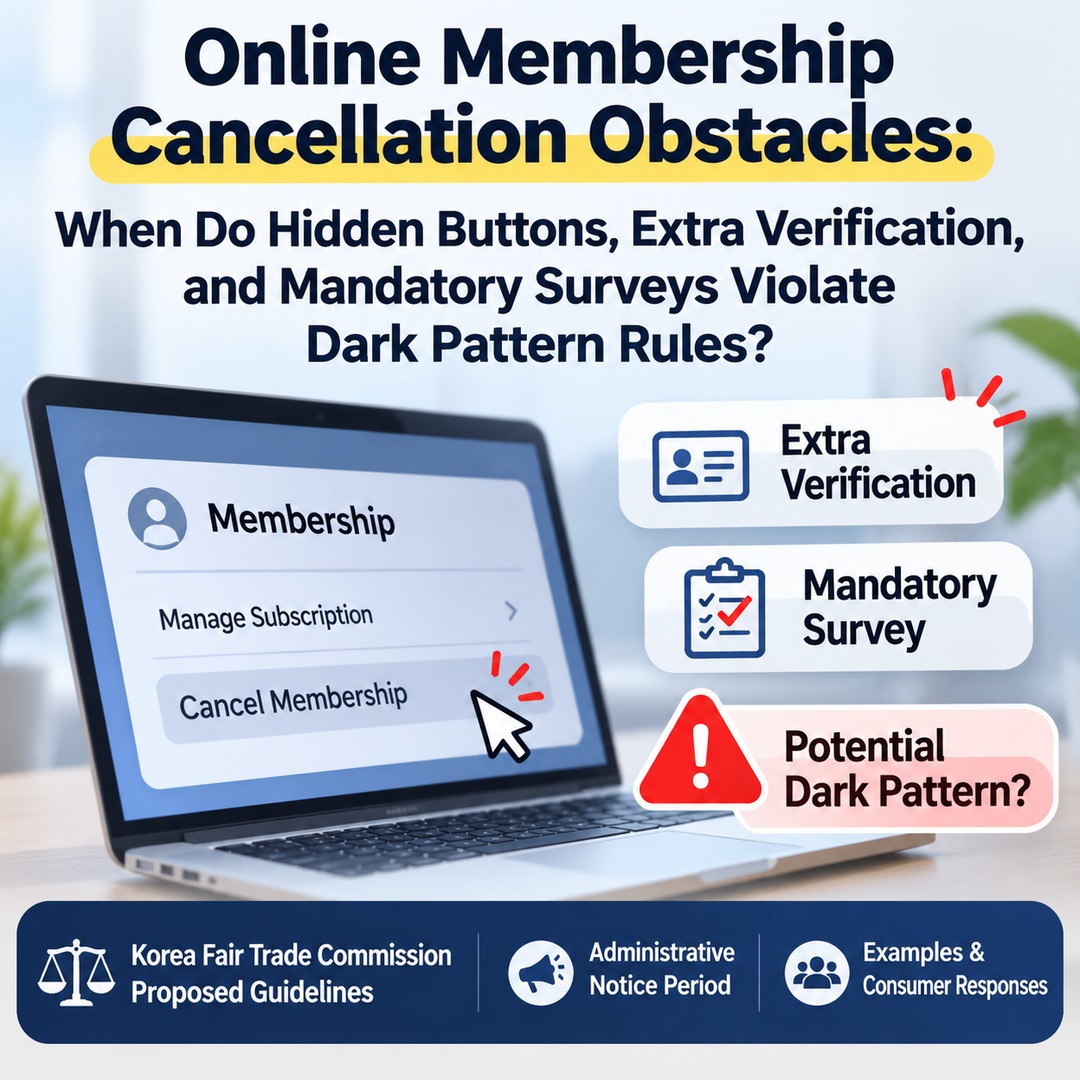
If an online shopping platform or subscription service hides its membership cancellation button deep within its menus, or requires identity verification and mandatory surveys that were not required during registration, these practices may constitute interference with cancellation or withdrawal under South Korea's Electronic Commerce Act. The Korea Fair Trade Commission (KFTC) announced proposed amendments to its Consumer Protection Guidelines for Electronic Commerce, with an administrative notice period running from November 6 through November 26, 2026. These proposed amendments should not be confused with finalized guidelines.
Signing up for a service may take only a few seconds, but if canceling membership requires navigating through multiple menus, the issue may go beyond inconvenient website design. The key questions are whether the service creates unnecessary differences between registration and cancellation procedures and whether it makes it unreasonably difficult for consumers to terminate their contractual relationships.
Where Should an Online Membership Cancellation Button Be Located?
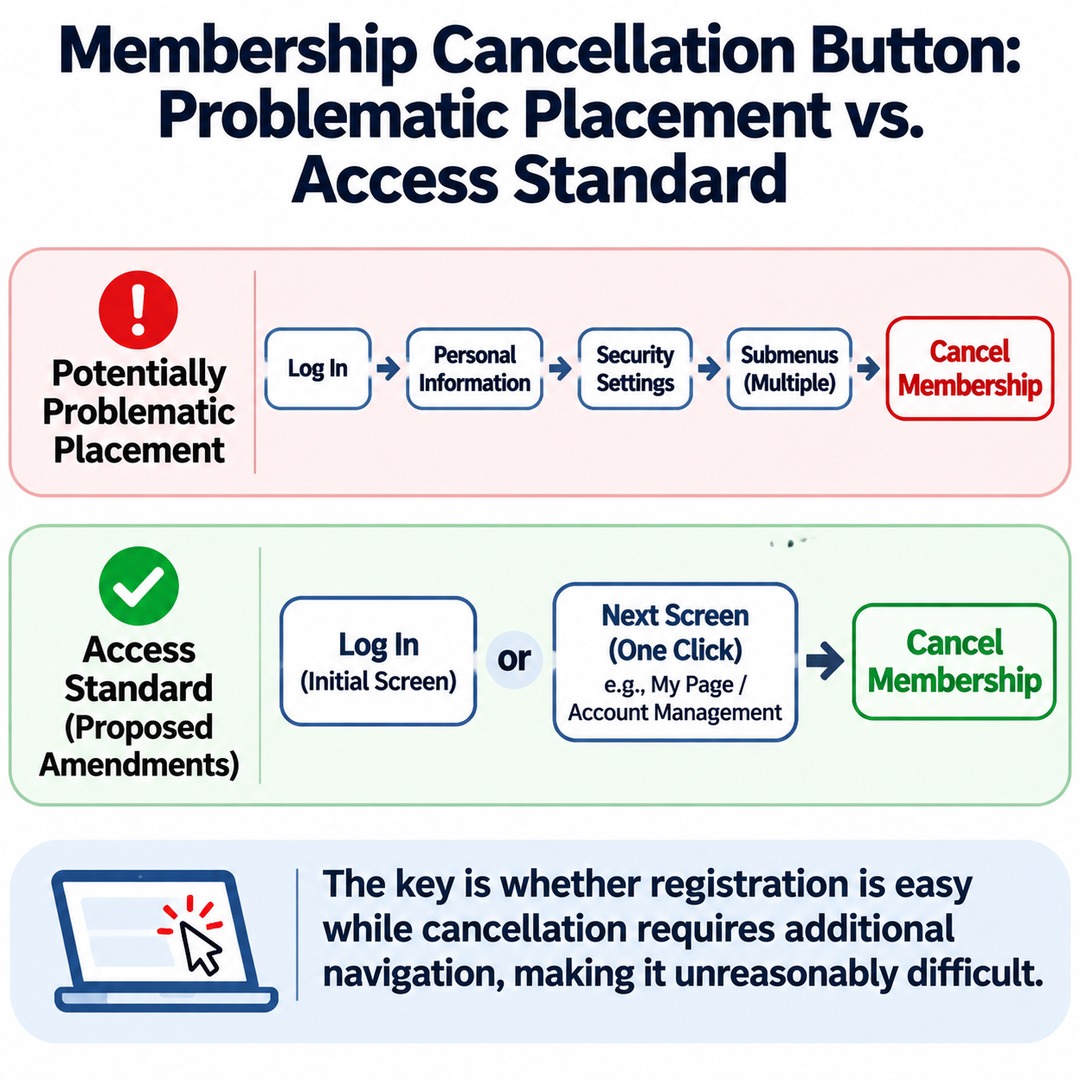
The KFTC's proposed amendments identify a potentially unlawful practice in which a business places its registration button on the initial screen but locates the membership cancellation button deeper within the website, beyond the initial login screen or the next screen directly accessible from it.
Here, the next screen refers to a page that can be reached with a single click from the initial screen, such as My Page or Account Management. The actual navigation steps and button placement matter more than the names of the menus.
The distinction can be illustrated as follows:
Potentially problematic placement: Users must navigate through Personal Information, Security Settings, and several layers of submenus after logging in before they can find the cancellation button.
Access standard described in the proposed amendments: Users can find the cancellation function on the initial login screen or on a screen directly accessible from it with a single click.
A cancellation option is not necessarily adequate simply because it exists somewhere on the website. Businesses should consider whether their design makes registration easy while requiring additional navigation specifically to terminate the contractual relationship.
Can Additional Identity Verification and Mandatory Surveys Be Problematic?
The KFTC's proposed amendments identify unnecessary additional identity verification and mandatory surveys as examples of potentially obstructive practices, not only for membership cancellation but also for purchase cancellations and contract termination.
Two situations should be distinguished in particular.
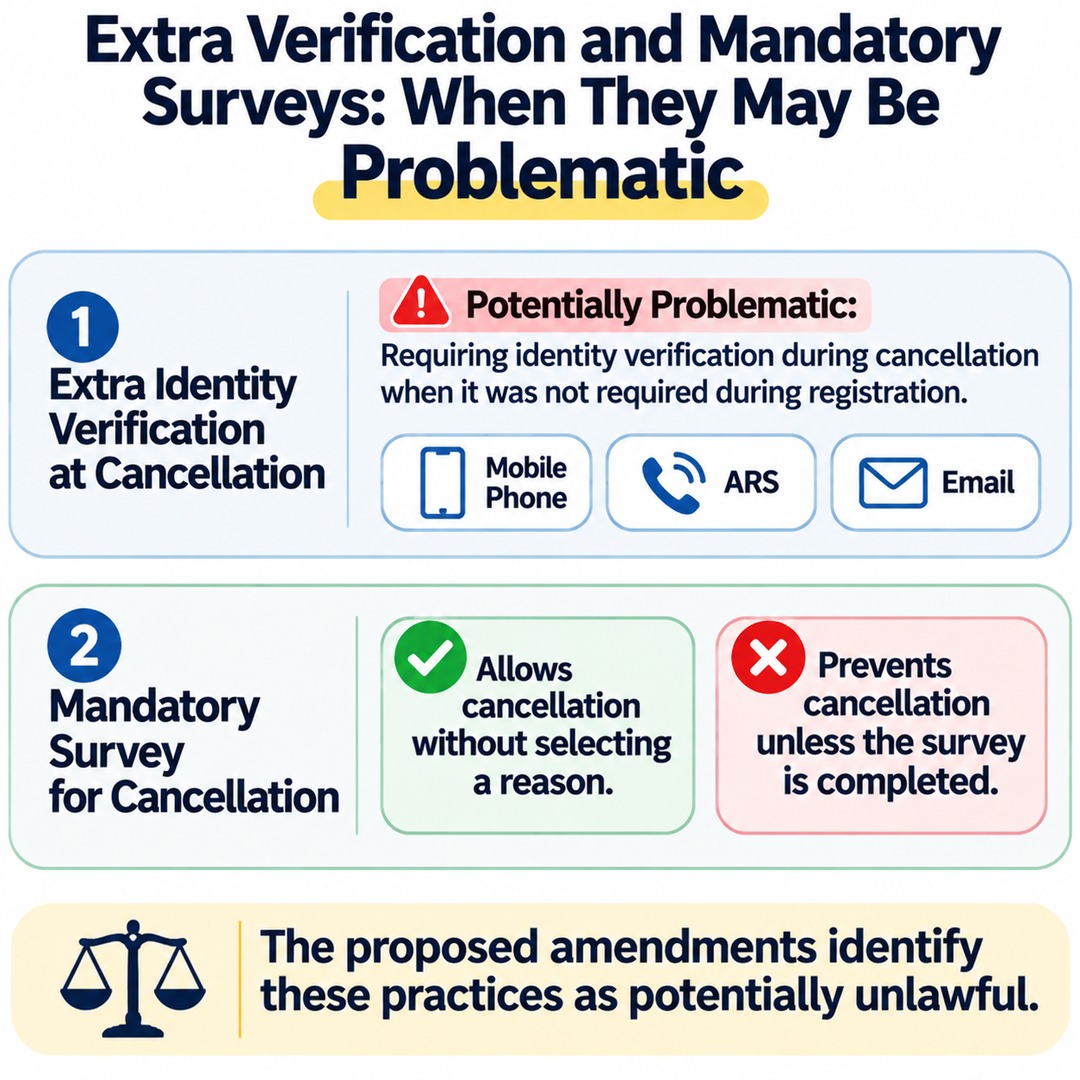
First, requiring identity verification during cancellation when it was not required during registration.
Examples include verification through a mobile phone, automated response service (ARS), or email. The proposed amendments do not suggest that every additional verification step is prohibited. Rather, they address situations in which a business unnecessarily requires verification during cancellation or withdrawal even though it was not required during registration or purchase.
Second, preventing membership cancellation unless the consumer completes a survey.
Asking consumers why they are leaving is different from making survey responses a mandatory condition of cancellation.
A process that allows consumers to continue without selecting a cancellation reason.
A process that prevents cancellation unless consumers complete the survey.
The second approach is specifically identified as a potentially unlawful practice in the proposed amendments.
Businesses may collect feedback to improve their services. However, forcing consumers to answer survey questions regardless of their decision to leave may create legal concerns.
Have the KFTC's Proposed Standards Already Become Final Law?
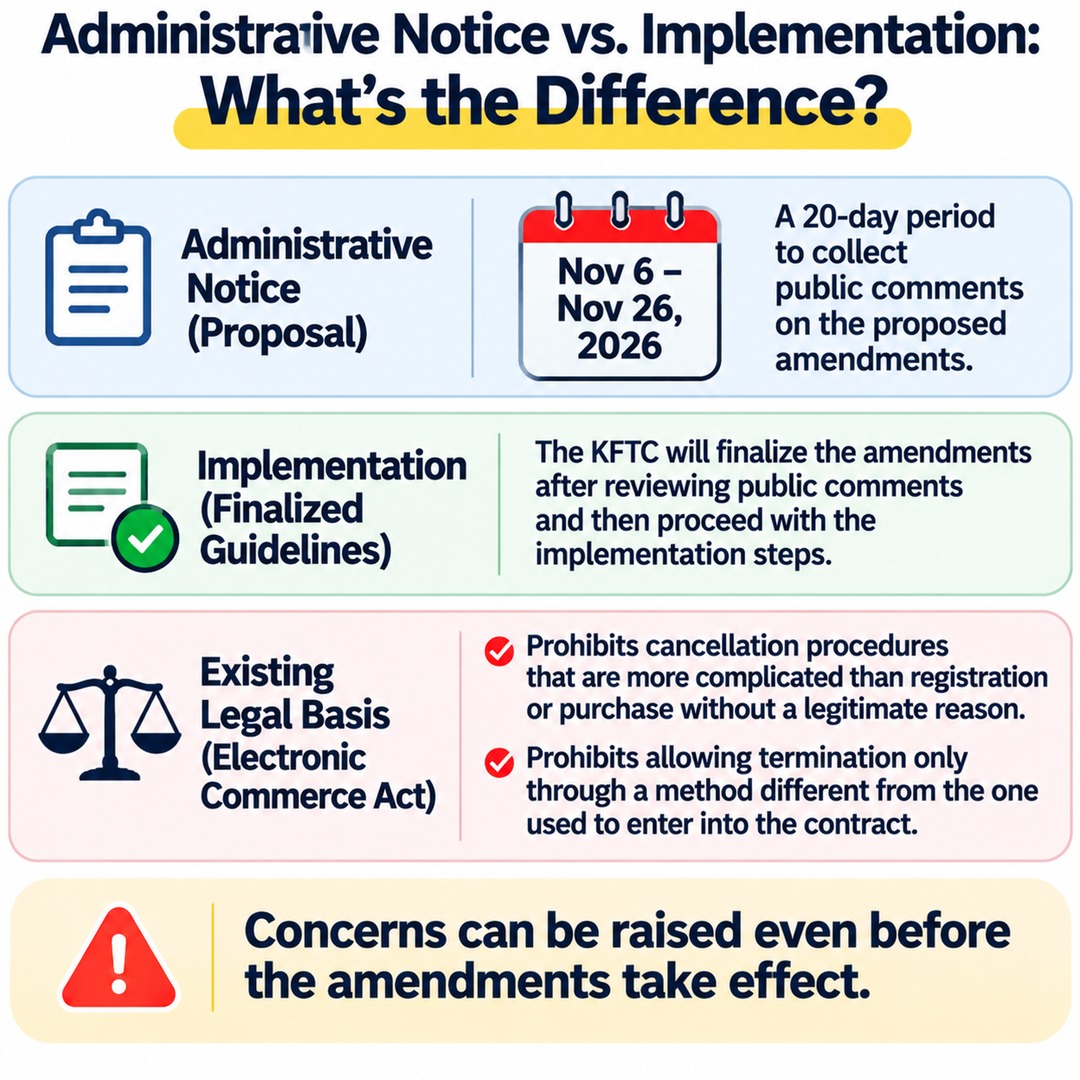
The most important distinction is between an administrative notice and the actual implementation of amended guidelines.the KFTC's proposed amendments to its Consumer Protection Guidelines for Electronic Commerce have not yet been finalized.
The proposal is undergoing a 20-day administrative notice period from November 6 through November 26, 2026. The KFTC has stated that it will finalize the amendments after collecting public comments and then proceed with the subsequent steps required for implementation.
However, this does not mean that obstructing membership cancellation is automatically lawful until the proposed amendments are finalized.
Article 21-2(1)(4) of South Korea's Electronic Commerce Act prohibits businesses from designing cancellation, withdrawal, or termination procedures to be more complicated than the procedures for purchasing, registering, or entering into a contract without a legitimate reason. It also prohibits allowing consumers to terminate a contract only through a method different from the one used to enter into it.
The proposed amendments aim to clarify how these existing legal provisions apply by providing specific examples involving screen layouts, identity verification, and mandatory surveys.
Therefore, consumers do not necessarily have to wait until the proposed amendments take effect before raising concerns. Whether a particular practice actually violates the law, and whether enforcement measures are warranted, depends on the business's conduct, the existence of legitimate reasons, and the circumstances of the specific transaction.
What Should You Do If a Service Prevents You From Canceling Membership?
If you attempt to cancel membership but cannot find the button, or the service demands additional verification or survey responses, start by documenting the screens and the instructions provided by the business.
You can follow these steps:
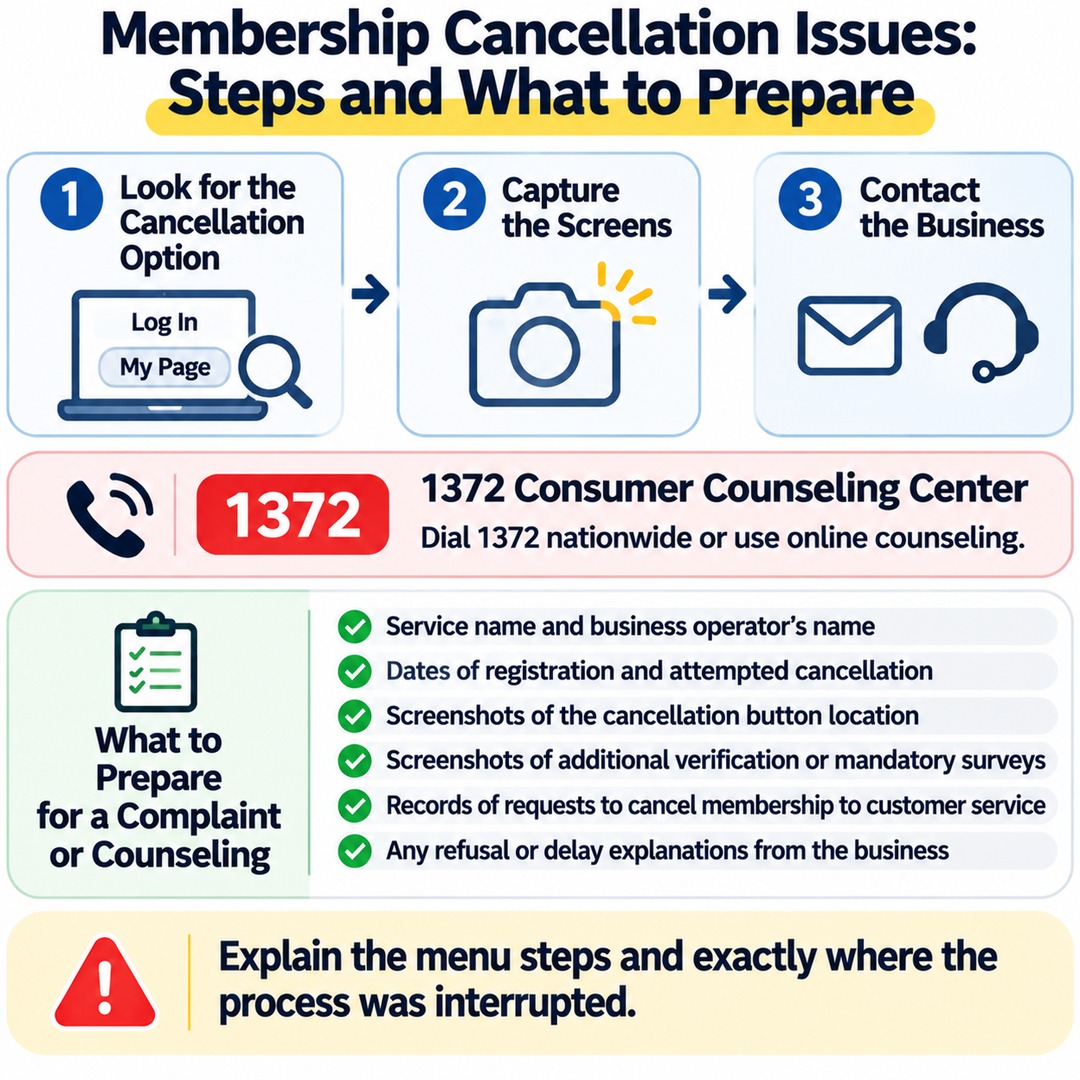
1. Look for the cancellation option: Check the initial login screen and My Page for the membership cancellation function.
2. Capture the screens: Save screenshots showing the absence of a cancellation option, additional verification requirements, or mandatory survey questions.
3. Contact the business: Clearly communicate your intention to cancel membership through a customer service channel, email, or another method that leaves a written record.
4. Keep the response: Save any explanation or response from the business if it refuses cancellation or demands additional procedures.
5. Seek consumer assistance: If the issue remains unresolved, contact the 1372 Consumer Counseling Center.
The 1372 Consumer Counseling Center can be reached nationwide by dialing 1372 without an area code. Online counseling is also available. Cases that cannot be resolved through the initial counseling process may proceed to formal consumer dispute resolution, subject to the applicable requirements.
The following information can be useful when preparing a complaint or requesting counseling:
The service name and business operator's name.
The dates of registration and attempted cancellation.
Screenshots showing where the cancellation button is located, if available.
Screenshots of additional identity verification or mandatory survey requirements.
Records of requests to cancel membership submitted to customer service.
Any refusal or delay explanations provided by the business.
Rather than simply stating that the cancellation button was difficult to find, explain how many menu levels you had to navigate and exactly where the process was interrupted. This makes it easier to assess the situation during consumer counseling.
Do the Same Rules Apply to Every Online Service and OTT Platform?
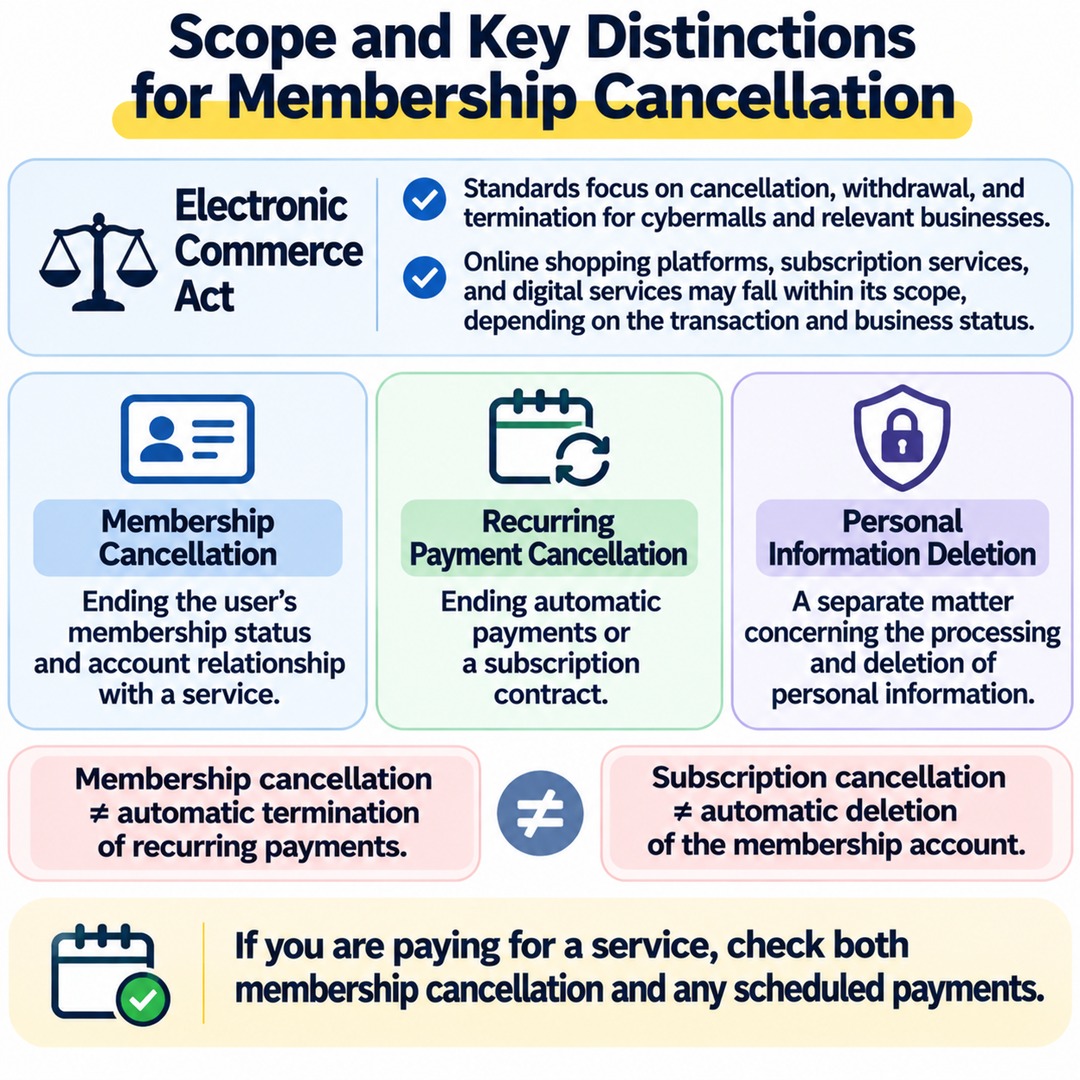
The first question is whether the service falls within the scope of South Korea's Electronic Commerce Act. The standards presented by the KFTC focus on cancellation, withdrawal, and termination procedures involving cybermalls and relevant business operators subject to that Act.
Online shopping platforms, subscription services, and digital services may also fall within its scope, depending on the actual transaction structure and the legal status of the business operator. However, the same legal assessment does not automatically apply to every account deletion process on every app or website.
Membership cancellation and recurring payment termination must also be considered separately.
Membership cancellation: Ending the user's membership status and account relationship with a service.
Recurring payment cancellation: Ending automatic payments or a subscription contract.
Personal information deletion: A separate matter concerning the processing and deletion of personal information held by the business.
Completing membership cancellation does not necessarily mean that all recurring payments have also been terminated. Conversely, canceling a subscription payment does not automatically mean that the membership account itself has been deleted.
If you are paying for a service, it is safest to check both whether membership cancellation has been completed and whether another payment is scheduled.
Frequently Asked Questions
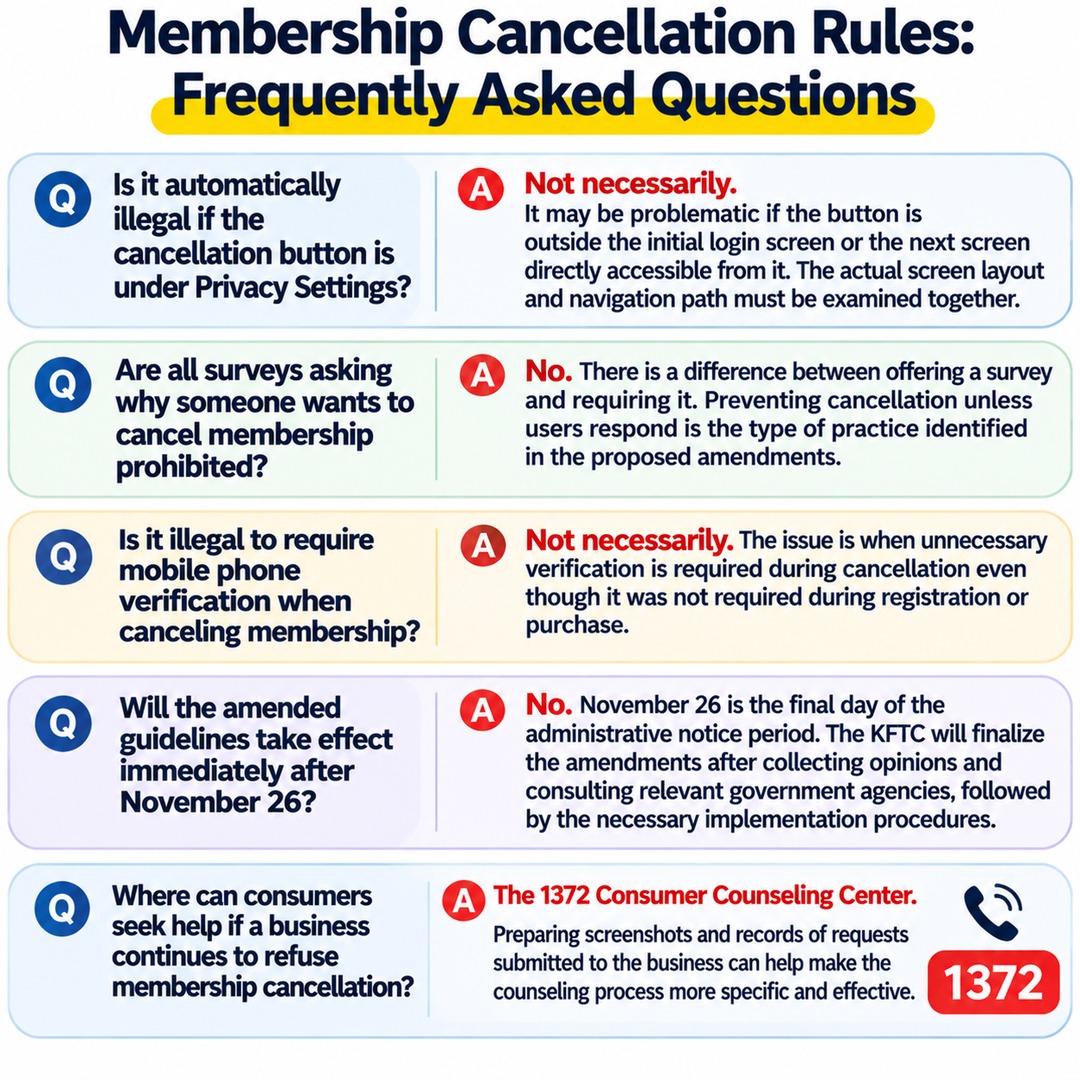
Q. Is it automatically illegal if the membership cancellation button is located under Privacy Settings?
Not necessarily. The proposed amendments identify placing the cancellation button outside the initial login screen or the next screen directly accessible from it as a specific example of a potentially unlawful practice. The actual screen layout and navigation path must be examined together.
Q. Are all surveys asking why someone wants to cancel membership prohibited?
No. There is a difference between offering a survey and requiring consumers to complete it. Preventing users from proceeding with cancellation unless they respond is the type of practice identified in the proposed amendments.
Q. Is it illegal to require mobile phone verification when canceling membership?
The mere presence of additional verification does not establish a violation. The proposed amendments identify unnecessary verification requirements during cancellation when the same verification was not required during registration or purchase as a potentially problematic practice.
Q. Will the amended guidelines take effect immediately after November 26?
No. November 26 is the final day of the administrative notice period for submitting comments. The KFTC has stated that it will finalize the amendments after collecting opinions and consulting relevant government agencies, followed by the necessary implementation procedures.
Q. Where can consumers seek help if a business continues to refuse membership cancellation?
Consumers can contact the 1372 Consumer Counseling Center. Preparing screenshots and records of requests submitted to the business can help make the counseling process more specific and effective.