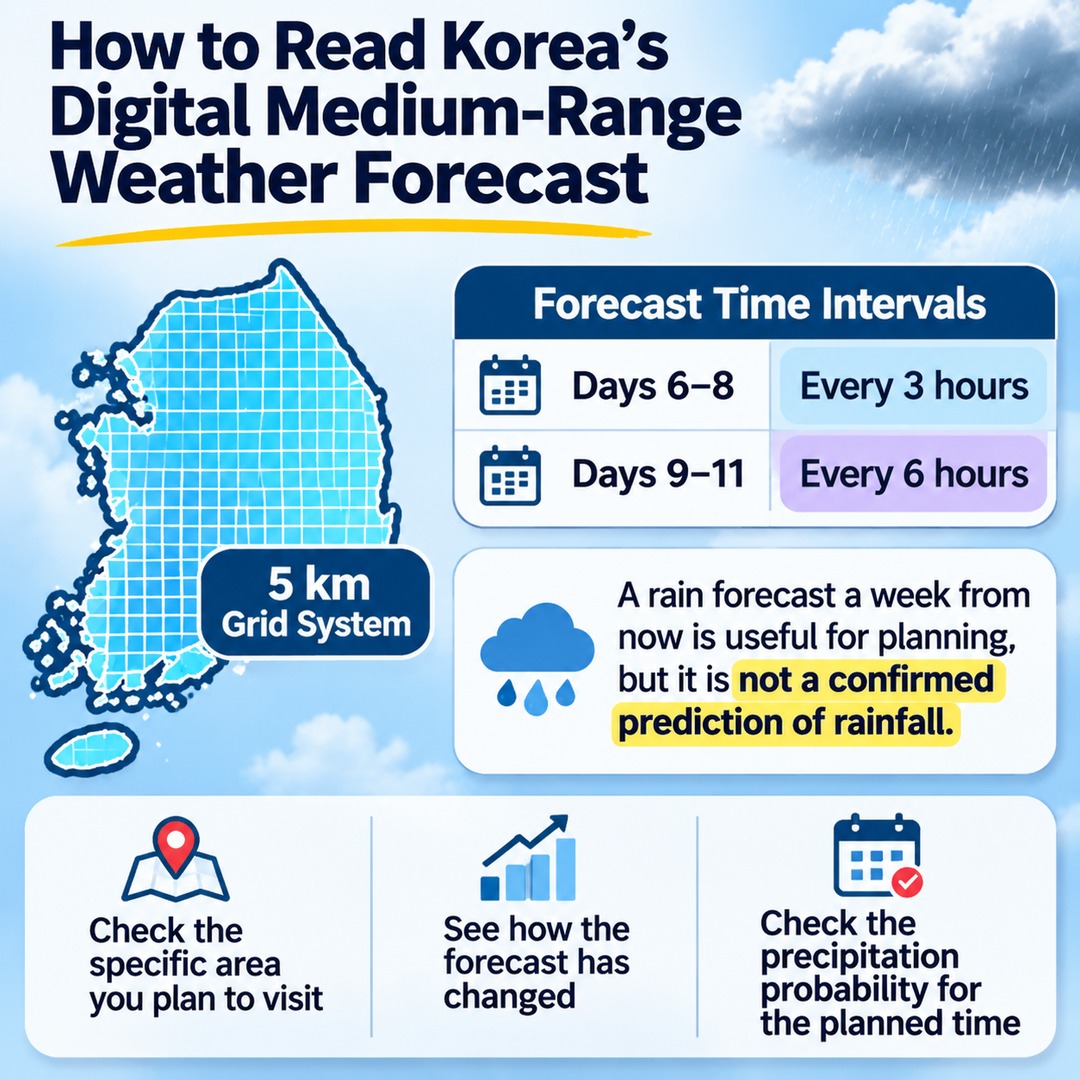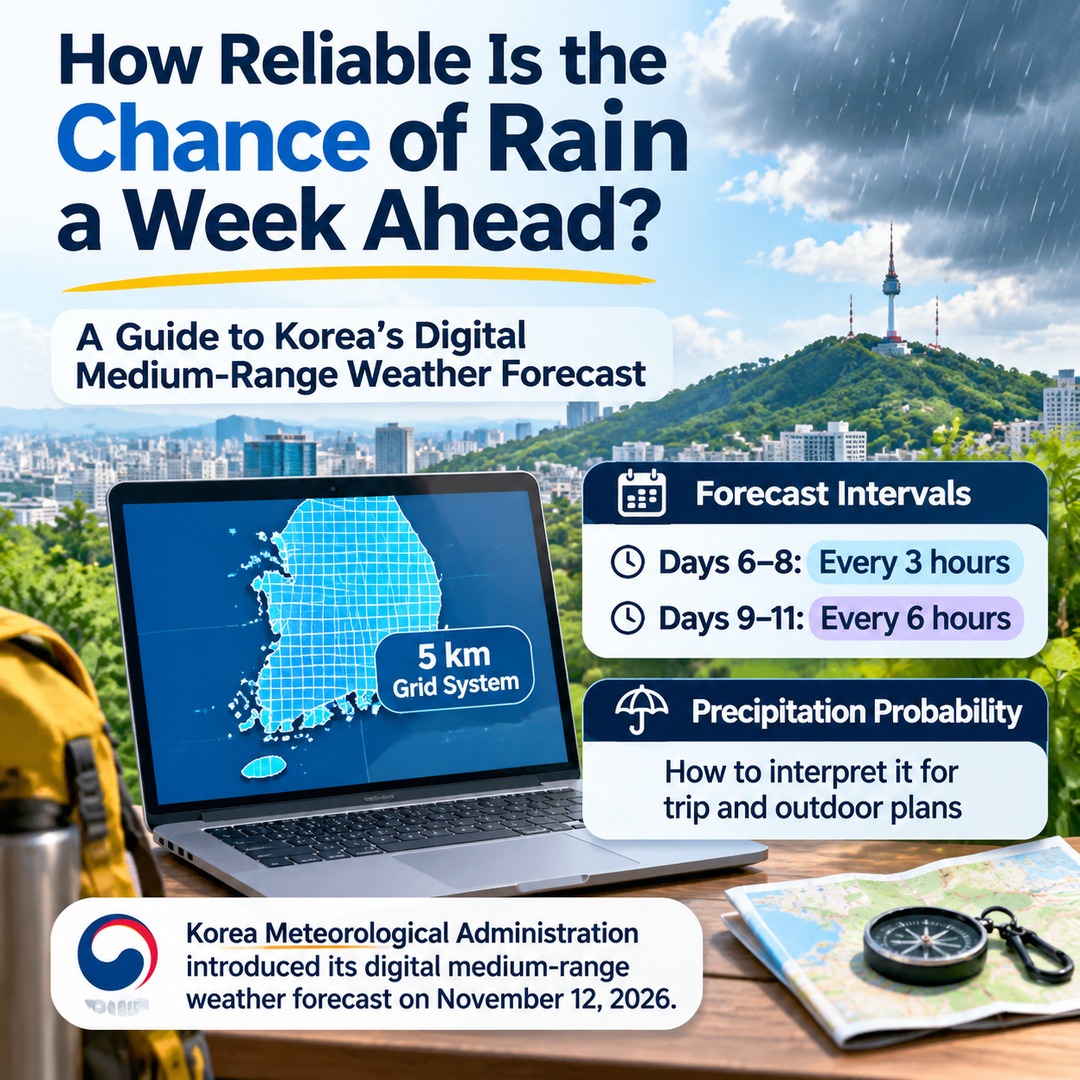
A rain forecast for a week from now is useful when planning an outing or trip, but it should not be treated as a confirmed prediction of rainfall. On November 12, 2026, the Korea Meteorological Administration (KMA) fully implemented its digital medium-range weather forecast based on a 5 km grid system. This allows users to examine regional precipitation probabilities and changes throughout the day in greater detail than before.
The key improvement is that users can now look beyond a simple indication that rain is expected. They can examine how likely rainfall is in the specific area they plan to visit and how the forecast has changed compared with the previous day.
How Detailed Can a Weather Forecast Be a Week Ahead?
The KMA's digital medium-range forecast divides forecast areas into 5 km grid cells and provides time intervals of 3 to 6 hours, depending on the forecast period.
Previously, forecasts primarily provided information by province or metropolitan area, divided into morning and afternoon periods or entire days. The new service makes it possible to examine precipitation probabilities in greater detail according to location and time.
One important point is that the time intervals differ depending on how far ahead the forecast extends.
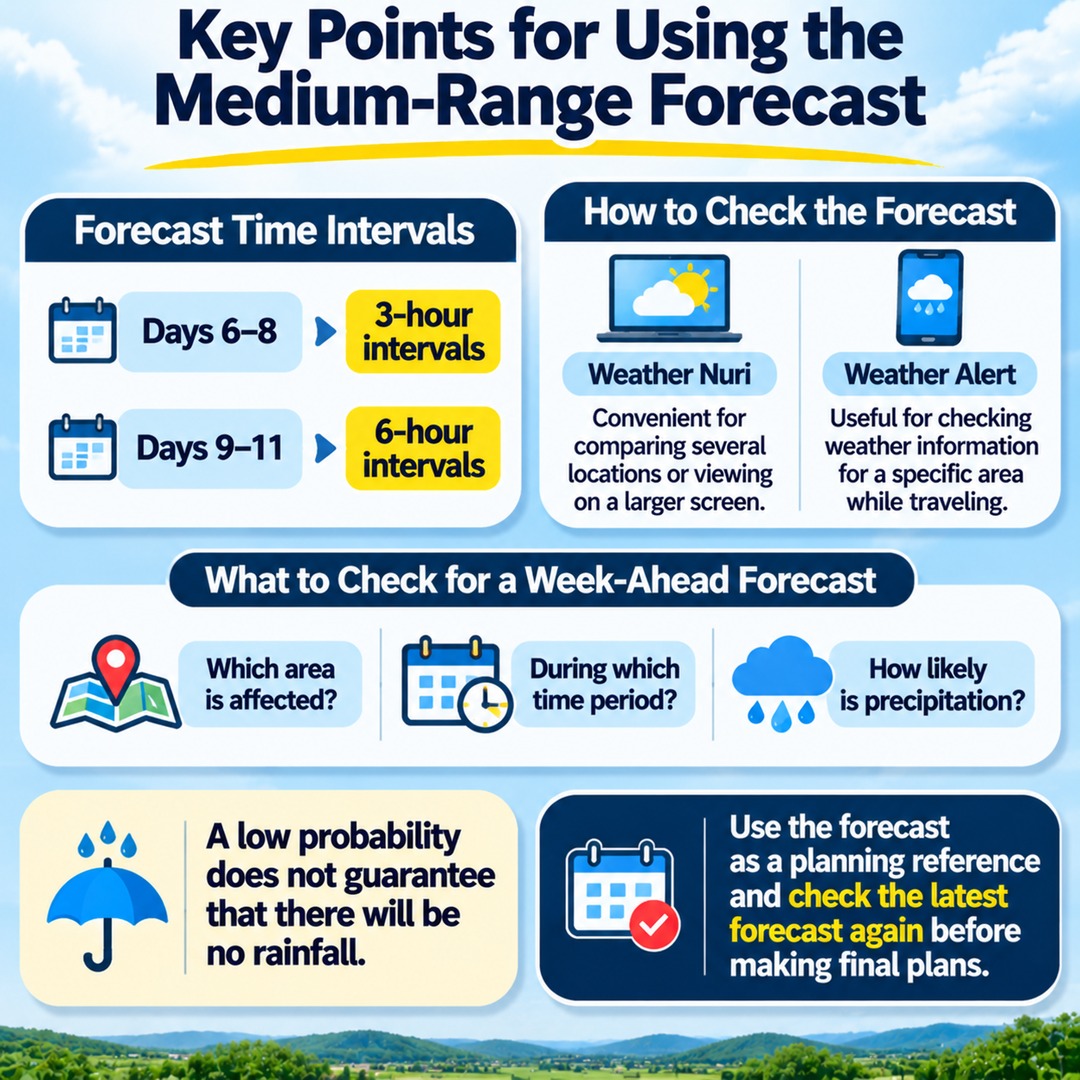
Days 6–8: Forecasts at 3-hour intervals
Days 9–11: Forecasts at 6-hour intervals
For example, if you have an outdoor event scheduled for a week from now, it is more useful to check the precipitation probability for the event's specific location and scheduled time than to judge the entire day based on a single rain forecast.
How Is Precipitation Probability Different from Rainfall Duration or Amount?
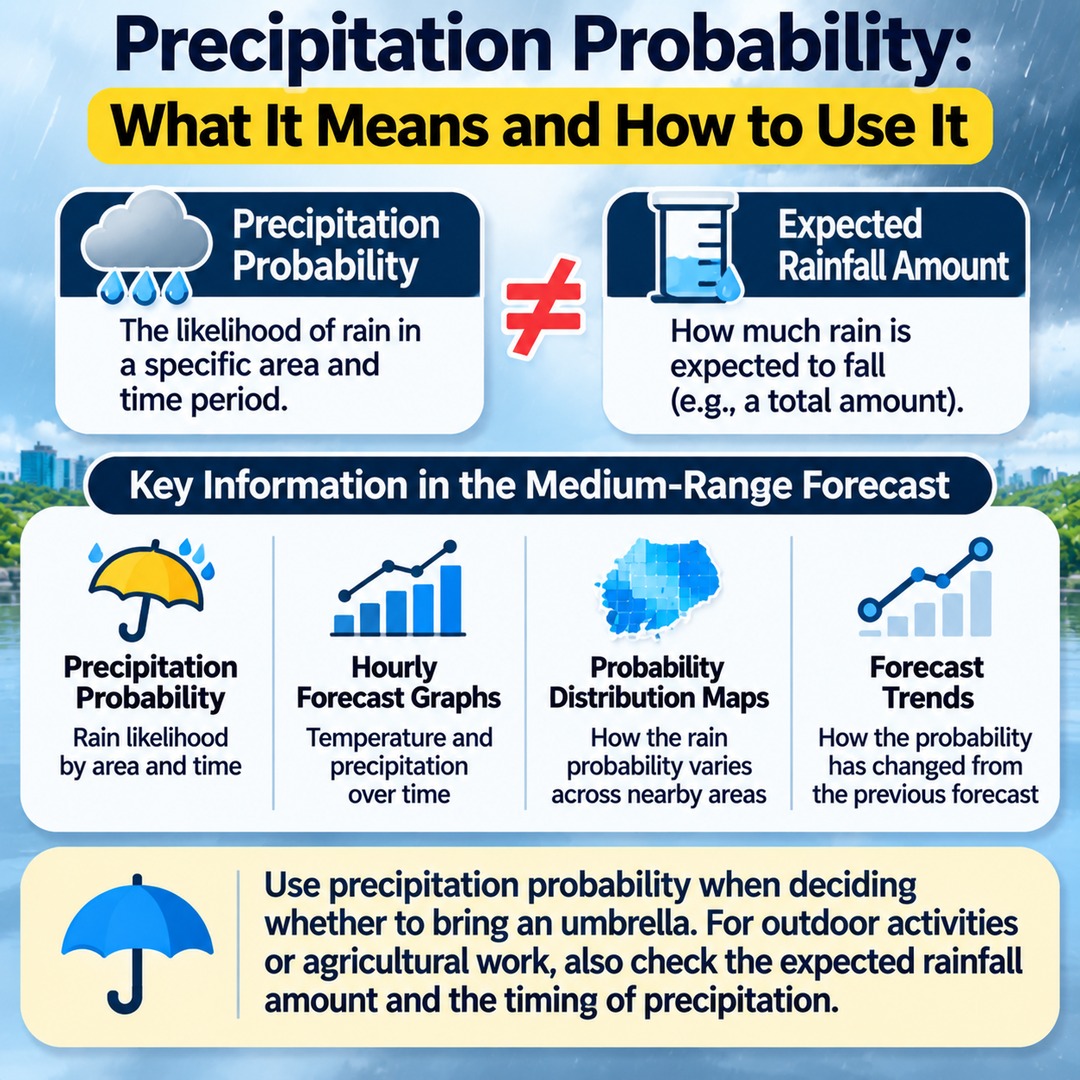
Precipitation probability indicates the likelihood of rain occurring in a particular area during a specified time period. It does not directly tell you how many hours it will rain or how much rainfall will accumulate.
Confusing these two types of information can lead to incorrect interpretations of a forecast.
For example, a high precipitation probability for the afternoon does not mean that heavy rain will continue throughout the entire afternoon. Conversely, a low probability does not guarantee that no rain will occur.
With the new medium-range forecast, it is helpful to distinguish between the following types of information:
Precipitation probability: The likelihood of rain in the selected area and time period.
Hourly forecast graphs: Predicted temperature and precipitation-related information over time.
Precipitation probability distribution maps: How precipitation probabilities vary across surrounding areas.
Forecast trends: How precipitation probabilities have changed compared with the previous forecast.
In particular, precipitation probability and expected rainfall amount are not the same thing. When deciding whether to bring an umbrella, precipitation probability is useful. However, when making decisions about outdoor activities or agricultural work, you should also consider other weather information, including expected rainfall amounts and the timing of precipitation.
Where Can You Check the KMA Digital Medium-Range Forecast?
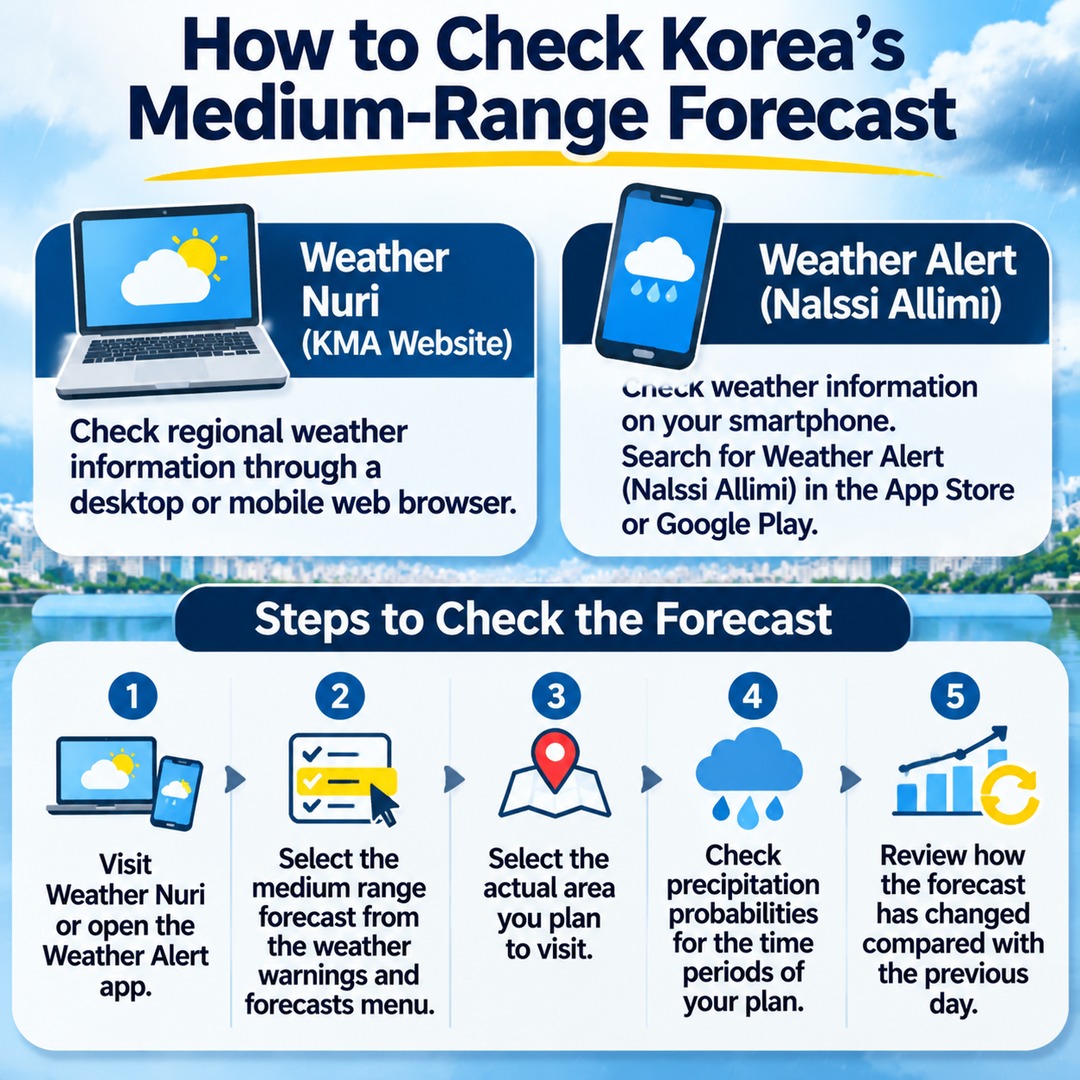
You can access the medium-range forecast through the Korea Meteorological Administration's Weather Nuri website or its official Weather Alert (Nalssi Allimi) app. No separate paid subscription or special application process is required to use the KMA's weather services.
KMA Weather Nuri
Check regional weather information through a desktop or mobile web browser.
Weather Nuri website
Weather Alert (Nalssi Allimi)
Check weather information on your smartphone.
Search for Weather Alert (Nalssi Allimi) in the App Store or Google Play.
Follow these steps:
1. Visit Weather Nuri or open the Weather Alert app.
2. Select the medium-range forecast from the weather warnings and forecasts menu.
3. Select the actual area you plan to visit rather than relying only on nationwide information.
4. Check precipitation probabilities for the time periods corresponding to your planned visit.
5. Also review how the forecast has changed compared with the previous day.
What Should You Check When the Forecast Changes from One Day to the Next?
If the rain forecast changes within a day, do not look only at the currently displayed result. It is also helpful to examine the direction of change in precipitation probability.
The forecast trend information included in the KMA's new service can help you understand how the forecast has changed compared with the previous day.
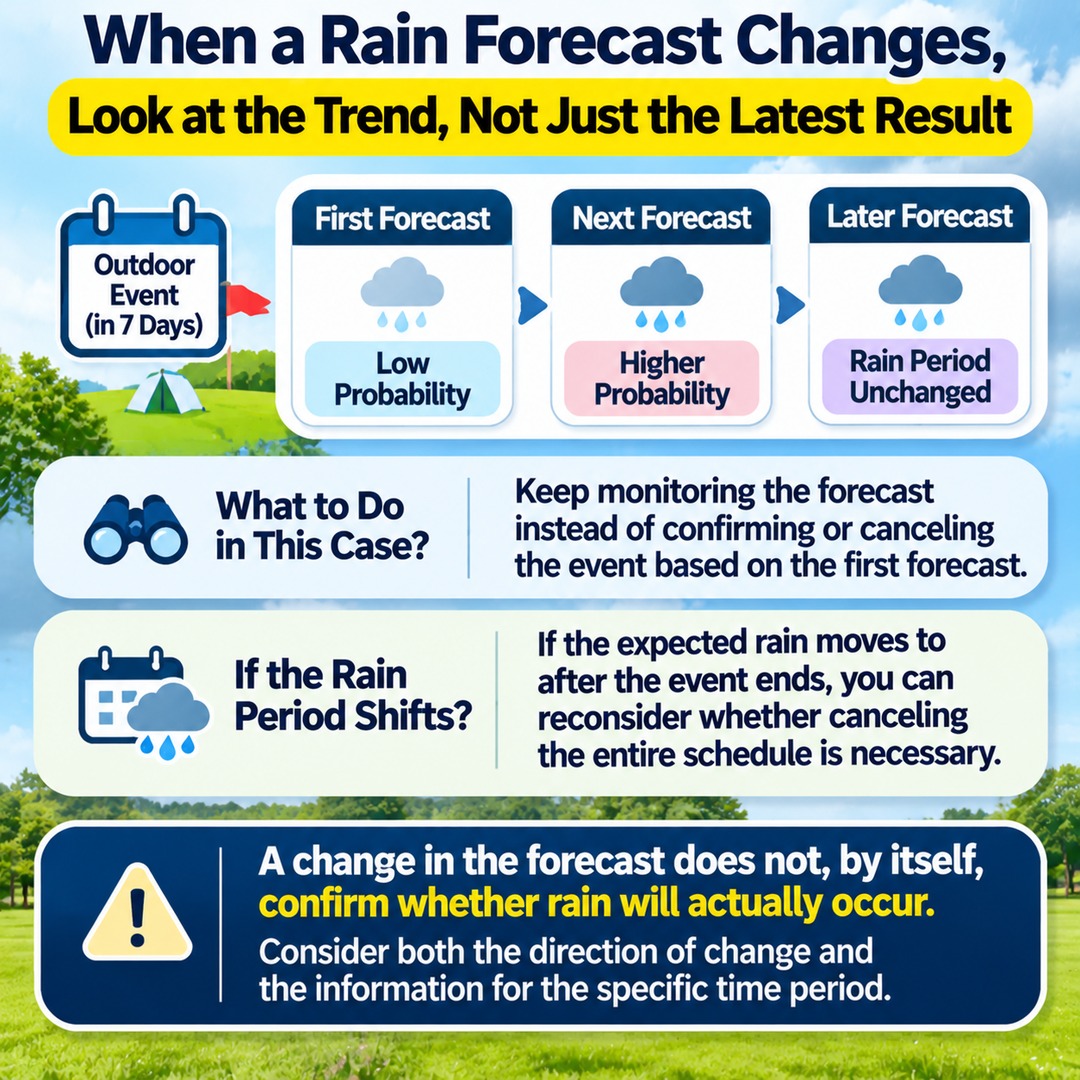
Consider an outdoor event scheduled for seven days from now:
In the first forecast, the precipitation probability during the event was low.
In the next forecast, the probability for the same time period increased.
In subsequent forecasts, the expected rainfall period remained unchanged.
In this situation, it would be more reasonable to keep monitoring the forecast rather than confirming the event based solely on the first announcement.
Conversely, if the period when rain is expected shifts to after the event ends, you can reconsider whether canceling the entire schedule is necessary.
The important point is that a change in the forecast does not, by itself, confirm whether rain will actually occur. You should consider both the direction of change and the information for the specific time period.
When Should You Make Decisions About a Trip or Outdoor Event a Week Ahead?
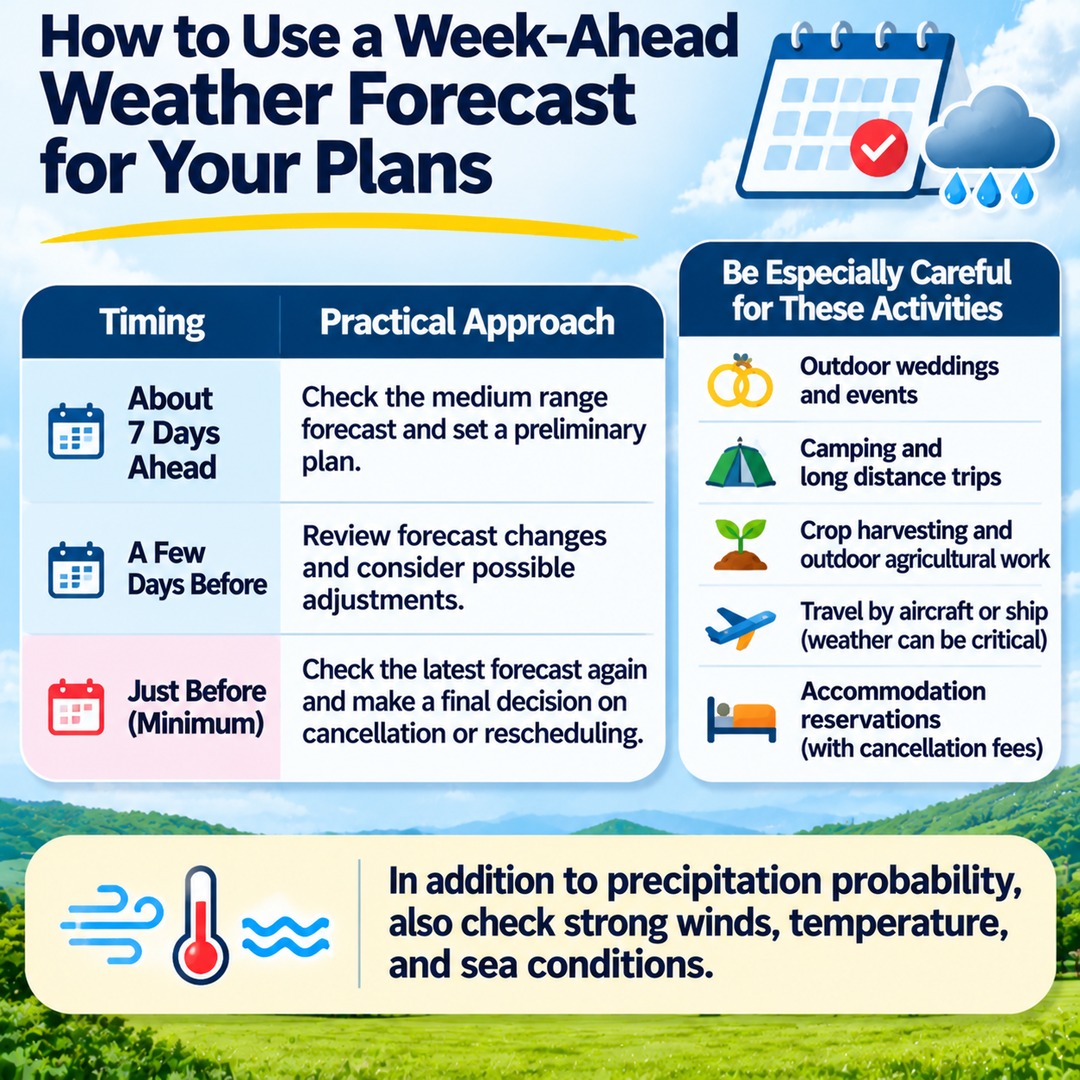
Use a forecast for a week ahead to plan your schedule in advance. For actual cancellation or rescheduling decisions, check the latest forecast again as the date approaches.
| Planning stage | What to check |
|---|---|
| 7–11 days before | Check precipitation probabilities for the destination and planned dates. |
| 3–6 days before | Review forecast changes and recheck precipitation information for specific time periods. |
| The day before | Check the short-range forecast and expected rainfall timing. |
| On the day | Check the latest forecast and weather warnings. |
This table provides a practical approach to schedule management using weather forecasts. It is not an official KMA standard for forecast accuracy or a mandatory schedule for checking forecasts.
You should be particularly careful about making decisions based on a single medium-range forecast for activities such as:
Outdoor weddings and events
Camping and long-distance trips
Crop harvesting and outdoor agricultural work
Travel by aircraft or ship, where weather conditions can be especially important
Accommodation reservations that involve cancellation fees
In addition to precipitation probability, check other factors that may affect your plans, including strong winds, temperature, and sea conditions.
Does a 5 km Grid Forecast Mean the Weather Is Accurate Down to Your Neighborhood?
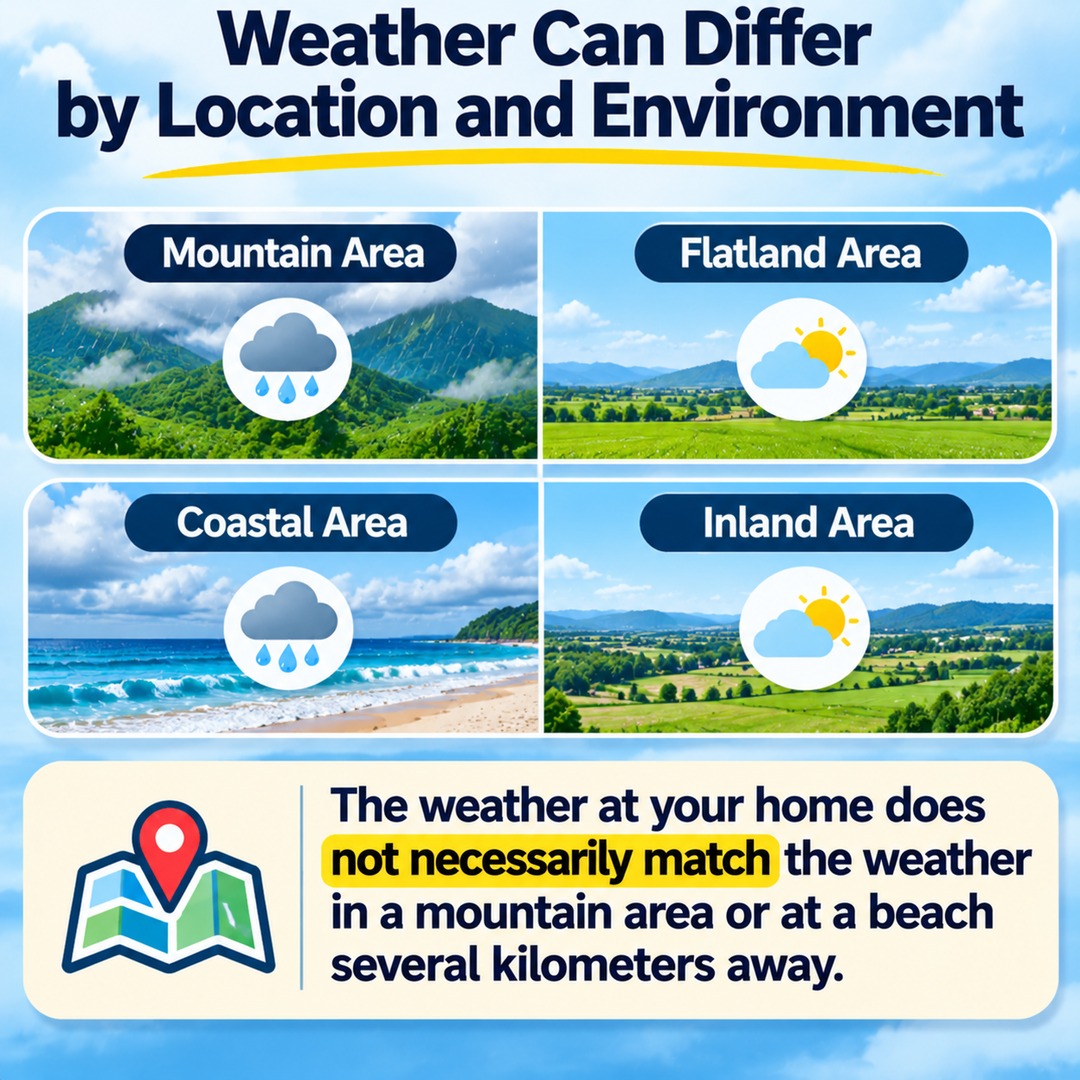
Actual weather can differ between locations with different surrounding terrain and environments, such as mountains and flatlands or coastal and inland areas.
Therefore, checking the forecast near your home does not mean that the weather will be the same in a mountain area or at a beach several kilometers away.
Frequently Asked Questions
If the Chance of Rain Is Low a Week Ahead, Can I Leave My Umbrella at Home?
A low probability does not guarantee that there will be no rainfall. If you will be outdoors for an extended period or have an important outdoor schedule, check the latest forecast again before leaving.
Why Are Days 9–11 Forecasts Provided in 6-Hour Intervals?
The KMA's digital medium-range forecast uses different time intervals depending on how far ahead the forecast extends. Days 6–8 are covered in 3-hour intervals, while days 9–11 are covered in 6-hour intervals.
What Is the Biggest Difference Between the New and Previous Medium-Range Forecasts?
Should I Use Weather Nuri or the Weather Alert App?
Weather Nuri is convenient if you want to compare several locations on a desktop or view information on a larger screen. If you need to check weather information for a specific area while traveling, you can use the Weather Alert app.
When checking the weather a week ahead, the important thing is not simply whether rain is indicated. You should examine which area is affected, during which time period, and how likely precipitation is.
The KMA's digital medium-range forecast provides more detailed information to support these decisions. However, forecasts for dates further in the future should be treated as planning references. For important decisions, check the latest forecast before making your final arrangements.