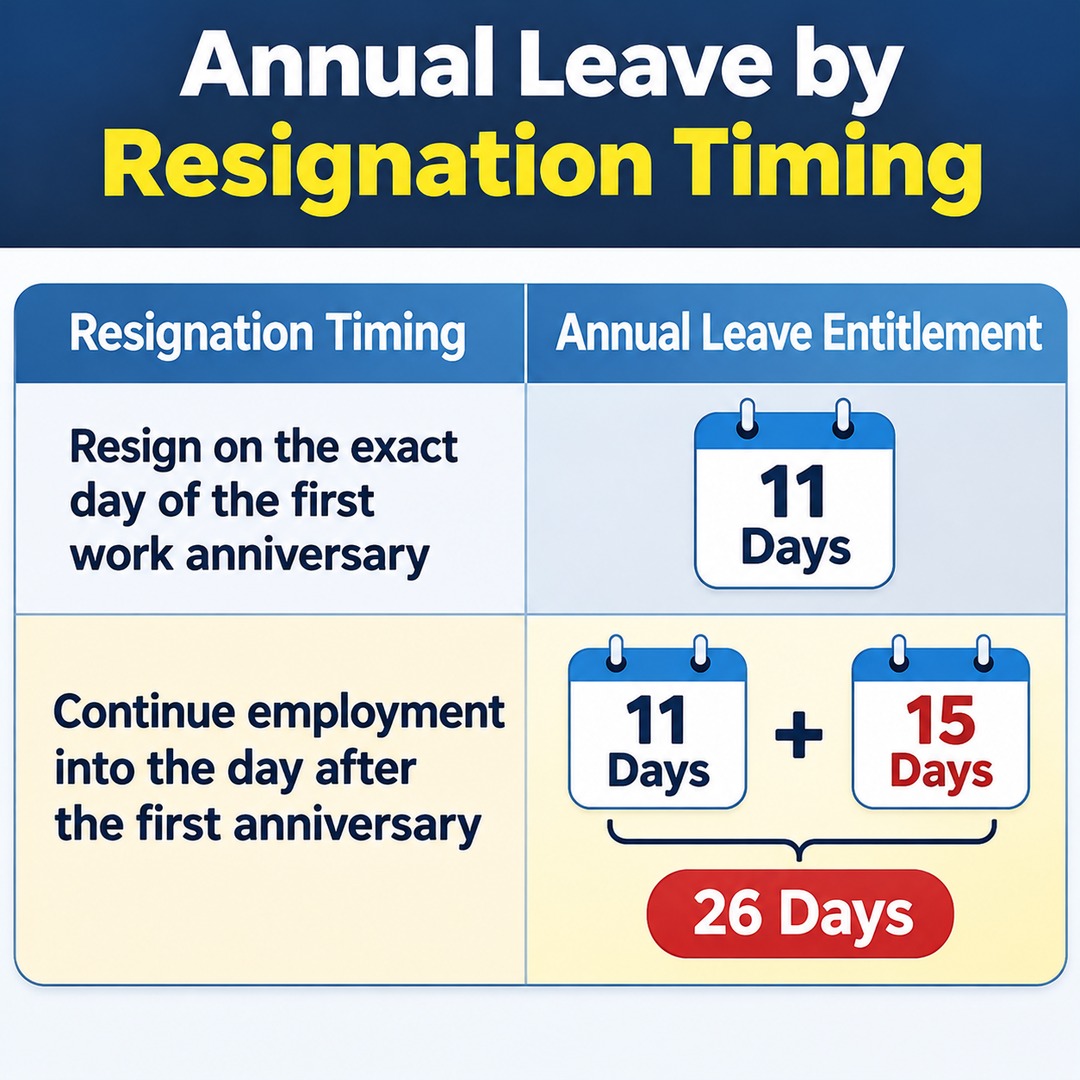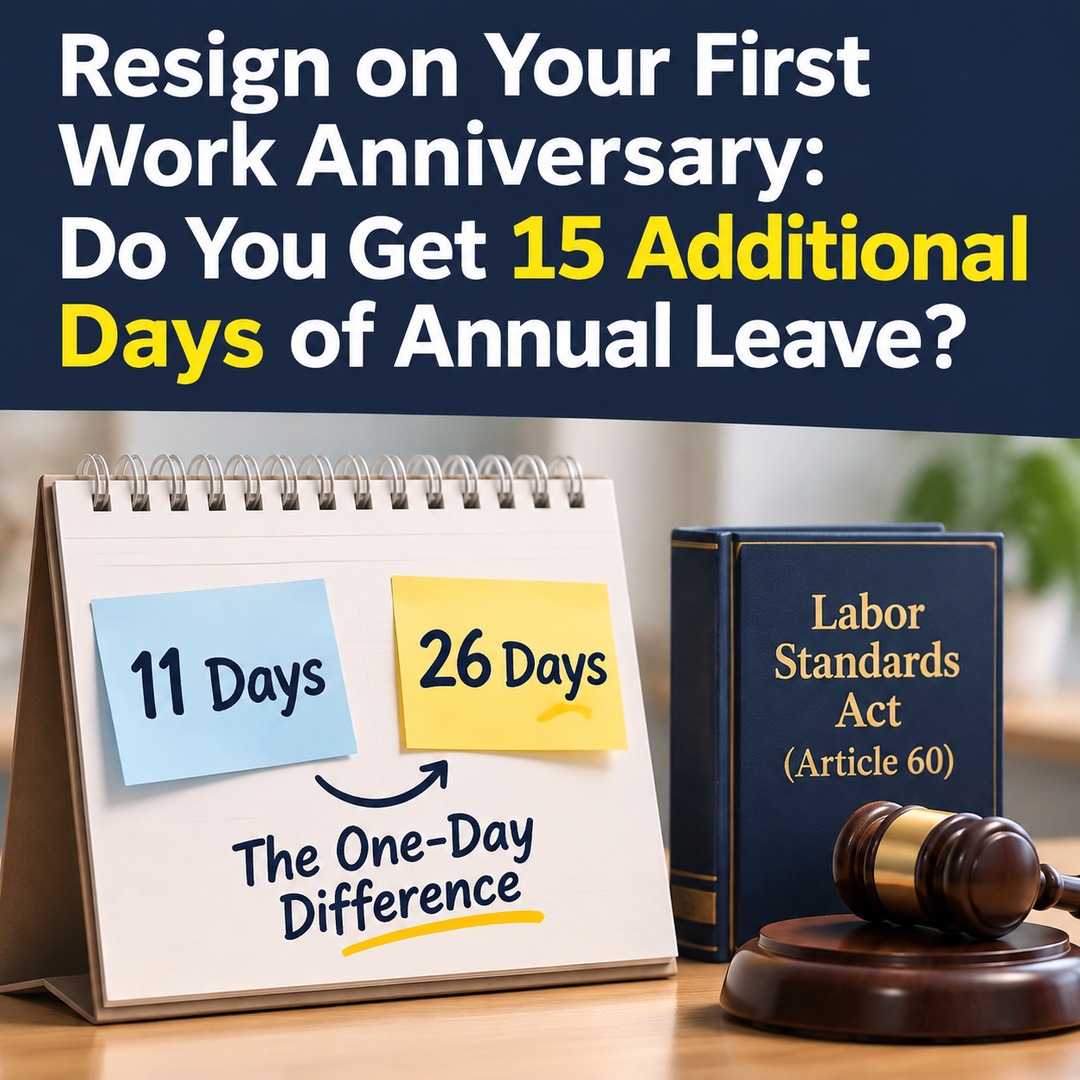
As a general rule, an employee who resigns after completing exactly one year of service does not receive an additional 15 days of annual paid leave. This is separate from the maximum of 11 days earned during the first year by completing each monthly service requirement. However, if the employment relationship continues into the day after the first year of service is completed, an additional 15 days are granted if the employee meets the attendance requirement of at least 80%, bringing the total to as many as 26 days.
When deciding on a resignation date, the first work anniversary is not the only important date. The key factor determining annual leave entitlement is whether the employment contract remains in effect through the day after the first year of service has been completed.
Why Employees Who Work Exactly One Year Do Not Receive an Additional 15 Days
Article 60 of South Korea’s Labor Standards Act provides for annual paid leave under two separate rules:
Less than one year of continuous service: One day of paid leave for each month in which the employee has perfect attendance.
At least 80% attendance over one year: 15 days of paid annual leave.
Under the first rule, an employee who has perfect attendance every month during the first year can earn up to 11 days. The additional 15 days under the second rule accrue on the day after the first year of service has been completed.
This distinction is important. The additional 15 days do not arise retroactively just because an employee has completed one year of service. The employment relationship must continue into the following day for the additional entitlement to arise.
Therefore, if a one-year fixed-term employment contract expires on its final day, or the employment relationship ends immediately after exactly one year of service, the employee is generally entitled only to the maximum of 11 days of annual leave earned during the first year.
How One Day Can Make the Difference Between 11 and 26 Days of Annual Leave
The difference depends on whether the employment relationship continues beyond the final day of the first year of service.
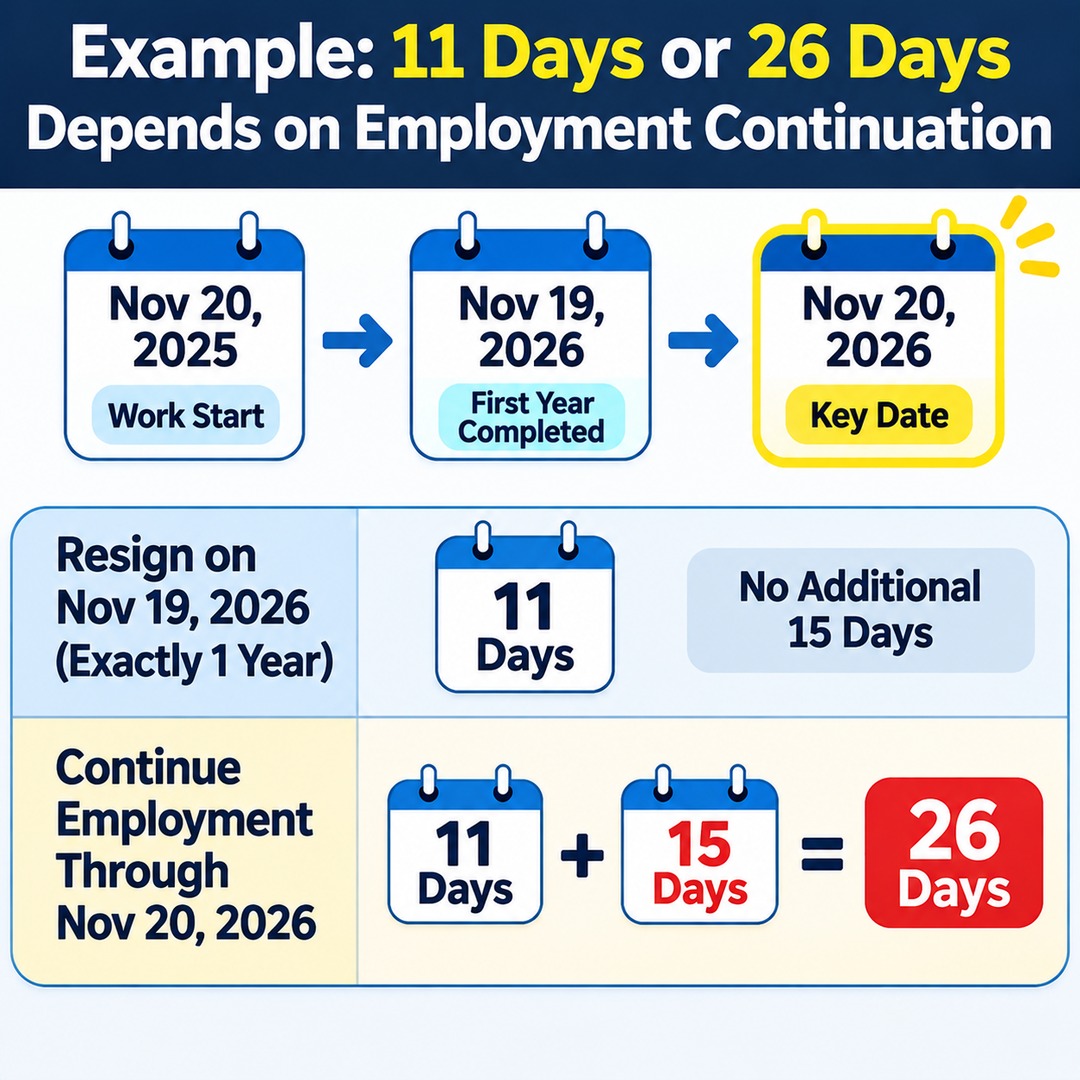
For example, suppose an employee started work on November 20, 2025. The first year of service is completed on November 19, 2026. The outcome depends on whether the employment relationship remains in effect through November 20.
| Situation | When the employment relationship ends | Annual leave entitlement |
|---|---|---|
| Exactly one year of service | Ends on November 19, 2026 | Up to 11 days |
| More than one year of service | Continues through November 20, 2026 | Up to 26 days |
This example assumes that the employee has at least 80% attendance during the first year, has perfect attendance in each qualifying month, and works at a business covered by the statutory annual leave provisions.
The total of 26 days consists of:
Annual leave earned through perfect monthly attendance during the first year: up to 11 days
Additional annual leave granted on the day after completing the first year of service: 15 days
Total: 26 days
Calculation: 11 days + 15 days = 26 days.
This distinction is not merely the result of an administrative date-counting convention. In its ruling dated October 14, 2021, case No. 2021Da227100, the Supreme Court of South Korea held that an employee whose one-year fixed-term employment contract expires is entitled to a maximum of 11 days of annual leave.
Subsequently, in its statutory interpretation dated July 9, 2024, the Ministry of Government Legislation explained that if the employment relationship continues into the day after the first year of service has been completed and the attendance requirement is met, the employee must receive an additional 15 days, separate from the original 11 days.
Taken together, these decisions clarify the difference between completing exactly one year of service and remaining employed beyond the first year.
Must You Actually Report to Work the Following Day to Receive the Additional 15 Days?
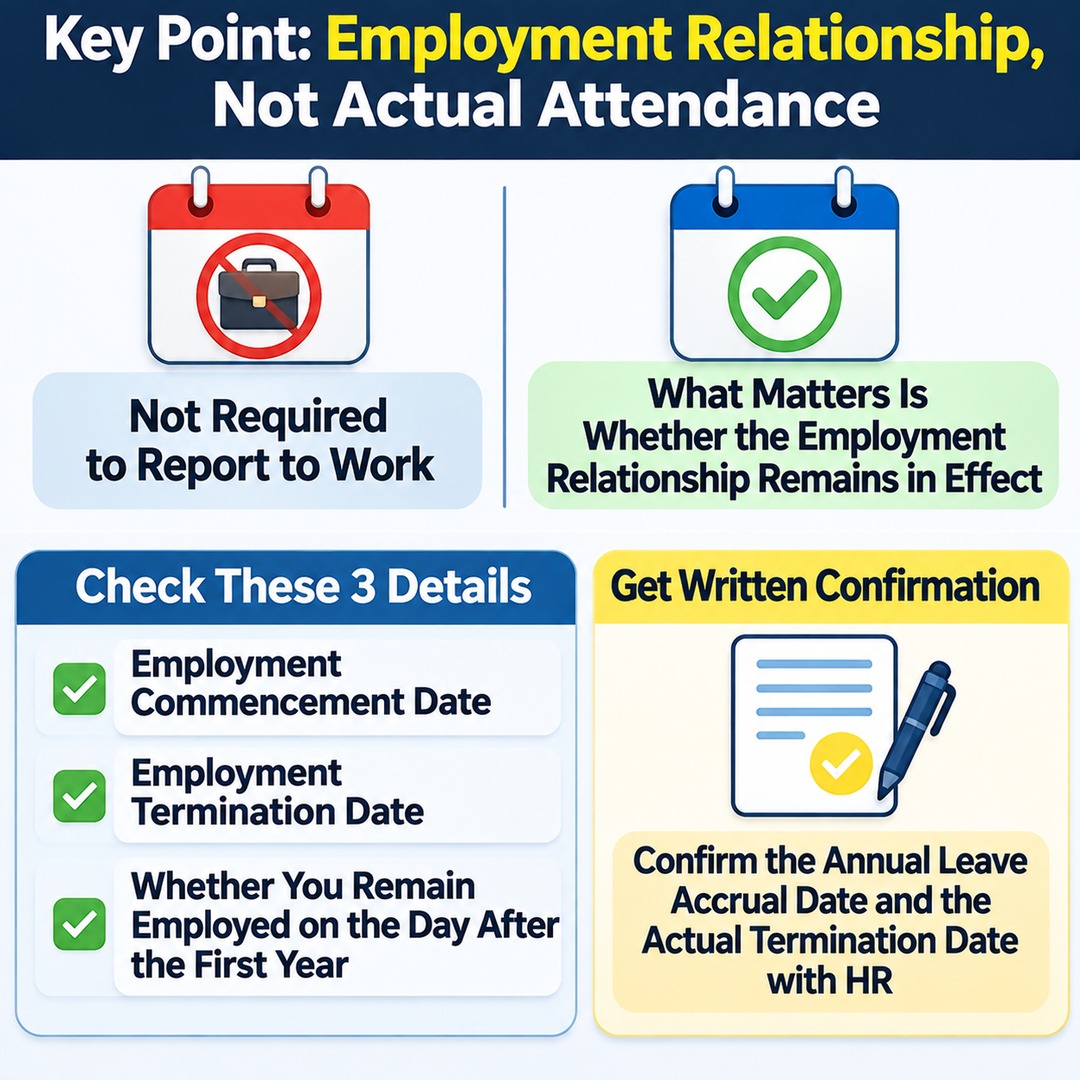
No. Actually reporting to work is not necessarily required. What matters is whether the employment relationship remains in effect, not whether the employee physically attends work that day.
For example, even if the day after the first year of service falls on a weekend or public holiday, the relevant question is whether the employment contract remains in effect on that day.
However, pay attention to the following situations:
The final day of the one-year employment period is designated as the contract expiration date.
The employee's employment relationship ends on the day the first year of service is completed.
The employee submits a resignation letter specifying the final day of the first year of service as the effective termination date.
The date on which an employee communicates an intention to resign may differ from the actual date on which the employment relationship ends. You should not determine annual leave entitlement solely by looking at the date the resignation letter was submitted.
There are three key details to check:
1. The employment commencement date stated in the employment contract.
2. The employment termination date specified in the resignation letter or employment contract.
3. Whether the employee remains employed on the day after completing the first year of service.
If you are considering moving your resignation date by one day, it is safer to obtain written confirmation from your HR department of both the annual leave accrual date and the actual employment termination date.
Even If You Accrue 26 Days of Annual Leave, You Are Not Automatically Entitled to Payment for All 26 Days
The number of annual leave days accrued and the unused annual leave payment due upon resignation are two different things.
Accruing 26 days means that you may have up to 26 days of annual leave available. If you have already used some of those days, the remaining unused balance to be settled when you leave will be lower.
For example, if you have not used any of the 11 days accrued during the first year and have also used none of the additional 15 days, your maximum unused balance is 26 days.
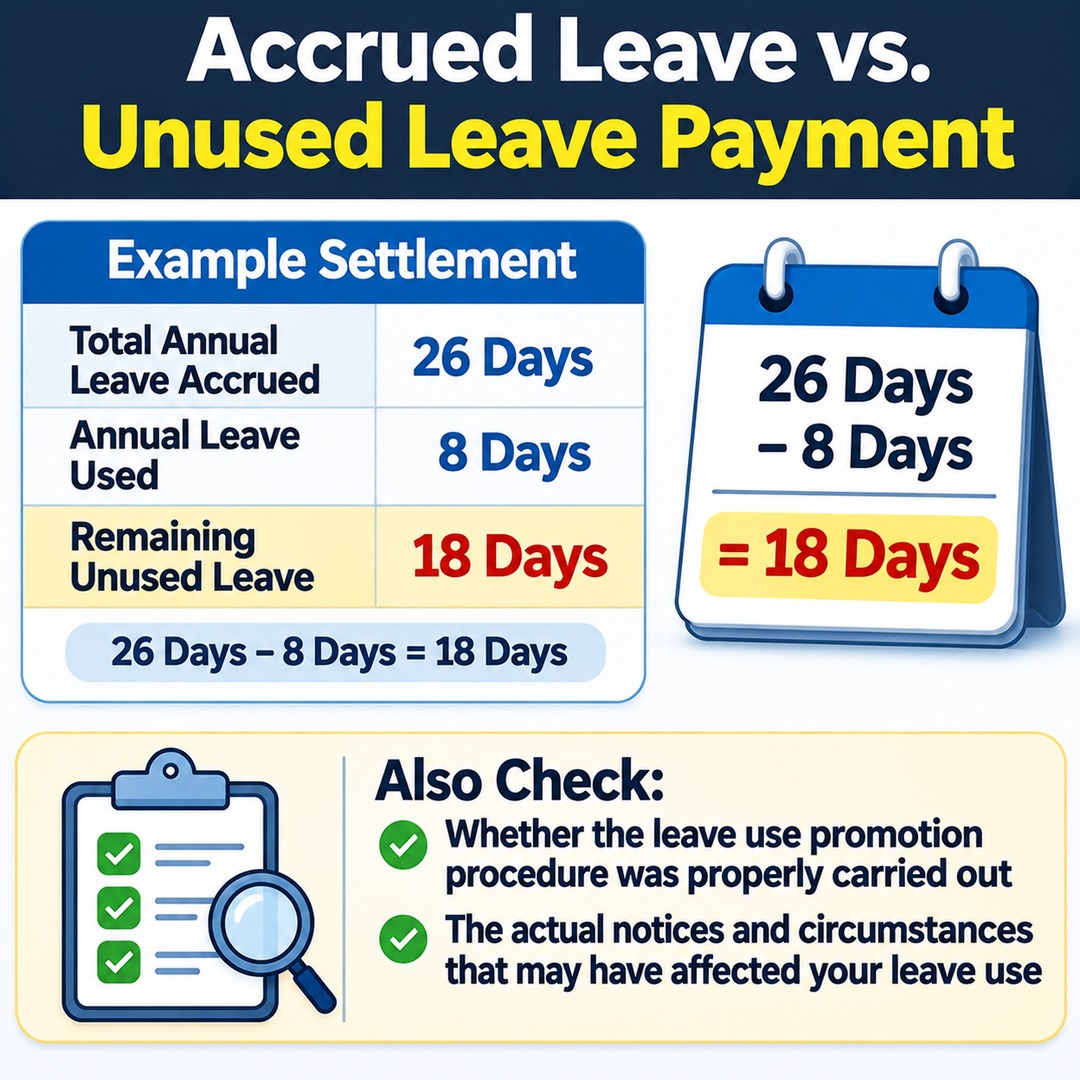
By contrast, if you used five days during the first year and another three days out of the subsequent 15 days, your remaining balance would be 18 days.
Hypothetical resignation settlement example
Total annual leave accrued: 26 days
Annual leave used: 8 days
Remaining unused annual leave: 18 days
Calculation: 26 days − 8 days = 18 days.
The actual payment must also be determined by checking the applicable unused leave payment calculation rules and whether the employer properly carried out the statutory leave-use promotion procedure.
Unused annual leave is not automatically converted into cash in every situation. You must also consider whether the employer properly followed the procedures under Article 61 of South Korea’s Labor Standards Act for encouraging employees to use their annual leave, and whether circumstances attributable to the employer affected the employee's ability to use it.
In particular, if unused leave remains when employment ends, check the employer's claimed leave-use promotion procedures and the actual notices provided to you.
Which Employers and Employees Qualify for the 26-Day Annual Leave Entitlement?
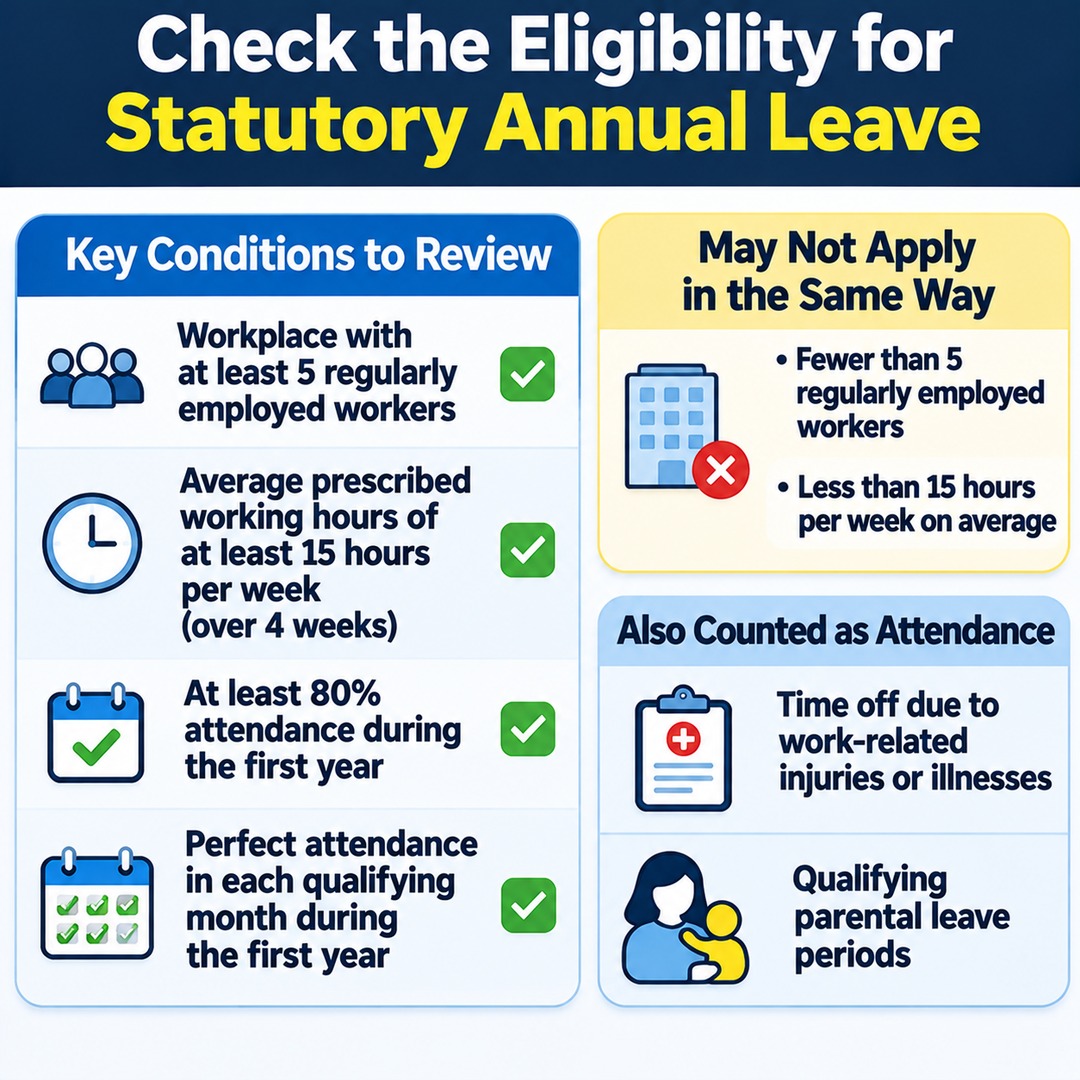
Not every employee is automatically subject to the same 11-day or 26-day entitlement. First, check whether the workplace and the employee's working hours fall within the scope of South Korea’s statutory annual paid leave provisions.
The general conditions to review include:
A workplace with at least five regularly employed workers.
An employee whose average prescribed working hours are at least 15 hours per week over a four-week period.
At least 80% attendance during the first year of service.
Perfect attendance in each qualifying month during the first year.
The statutory annual leave provisions may not apply in the same way to workplaces with fewer than five regularly employed workers or employees whose average prescribed working hours are less than 15 hours per week.
Also, not every period of leave or absence should be treated identically when calculating attendance. Certain periods, including time off due to work-related injuries or illnesses and qualifying parental leave periods specified by law, are treated as attendance under applicable rules. Individual attendance records should therefore be reviewed.
What Happens If the Employer Calculates Annual Leave by Calendar Year?
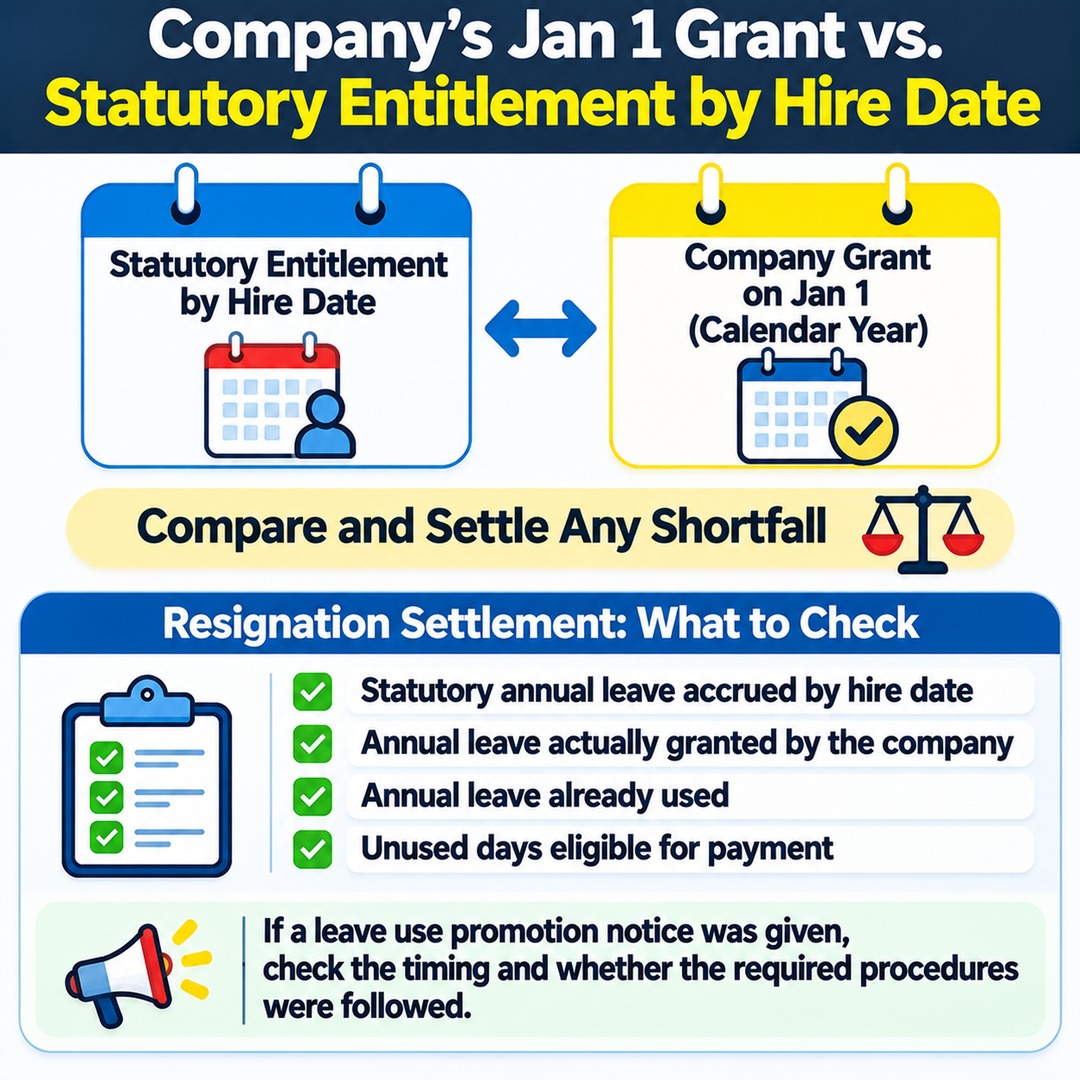
Even if an employer grants annual leave collectively on January 1 each year, the statutory entitlement calculated based on the employee's hire date must be considered when settling leave upon resignation.
The Ministry of Employment and Labor has explained in its guidance that employers may administer annual leave on a calendar-year basis. However, if the resulting entitlement at resignation is lower than the statutory entitlement calculated from the employee's hire date, the shortfall must be settled.
For example, an employee's statutory annual leave entitlement cannot be reduced merely because the company grants leave on January 1 each year.
When settling annual leave upon resignation, compare the following:
Statutory annual leave accrued based on the employee's hire date.
Annual leave actually granted by the company.
Annual leave already used.
The number of unused days eligible for payment.
If you received a notice encouraging you to use your annual leave, also check when the notice was issued and whether the required procedures were followed.
Annual Leave Settlement Items to Confirm with Your Employer Before Resigning
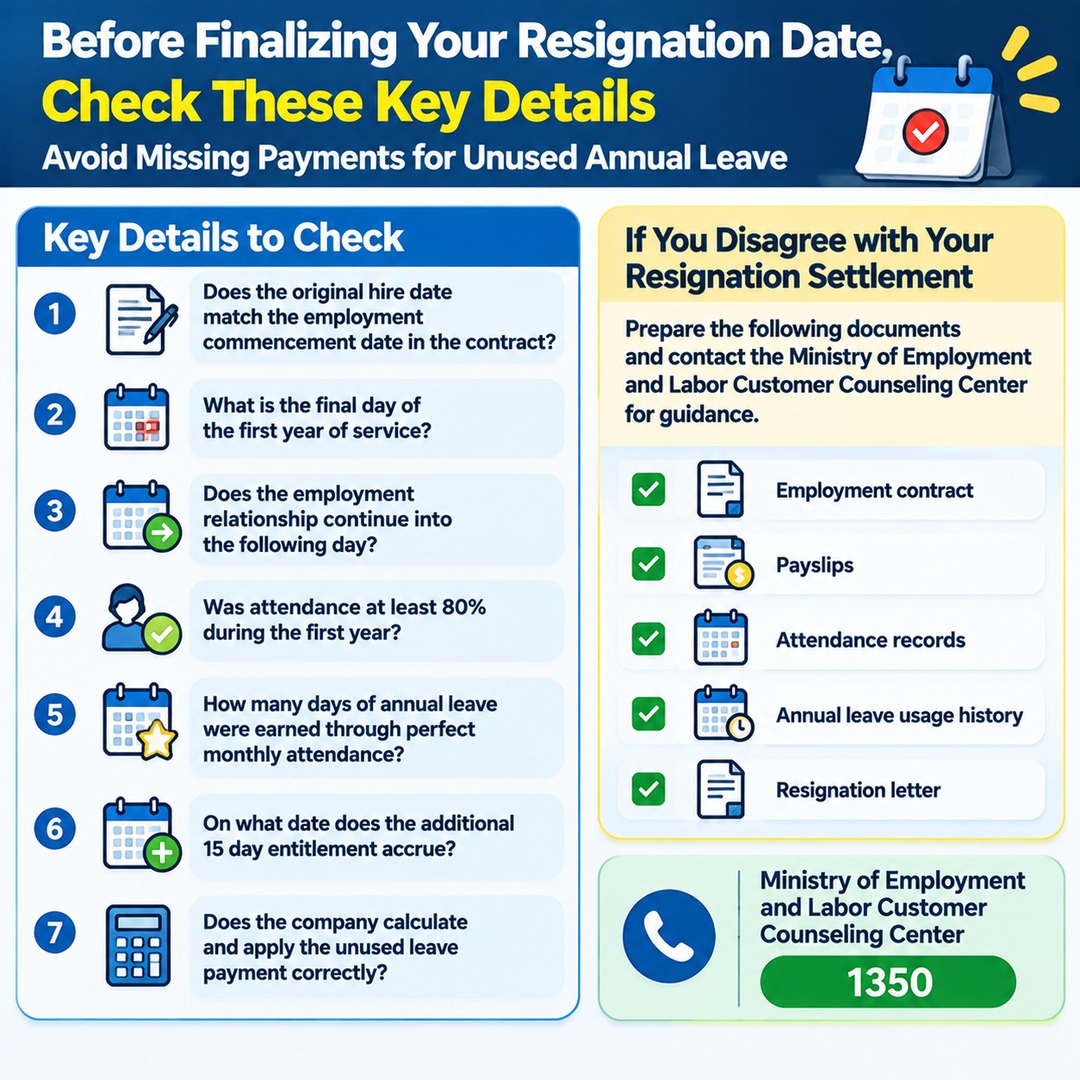
Checking the following details before finalizing your resignation date can help prevent missing payments for unused annual leave.
Does the original hire date match the employment commencement date in the contract?
What is the final day of the first year of service?
Does the employment relationship continue into the following day?
Was attendance at least 80% during the first year?
How many days of annual leave were earned through perfect monthly attendance?
On what date does the additional 15-day entitlement accrue?
Does the company calculate annual leave based on the hire date or the calendar year?
How many days of annual leave have been used, and how many remain?
Did the employer properly carry out the statutory annual leave-use promotion procedure?
If you disagree with your employer's resignation settlement, prepare your employment contract, payslips, attendance records, annual leave usage history, and resignation letter. You can then contact the Ministry of Employment and Labor Customer Counseling Center in South Korea at 1350 for guidance.