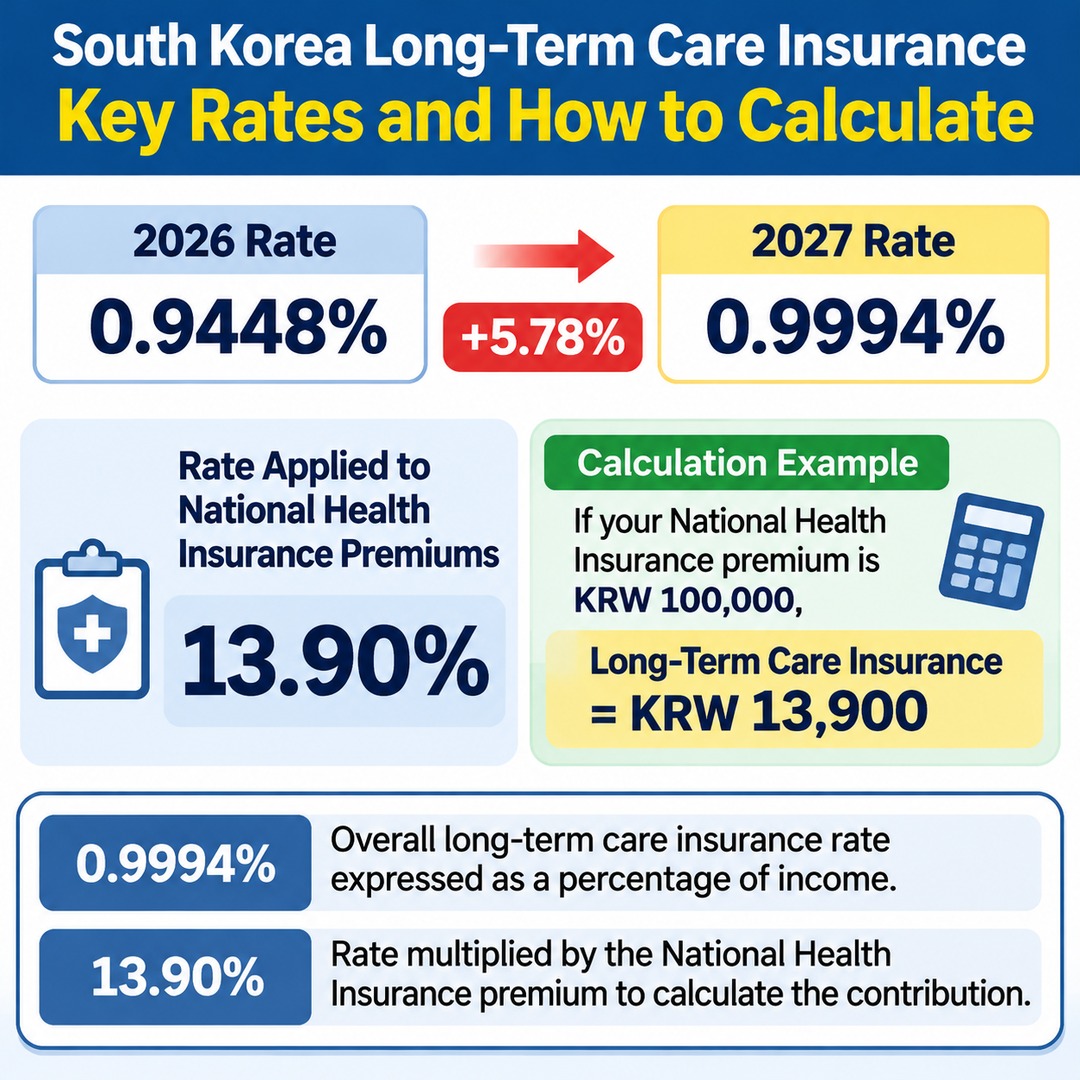


South Korea’s long-term care insurance contribution rate will increase from 0.9448% in 2026 to 0.9994% in 2027, representing a 5.78% increase. The rate applied to National Health Insurance premiums has also been set at 13.90%. For employee subscribers, the employee’s share must be calculated based on their National Health Insurance premium. The projected average monthly increase of KRW 1,100 per insured household does not mean that the same amount will be deducted from every employee’s paycheck.
The most important distinction is between a 5.78% increase in the long-term care insurance contribution rate and a 5.78% increase in the actual amount deducted from monthly wages. The additional amount people pay depends on their existing National Health Insurance premiums and their subscriber category.
How Much Will South Korea’s Long-Term Care Insurance Rate Increase in 2027?
The 2027 long-term care insurance contribution rate, expressed as a percentage of income, is 0.9994%. This is 0.0546 percentage points higher than the 2026 rate of 0.9448%, representing a year-over-year increase of 5.78%.
The long-term care insurance rate applied to National Health Insurance premiums will be 13.90% in 2027. This means that a subscriber with a monthly National Health Insurance premium of KRW 100,000 will pay KRW 13,900 in long-term care insurance contributions.
| Category | 2026 | 2027 |
|---|---|---|
| Contribution rate as a percentage of income | 0.9448% | 0.9994% |
| Rate relative to National Health Insurance premiums | Approximately 13.14% | 13.90% |
| Year-over-year increase | - | 5.78% |
These two rates should not be confused.
0.9994%: The overall long-term care insurance contribution rate expressed as a percentage of income.
13.90%: The rate multiplied by the National Health Insurance premium to calculate the long-term care insurance contribution.
The second rate is generally more convenient when checking an employee’s payroll deductions.
How Much More Will Employees Earning KRW 3M, 4M, or 5M Per Month Pay?
To calculate the additional cost for employee subscribers, it is necessary to distinguish between the total National Health Insurance premium and the employee’s share. The exact deduction cannot be determined from monthly salary alone. However, a comparison can be made assuming that the National Health Insurance premium is calculated using the monthly standard remuneration amount.
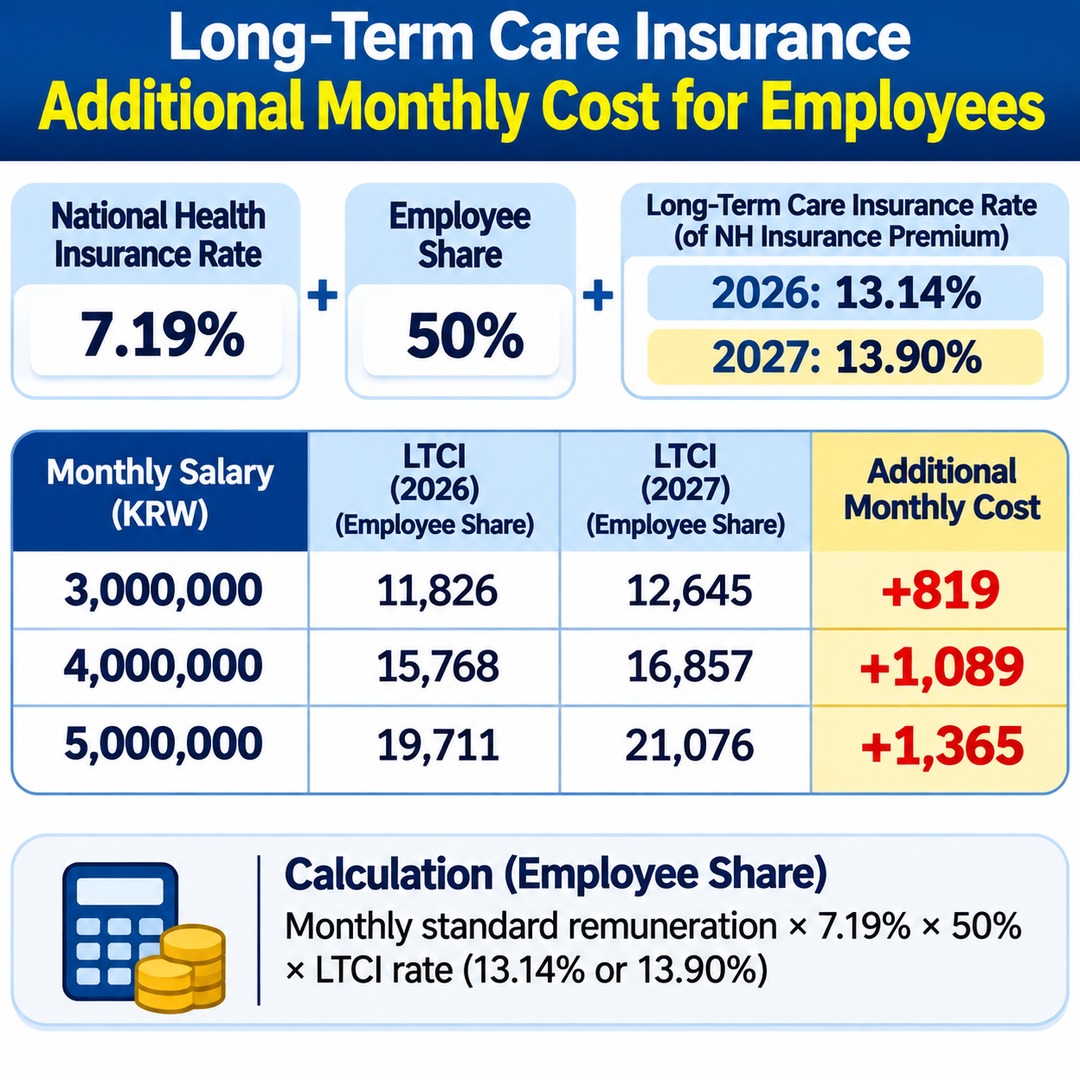
Assuming a 2027 National Health Insurance contribution rate of 7.19%, with employee subscribers and employers each paying half of the premium, the calculation is as follows.
The following figures are illustrative calculations prepared by the author solely to compare changes in long-term care insurance contributions. They are not guaranteed amounts that will appear on actual payroll statements.
| Monthly Standard Remuneration | Employee Share in 2026 | Employee Share in 2027 | Monthly Increase |
|---|---|---|---|
| KRW 3 million | Approximately KRW 10,180 | Approximately KRW 10,770 | Approximately KRW 590 |
| KRW 4 million | Approximately KRW 13,570 | Approximately KRW 14,360 | Approximately KRW 790 |
| KRW 5 million | Approximately KRW 16,960 | Approximately KRW 17,950 | Approximately KRW 990 |
Calculation formula
Monthly standard remuneration × National Health Insurance contribution rate × 50% × Long-term care insurance rate (as a percentage of the National Health Insurance premium)
This comparison applies approximately 13.14% of the National Health Insurance premium for 2026 and 13.90% for 2027. Actual billed amounts may differ due to rounding to the nearest won.
Under this example, the additional monthly cost is approximately KRW 590 for an employee earning KRW 3 million, KRW 790 for someone earning KRW 4 million, and KRW 990 for someone earning KRW 5 million.
Employers also share the long-term care insurance contribution associated with employee National Health Insurance premiums. Therefore, the employee’s share should not be confused with the total insurance contribution.
The calculation table above is corrected below after cross-checking the arithmetic using the National Health Insurance contribution rate.
| Monthly Standard Remuneration | Employee Share in 2026 | Employee Share in 2027 | Monthly Increase |
|---|---|---|---|
| KRW 3 million | KRW 14,172 | KRW 14,991 | KRW 819 |
| KRW 4 million | KRW 18,896 | KRW 19,988 | KRW 1,092 |
| KRW 5 million | KRW 23,620 | KRW 24,985 | KRW 1,365 |
The author's calculation uses a National Health Insurance contribution rate of 7.19%, an employee share of 50% for employee subscribers, a 2026 long-term care insurance rate of 0.9448%, and a 2027 rate of 0.9994%. The income-based long-term care insurance contribution rate is applied to the monthly standard remuneration, after which the employee's half is calculated.
Therefore, an employee earning KRW 3 million per month will pay approximately KRW 819 more per month in long-term care insurance contributions. For someone earning KRW 5 million, the additional amount will be approximately KRW 1,365. Since the National Health Insurance contribution rate itself remains unchanged at 7.19% in 2027, this comparison reflects only the change in the long-term care insurance contribution rate.
Do Regional Subscribers Calculate Their Premiums Differently From Employees?
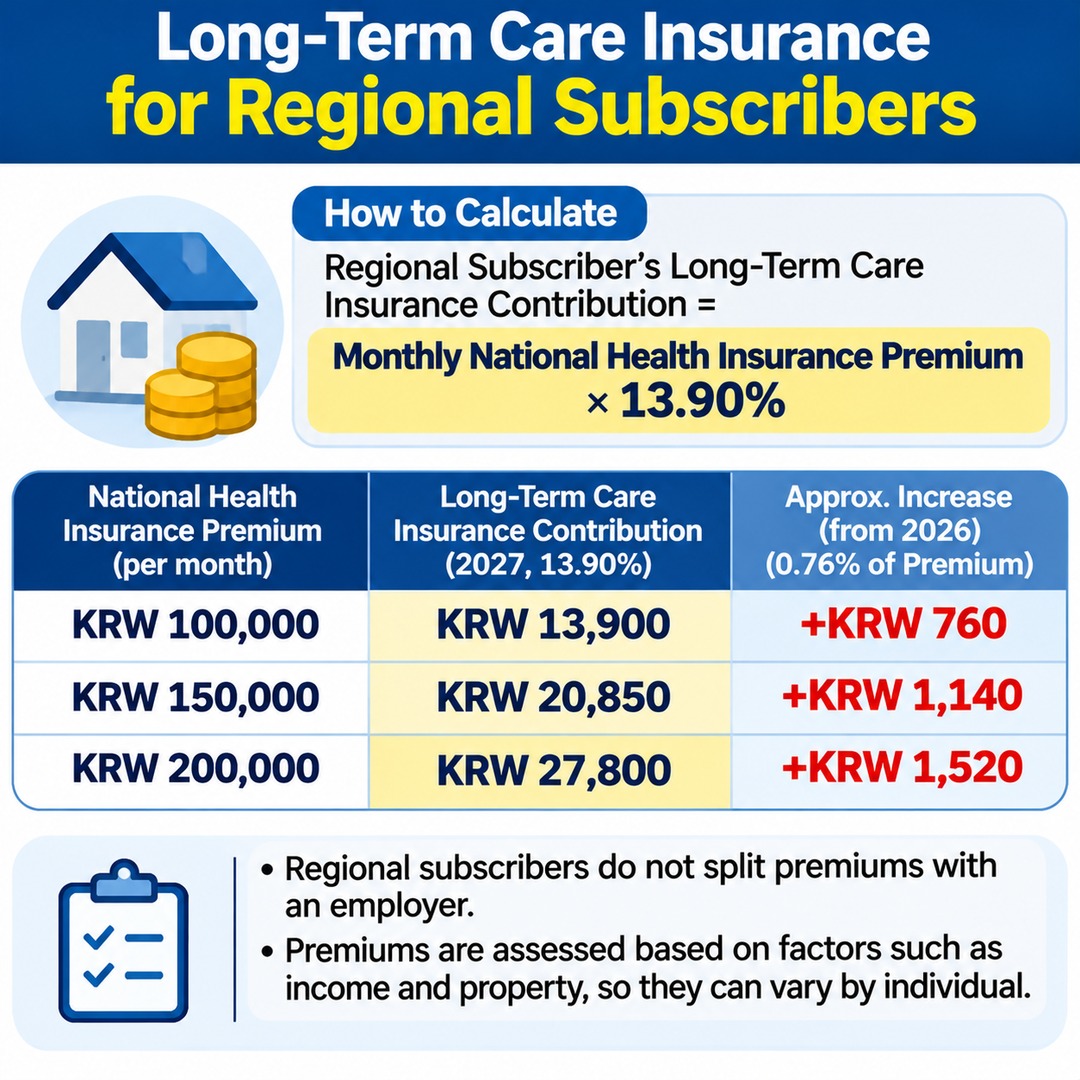
Regional subscribers do not divide their premiums equally between an employee and an employer based on monthly wages, as employee subscribers do. Instead, their long-term care insurance contributions are calculated using the assessed National Health Insurance premium.
The 2027 long-term care insurance contribution for regional subscribers can be calculated as follows:
Regional Subscriber's Long-Term Care Insurance Contribution = Monthly National Health Insurance Premium × 13.90%
For example, the long-term care insurance contribution would be approximately:
National Health Insurance premium of KRW 100,000 → Long-term care insurance contribution of KRW 13,900
National Health Insurance premium of KRW 150,000 → Long-term care insurance contribution of KRW 20,850
National Health Insurance premium of KRW 200,000 → Long-term care insurance contribution of KRW 27,800
To calculate the increase compared with 2026, you must assume that the existing National Health Insurance premium remains unchanged. If the National Health Insurance premium stays the same in 2027, the additional long-term care insurance contribution will be approximately 0.76% of the existing National Health Insurance premium.
For regional subscribers, premiums can vary depending on factors used to assess National Health Insurance contributions, including income and property. Therefore, calculating long-term care insurance contributions using monthly income alone may produce a different result from the actual amount payable.
What Does the Average Monthly Increase of KRW 1,100 Per Insured Household Mean?
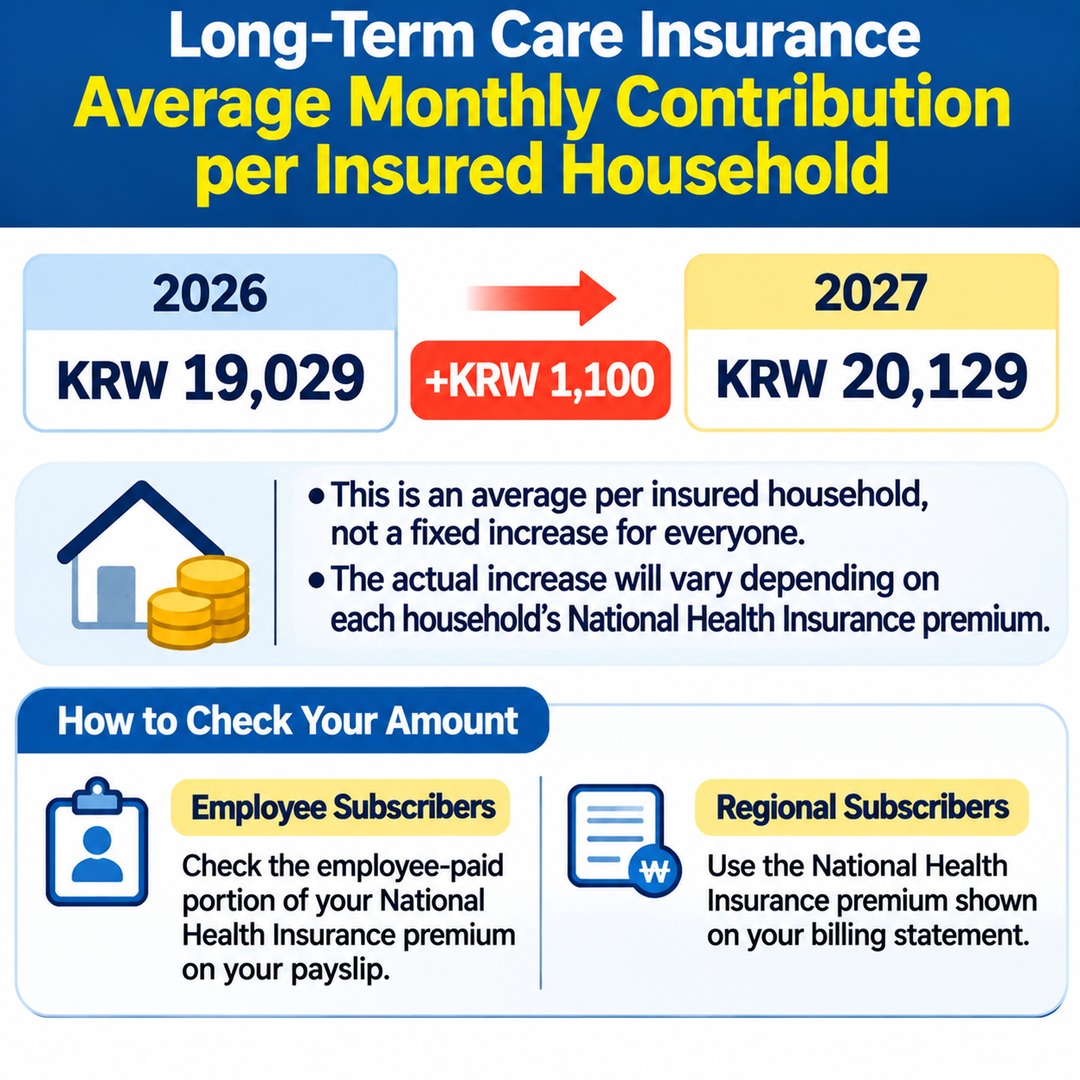
The projected average monthly long-term care insurance contribution per insured household in 2027 is KRW 20,129. Compared with KRW 19,029 in 2026, this represents an increase of KRW 1,100.
This is not a fixed increase for each individual or employee. It is an average calculated across insured households, meaning that the actual increase will differ between households with higher and lower National Health Insurance premiums.
In particular, employee subscribers share the contribution with their employers. Therefore, the average increase per insured household should not be interpreted as the additional amount that will automatically be deducted from an employee's monthly salary.
The easiest way to estimate the amount deducted from your wages is to check your National Health Insurance premium on your payslip first. Employee subscribers should use the employee-paid portion, while regional subscribers should use the National Health Insurance premium shown on their billing statement.
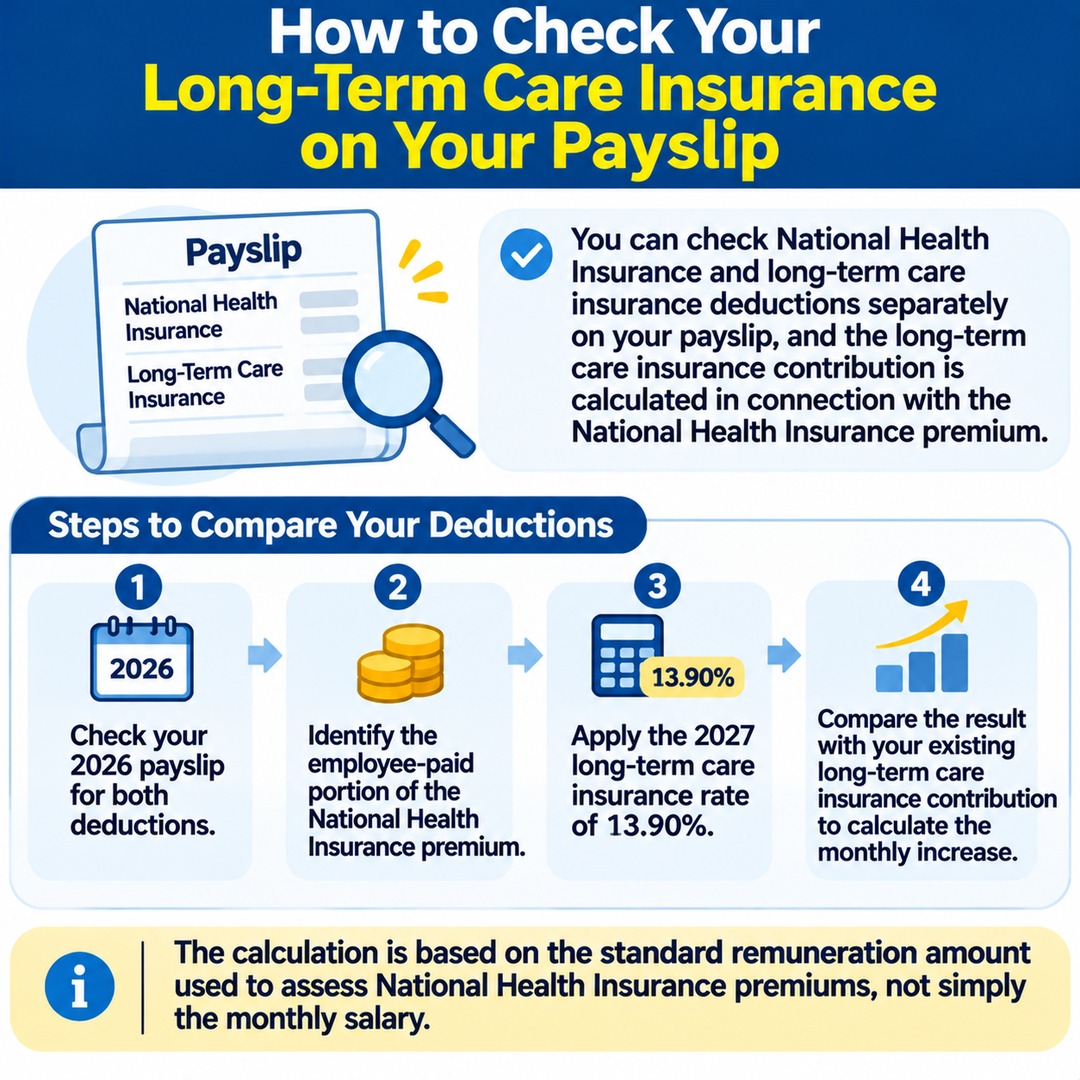
How Can You Check National Health Insurance and Long-Term Care Insurance Deductions on Your Payslip?
You can check your National Health Insurance and long-term care insurance deductions separately on your payslip. Although long-term care insurance may appear as a separate deduction, its contribution is calculated in connection with the National Health Insurance premium.
The following steps are useful when comparing actual deductions:
1. Check your 2026 payslip for the National Health Insurance and long-term care insurance deductions.
2. Identify the portion of the National Health Insurance premium paid by the employee.
3. Apply the 2027 long-term care insurance rate of 13.90%.
4. Compare the result with your existing long-term care insurance contribution to calculate the monthly increase.
It is also important to remember that the calculation is based on the standard remuneration amount used to assess National Health Insurance premiums, not simply the monthly salary stated in an employment contract. If certain non-taxable allowances or other forms of remuneration are excluded from premium calculations, the result may differ from an estimate based solely on the stated monthly salary.
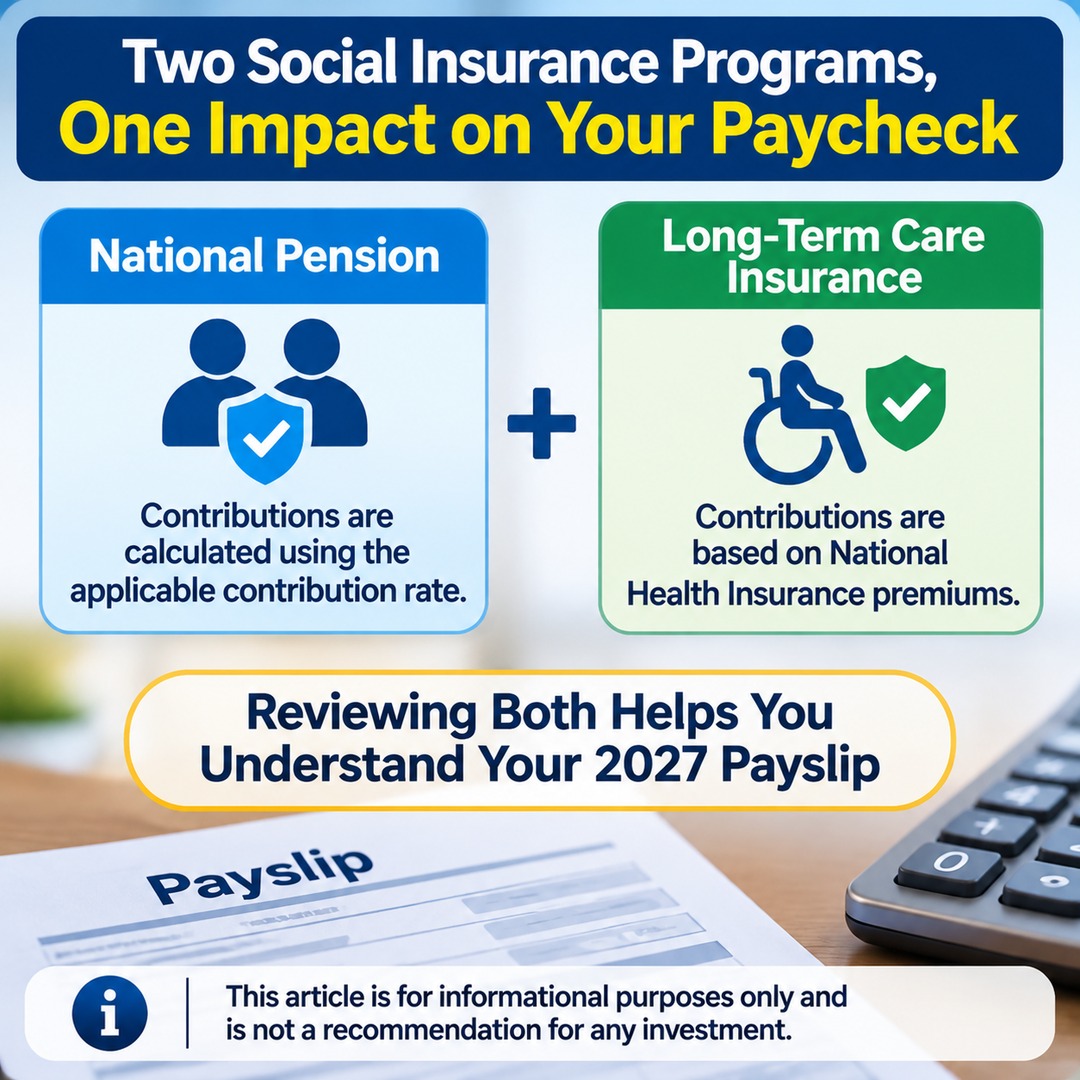
Should You Consider the National Pension Increase Alongside the Long-Term Care Insurance Increase?
Although the two insurance programs use different methods for calculating contributions, both affect the amount deducted from employees' wages.
National Pension contributions are calculated using the applicable contribution rate, whereas long-term care insurance contributions are calculated based on National Health Insurance premiums.
The 2027 National Pension contribution rate changes and the corresponding contribution amounts by monthly salary are covered in a separate article.
Reviewing both items together can help you understand more accurately how social insurance deductions on your 2027 payslip may change.
*This article is provided for informational purposes to help readers understand market developments and is not a recommendation to invest in any particular security or asset. All final decisions and investment responsibilities remain with the individual.*