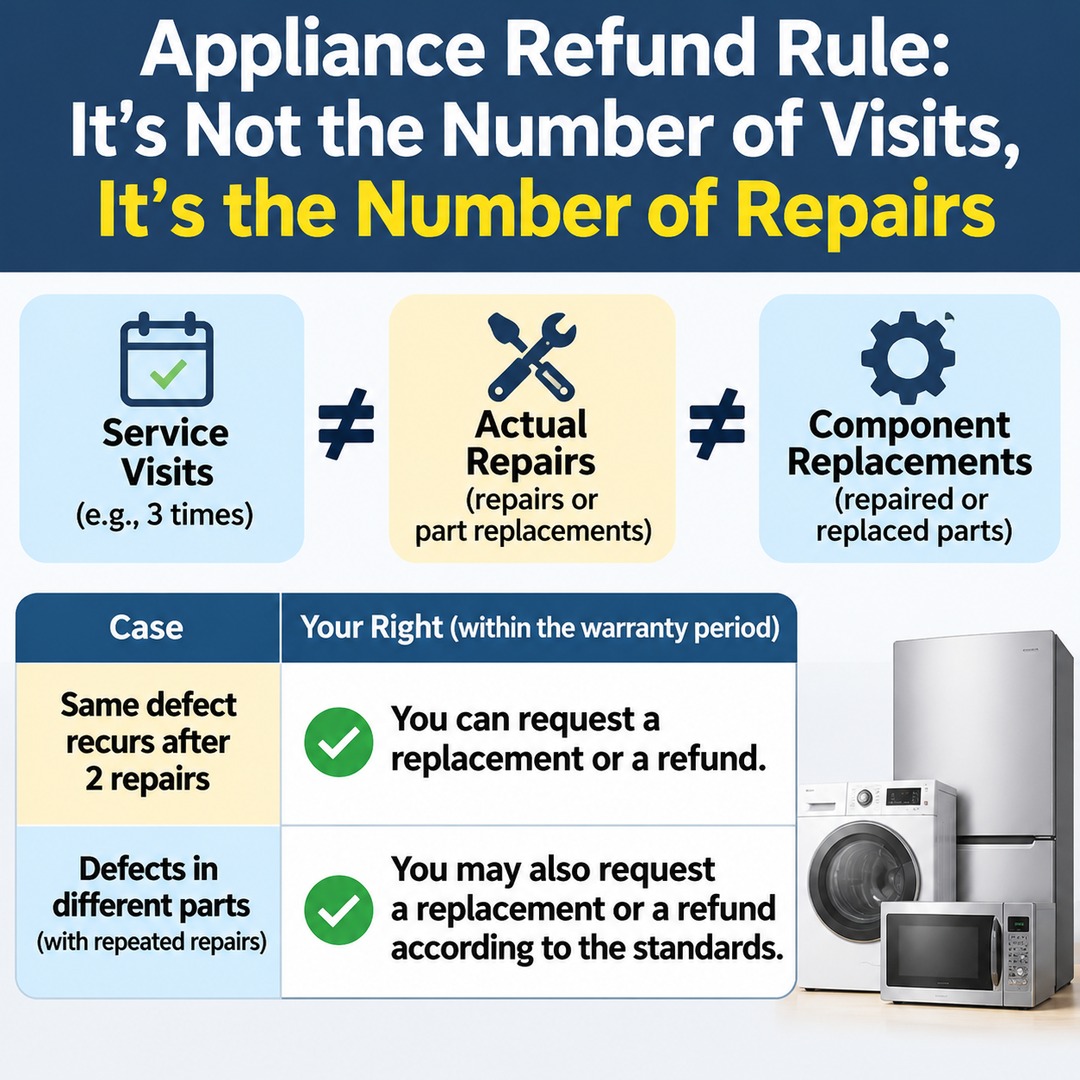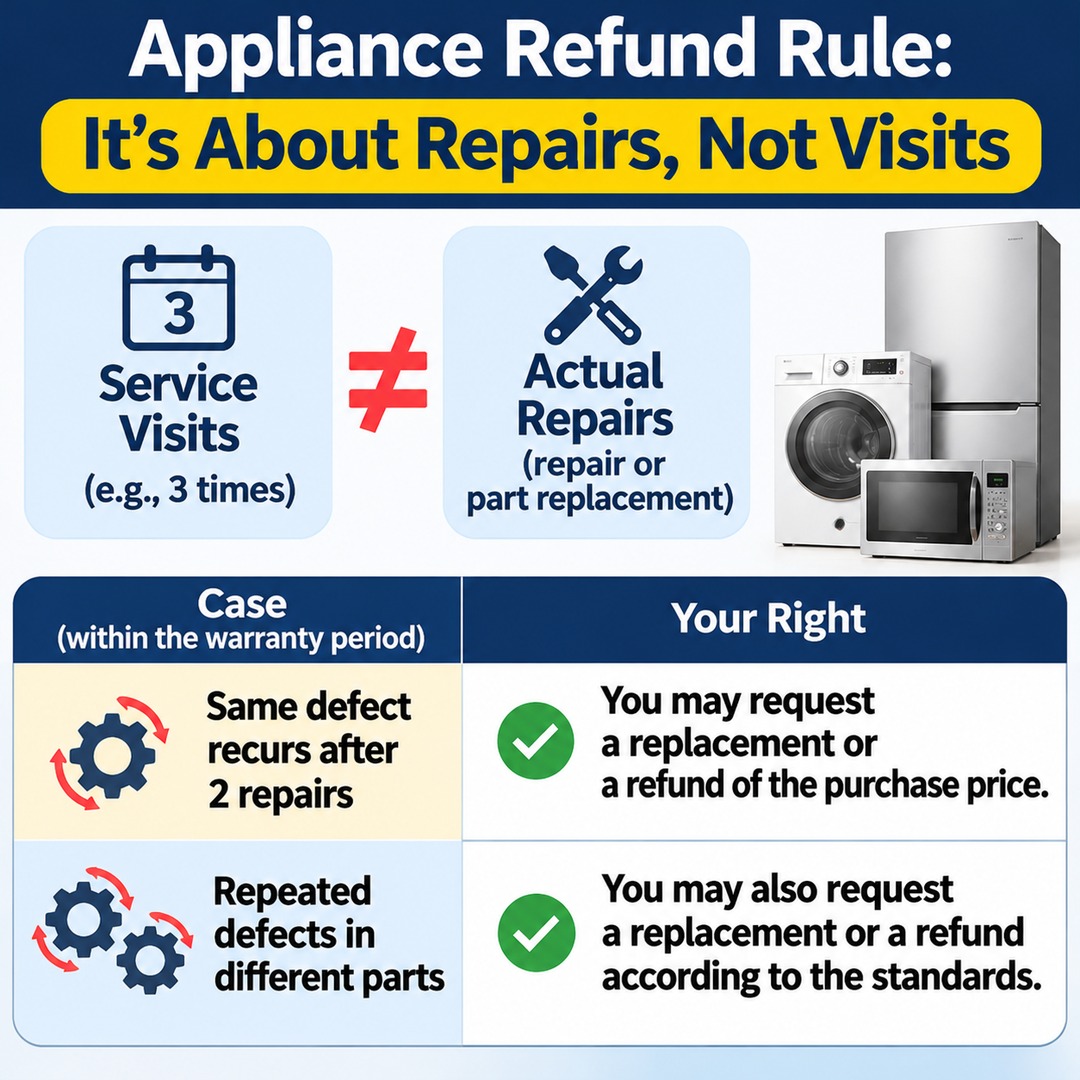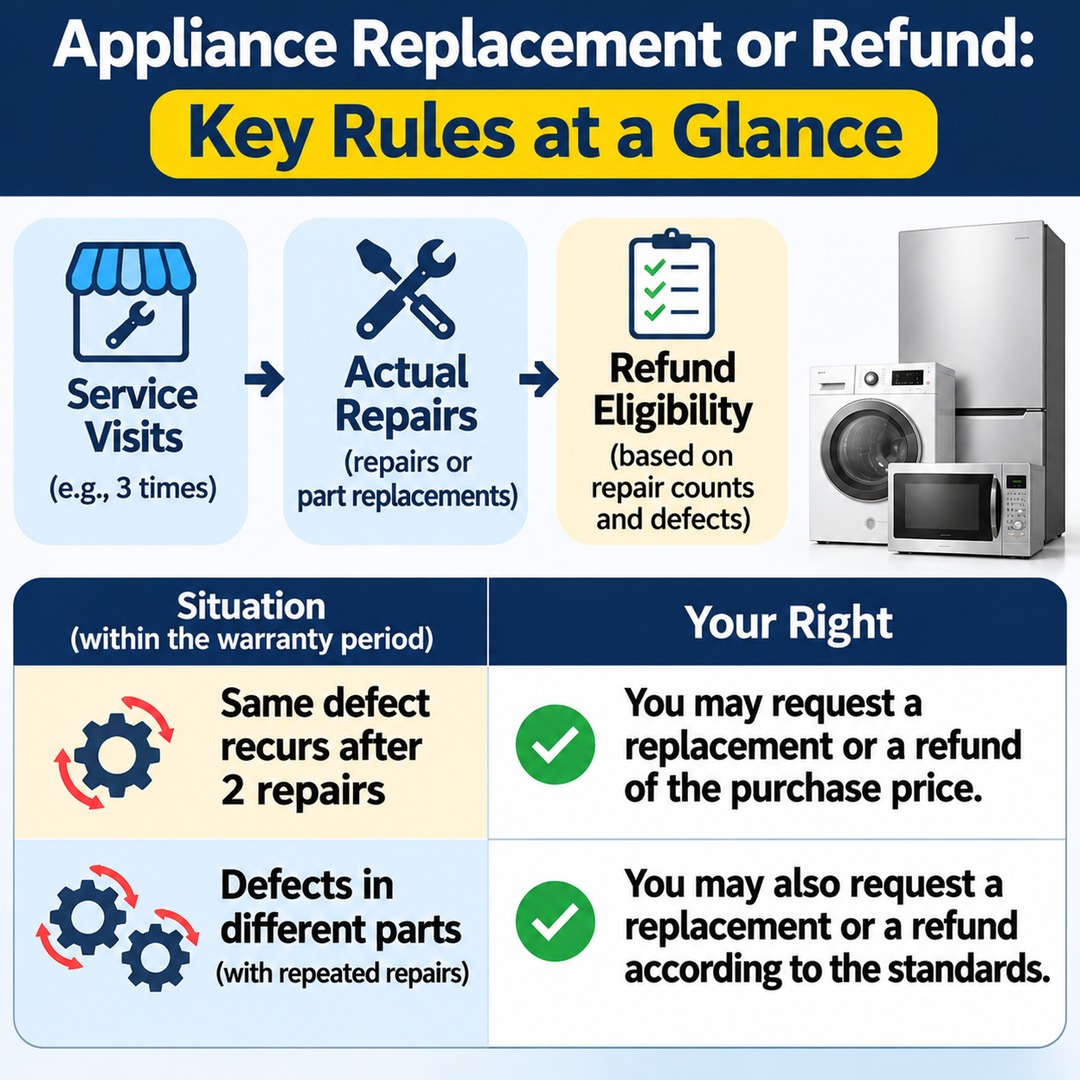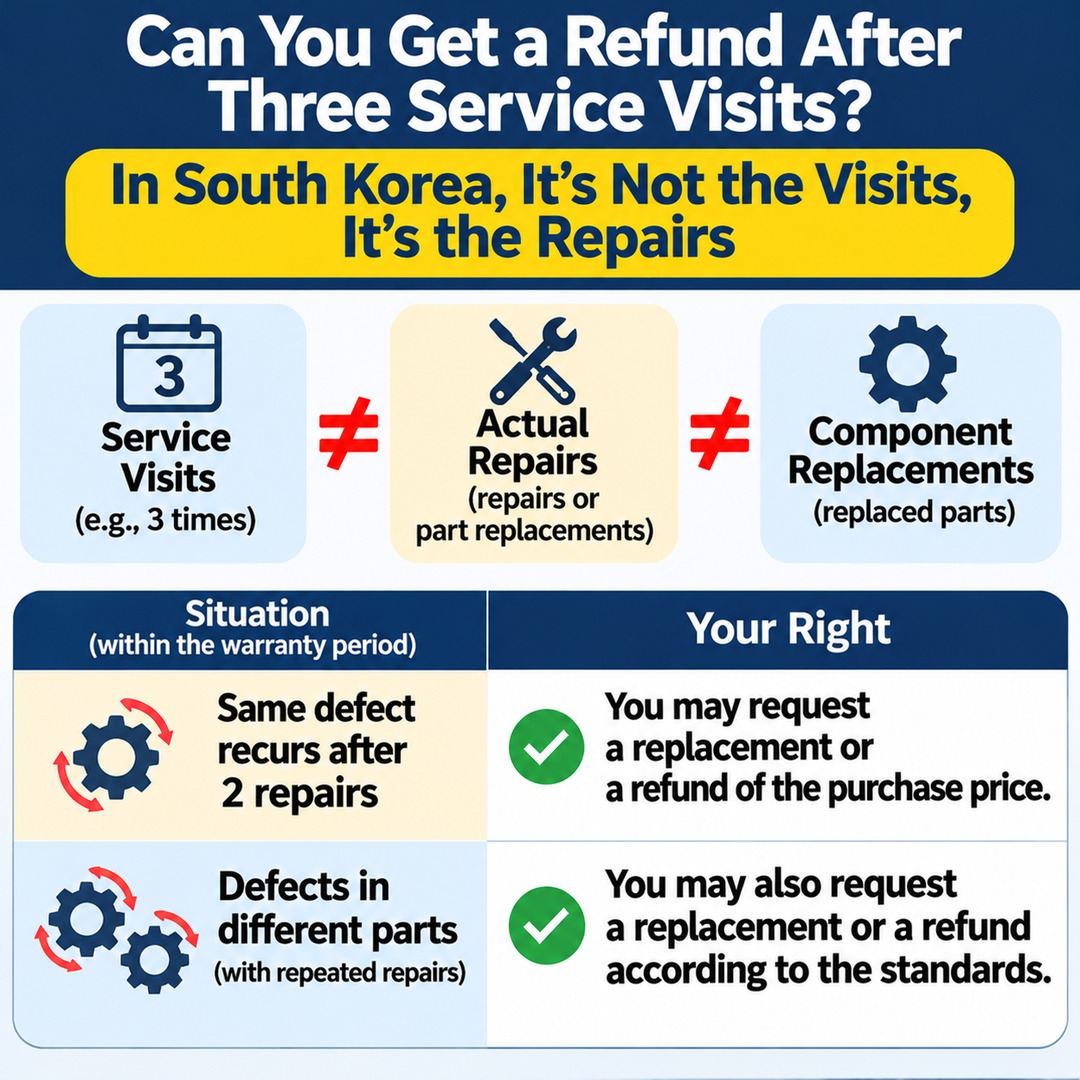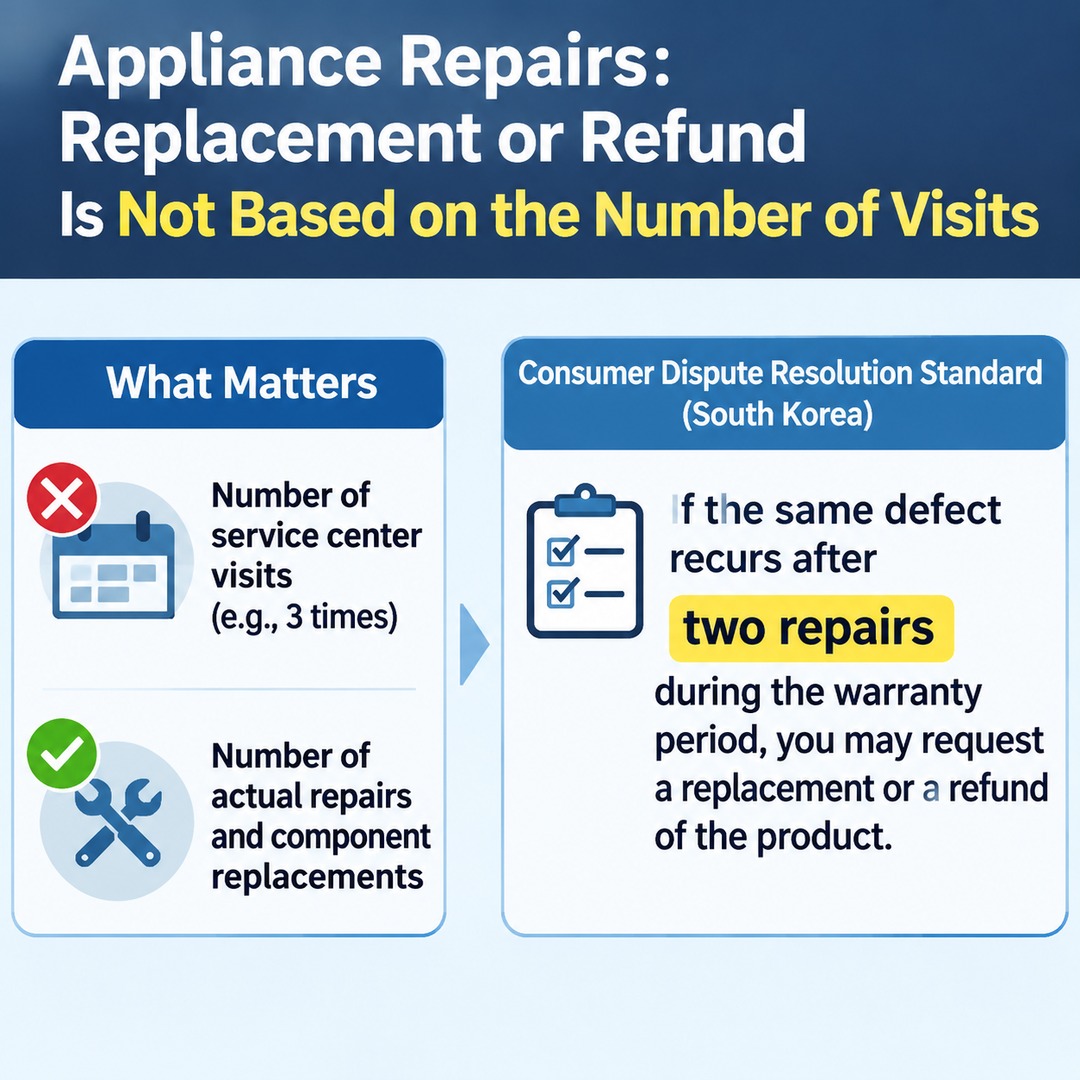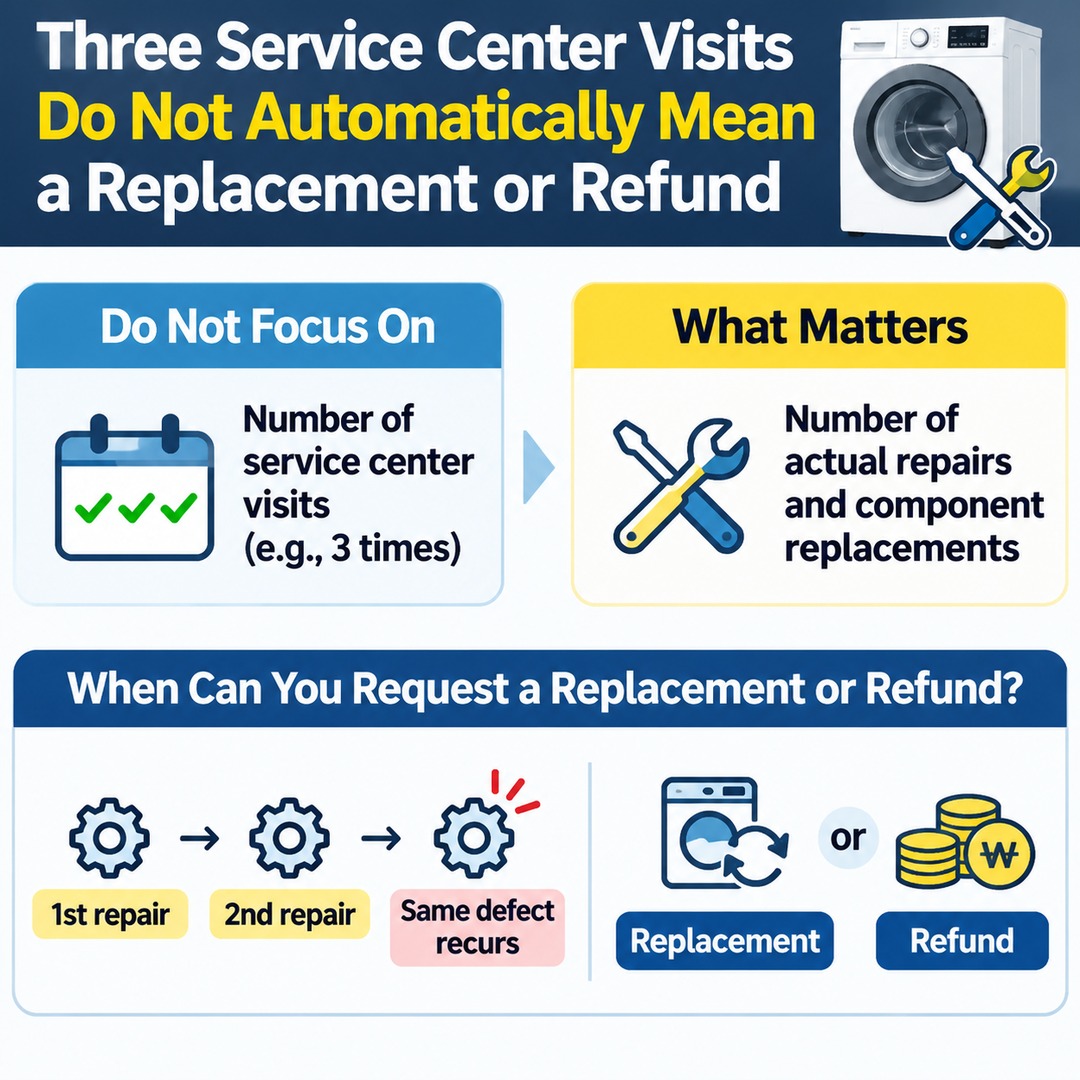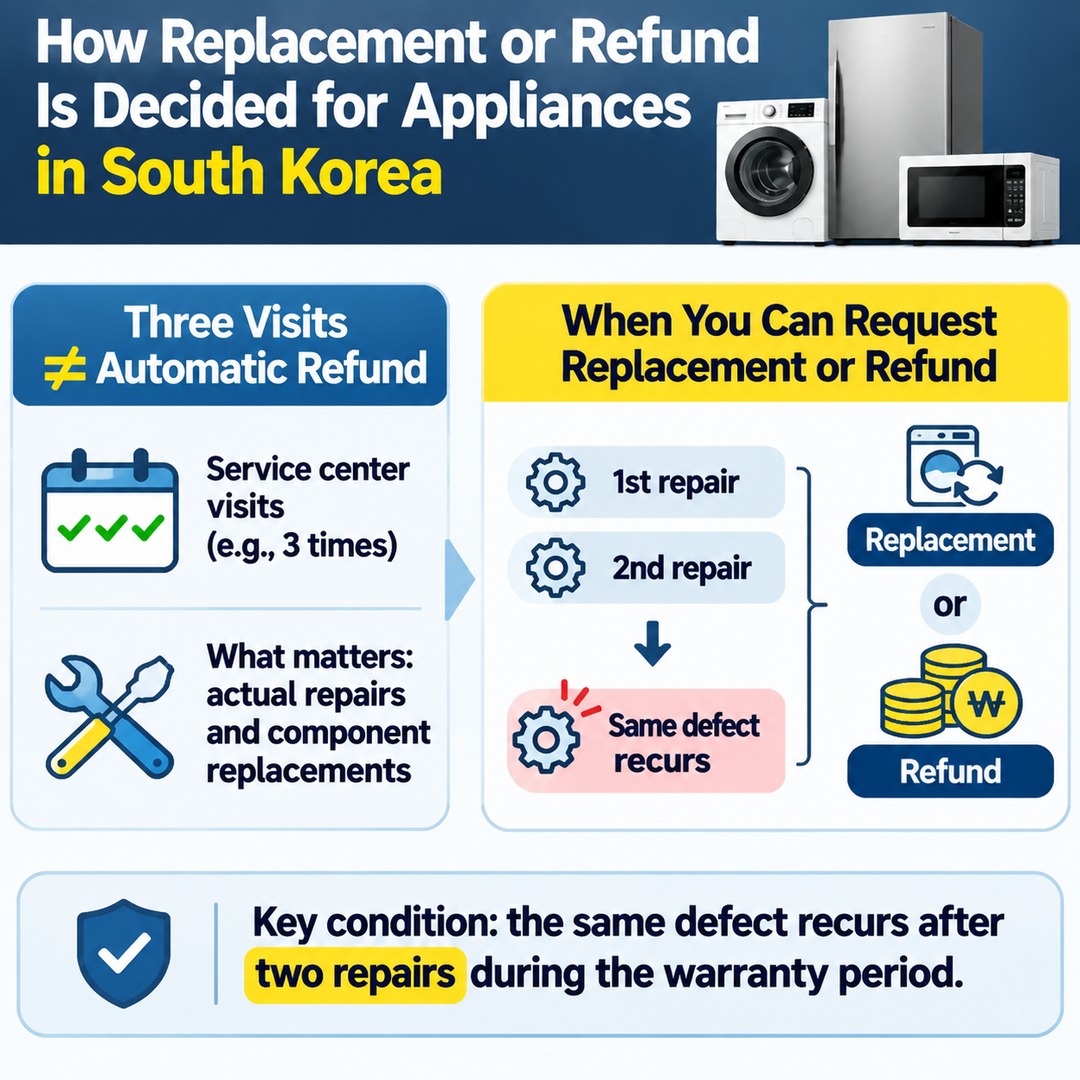

Visiting an appliance service center three times does not automatically entitle you to a product replacement or refund in South Korea. What matters is not the number of visits but the number of actual repairs and component replacements. Under the applicable consumer dispute resolution standards, if the same defect recurs after two repairs during the warranty period, you may request a replacement or a refund of the purchase price. If defects occur in multiple parts of the product, the relevant threshold is four repairs followed by another recurrence.\n\nFor household appliances, including televisions, compensation should not be determined solely by looking at service center visit records. You need to distinguish between visits involving inspection only and visits during which components were actually replaced or repairs were performed. You must also establish whether the problem was the same recurring defect or involved different parts of the product.\n\n## Why Can a Replacement Be Refused After Three Service Center Visits?\n\nEven if you have visited a service center three times, the actual repair count may still be zero if no repairs were performed.\n\nA consumer consultation case involving a television, published by the Korea Consumer Agency, illustrates a similar situation.\n\nA television owner visited an after-sales service center three times within one year. When the television broke down again, the consumer requested an exchange for a different product. The manufacturer explained that an exchange would be difficult because the defects involved different parts of the television.\n\nThe important point in this case is not simply that the consumer made three visits.\n\nUnder South Korea's Consumer Dispute Resolution Standards, repair counts are based on the number of times a product was actually repaired or its components were replaced after a problem was identified, not the number of times the consumer visited a service center.\n\nFor example, consider the following sequence:\n\n- First visit: An engineer inspects the product and finds no fault.\n- Second visit: An internal component is replaced.\n- Third visit: The same symptom is reported, but the engineer only performs an additional inspection.\n\nIn this situation, there were three service visits but only one actual repair.\n\nBy contrast, if an actual repair or component replacement took place during each of the three visits, each repair record must be examined.\n\n## The Standards Differ for Repeated Defects and Defects in Multiple Parts\n\nReplacement and refund eligibility for repeatedly defective appliances generally falls into two categories.\n\n1. The same defect occurs repeatedly\n\nRecurrence after two repairs\n\nIf the same defect has been repaired twice and the same problem occurs again, the case meets the standard for treating the product as unrepairable.\n\n2. Defects occur in multiple parts of the product\n\nRecurrence after four repairs\n\nIf defects in multiple parts have required four actual repairs and another defect occurs afterward, the case meets the standard for treating the product as unrepairable.\n\nThese two standards cannot be substituted for one another.\n\nFor example, if a television repeatedly shuts off because of the same problem, the repeated-defect standard should be considered.\n\nHowever, if the first problem involves the screen, the second involves the power supply, and the third affects a different function or component, the repair history must be examined to determine whether the case involves defects in multiple parts.\n\nA symptom that appears different does not automatically establish that the underlying defect is different. The actual diagnostic findings, repaired components, and replacement parts must all be reviewed.\n\n## Which Standard Applies to Your Repair History?\n\nThe distinction becomes clearer when we look at some hypothetical repair histories.\n\n| Repair history | Applicable assessment |\n| --- | --- |\n| The same defect recurs after one repair | Does not yet meet the two-repair threshold for the same defect |\n| The same defect recurs after two repairs | Meets the standard for recurrence after two repairs |\n| A defect in multiple parts recurs after two repairs | Does not yet meet the four-repair threshold for multiple parts |\n| A defect in multiple parts recurs after four repairs | Meets the standard for recurrence after four repairs |\n| Three service visits but only one actual repair | Three visits alone do not satisfy the replacement or refund criteria |\n\nThese examples assume that the defects occurred during the quality warranty period while the product was being used normally.\n\nOne particularly important distinction is the difference between an inspection and a repair.\n\nIf an engineer visits, examines the product, and determines that it is operating normally without replacing any components or performing repairs, it is difficult to count that visit as one actual repair.\n\nHowever, if a component was replaced or the defective part was actually repaired, the corresponding service record should be reviewed.\n\n## What Should You Check If the Manufacturer Says the Defects Were Different?\n\nIf the manufacturer claims that the failures involved different parts, do not rely solely on a verbal explanation.\n\nCompare the following information in your repair records:\n\n- Date each defect occurred\n- Symptoms reported by the consumer\n- Defective parts identified by the engineer\n- Components actually repaired and work performed\n- Whether any components were replaced\n- Whether the repair was marked as completed\n\nThe most important details are how the symptoms and actual repair locations were documented.\n\nFor example, even if the television repeatedly shut off, the assessment of whether the problem involved the same defect or defects in multiple parts may differ if the manufacturer diagnosed a different component as the cause each time.\n\nIn that situation, compare the previous repair records with the latest diagnostic findings side by side.\n\nYou can request the following information from the manufacturer:\n\n- Complete records of previous after-sales service requests and repairs\n- Inspection results for each visit\n- A list of components actually replaced\n- Whether each repair was completed\n- Specific reasons for classifying each incident as the same symptom or a defect in a different part\n\nThese documents can provide important evidence if there is a dispute over the number of qualifying repairs.\n\n## What Conditions Must Be Met to Request a Replacement or Refund?\n\nEven if your case meets the repeated-defect criteria, an immediate refund is not automatically guaranteed in every situation.\n\nFirst, check the following conditions.\n\nFirst, confirm that the defect occurred during the quality warranty period.\n\nThe replacement and refund standards for repeated defects in household appliances apply to performance or functional defects that occur during the quality warranty period while the product is being used normally.\n\nCheck the product's warranty certificate together with the Consumer Dispute Resolution Standards applicable to the relevant product category.\n\nSecond, confirm that the actual repair count meets the applicable threshold.\n\nYou must distinguish between recurrence after two repairs for the same defect and recurrence after four repairs involving multiple parts.\n\nThird, check whether the consumer was responsible for the damage.\n\nIf the product was damaged through improper handling by the consumer or due to a natural disaster, the case may be handled differently from an ordinary warranty claim.\n\nFourth, confirm which remedy applies: replacement or refund.\n\nUnder the Consumer Dispute Resolution Standards, when a product is considered unrepairable under the applicable conditions, the stated remedies are product replacement or a refund of the purchase price.\n\nIf a replacement is not possible, you can also check the purchase-price refund standard.\n\nHowever, the Consumer Dispute Resolution Standards serve as criteria for dispute resolution through agreement or recommendations. They are not equivalent to a final court judgment that automatically binds every business. In an actual dispute, the manufacturer's policies, contract terms, product condition, and repair documentation may also need to be considered.\n\n## What to Do If the Service Center Refuses Your Request\n\nIf you have already made several visits and your request for a replacement or refund has been refused, it is better to collect the relevant documents before making another visit.\n\n1. Prepare your purchase receipt and product warranty certificate.\n2. Request the manufacturer's complete after-sales service and repair history.\n3. Separate actual repairs from inspections for each visit, and identify any replaced components.\n4. Determine which standard applies: repeated defects in the same part or defects in multiple parts.\n5. Request a replacement or a refund of the purchase price, and keep a written record of the reasons for any refusal.\n\nIf you and the manufacturer continue to disagree, you can contact South Korea's 1372 Consumer Counseling Center by dialing 1372 without an area code.\n\nWhen seeking advice, it is more accurate to provide the dates of actual repairs, the components involved, and the symptoms in chronological order rather than simply saying how many times you visited the service center.\n\nIn particular, if the manufacturer does not recognize certain repairs in its repair count, distinguish the visit records from the records confirming completed repairs when submitting your documents.\n\n## The Most Commonly Overlooked Distinction in Appliance Repair Counts\n\nWhen requesting a replacement or refund because of repeated defects, you need to distinguish among three different counts.\n\n- Service center visits: The total number of visits for consultations, inspections, and repairs.\n- Actual repairs: The number of times the product was repaired or a component was replaced after a defect was identified.\n- Defect occurrences: The number of times an actual defect occurred in the product.\n\nThese three numbers do not necessarily match.\n\nUltimately, visiting an appliance service center three times is not enough to determine whether you qualify for a refund. You need to establish whether the defect was the same or involved multiple parts, and how many actual repairs were performed.\n\nStart by requesting the manufacturer's complete repair history. Having that documentation will make it much easier to assess whether your situation meets the replacement or refund criteria.