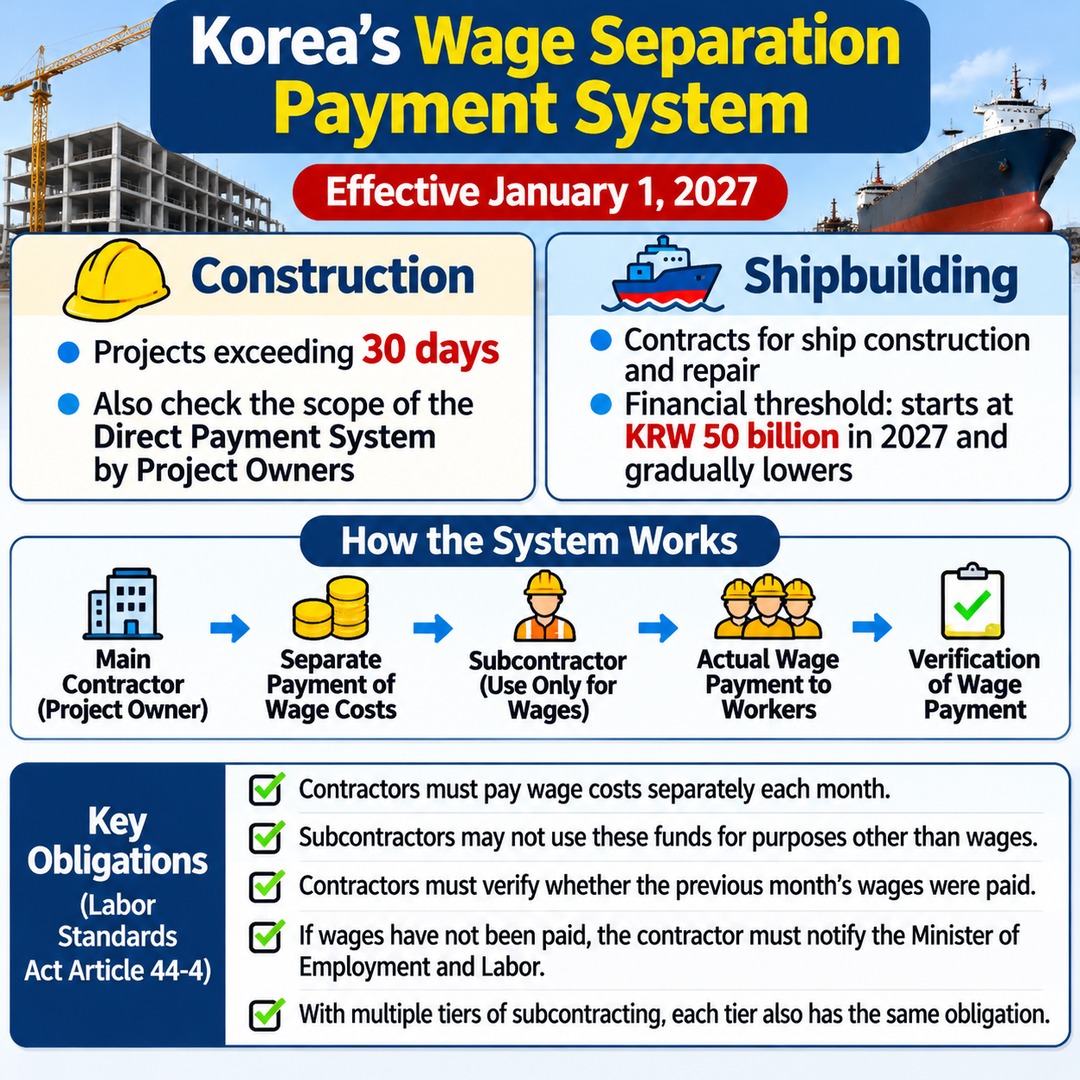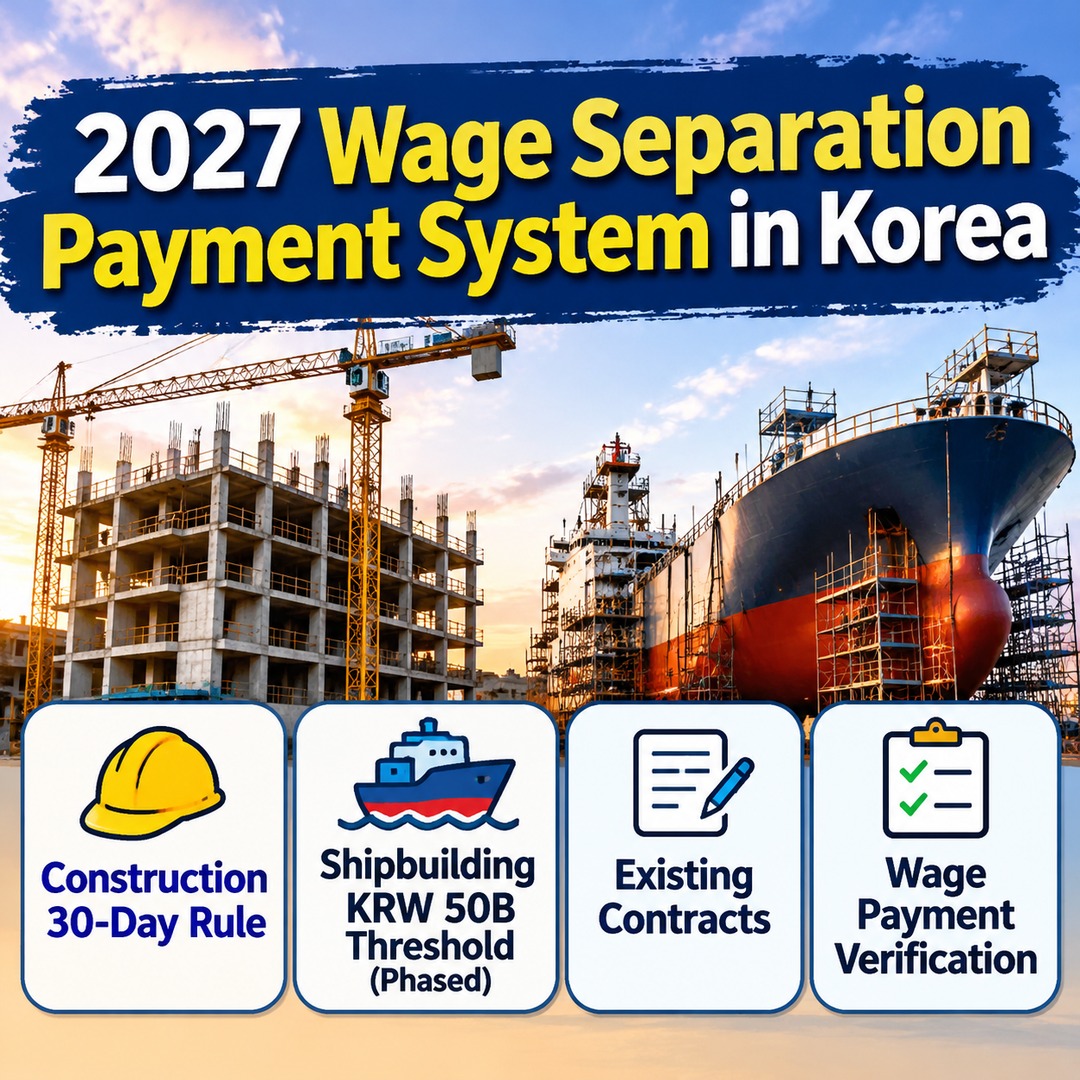
South Korea's Wage Separation Payment System will take effect on January 1, 2027, for certain subcontracting projects in the construction and shipbuilding industries. When the applicable project-duration and industry-specific financial thresholds are met, labor costs allocated to subcontracted workers' wages must be paid separately at the main contracting level, and actual wage payments must also be verified. One important point is that the system applies only to contracts awarded on or after January 1, 2027.
In construction, both the requirement that a project exceed 30 days and the scope of the Direct Payment System by Project Owners must be considered. In shipbuilding, the system covers contracts for ship construction and repair, beginning with a KRW 50 billion threshold in 2027 and gradually lowering the applicable financial threshold.
What Changes Under the Wage Separation Payment System?
The Wage Separation Payment System requires a main contractor or project owner to separately identify the portion of a construction or contract payment allocated to workers' wages when paying a subcontractor.
Unlike the previous approach, in which the entire contract payment was managed as a single amount, the new system focuses on tracking the payment flow of wage costs and verifying whether workers actually receive their wages.
Article 44-4 of South Korea's Labor Standards Act establishes the following obligations:
Contractors must pay wage costs separately each month.
Subcontractors may not use these funds for purposes other than paying wages to their employees.
Contractors must verify whether subcontractors actually paid the previous month's wages.
If a contractor confirms that wages have not been paid, the contractor must notify the Minister of Employment and Labor.
Where multiple tiers of subcontracting are involved, each immediate upper-tier contractor and lower-tier subcontractor is treated respectively as a contractor and subcontractor for these purposes.
In other words, the process does not end simply because money has been transferred from the main contractor to the subcontractor. The system also requires verification that the subcontractor has actually paid its workers.
Does the System Apply to Both Public and Private Construction Projects?
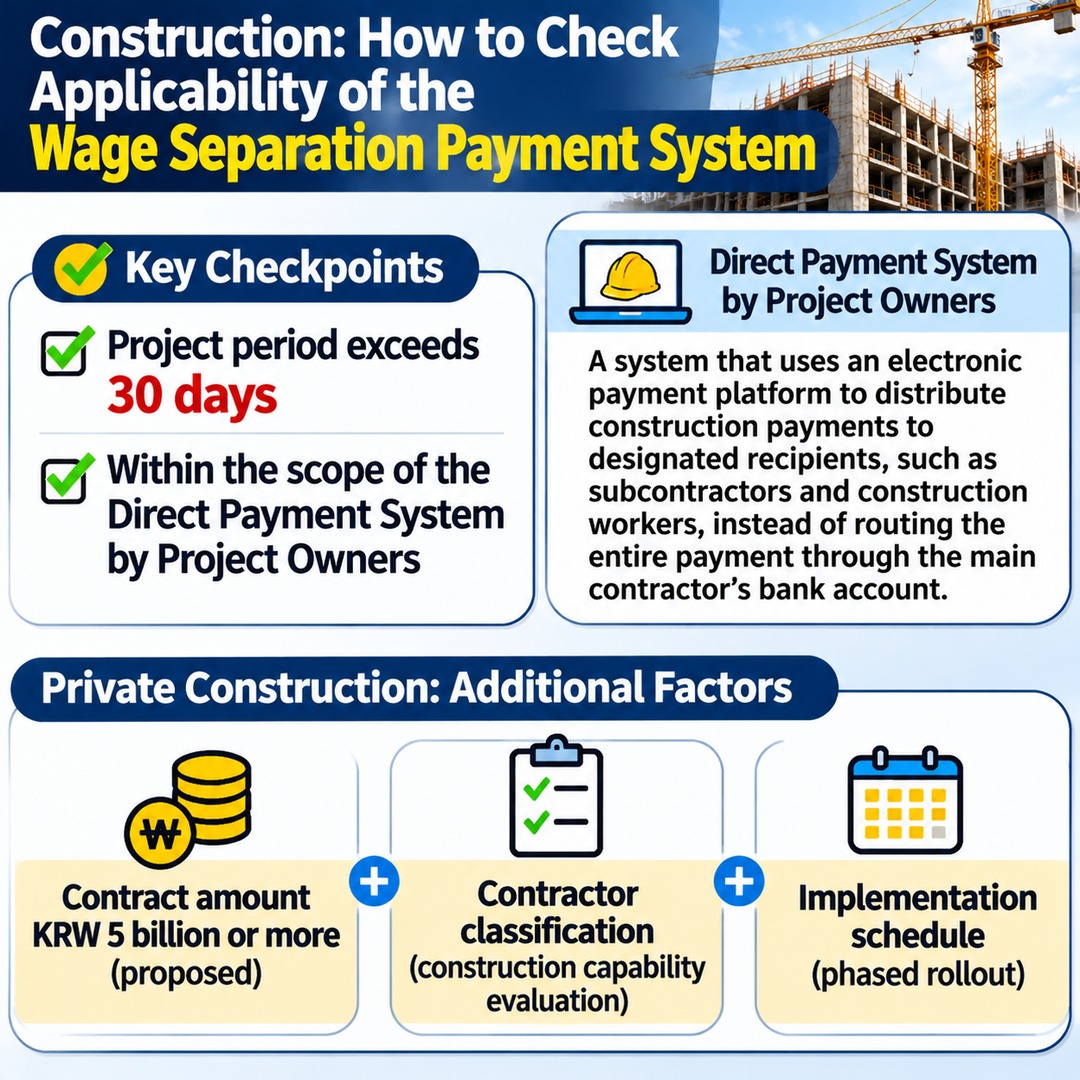
Applicability in the construction industry cannot be determined solely by whether a project is public or private. Both the requirement that the contracted project exceed 30 days and the scope of the Direct Payment System by Project Owners must be checked.
The implementation standards announced by the Ministry of Employment and Labor link the scope of the Wage Separation Payment System in construction to the Direct Payment System by Project Owners.
The Direct Payment System by Project Owners is a system that uses an electronic payment platform to distribute construction payments to designated recipients, such as subcontractors and construction workers, rather than routing the entire payment solely through the main contractor's bank account.
The following factors must be reviewed separately for construction projects:
| Item to Check | Applicable Standard |
|---|---|
| Project duration | Whether the project exceeds 30 days |
| Project owner | Public or private |
| Project size | Whether the project meets the Direct Payment System's applicability requirements |
| Payment method | Whether an electronic payment system is required or used |
| Contract date | Whether the contract was concluded on or after January 1, 2027 |
A separate financial threshold is particularly important for private construction projects.
Following amendments to the Framework Act on the Construction Industry, the obligation to use an electronic payment system is being expanded to include privately commissioned construction projects. An amendment proposed by the Ministry of Land, Infrastructure and Transport to the Enforcement Rules includes provisions covering private construction sites with contract amounts of KRW 5 billion or more.
However, this does not mean that all private construction projects will be subject to the requirement simultaneously. The proposed amendment also includes phased implementation based on contractors' construction capability evaluation results.
Therefore, the KRW 5 billion threshold alone is not sufficient to determine whether an individual project is covered. The applicable contractor classification and implementation schedule must also be checked.
Why Does Shipbuilding Start at KRW 50 Billion?
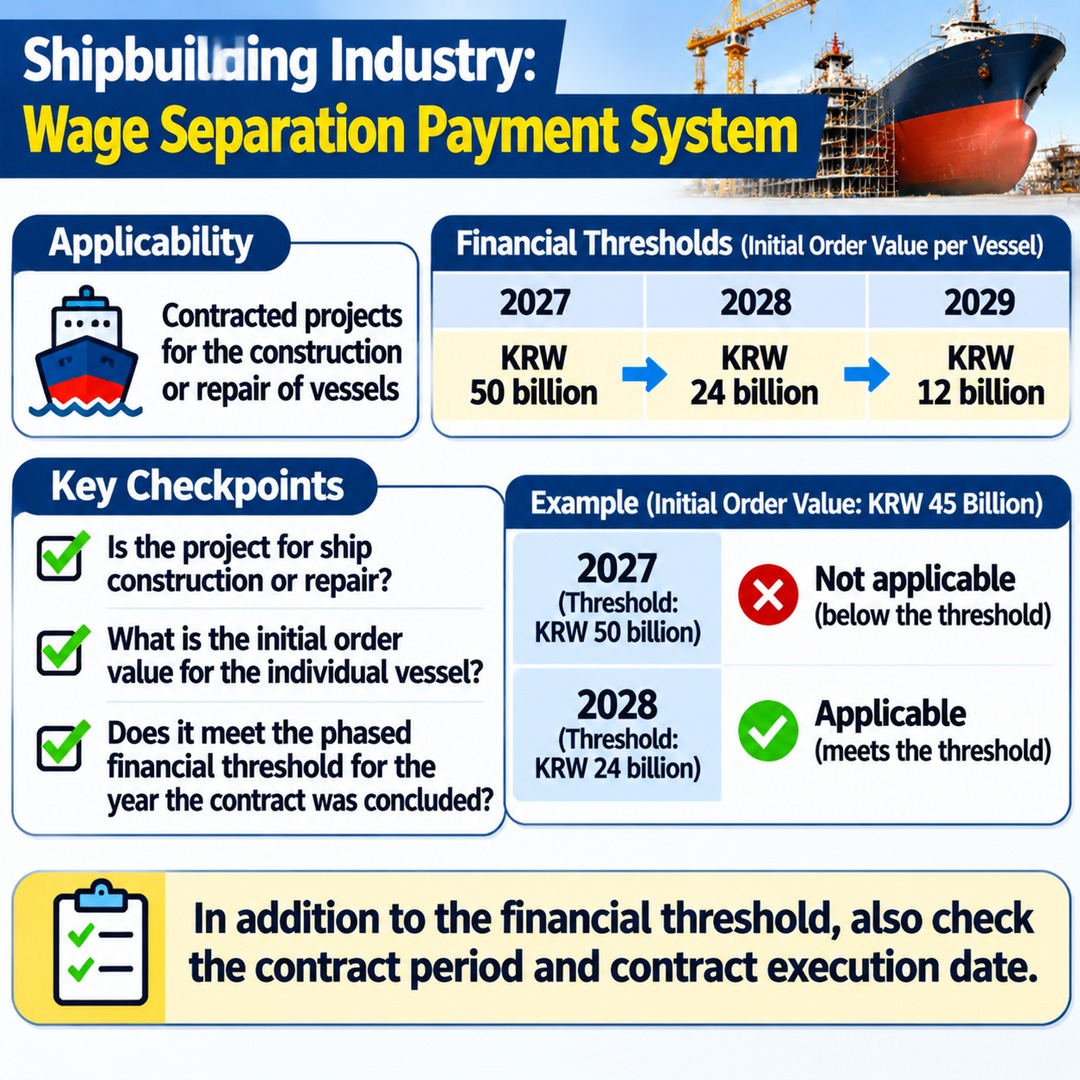
In shipbuilding, the system applies to contracted projects intended for the construction or repair of vessels. The initial order value is assessed on a per-vessel basis, with phased implementation beginning in 2027 for projects valued at KRW 50 billion or more.
Financial Thresholds for the Shipbuilding Industry
Initial order value per vessel
2027
The threshold will decrease from KRW 50 billion in 2027 to KRW 12 billion in 2029. This represents a reduction of KRW 38 billion, or 76% of the original threshold, calculated by the author.
When determining whether a project is covered, the total order value of an entire shipyard must not simply be aggregated.
Three factors must be checked:
1. Whether the contracted project is intended for ship construction or repair.
2. The initial order value for the individual vessel.
3. Whether the project meets the phased financial threshold applicable in the year the contract was concluded.
For example, a shipbuilding project with an initial order value of KRW 45 billion in 2027 would fall below the KRW 50 billion threshold for that year. However, a project with the same order value would satisfy the financial requirement if the KRW 24 billion threshold applicable in 2028 were used.
Other eligibility requirements, including the contract period and contract execution date, must also be checked in addition to the financial threshold.
Are Existing Subcontracting Agreements Also Covered?
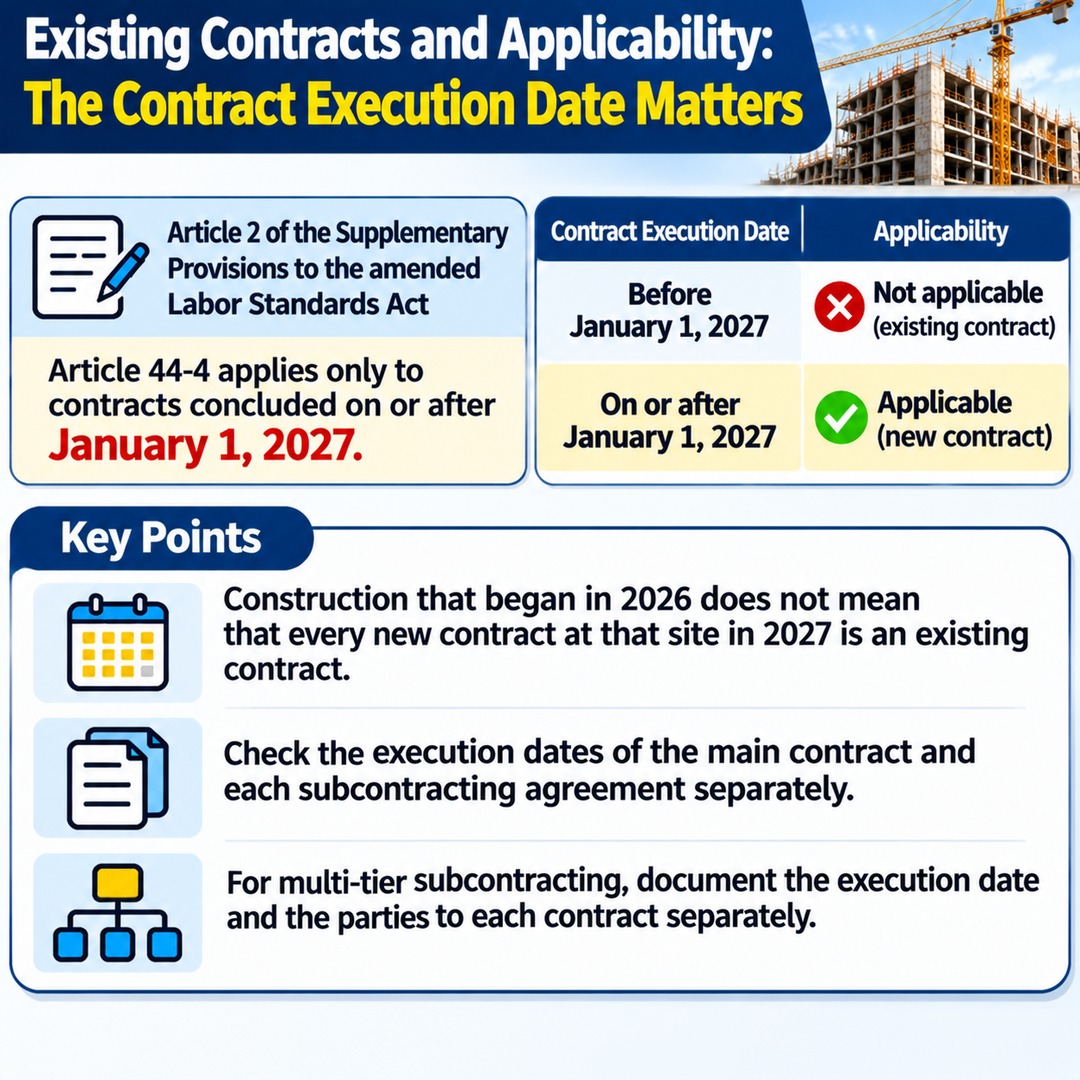
The most important distinction is the date on which the contract was concluded.
Article 2 of the Supplementary Provisions to the amended Labor Standards Act stipulates that Article 44-4 applies only to contracts concluded on or after January 1, 2027.
The following situations can therefore be assessed as follows:
| Contract Situation | Assessment |
|---|---|
| Contract concluded in December 2026 | Not covered under the new system's transitional application rules |
| New contract concluded on or after January 1, 2027 | Covered if the other applicable requirements are also met |
| Contract concluded in 2026 that continues into 2027 | The new requirements do not apply retroactively to the existing contract |
| A separate new subcontracting agreement concluded after 2027 for an existing project | The contract date and applicable scope must be assessed separately |
There is an important point to keep in mind.
The fact that construction began in 2026 does not mean that every new contract concluded at that site in 2027 can automatically be treated as an existing contract.
The execution dates of the main contract and each subcontracting agreement must be checked separately. Where multiple tiers of subcontracting are involved, it is advisable to document the execution date and the parties to each contract separately.
What Should Main Contractors and Subcontractors Prepare?
Once the system takes effect, separately managing wage costs and verifying actual wage payments will both be required.
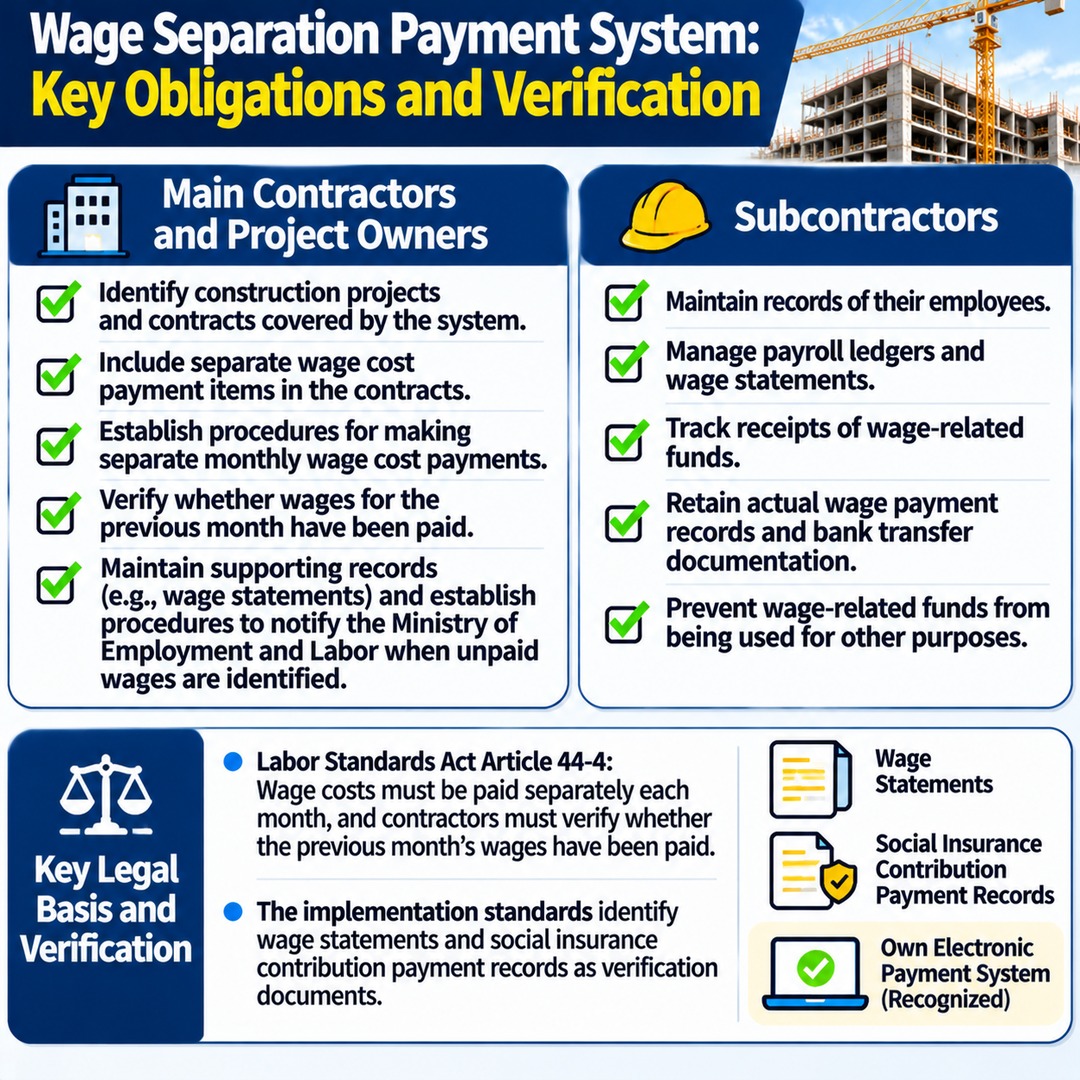
For Main Contractors and Project Owners
Identify construction projects and contracts covered by the system.
Include separate wage-cost payment items in the relevant contracts.
Establish procedures for making separate monthly wage-cost payments.
Verify whether wages for the previous month have been paid.
Maintain supporting records, including wage statements.
Establish procedures for notifying the Ministry of Employment and Labor when unpaid wages are identified.
For Subcontractors
Maintain records of their employees.
Manage payroll ledgers and wage statements.
Track receipts of wage-related funds.
Retain actual wage payment records and bank transfer documentation.
Prevent wage-related funds from being used for other purposes.
Article 44-4 of the Labor Standards Act requires wage costs to be paid separately each month and imposes an obligation on contractors to verify whether wages for the previous month have been paid.
The implementation standards announced by the Ministry of Employment and Labor also identify wage statements and social insurance contribution payment records as documents that may be used for verification.
A proposal has also been made to recognize the use of a company's own electronic payment system as satisfying the relevant obligations.
Are the Five-Day Payment Deadline and Administrative Fines Finalized?
This issue requires distinguishing between the statute itself and proposed amendments to its Enforcement Decree and Enforcement Rules.
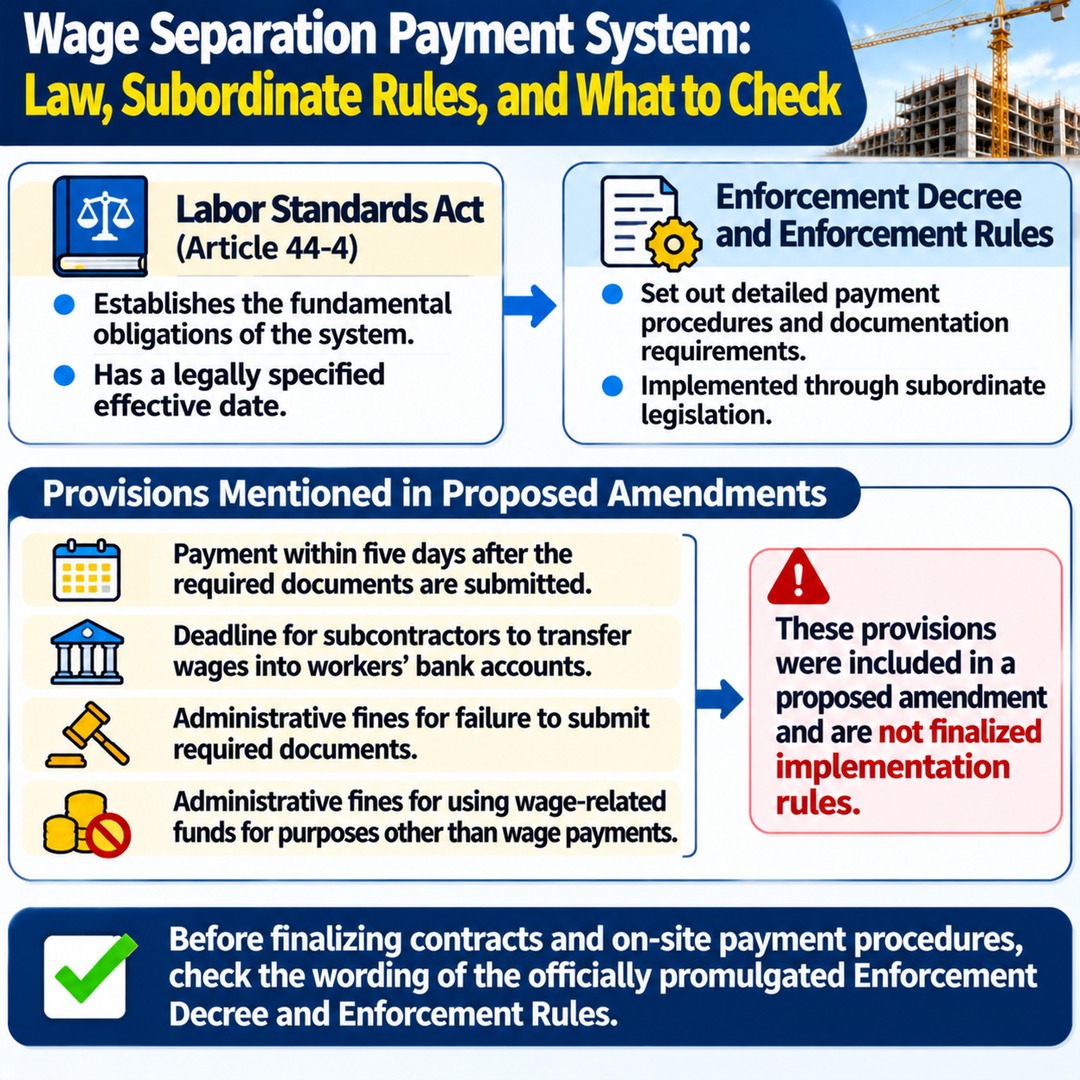
The fundamental obligations under Article 44-4 of the Labor Standards Act have been established by legislation, with a specified effective date. However, detailed payment procedures and documentation requirements have been delegated to subordinate legislation.
The following provisions mentioned in legislative notices and related explanations must be distinguished from the final promulgated regulations:
Payment within five days after the required documents are submitted.
The deadline for subcontractors to transfer wages into workers' bank accounts.
Administrative fines for failure to submit required documents.
Administrative fines for using wage-related funds for purposes other than wage payments.
The fact that these provisions appeared in a proposed amendment does not mean they can be described as finalized implementation rules.
Before finalizing contracts and on-site payment procedures, the wording of the officially promulgated Enforcement Decree and Enforcement Rules must be checked.
How to Check Whether Your Contract Is Covered
Main contractors and subcontractors managing contracts can follow these steps:
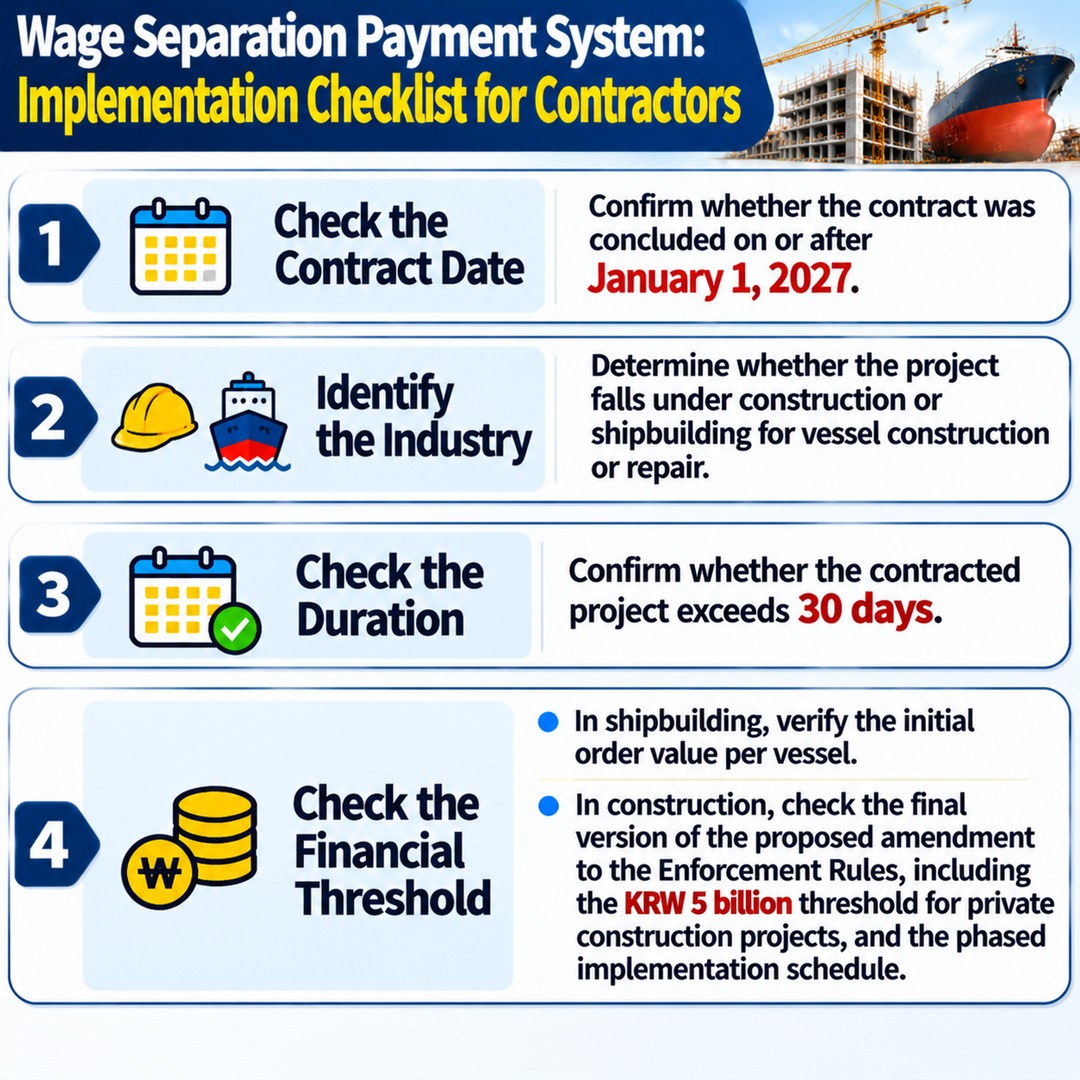
1. Check the contract date: Confirm whether the contract was concluded on or after January 1, 2027.
2. Identify the industry: Determine whether the project falls under construction or shipbuilding for the purpose of vessel construction or repair.
3. Check the duration: Confirm whether the contracted project exceeds 30 days.
4. Check the financial threshold: In shipbuilding, verify the initial order value per vessel. In construction, check whether the project falls within the scope of the Direct Payment System by Project Owners.
5. Check each subcontracting tier: Review the main contract, subcontracting agreements, and any further subcontracting agreements separately.
6. Prepare payment records: Maintain documents that demonstrate actual wage payments, including payroll ledgers, wage statements, and bank transfer records.
In particular, construction companies should check the final version of the Ministry of Land, Infrastructure and Transport's proposed amendment to the Enforcement Rules, which includes the KRW 5 billion threshold for private construction projects, along with the phased implementation schedule.
Frequently Asked Questions
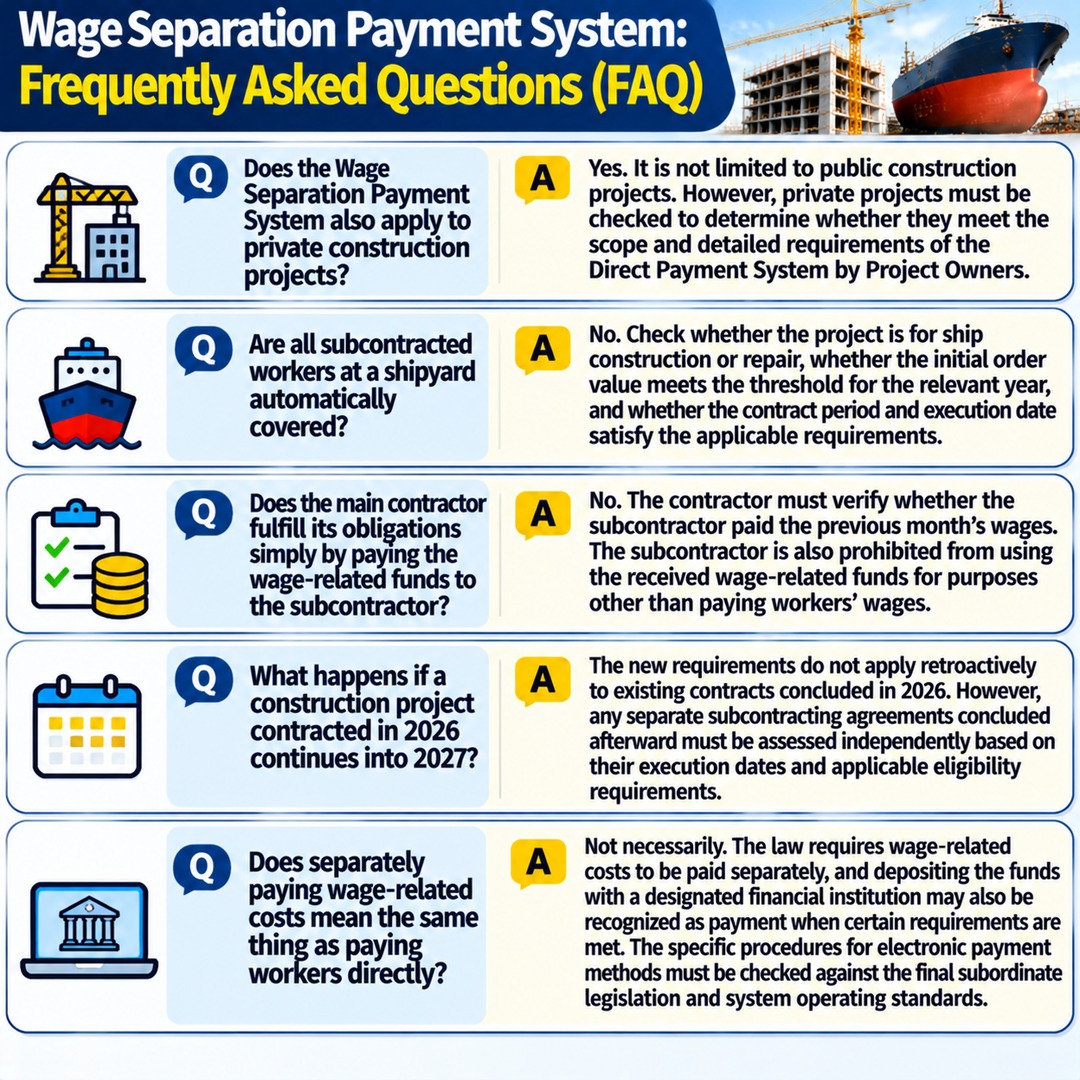
Q. Does the Wage Separation Payment System also apply to private construction projects?
Yes. It is not limited to public construction projects. However, private projects must be checked to determine whether they meet the scope and detailed requirements of the Direct Payment System by Project Owners.
Q. Are all subcontracted workers at a shipyard automatically covered?
No. It is necessary to check whether the contracted project is for ship construction or repair, whether the initial order value meets the threshold for the relevant year, and whether the contract period and execution date satisfy the applicable requirements.
Q. Does the main contractor fulfill its obligations simply by paying the wage-related funds to the subcontractor?
No. The contractor must verify whether the subcontractor paid the previous month's wages. The subcontractor is also prohibited from using the received wage-related funds for purposes other than paying workers' wages.
Q. What happens if a construction project contracted in 2026 continues into 2027?
The principle under the supplementary provisions is that the new requirements do not apply retroactively to existing contracts concluded in 2026. However, any separate subcontracting agreements concluded afterward must be assessed independently based on their execution dates and applicable eligibility requirements.
Q. Does separately paying wage-related costs mean the same thing as paying workers directly?
Not necessarily. The law requires wage-related costs to be paid separately, and depositing the funds with a designated financial institution may also be recognized as payment when certain requirements are met. The specific procedures for electronic payment methods must be checked against the final subordinate legislation and system operating standards.