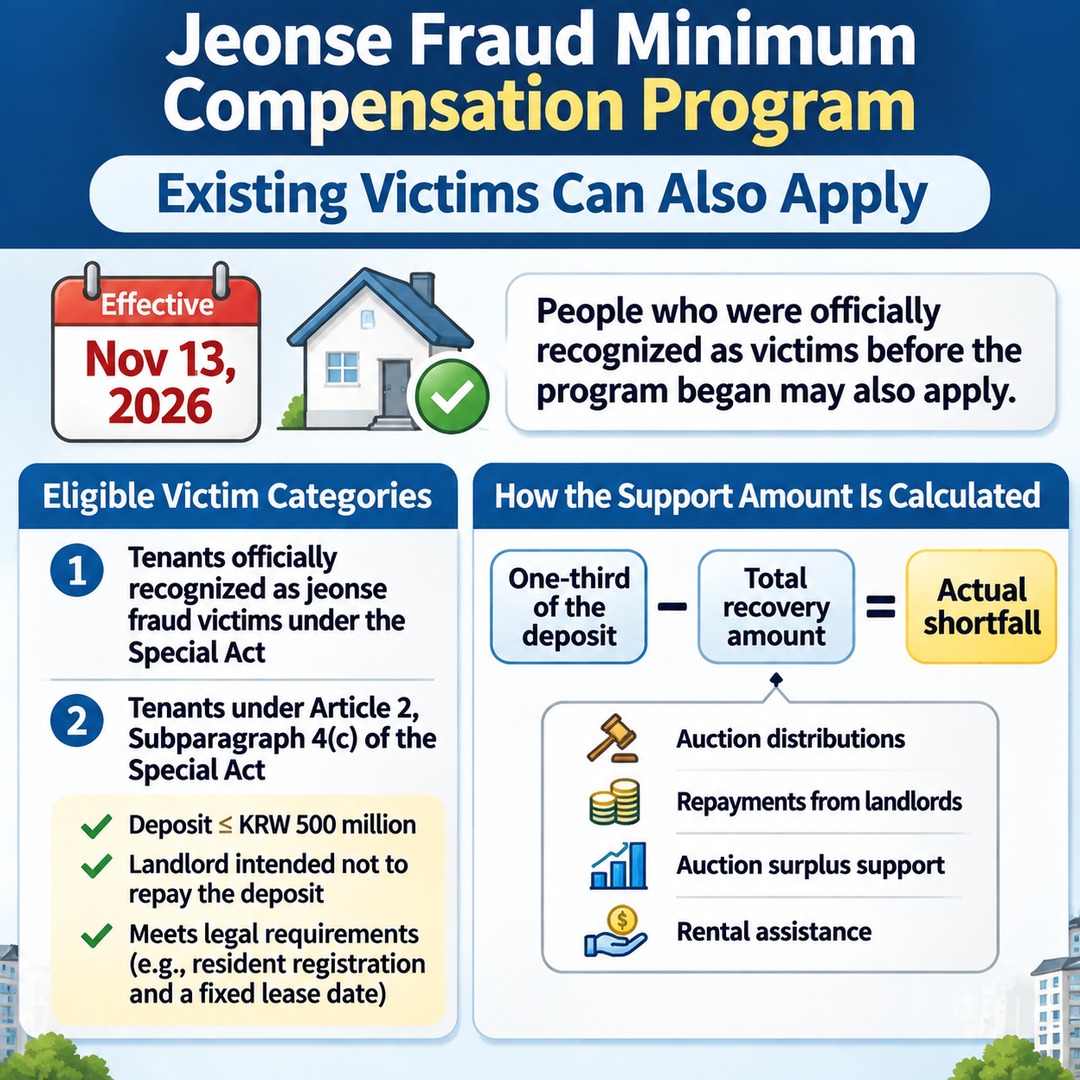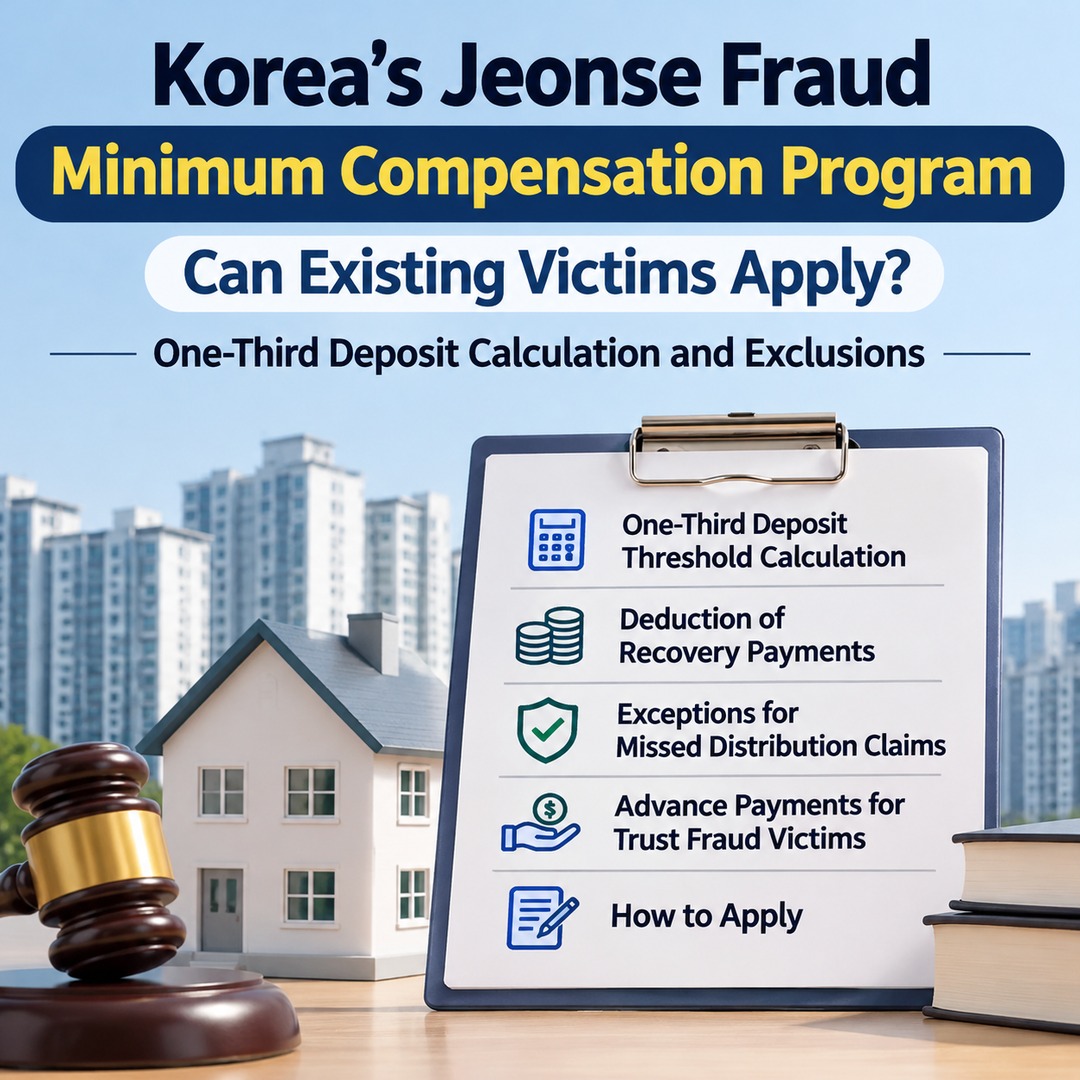
South Korea’s Jeonse Fraud Minimum Compensation Program took effect on November 13, 2026. People who were officially recognized as victims before the program began may also apply. However, the program does not automatically pay one-third of every victim’s deposit. Instead, it calculates the actual shortfall after adding auction distributions, repayments from landlords, auction-surplus support, and rental assistance. Eligibility and payment amounts depend on the type of fraud and the applicable exclusions.
Can You Apply If You Were Already Recognized as a Jeonse Fraud Victim?
Yes. Tenants who were officially recognized as jeonse fraud victims before the Minimum Compensation Program took effect may also qualify if they meet the applicable requirements.
Being recognized as a victim before November 13, 2026, does not automatically disqualify someone from receiving support.
However, two categories must be distinguished:
Tenants officially recognized as jeonse fraud victims under the Special Act on Support for Victims of Jeonse Fraud and Residential Stability
Tenants who fall under Article 2, Subparagraph 4(c) of the Special Act
The second category covers tenants whose deposits do not exceed KRW 500 million, whose landlords are confirmed to have intended not to fulfill their deposit repayment obligations, and who meet the statutory requirements, including resident registration and a fixed date for the lease agreement.
Simply being unable to recover a jeonse deposit does not automatically qualify someone for assistance. First, check the official victim classification and the amount already recovered.
How Is the One-Third Deposit Amount Calculated?
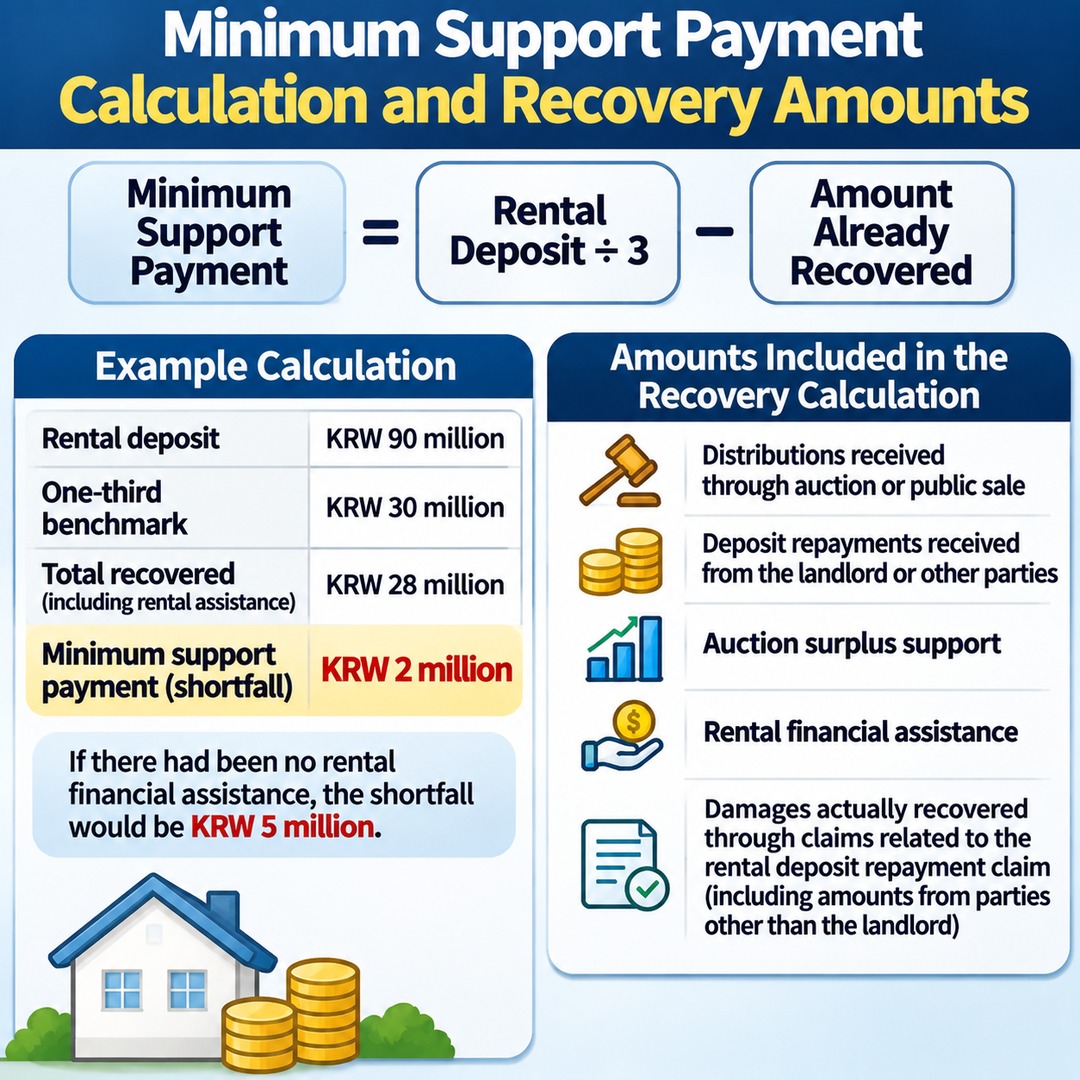
The calculation starts with one-third of the rental deposit and subtracts the amounts already recovered. Auction distributions are not the only amounts that count. Money repaid by the landlord, auction-surplus support, and rental financial assistance are also included in the recovery total.
The calculation is structured as follows:
Minimum Support Payment = Rental Deposit ÷ 3 − Amount Already Recovered
For example, if the rental deposit is KRW 90 million, the one-third minimum compensation benchmark is KRW 30 million.
| Recovery item | Amount |
|---|---|
| Rental deposit | KRW 90 million |
| Minimum compensation benchmark | KRW 30 million |
| Auction distribution | KRW 10 million |
| Repayment by landlord | KRW 0 |
| Auction-surplus support | KRW 15 million |
| Rental financial assistance | KRW 3 million |
In this example, the total amount recovered is KRW 28 million. The resulting shortfall, and the calculated minimum support payment, is KRW 2 million.
If there had been no rental financial assistance, the shortfall would instead have been KRW 5 million.
The important distinction is that auction distributions and total financial recovery are not the same thing. Because amounts recovered through other channels are also included, the final support payment may differ even when the tenant received only a small distribution from the auction.
Amounts included in the recovery calculation
Distributions received through auction or public sale
Deposit repayments received from the landlord or other parties
Auction-surplus support
Rental financial assistance
Damages actually recovered through claims related to the rental deposit repayment claim may also be reflected in the calculation, including amounts recovered from parties other than the landlord.
What Is the Difference Between Minimum Support Payments and Advance Payments?
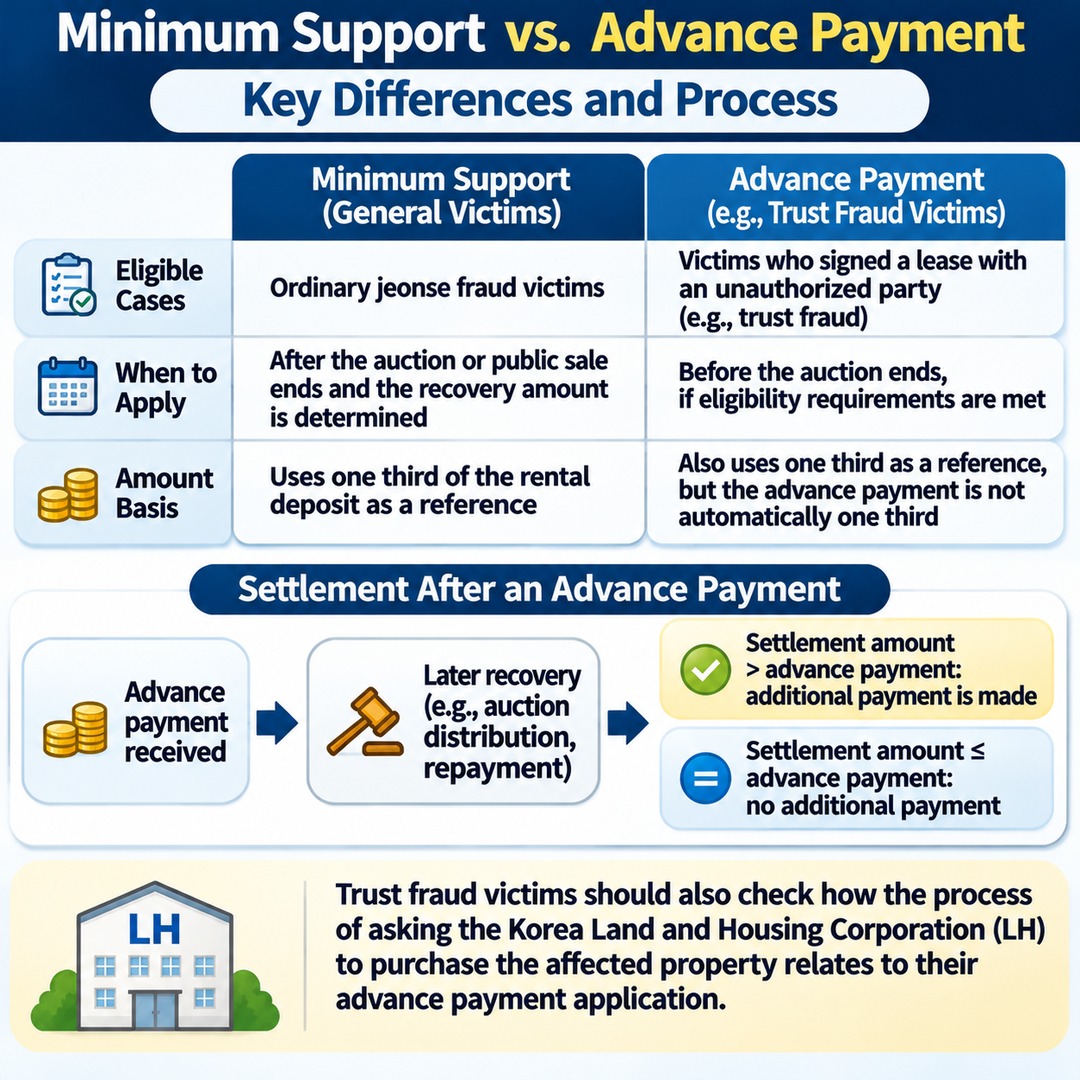
Both arrangements use one-third of the rental deposit as a reference point, but they differ in eligibility and application timing.
| Category | Minimum Support Payment | Advance Payment |
|---|---|---|
| Eligible applicants | Jeonse fraud victims and tenants under Article 2, Subparagraph 4(c) | Victims of trust fraud or unauthorized lease contracts who fall under Subparagraph 4(c) |
| Application timing | After the disposal process for the affected property has ended | Before the auction or public sale has ended |
| Payment method | Payment of the calculated shortfall | Initial payment followed by settlement |
| Main calculation factors | Auction distributions, repayments, auction surplus, and rental assistance | Repayments, rental assistance, and other applicable amounts |
As a general rule, ordinary jeonse fraud victims apply for minimum support after the auction or public sale has ended and the amount recovered has been determined.
However, victims who entered into contracts with people who lacked lawful authority to lease the property, such as in trust fraud cases, may use a separate advance payment program. They can apply for initial support before the auction ends if they meet the eligibility requirements.
The advance payment is also not automatically equal to one-third of the deposit. Amounts already repaid and rental financial assistance received before the advance payment are deducted.
A settlement process still follows the advance payment. If additional amounts subject to settlement arise later, such as auction distributions or deposit repayments, they are compared with the advance payment already received. If the settlement amount exceeds the advance payment, the difference is paid additionally. If it is equal to or less than the advance payment, no additional payment is made, and the account is settled accordingly.
Victims of trust fraud should also check how the process of asking the Korea Land and Housing Corporation (LH) to purchase the affected property relates to their advance payment application.
Who Is Excluded from the Minimum Compensation Program?
Not everyone officially recognized as a victim will receive assistance. Applicants must check their nationality, whether they acquired the affected property themselves, their history of requesting auction distributions, and whether they have already received other support.
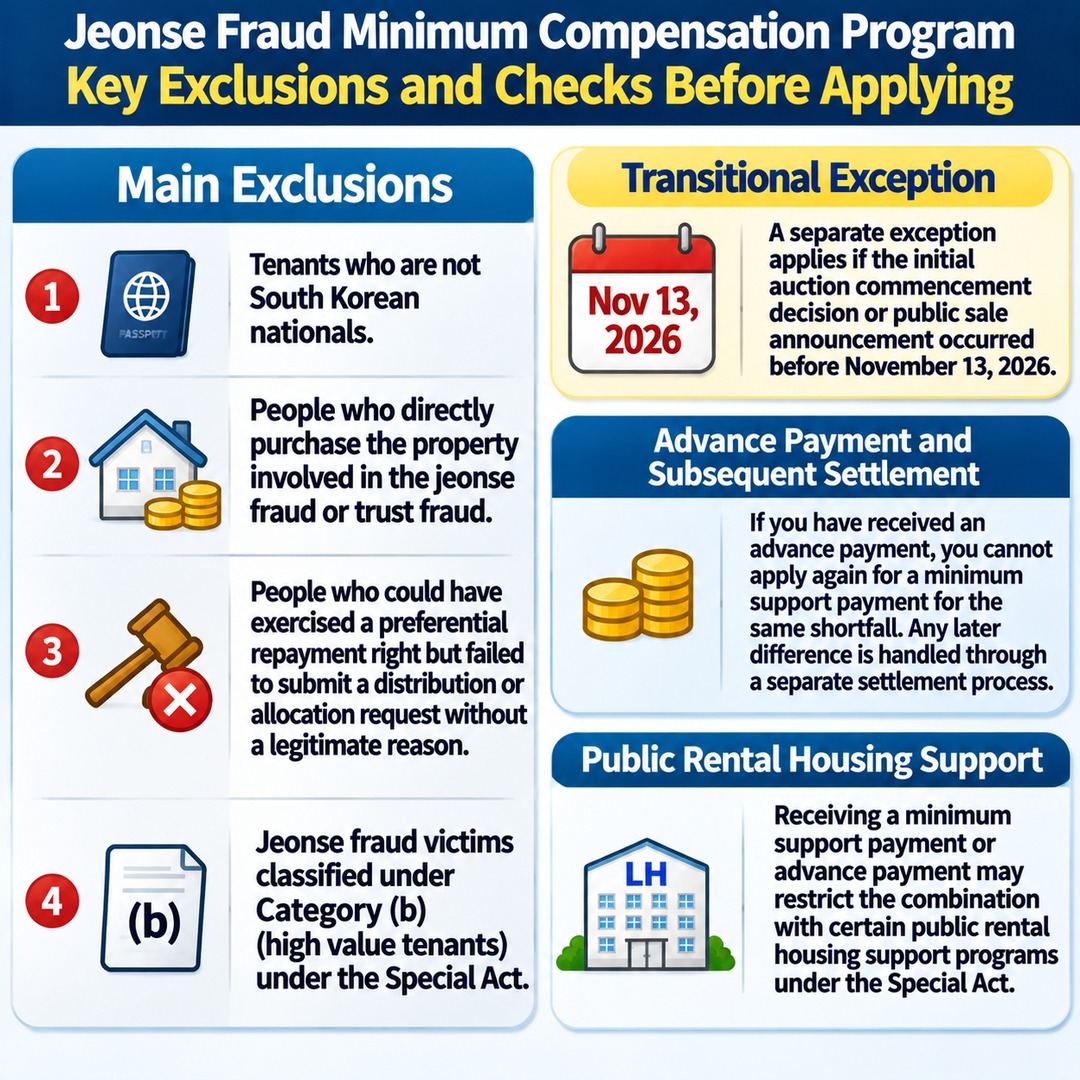
The main exclusions include:
1. Tenants who are not South Korean nationals.
2. People who directly purchase the property involved in the jeonse fraud or trust fraud that affected them.
3. People who could have exercised a preferential repayment right but failed to submit a distribution or allocation request without a legitimate reason.
4. Jeonse fraud victims classified under Category (b), which covers high-value tenants under the Special Act.
5. Separate applications for minimum support payments by people who have already received all or part of the minimum compensation as an advance payment.
The third condition deserves particular attention.
Not every previous victim is excluded simply because they failed to request an auction distribution. A transitional exception applies to cases in which the initial auction commencement decision or public sale announcement occurred before November 13, 2026.
In other words, existing victims whose auctions have already ended or who were unable to request a distribution should check the date of the initial auction commencement decision or public sale announcement.
Another important point is that someone who has received an advance payment cannot apply again for a minimum support payment covering the same shortfall. Any difference arising after the advance payment is handled through the separate subsequent settlement process.
Receiving a minimum support payment or advance payment may also restrict the recipient from combining it with certain public rental housing support programs under the Special Act. If you are already receiving LH public rental housing assistance, make sure to check how your housing support arrangements may change before receiving payment.
When and Where Should You Apply?
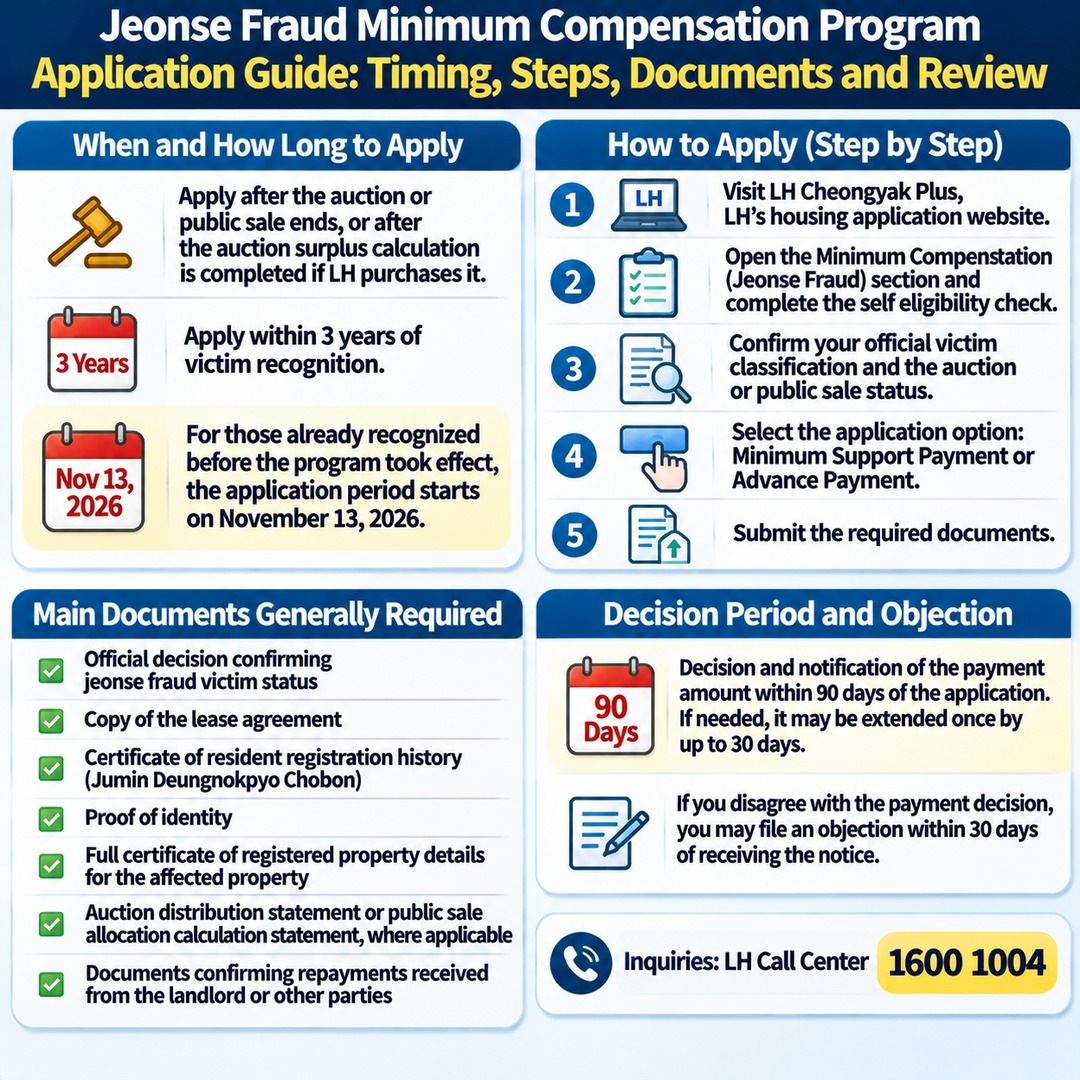
An ordinary minimum support application can be submitted after the auction or public sale process for the affected property has ended. If LH purchases the property, the application can be made after the auction-surplus calculation has been completed.
As a general rule, applications must be submitted within three years of the date the applicant was officially recognized as a victim. For people who were already recognized before the program took effect, the application period is calculated starting November 13, 2026.
Existing victims should therefore check the applicable period using the program's effective date and their victim recognition date to avoid missing the application deadline.
Follow these steps to apply:
1. Visit LH Cheongyak Plus, the Korea Land and Housing Corporation's housing application website.
2. Open the Minimum Compensation (Jeonse Fraud) section and complete the self-eligibility check before applying.
3. Confirm your official victim classification and the auction or public sale status of the affected property.
4. Select the appropriate application option: Minimum Support Payment or Advance Payment.
5. Submit the application and supporting documents.
Application website
Use the Minimum Compensation (Jeonse Fraud) section on LH Cheongyak Plus.
The documents generally required include:
Official decision confirming jeonse fraud victim status
Copy of the lease agreement
Certificate of resident registration history (Jumin Deungnokpyo Chobon)
Proof of identity
Full certificate of registered property details for the affected property
Auction distribution statement or public sale allocation calculation statement, where applicable
Documents confirming repayments received from the landlord or other parties, where applicable
Copy of a bank account statement or bankbook in the applicant's name
Trust register (Sin-tak Wonbu) for victims of trust fraud
Additional documents may be requested depending on the applicant's type of victimization and the status of the property's disposal process.
LH will determine and notify the applicant of the payment decision and amount within 90 days of the application date. If an extension is unavoidable, such as when additional documents are required, the period may be extended once by up to 30 days. If you disagree with the payment decision, you may file an objection within 30 days of receiving the notice.
For inquiries, contact the LH Call Center at 1600-1004.
What Existing Victims Should Check Before Applying
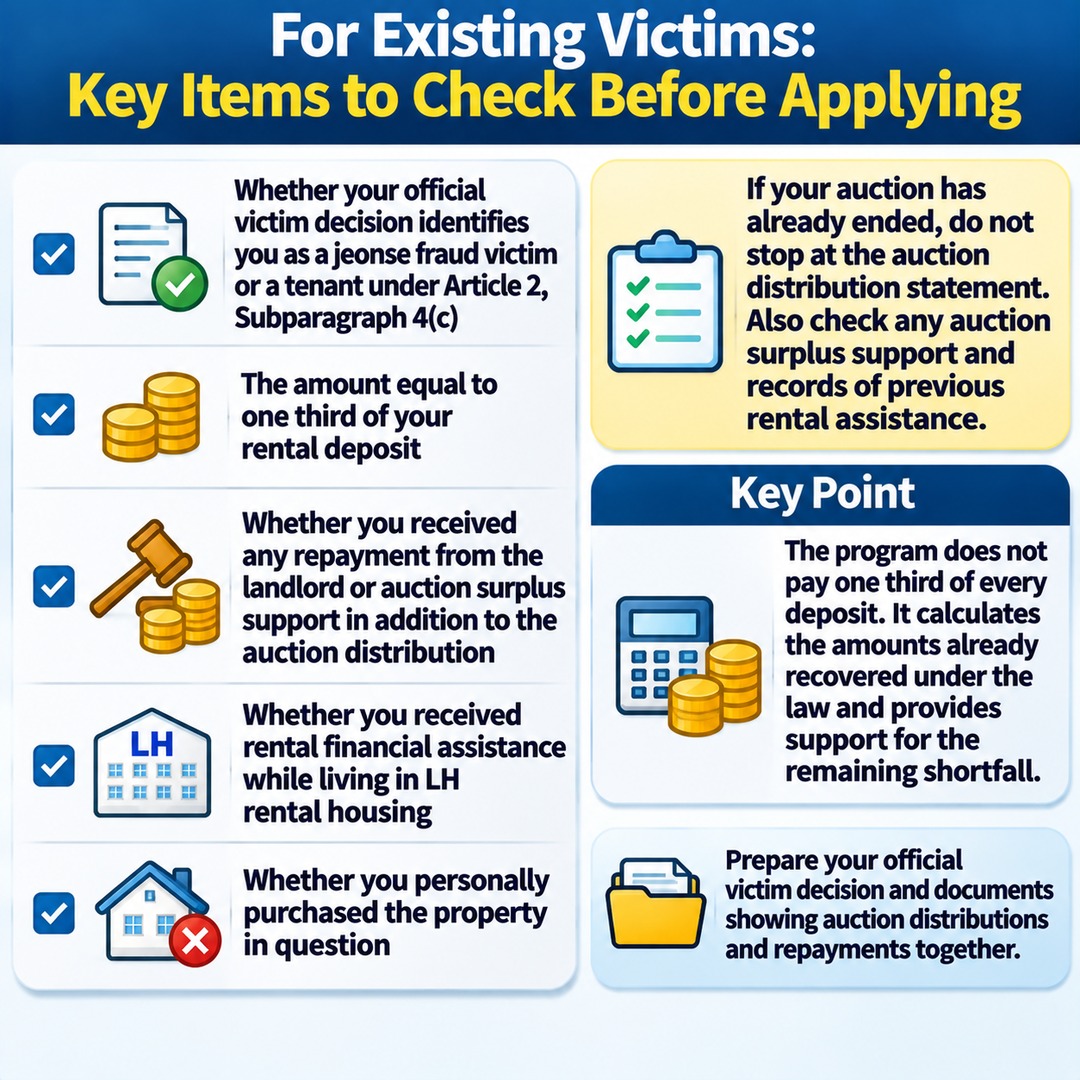
If you have already been recognized as a jeonse fraud victim or your property's auction has ended, check the following information first:
Whether your official victim decision identifies you as a jeonse fraud victim or a tenant under Article 2, Subparagraph 4(c)
The amount equal to one-third of your rental deposit
Whether you received any repayment from the landlord or auction-surplus support in addition to the auction distribution
Whether you received rental financial assistance while living in LH rental housing
Whether you personally purchased the property affected by the fraud
Whether you submitted an auction distribution or public sale allocation request, and the date of the initial auction commencement decision
Whether you have previously received an advance payment under the Minimum Compensation Program
Your victim recognition date and the applicable application period
In particular, existing victims whose auctions have already ended should not stop at preparing the auction distribution statement. They should also check any auction-surplus support and records of previous rental assistance.
The key point of the Minimum Compensation Program is not that every victim receives the same payment equal to one-third of their deposit. Instead, the program calculates the amounts already recovered under the categories specified by law and provides support for the remaining shortfall. Preparing your official victim decision and documents showing auction distributions and repayments together is therefore essential to determining whether you qualify and how much support you may receive.