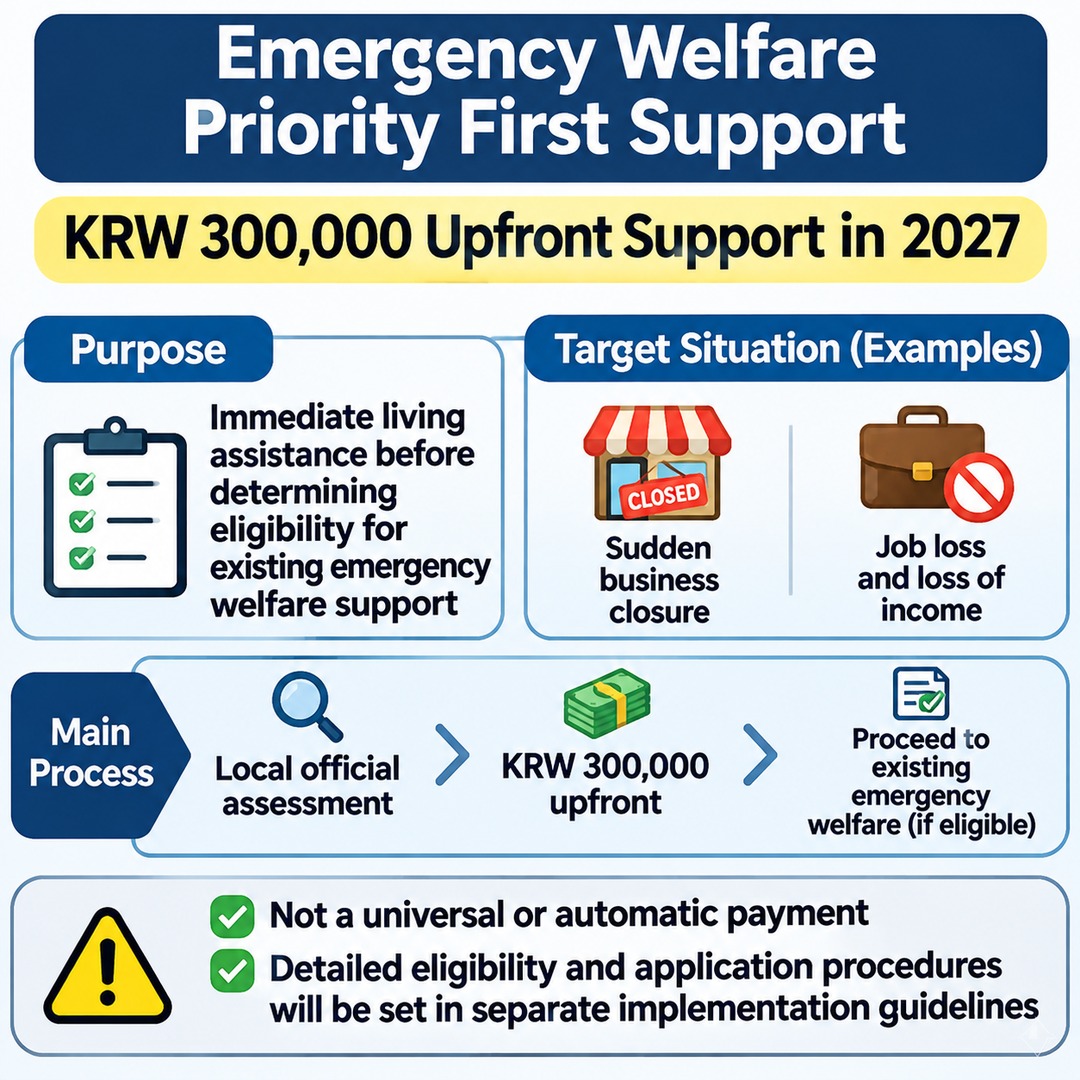

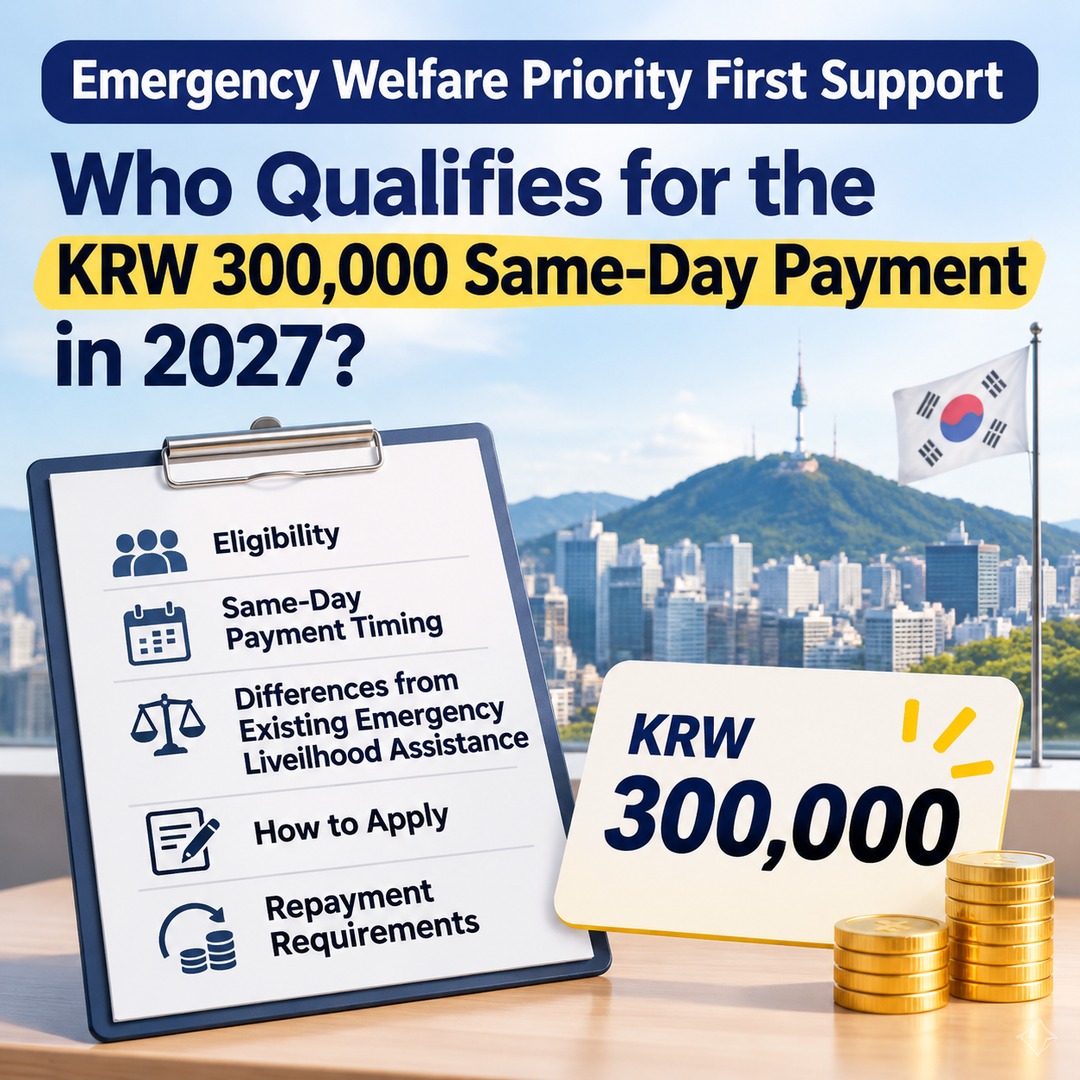
A new support measure called Emergency Welfare Priority First Support is being planned for 2027 to provide KRW 300,000 upfront to households facing an immediate financial crisis, such as sudden business closure or job loss, that leaves them unable to cover basic living expenses or medical bills. Under the proposed system, local government officials in eup, myeon, and dong administrative districts will assess the household's circumstances in person. If they determine that urgent assistance is necessary, the payment may be issued on the same day, even before a decision on existing emergency livelihood assistance has been made.
However, this is not a payment available to everyone. It will not be distributed automatically based solely on income or asset thresholds. The actual circumstances of the crisis and the responsible official's assessment will be important. Detailed eligibility requirements and application procedures still need to be established through separate implementation guidelines.
What Is Emergency Welfare Priority First Support?
Emergency Welfare Priority First Support is a proposed program that provides a small amount of immediate living assistance before a household's eligibility for existing emergency welfare livelihood assistance has been formally determined.
The program was included in the Fourth Comprehensive Plan for Basic Livelihood Security (2027–2029), announced by South Korea's Ministry of Health and Welfare on November 23, 2026. The government plans to launch the program in 2027.
For example, consider a household that suddenly loses its income because a business closes or a family member loses their job. If the household cannot afford essential groceries or medical expenses, a local government official may assess its living conditions and determine whether immediate assistance is necessary. If the situation qualifies, KRW 300,000 would be provided upfront.
If the household subsequently meets the eligibility requirements for existing emergency welfare assistance, it may proceed through the formal emergency welfare process and receive additional support.
The important distinction is that Priority First Support is not intended to replace the existing program. It is a separate preliminary assistance procedure designed to reduce the financial gap that can arise while an existing support decision is pending.
Who May Receive the KRW 300,000 Payment on the Same Day?
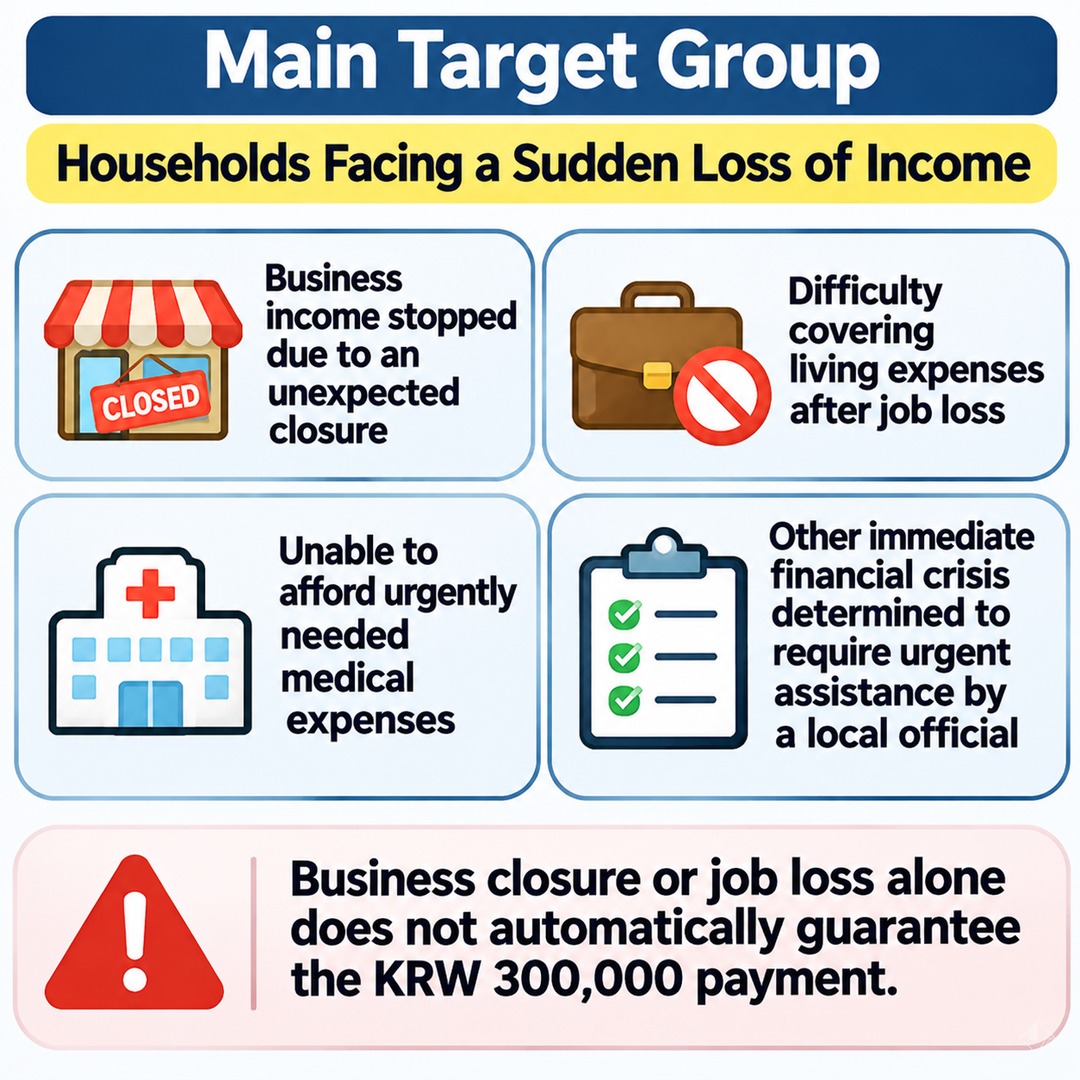
According to the currently announced plan, the main target group consists of households experiencing a sudden loss of income due to circumstances such as business closure or unemployment, leaving them unable to cover immediate living expenses or medical bills.
The following situations may be considered when assessing the need for assistance:
Households whose business income has stopped because of an unexpected business closure.
Households struggling to cover living expenses after losing employment.
Households unable to afford urgently needed medical expenses.
Households facing an immediate financial crisis that local government officials in their eup, myeon, or dong district determine requires urgent assistance.
One important point needs to be emphasized: simply having closed a business or lost a job does not guarantee payment of KRW 300,000.
According to the government's announcement, local officials will examine the household's actual living conditions and assess the urgency of its circumstances. Therefore, even people experiencing similar situations, such as unemployment, may receive different assessments depending on their financial circumstances and the level of assistance they need.
The published plan does not yet establish specific income or asset ceilings or payment conditions based on household size. The detailed guidelines will also need to clarify which circumstances beyond business closure and unemployment may qualify.
How Does It Differ from Existing Emergency Welfare Livelihood Assistance?
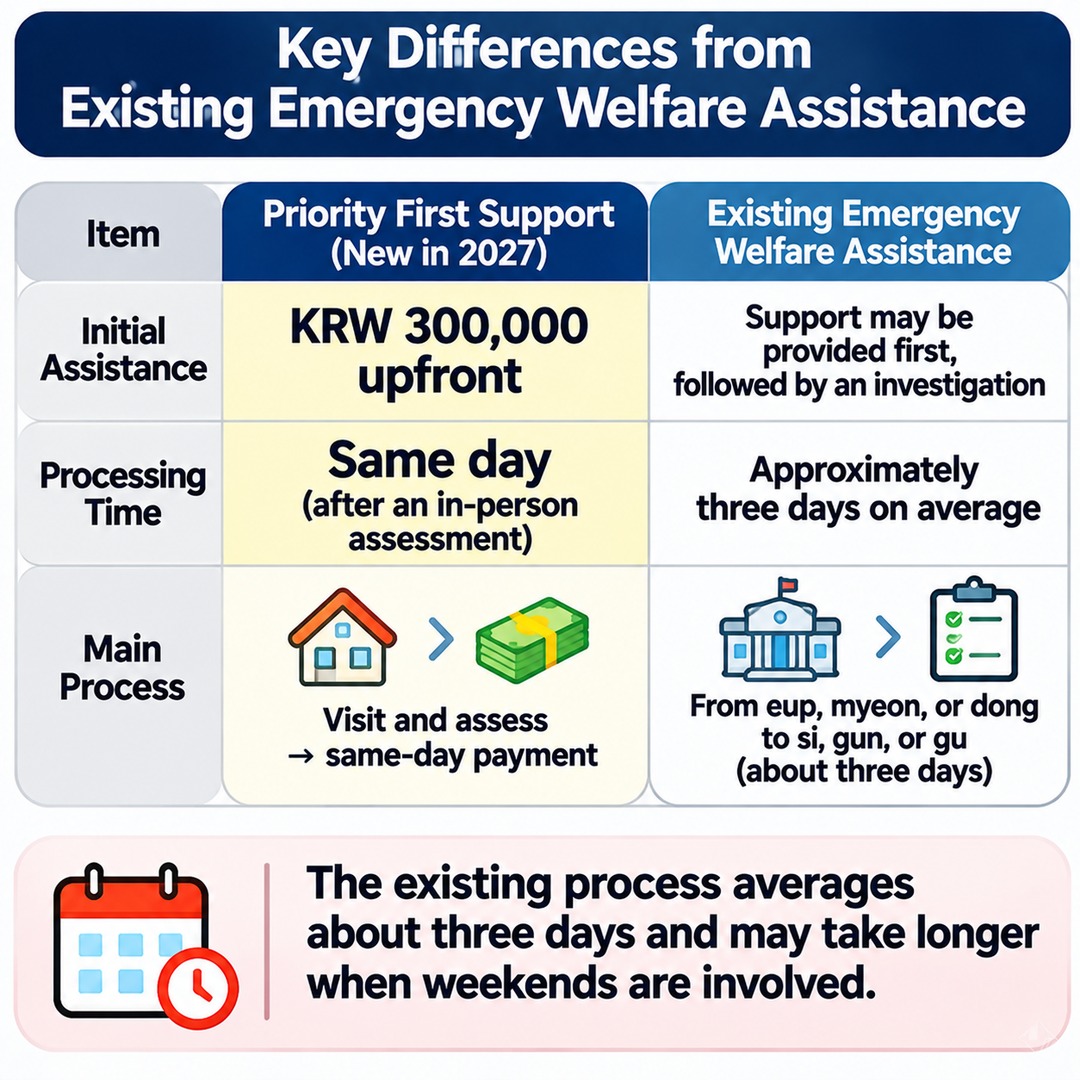
The biggest differences concern the initial assistance process and how long applicants may have to wait. Existing emergency welfare assistance takes an average of approximately three days to process through the administrative procedure from the eup, myeon, or dong level to the si, gun, or gu level. Priority First Support aims to provide KRW 300,000 on the same day after an in-person assessment.
| Comparison | Existing Emergency Welfare Assistance | Priority First Support |
|---|---|---|
| Purpose | Support for crisis-affected households, including livelihood and medical assistance | Address immediate gaps in essential living expenses |
| Initial assistance | Follows the emergency welfare assistance decision process | KRW 300,000 provided upfront |
| Processing time | Approximately 3 days on average | Same-day payment is the target after an in-person assessment |
| Decision-making authority | Administrative agencies responsible for existing emergency welfare assistance | Local officials at the eup, myeon, or dong level |
| Subsequent procedure | Assistance decision and provision of benefits | Referral to the existing emergency welfare assessment and assistance process |
Existing emergency welfare assistance also operates under a system in which support may be provided first, followed by an investigation. The new element introduced by Priority First Support is the provision of a small initial payment at the local administrative level without waiting for a formal emergency welfare assistance decision.
The government has explained that the existing procedure takes approximately three days on average as applications move from the eup, myeon, or dong level to the si, gun, or gu level. The process may take longer when weekends are involved.
Priority First Support is designed to enable an official to visit the household, assess its living conditions, determine whether immediate assistance is necessary, and arrange payment on the same day.
Can You Also Receive Existing Emergency Welfare Assistance After Getting KRW 300,000?
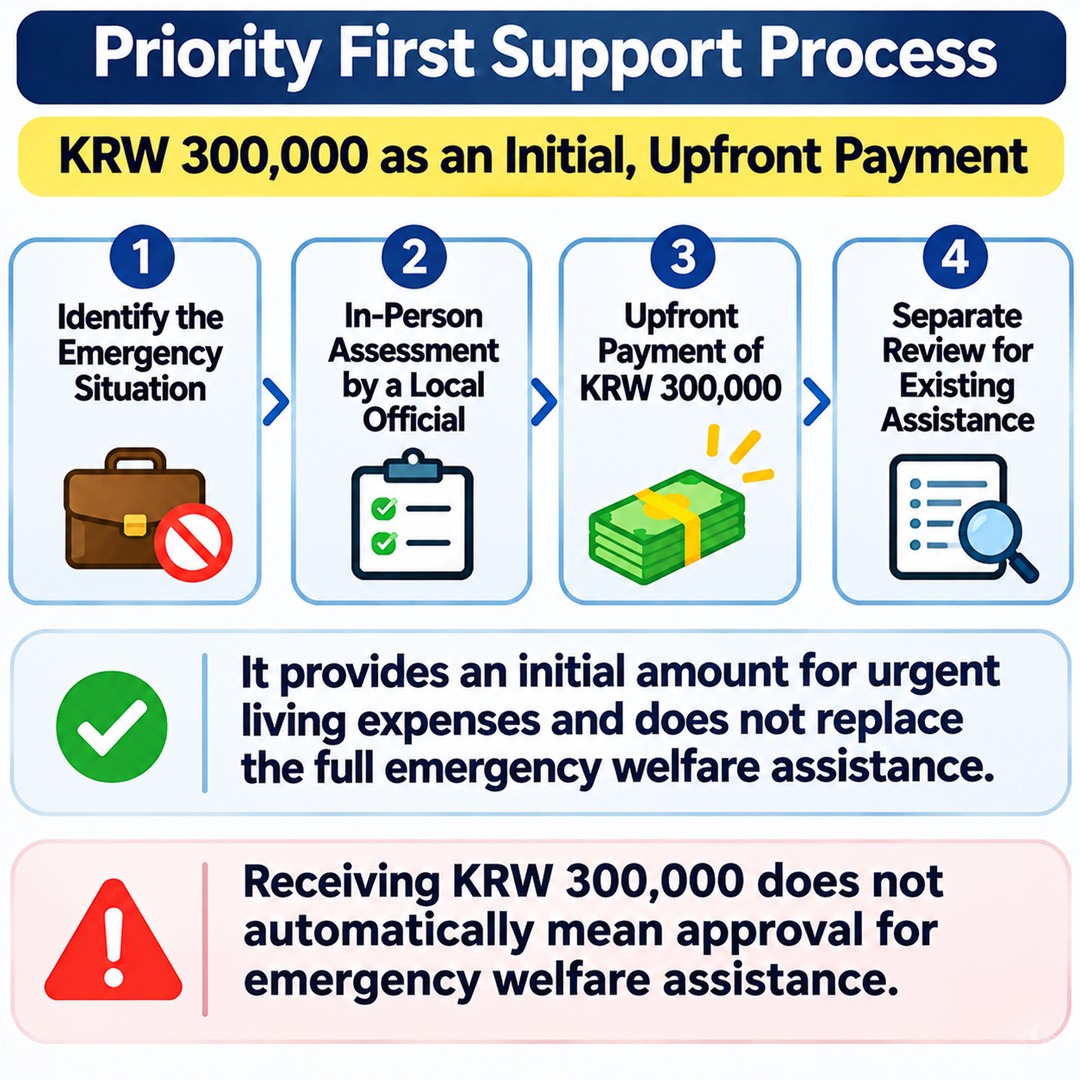
That is the basic approach outlined in the government's plan. The KRW 300,000 Priority First Support payment is not intended to replace the full amount of existing emergency welfare livelihood assistance. Instead, it is designed to provide an initial amount needed before a formal assistance decision is made.
The government has described the following process:
1. Identify the emergency situation: Report circumstances such as sudden business closure or unemployment that have left the household unable to cover living expenses or medical bills.
2. In-person assessment by a local official: An official examines the household's actual living conditions and determines whether immediate assistance is necessary.
3. Upfront payment of KRW 300,000: If the situation is considered urgent, the payment is provided before a decision on existing emergency welfare assistance.
4. Referral to the existing emergency welfare process: If the household meets the eligibility requirements for existing emergency welfare assistance, it proceeds to the relevant additional support procedures.
Receiving the KRW 300,000 payment does not automatically mean that the household will subsequently be approved for emergency welfare livelihood assistance. Eligibility under the existing program must be assessed separately.
It is also important not to interpret the KRW 300,000 as additional cash that everyone can receive on top of all other benefits. The government's explanation describes it as an advance payment covering part of the household's immediate living expenses.
Where Can You Apply, and What Documents Should You Prepare?
The currently announced information does not yet specify the final application documents or whether online applications will be available. The government has stated that it will develop and share detailed guidelines for local officials to use when assessing households in person.
Before the program begins, it may be helpful to check the following:
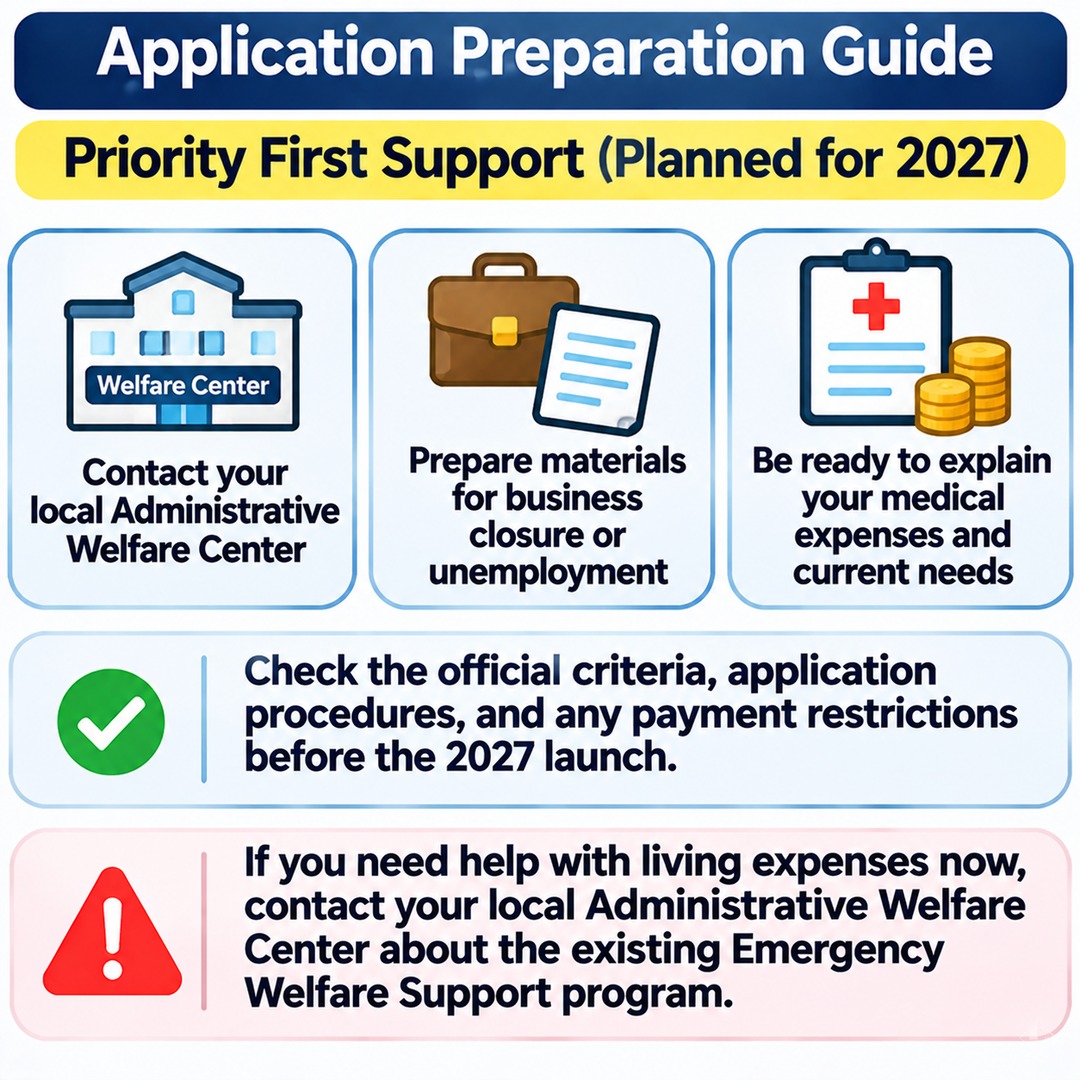
Contact the welfare department at your local eup, myeon, or dong Administrative Welfare Center to ask whether Priority First Support has been introduced.
If your income has stopped because of business closure or unemployment, prepare documents that can help explain and substantiate your circumstances.
If you cannot afford medical expenses, be ready to explain the financial burden and the assistance you currently need.
Prepare documents that can help establish your household's income, assets, and current living conditions.
These are examples of materials that may help you prepare for a consultation. They are not an officially confirmed list of mandatory documents for Priority First Support.
In particular, before the planned 2027 launch, applicants should check the official criteria used by public officials, the specific procedures for individual applications and proactive identification of households in crisis, and any payment restrictions.
If you are currently unable to cover essential living expenses, you do not need to wait for Priority First Support to begin in 2027. Your first step should be to contact the Administrative Welfare Center in your area about applying for or receiving advice on the existing Emergency Welfare Support program.
Will You Have to Repay the KRW 300,000 If You Are Found to Have Received It Improperly?
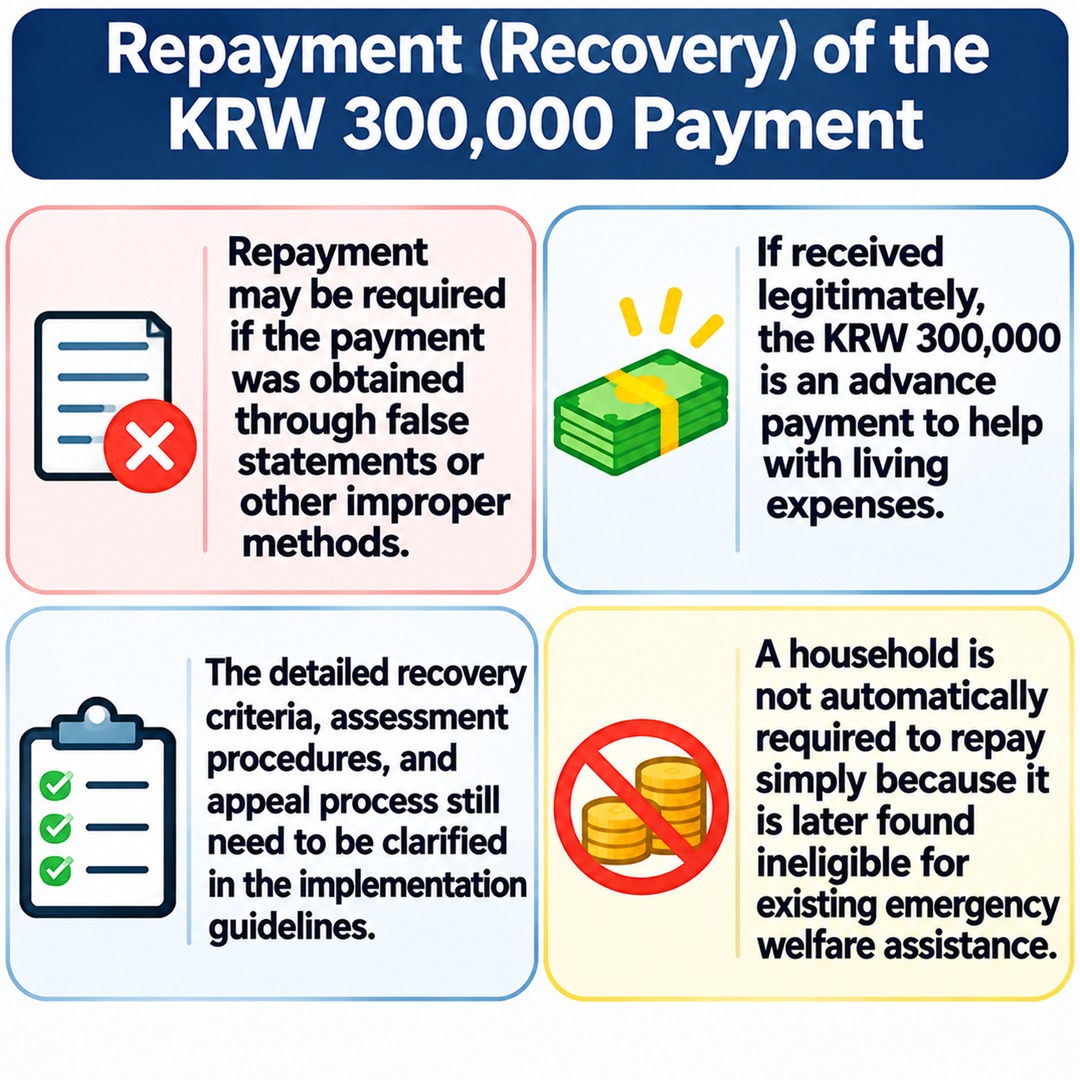
Repayment may be required if the payment was obtained through false statements or other improper methods.
The government has explained that because Priority First Support provides money upfront, a subsequent finding that someone received the payment through false information or improper means may result in a determination of improper benefit receipt and recovery of the funds.
By contrast, where assistance was received legitimately, the KRW 300,000 is intended as an advance payment covering part of the household's living expenses.
However, the detailed recovery criteria, assessment procedures, and appeal process still need to be clarified in the implementation guidelines. A household cannot automatically be classified as having improperly received benefits, or as being subject to repayment, simply because it is later found ineligible for existing emergency welfare assistance.
Key Conditions to Check Before the 2027 Launch
For Priority First Support, determining which households are experiencing an urgent crisis is just as important as the amount of assistance. The government has also stated that it will establish consistent assessment standards because local officials will exercise a degree of discretion when making decisions.
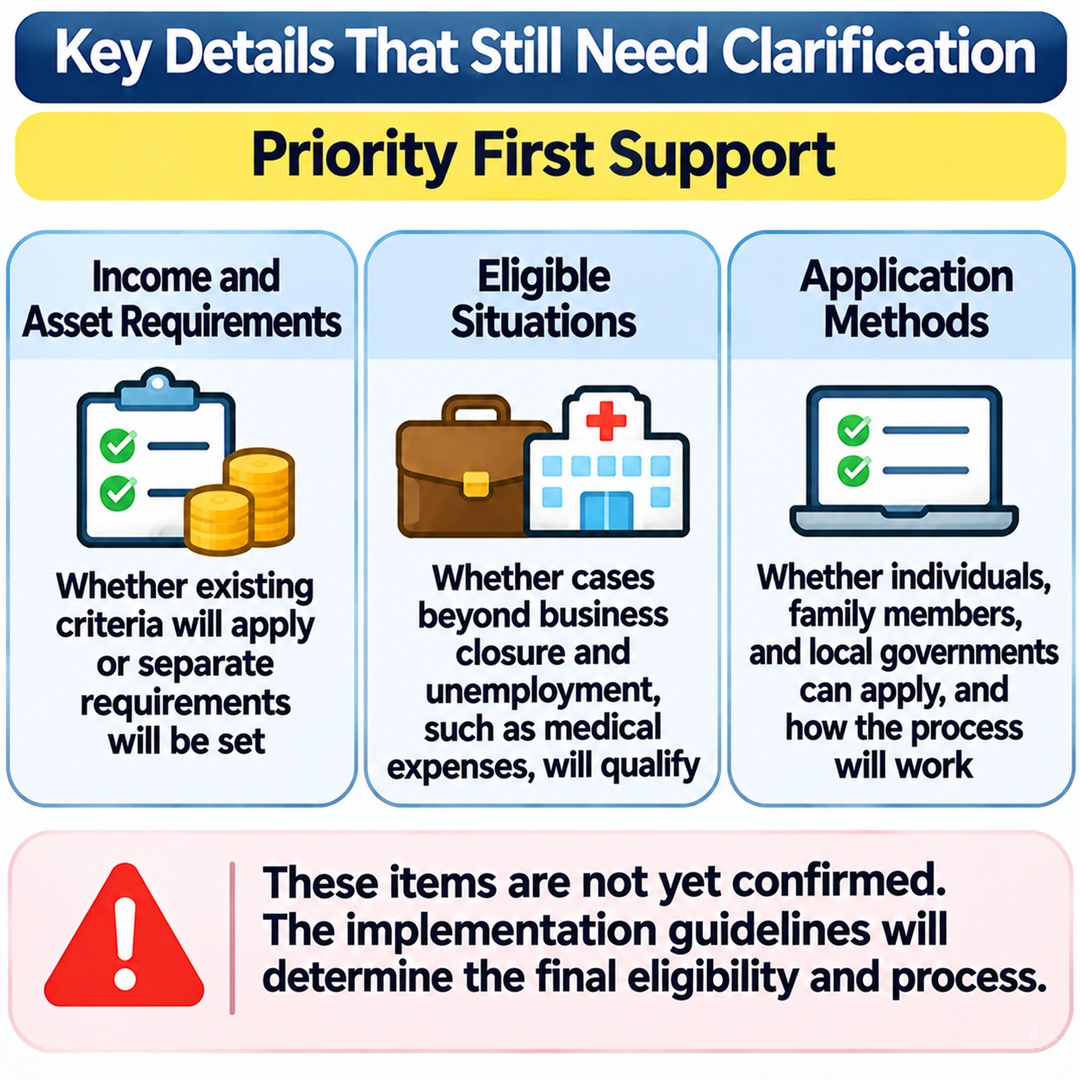
The following details still need official clarification:
1. Income and asset requirements: Whether the existing emergency welfare income and asset criteria will apply unchanged or whether Priority First Support will have separate requirements.
2. Eligible situations: Whether circumstances beyond business closure and unemployment, including medical expenses and other livelihood crises, will qualify.
3. Application methods: Whether individuals, family members, and local government officials identifying households in crisis can each initiate the process.
4. Payment restrictions: Whether there will be limits on the number of payments per household or restrictions on repeated assistance.
5. Relationship with existing benefits: How the KRW 300,000 payment will be accounted for when a decision is made on existing emergency welfare livelihood assistance.
6. Recovery procedures: The standards for determining improper benefit receipt, recovering payments, and handling appeals.
These details are not yet confirmed regulations under the currently announced plan. Once the implementation guidelines are published, they will be important for determining whether a household can actually receive assistance.
Frequently Asked Questions
Q. Can I apply for the KRW 300,000 Emergency Welfare Priority First Support payment in November 2026?
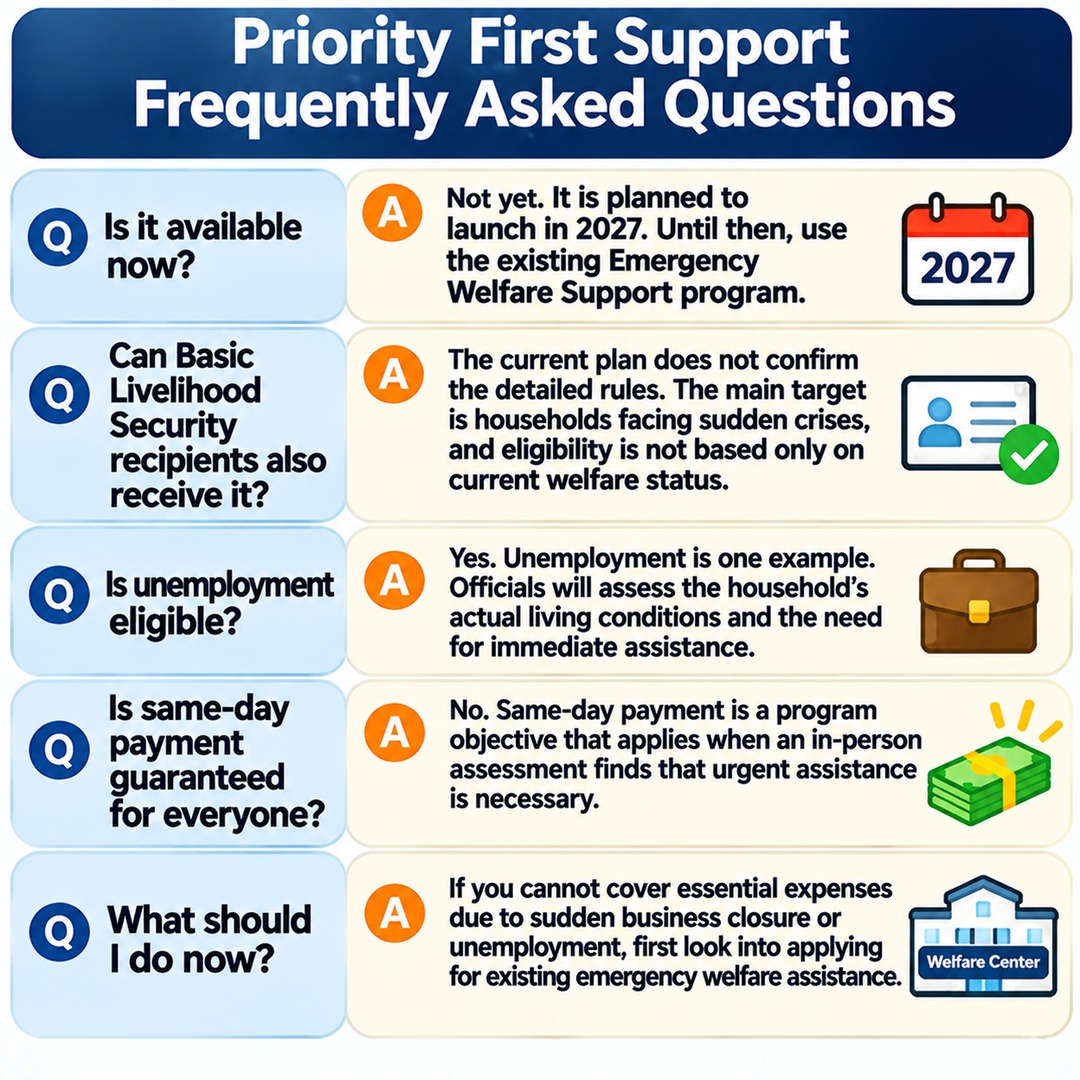
Not yet. The announced plan is to launch the program in 2027. Until then, people in need should use the existing Emergency Welfare Support program.
Q. Can Basic Livelihood Security recipients also receive Priority First Support?
The current announcement does not contain detailed rules confirming whether recipients of South Korea's Basic Livelihood Security program can receive this payment. The government has identified households facing sudden crises as the main target group. Eligibility cannot be determined solely by whether someone already receives existing welfare benefits.
Q. Will I automatically receive KRW 300,000 if I lose my job?
No. Unemployment is one example of an emergency situation identified by the government. Officials must assess the household's actual living conditions and determine whether immediate assistance is necessary.
Q. Can I receive existing emergency welfare livelihood assistance after receiving the Priority First Support payment?
The government has outlined a plan to connect recipients with the existing emergency welfare process after the initial payment so that eligible households can receive additional assistance. However, they must still undergo the separate eligibility assessment required under the existing program.
Q. Will the money automatically be deposited on the same day if I apply?
No. Same-day payment is a program objective that applies when a local official has completed an in-person assessment and determined that urgent assistance is necessary. It is not a guaranteed payment for everyone who applies.
The central purpose of Emergency Welfare Priority First Support is not simply to provide KRW 300,000, but to reduce the gap in essential living expenses before an existing assistance decision is made. If sudden business closure or unemployment has left you unable to cover immediate expenses, first look into applying for existing emergency welfare assistance. When Priority First Support launches in 2027, check its detailed eligibility requirements and payment procedures.