
When you return goods purchased directly from overseas retailers, you may also recover the customs duties and value-added tax (VAT) you paid in South Korea. However, receiving a refund for the purchase price does not automatically mean that your taxes will be refunded. The required documents depend on whether the export declaration value exceeds KRW 2 million. From April 1, 2026, buyers can also electronically transfer their tax refund rights to online shopping platforms.
What Are the Requirements for a Customs Duty Refund on Overseas Purchase Returns?
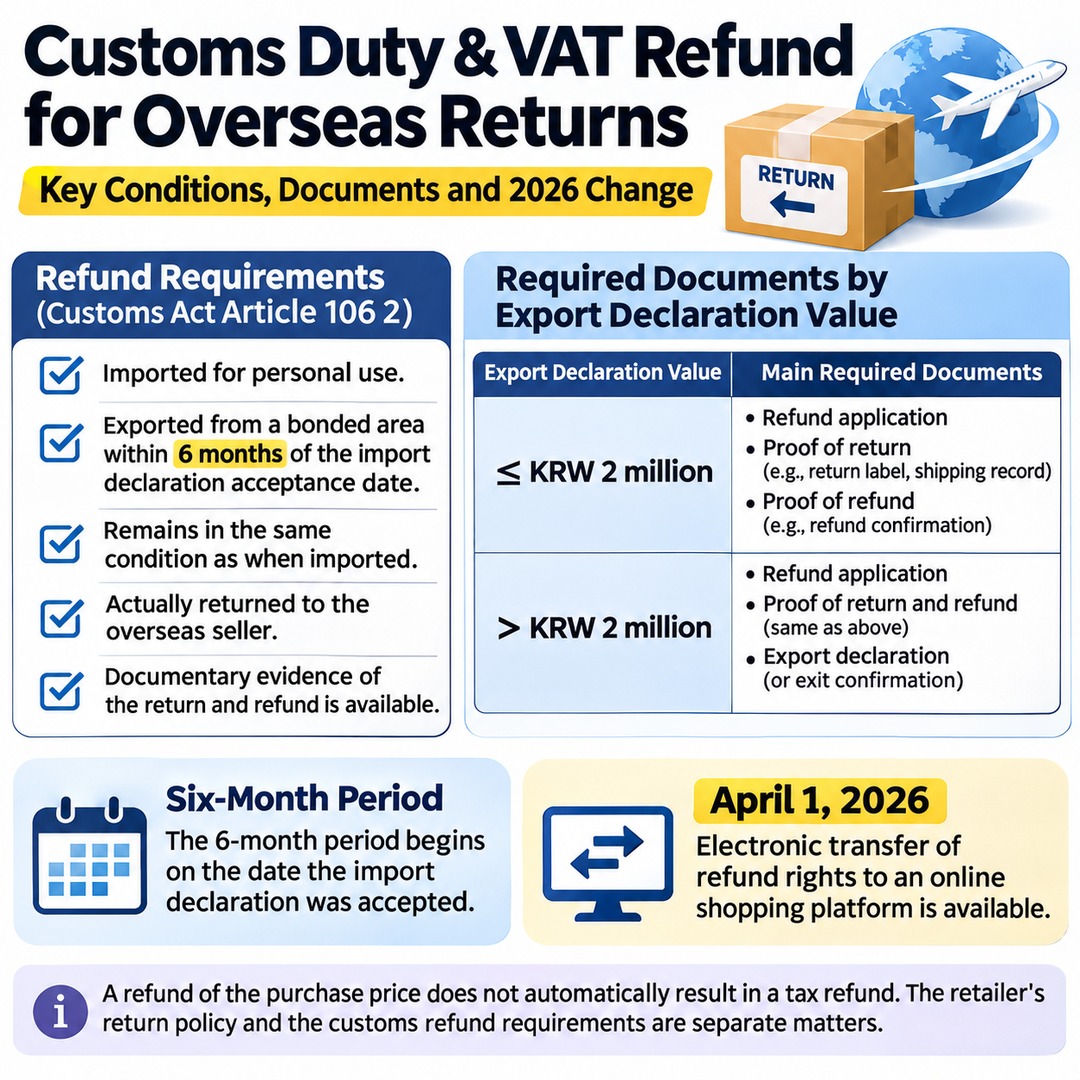
Under Article 106-2 of South Korea's Customs Act, individuals who purchase goods directly from overseas for personal use may receive a refund of taxes paid upon import if certain conditions are met. The goods must remain in their original imported condition and be returned within the prescribed period.
Before applying for a customs duty refund, check the following requirements:
The goods were imported for personal use.
The goods are brought into a bonded area and exported within six months of the date the import declaration was accepted.
The goods remain in the same condition as when they were imported.
The goods have actually been returned to the overseas seller.
Documentary evidence of the return and refund is available.
The six-month period begins on the date the import declaration was accepted, not the date the order was placed or the goods were delivered.
The retailer's return policy and the refund requirements under South Korea's Customs Act are separate matters. Even if the seller accepts your return, recovering the taxes may be difficult if you do not meet the customs refund requirements.
What Changes at the KRW 2 Million Export Declaration Value Threshold?
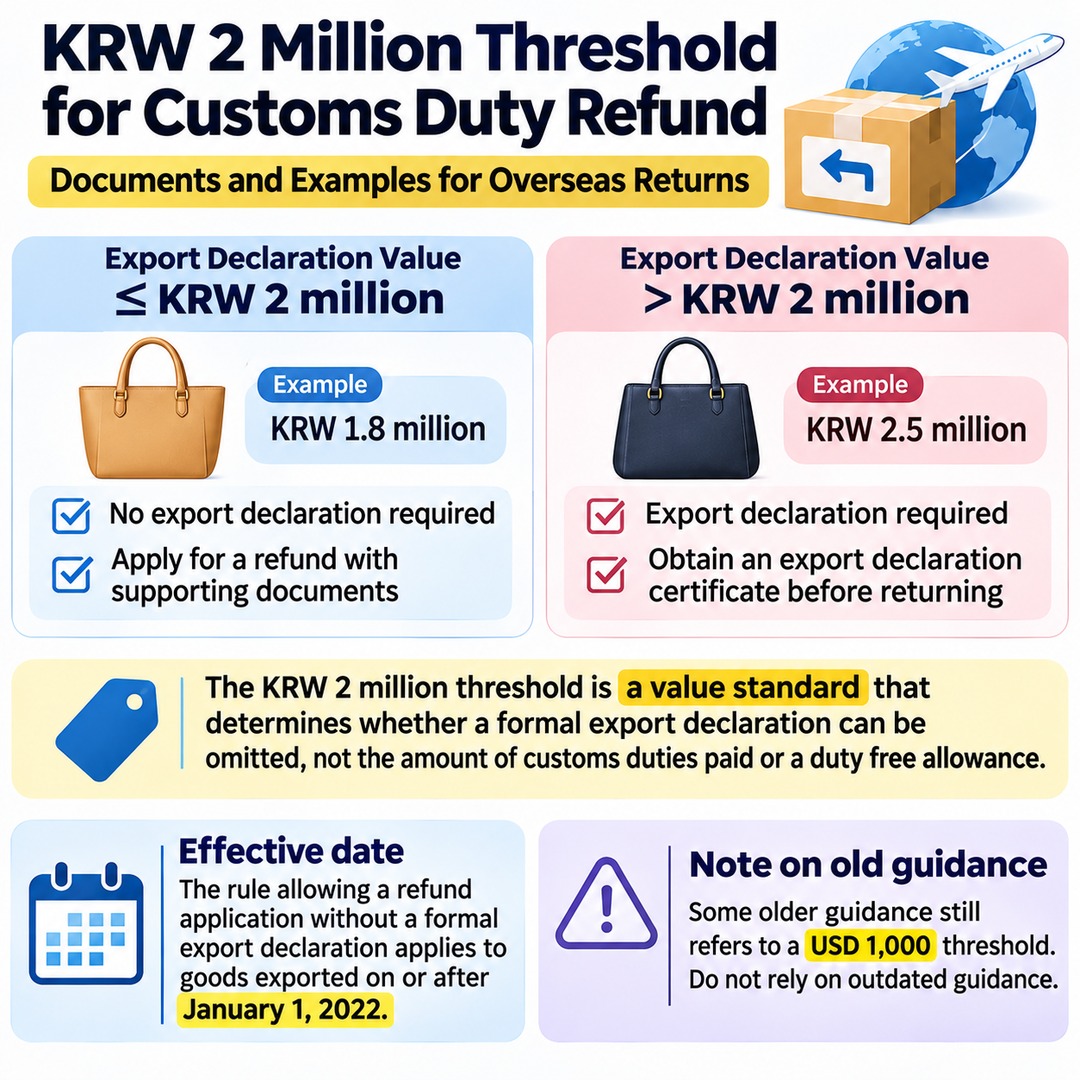
If the export declaration value is KRW 2 million or less, you may apply for a customs duty refund using supporting documents even without filing a formal export declaration. Goods valued above KRW 2 million require an export declaration certificate, so you must prepare for the export declaration process before returning them overseas.
| Category | KRW 2 million or less | Above KRW 2 million |
|---|---|---|
| Export declaration | May be omitted | Required |
| Refund application form | Required | Required |
| Import declaration certificate | Required | Required |
| Proof of export | Commercial invoice for the goods | Export declaration certificate |
| Seller's return confirmation documents | Required | Retain in case additional evidence is requested |
| Refund receipts or records | Required | Retain in case additional evidence is requested |
The KRW 2 million threshold is neither the amount of customs duties paid nor a duty-free allowance. It is a value threshold that determines whether a formal export declaration can be omitted and alternative documents can be used to prove that the goods were exported during the return process.
For example, a bag with an export declaration value of KRW 1.8 million may qualify for a refund application supported by alternative documentation, while a bag valued at KRW 2.5 million must go through the export declaration process. Goods valued at exactly KRW 2 million fall within the lower-value category.
Some older guidance on refunds for overseas purchases still refers to a USD 1,000 threshold. The Korean rule allowing refund applications without a formal export declaration for goods valued at KRW 2 million or less applies to goods exported on or after January 1, 2022. Be careful not to rely on outdated guidance.
What Is the Transfer of Refund Rights Introduced in April 2026?
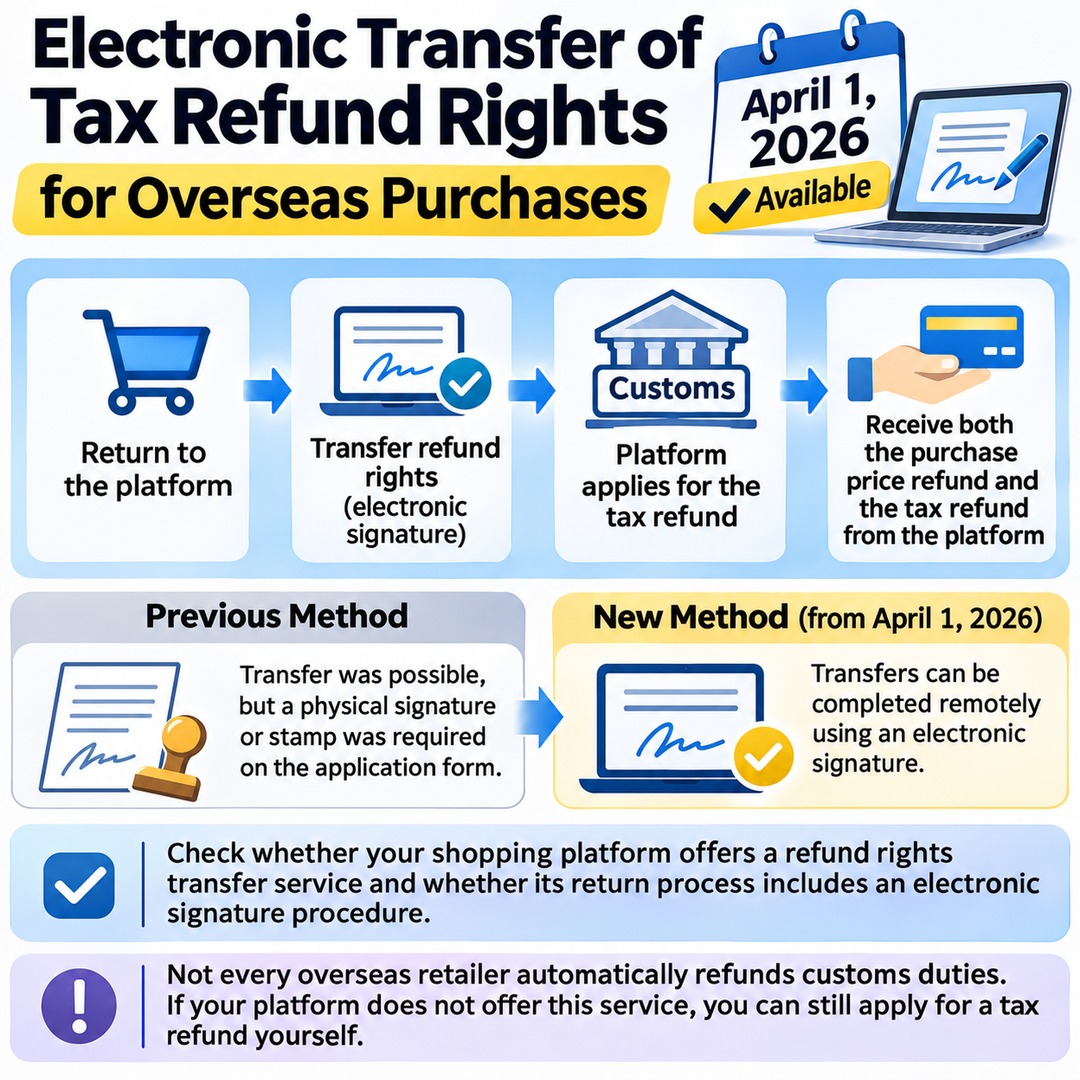
From April 1, 2026, consumers who purchase goods directly from overseas retailers can transfer their rights to customs duty and VAT refunds to online shopping platforms using electronic signatures. Once the refund rights have been transferred, the platform applies to Korean customs authorities for the tax refund, and the buyer can receive both the purchase price refund and the tax refund from the platform.
Transferring refund rights was previously possible, but applicants were required to physically sign or stamp the transfer application form. An amendment to South Korea's Notice on the Handling of Tax Payment Affairs has made remote transfers using electronic signatures possible.
| Category | Direct application by the buyer | Transfer of refund rights to a platform |
|---|---|---|
| Party applying to customs for a refund | Buyer | Online shopping platform |
| Submission of refund-related documents | Buyer prepares the documents | Platform submits the application |
| Electronic transfer procedure | Not required | Buyer identity verification and electronic signature |
| Tax refund payment channel | Customs authorities | Online shopping platform |
| Purchase price and taxes | Refunded separately | May be refunded together |
However, the introduction of this system does not mean that every overseas retailer automatically refunds customs duties. You should check whether your shopping platform offers a refund rights transfer service and whether its return process includes an electronic signature procedure.
If the retailer does not offer a refund rights transfer service, you can still apply for a tax refund yourself.
How to Apply Directly for a Customs Duty Refund Through UNI-PASS After Returning Overseas Purchases
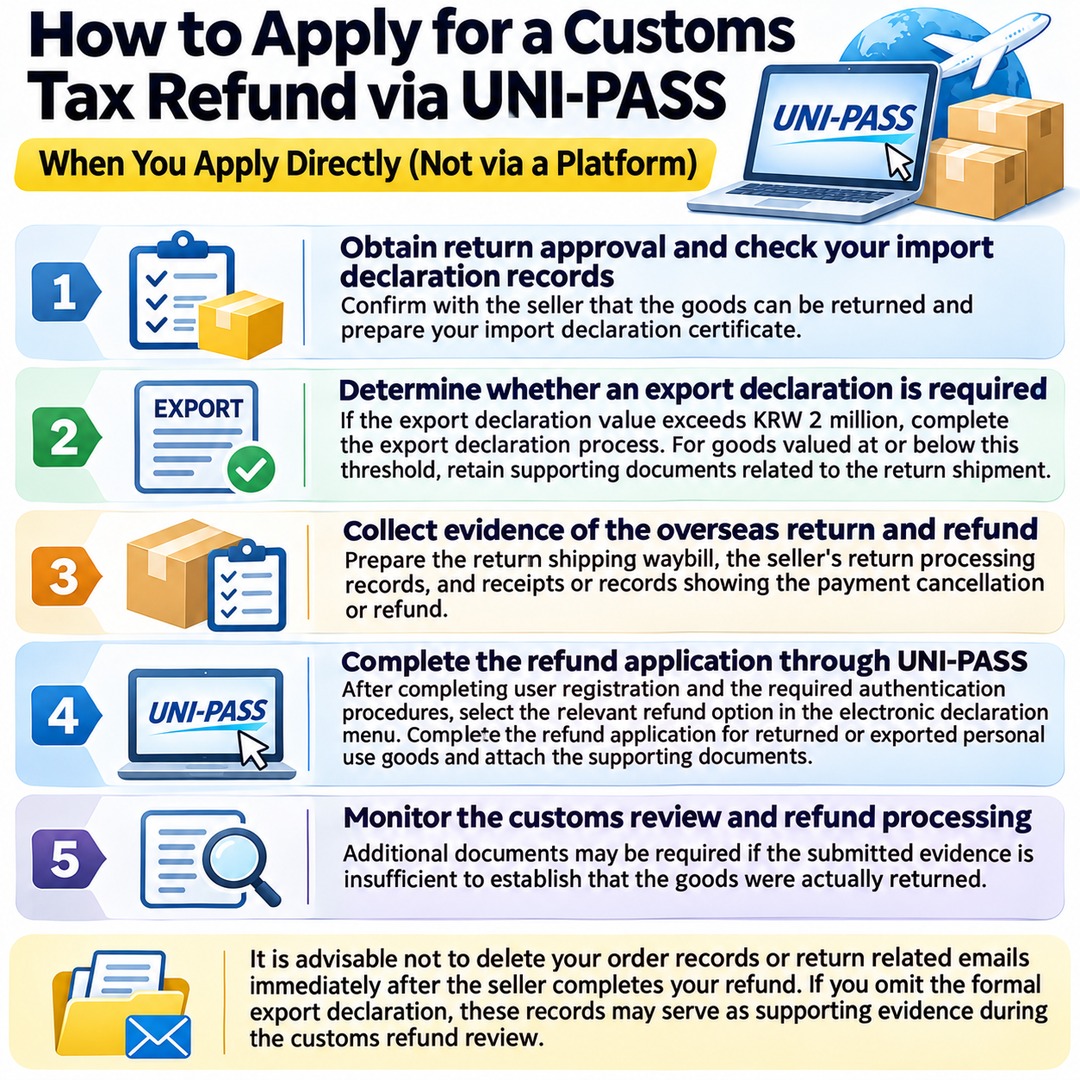
If you do not use an online platform's refund rights transfer service, you can apply for a refund through UNI-PASS, the Korea Customs Service's electronic customs clearance system. You can also apply in person at a customs office.
If you intend to apply directly, it is important to collect the necessary documents before shipping the goods overseas.
1. Obtain return approval and check your import declaration records
Confirm with the seller that the goods can be returned and prepare your import declaration certificate.
2. Determine whether an export declaration is required
If the export declaration value exceeds KRW 2 million, complete the export declaration process. For goods valued at or below this threshold, retain supporting documents related to the return shipment.
3. Collect evidence of the overseas return and refund
Prepare the return shipping waybill, the seller's return processing records, and receipts or records showing the payment cancellation or refund.
4. Complete the refund application through UNI-PASS
After completing user registration and the required authentication procedures, select the relevant refund option in the electronic declaration menu. Complete the refund application for returned or exported personal-use goods and attach the supporting documents.
5. Monitor the customs review and refund processing
Additional documents may be required if the submitted evidence is insufficient to establish that the goods were actually returned.
It is advisable not to delete your order records or return-related emails immediately after the seller completes your refund. If you omit the formal export declaration, these records may serve as supporting evidence during the customs refund review.
Why Should You Check the Purchase Price Refund and Customs Duty Refund Separately?
When returning goods purchased from overseas retailers during Black Friday, you should distinguish between the original purchase price and the taxes paid during the import process.
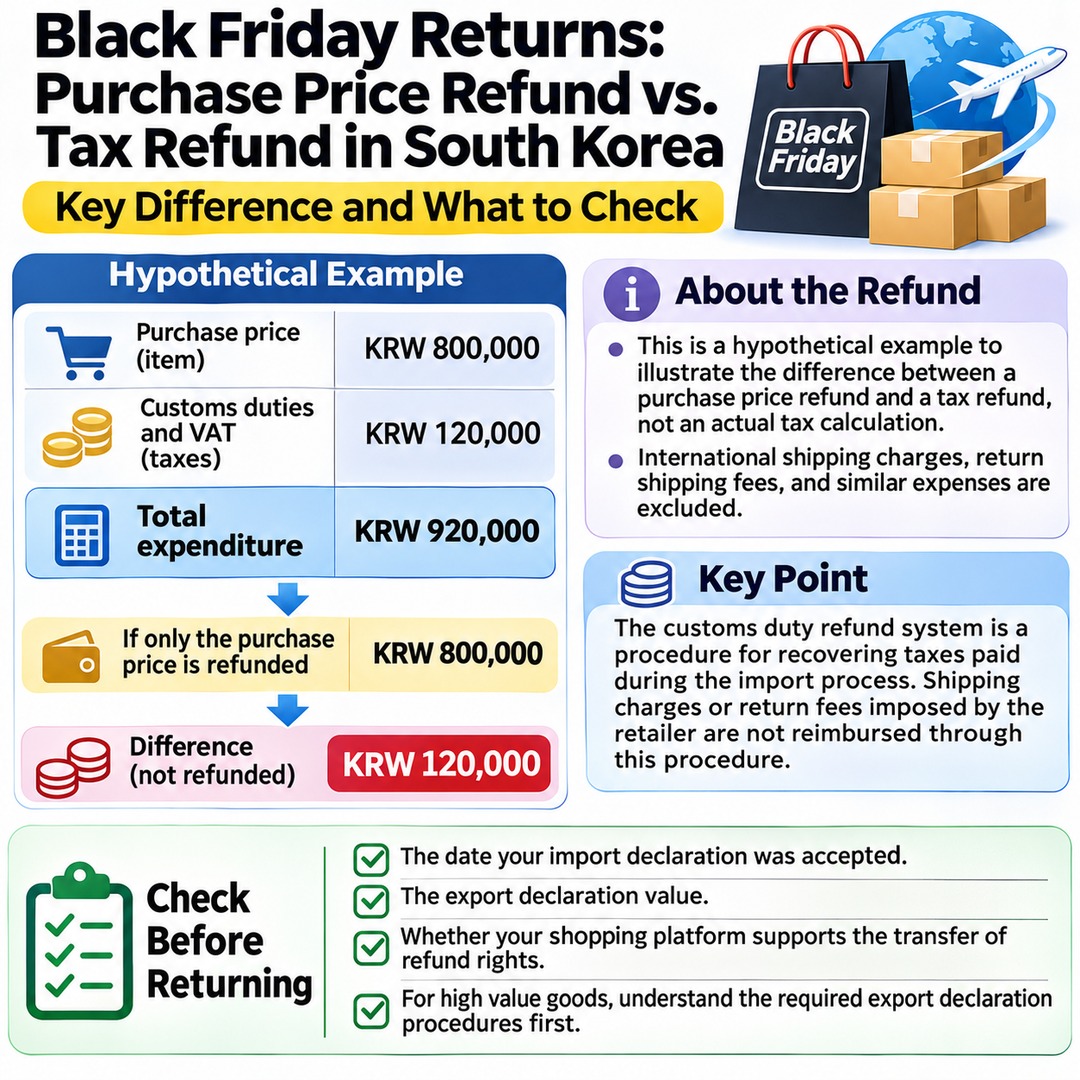
Suppose you paid KRW 800,000 for an item and KRW 120,000 in customs duties and VAT.
| Category | Hypothetical amount |
|---|---|
| Purchase price | KRW 800,000 |
| Customs duties and VAT paid | KRW 120,000 |
| Initial total expenditure | KRW 920,000 |
| Refund if only the purchase price is returned | KRW 800,000 |
| Taxes to be checked separately | KRW 120,000 |
Author's calculation: Adding the purchase price of KRW 800,000 and taxes of KRW 120,000 gives an initial total expenditure of KRW 920,000. If only the purchase price is refunded in full, the difference between the refund and the original expenditure is KRW 120,000.
This is a hypothetical example intended to illustrate the difference between a purchase price refund and a tax refund, rather than an actual tax calculation. International shipping charges, return shipping fees, and similar expenses are excluded from the calculation.
South Korea's customs duty refund system is a procedure for recovering taxes paid during the import process. You should not assume that shipping charges or return fees imposed by the retailer will also be reimbursed through the same procedure.
If you plan to return an item purchased during Black Friday, check the date your import declaration was accepted, the export declaration value, and whether your shopping platform supports the transfer of refund rights before packing and shipping the item overseas. For high-value goods in particular, it is important to understand the required export declaration procedures first.