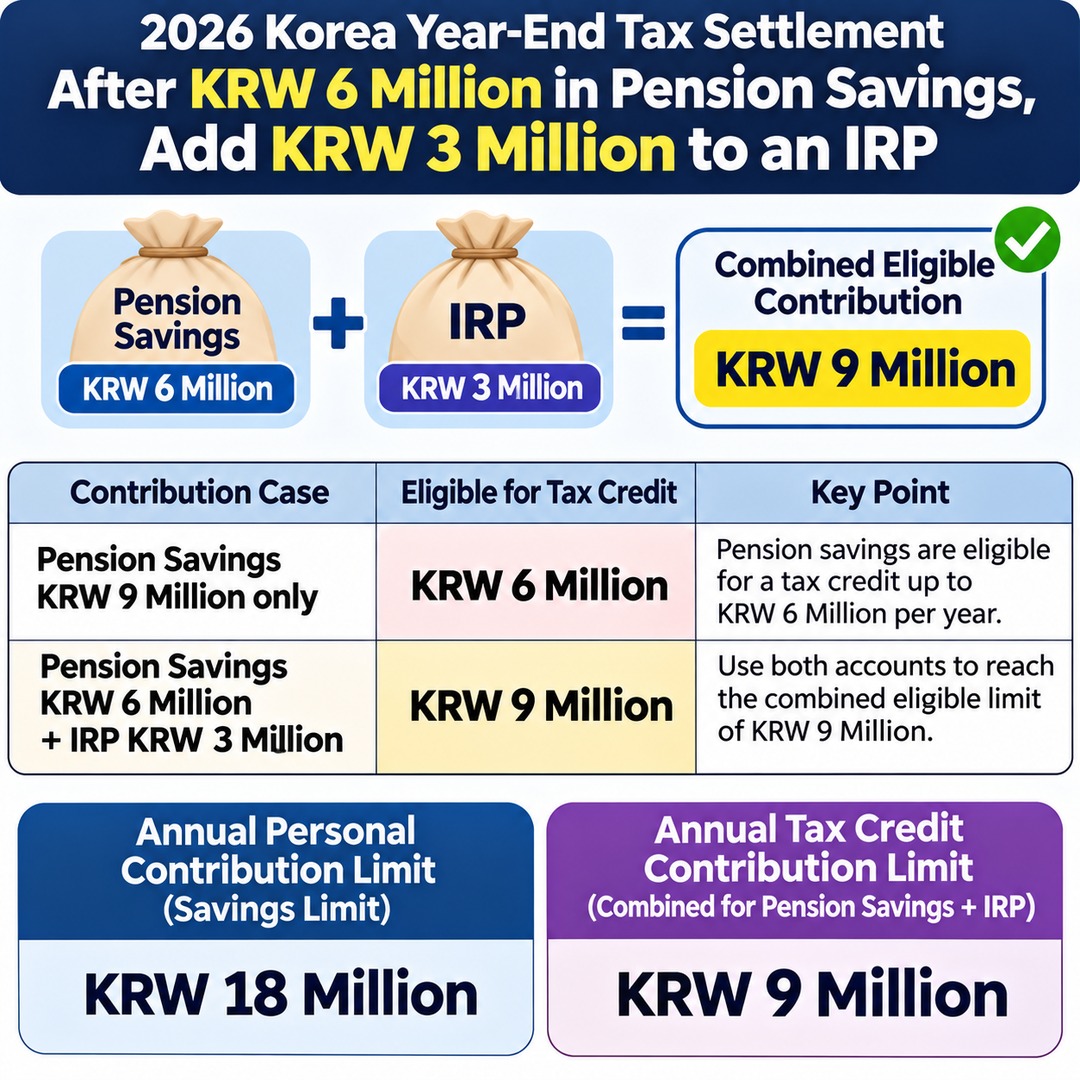

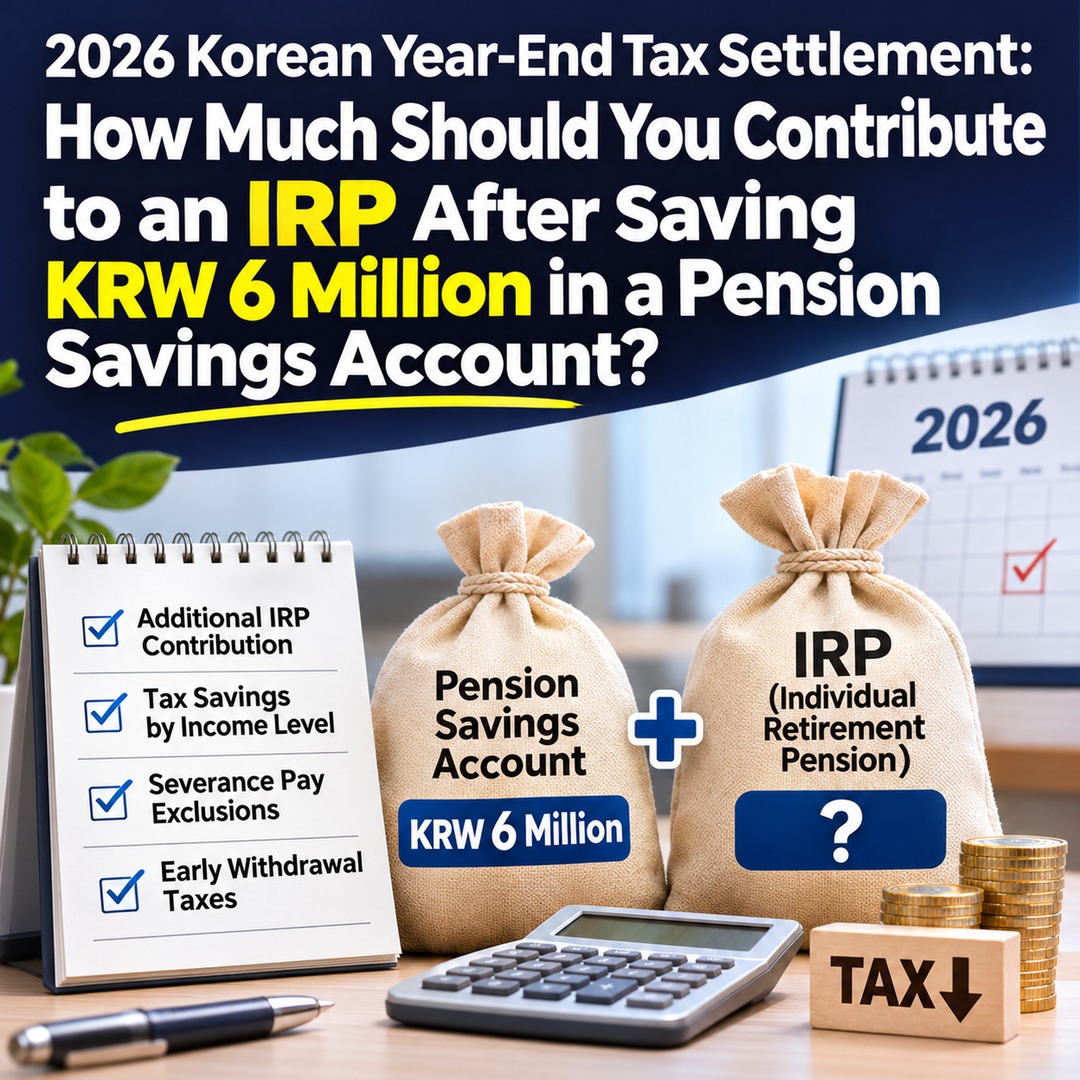
For South Korea's 2026 year-end tax settlement, if you have contributed KRW 6 million to a pension savings account, you can contribute an additional KRW 3 million to an Individual Retirement Pension (IRP) account to reach the combined pension account tax credit contribution limit of KRW 9 million. Assuming you have no other eligible retirement pension contributions, your maximum potential tax savings, including local income tax, are KRW 1,188,000 or KRW 1,485,000. However, your actual tax refund depends on your individual tax liability.
How Do the Tax Credit Limits for Pension Savings and IRP Accounts Differ?
In South Korea, pension savings contributions qualify for a tax credit on up to KRW 6 million annually. The combined eligible contribution limit for pension savings and retirement pension accounts, including IRPs, is KRW 9 million annually. It is important to understand that these limits do not apply independently to each account.
| Contribution Type | Contribution Limit Eligible for Tax Credits |
|---|---|
| Pension savings account only | KRW 6 million annually |
| IRP account only | KRW 9 million annually |
| Both pension savings and IRP accounts | Combined annual limit of KRW 9 million |
| Standard personal contribution limit for pension accounts | Combined annual limit of KRW 18 million |
If you contribute KRW 9 million exclusively to a pension savings account, only KRW 6 million qualifies for the standard tax credit. However, if you contribute KRW 6 million to pension savings and KRW 3 million to an IRP, the entire KRW 9 million can qualify.
The amount you can save in pension accounts differs from the amount eligible for tax credits. The standard annual personal contribution limit is KRW 18 million, while the standard tax credit contribution limit is KRW 9 million.
How Much More Should You Contribute to an IRP Based on Your Existing Contributions?
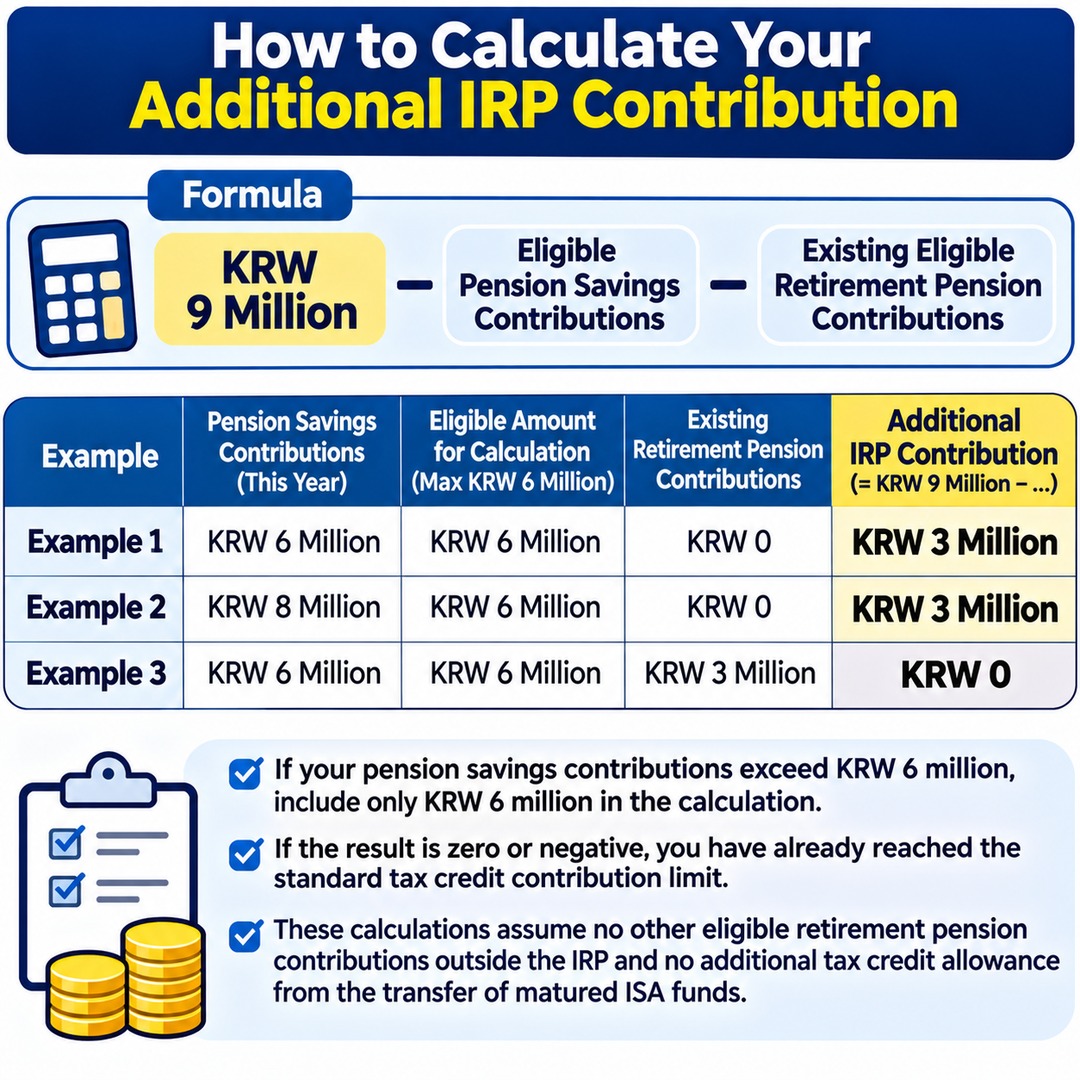
You can calculate your remaining eligible contribution amount by subtracting your eligible pension savings contributions and personal retirement pension contributions made during the year from KRW 9 million.
If your pension savings contributions exceed KRW 6 million, include only KRW 6 million in the calculation.
Formula for Calculating Additional IRP Contributions
KRW 9 million − Eligible pension savings contributions − Existing eligible retirement pension contributions
If the result is zero or negative, you have already reached the standard tax credit contribution limit.
| Pension Savings Contributions | Existing Personal IRP Contributions | Additional IRP Contribution Required |
|---|---|---|
| KRW 0 | KRW 0 | KRW 9 million |
| KRW 3 million | KRW 0 | KRW 6 million |
| KRW 4 million | KRW 0 | KRW 5 million |
| KRW 5 million | KRW 0 | KRW 4 million |
| KRW 6 million | KRW 0 | KRW 3 million |
| KRW 6 million | KRW 1 million | KRW 2 million |
| KRW 6 million | KRW 2 million | KRW 1 million |
| KRW 6 million | KRW 3 million | KRW 0 |
| KRW 8 million | KRW 0 | KRW 3 million |
These calculations were prepared by the author and assume there are no other eligible retirement pension contributions outside the IRP and no additional tax credit allowance arising from the transfer of matured Individual Savings Account (ISA) funds.
As shown in the final example, even if you have already contributed KRW 8 million to a pension savings account, you must contribute another KRW 3 million to an IRP to reach the standard tax credit contribution limit. This is because the excess KRW 2 million in pension savings contributions is excluded from the standard tax credit limit calculation.
How Much Tax Can You Save by Contributing an Additional KRW 3 Million to an IRP?
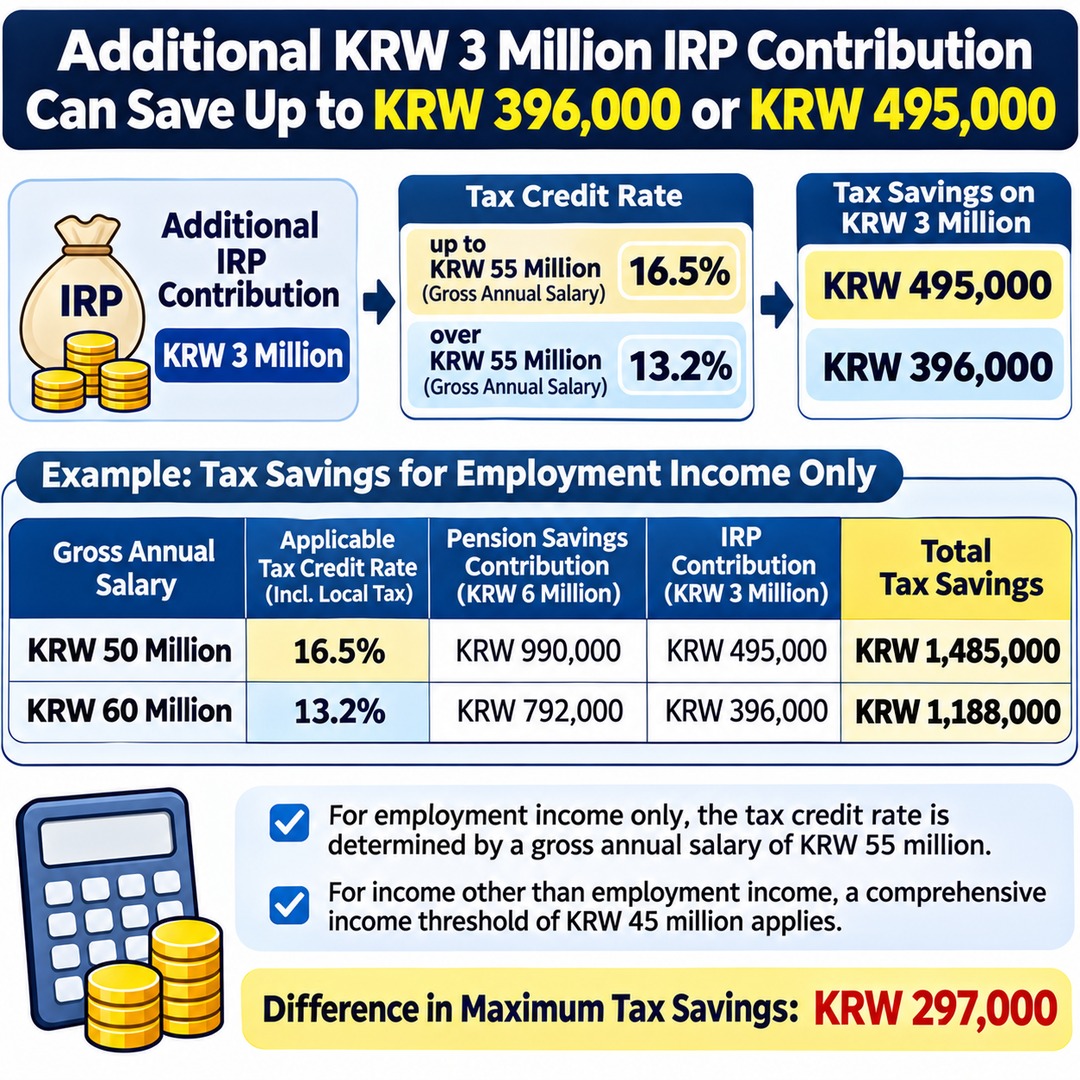
An additional IRP contribution of KRW 3 million can reduce your combined income tax and local income tax by up to KRW 396,000 or KRW 495,000. The applicable tax credit rate depends on your gross salary or comprehensive income amount under South Korean tax law.
For individuals whose only income is employment income, the applicable tax credit rate is determined using a gross annual salary threshold of KRW 55 million. For individuals whose income is not limited to employment income, a comprehensive income threshold of KRW 45 million applies.
| Category | Gross Annual Salary of KRW 55 Million or Less | Gross Annual Salary Above KRW 55 Million |
|---|---|---|
| Income tax credit rate | 15% | 12% |
| Effective tax savings rate including local income tax | 16.5% | 13.2% |
| Tax savings on KRW 6 million in pension savings contributions | KRW 990,000 | KRW 792,000 |
| Additional tax savings on KRW 3 million in IRP contributions | KRW 495,000 | KRW 396,000 |
| Maximum combined tax savings on KRW 9 million in contributions | KRW 1,485,000 | KRW 1,188,000 |
The table contains the author's calculations for individuals whose only income is employment income, obtained by multiplying contribution amounts by the applicable rates.
For example, suppose an employee with a gross annual salary of KRW 50 million has already contributed KRW 6 million to a pension savings account and makes an additional IRP contribution of KRW 3 million. The calculation is as follows:
Existing pension savings contributions: KRW 6 million × 16.5% = KRW 990,000
Additional IRP contributions: KRW 3 million × 16.5% = KRW 495,000
Total potential tax savings: KRW 1,485,000
If the employee's gross annual salary is KRW 60 million, the applicable rate falls to 13.2%, resulting in total potential tax savings of KRW 1,188,000 for the same contribution amount.
Even with identical contributions of KRW 9 million, the difference in maximum tax savings between the two income brackets is KRW 297,000.
Why Does the Tax Credit Amount Differ From the Actual Year-End Tax Refund?
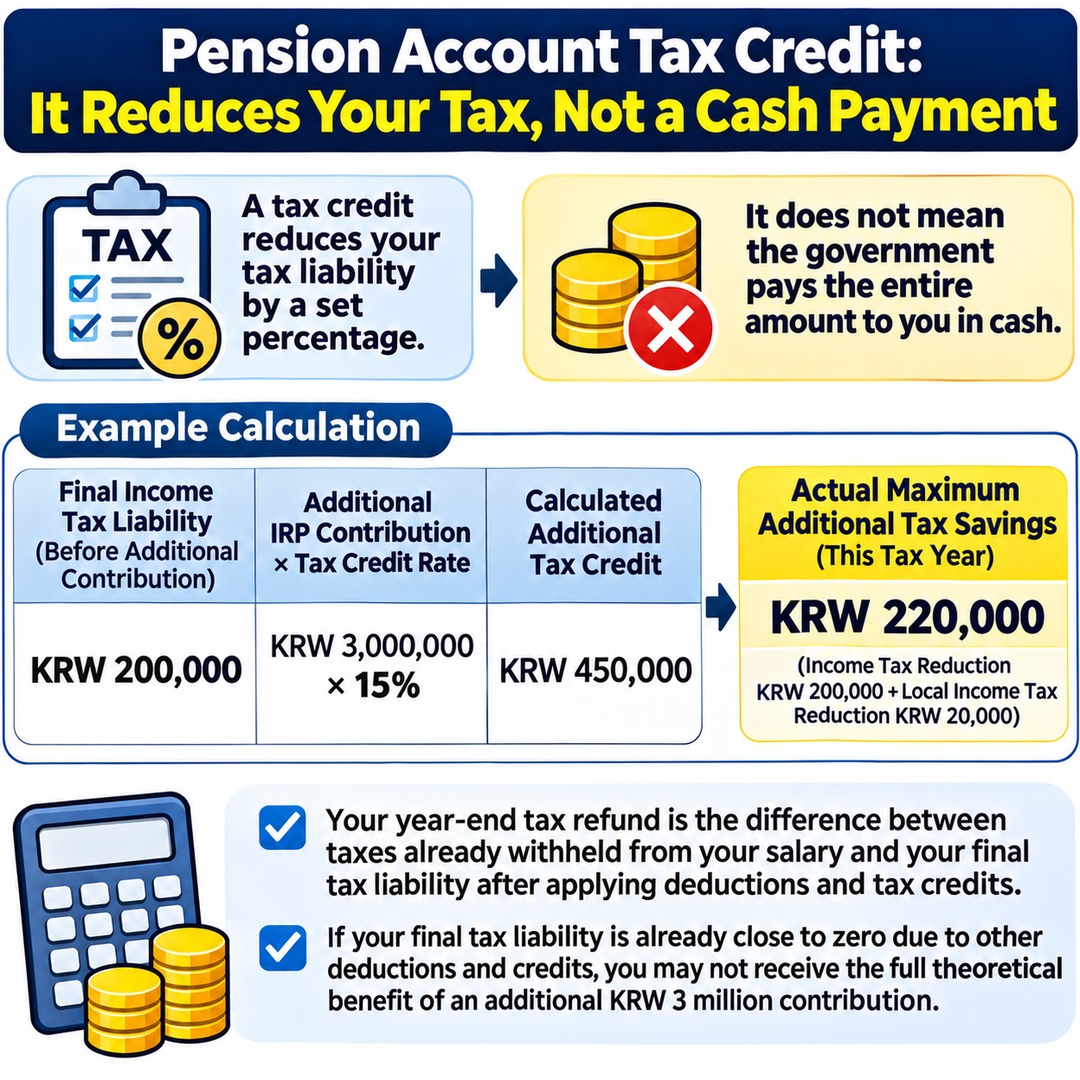
South Korea's pension account tax credit system reduces your tax liability by a specified percentage of eligible contributions. It does not mean that the government pays the entire calculated tax credit amount directly to you in cash.
Your year-end tax refund is determined by the difference between taxes previously withheld from your salary and your final tax liability after applying various deductions and tax credits.
For example, suppose an employee has a final income tax liability of KRW 200,000 before making an additional IRP contribution of KRW 3 million.
At an income tax credit rate of 15%, the calculated additional tax credit is KRW 450,000. However, if the remaining income tax liability before the additional contribution is only KRW 200,000, the maximum income tax reduction available for that tax year is KRW 200,000.
Including the corresponding reduction in local income tax, the maximum additional tax savings in this example are KRW 220,000.
Therefore, if your final tax liability is already close to zero because of other income deductions and tax credits, you may not receive the full theoretical benefit of contributing an additional KRW 3 million.
Does Severance Pay Held in an IRP Count Toward the Tax Credit Limit?
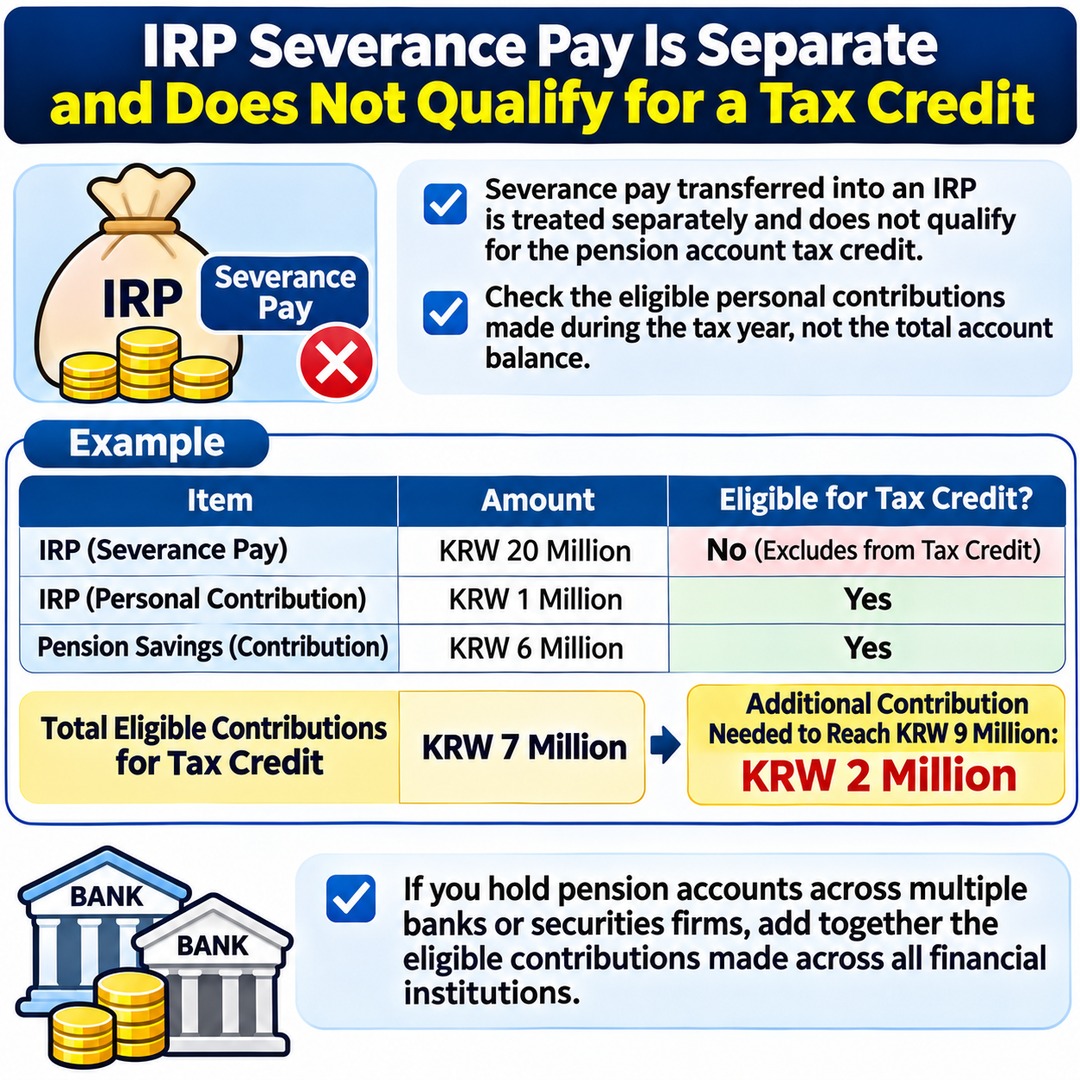
Severance pay transferred into an IRP upon leaving employment is treated separately from additional personal contributions and does not qualify for the pension account tax credit.
You must check the eligible personal contributions made during the relevant tax year rather than the total account balance.
| IRP or Retirement Pension Deposit Type | Eligible for the Standard Tax Credit |
|---|---|
| Additional personal IRP contributions | Yes |
| Additional employee contributions to a defined contribution (DC) retirement pension plan | Yes |
| Employer retirement pension contributions | No |
| Tax-deferred severance pay transferred into an IRP | No |
| Accumulated funds transferred from another pension account | No |
| Investment earnings within the account | No |
For example, suppose you have an IRP containing KRW 20 million in severance pay, contribute an additional KRW 1 million in personal funds during the year, and contribute KRW 6 million to a pension savings account. Your total contributions eligible for the standard tax credit amount to KRW 7 million.
In this case, despite having a substantial balance in your IRP, you must contribute another KRW 2 million to reach the standard tax credit contribution limit.
If you hold pension accounts across multiple banks or securities firms, you must add together the eligible contributions made across all financial institutions rather than looking at each institution's account balance.
Does Transferring Matured ISA Funds Into a Pension Account Increase the Tax Credit Limit?
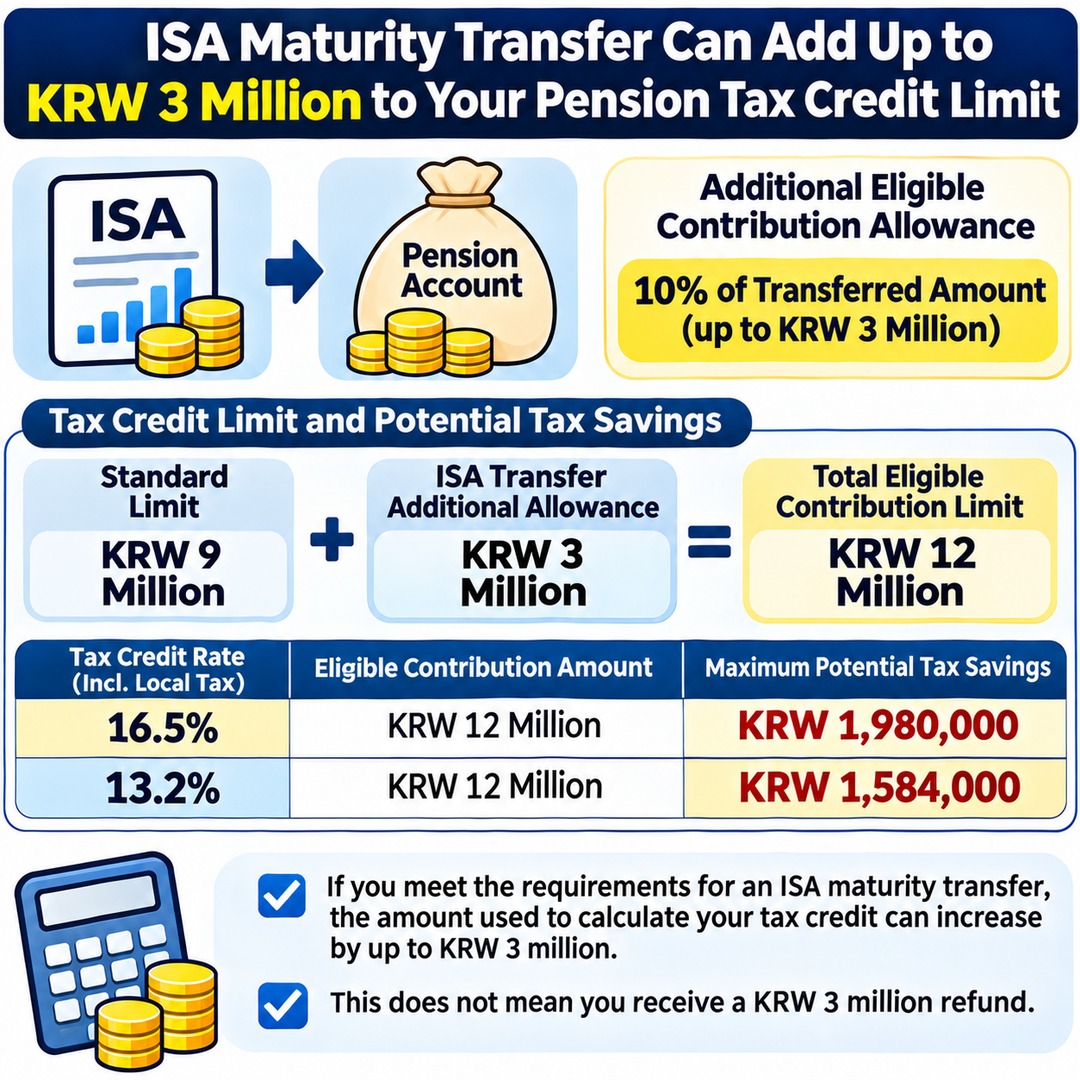
If you transfer matured funds from a Korean Individual Savings Account (ISA) into a pension account and meet the applicable requirements, you can qualify for an additional eligible contribution allowance beyond the standard KRW 9 million limit.
The additional eligible contribution allowance is 10% of the transferred amount, up to a maximum of KRW 3 million.
| Matured ISA Funds Transferred | Additional Eligible Contribution Allowance | Total Eligible Contribution Limit |
|---|---|---|
| KRW 10 million | KRW 1 million | KRW 10 million |
| KRW 20 million | KRW 2 million | KRW 11 million |
| KRW 30 million | KRW 3 million | KRW 12 million |
These calculations were prepared by the author and assume that the standard tax credit contribution limit and all applicable ISA transfer requirements are satisfied.
If your ISA maturity fund transfer qualifies for an additional eligible contribution allowance of KRW 3 million and you also fully utilize the standard allowance, the maximum total amount eligible for tax credits is KRW 12 million.
In this case, maximum potential tax savings, including local income tax, are KRW 1,980,000 at the 16.5% rate or KRW 1,584,000 at the 13.2% rate.
This does not mean that you receive a KRW 3 million refund. Instead, the amount used to calculate your tax credit increases by up to KRW 3 million.
What Is the Contribution Deadline for the 2026 Year-End Tax Settlement?
To qualify for pension account tax credits for the 2026 tax year in South Korea, eligible contributions must be processed by December 31, 2026, the end of the tax year.
Toward the end of the year, it is advisable to check your bank's or securities firm's contribution processing hours and registered contribution limits for each account in advance. Do not assume that all financial institutions have identical processing hours on the final day of the year.
Before making additional contributions, follow these steps:
1. Check your 2026 pension savings contributions across all financial institutions.
2. Check your additional personal contributions to IRP accounts and defined contribution (DC) retirement pension plans.
3. Exclude transferred severance pay and employer contributions.
4. Subtract your eligible contributions from the standard tax credit contribution limit of KRW 9 million.
5. Review your estimated final tax liability and how much you can afford to contribute.
6. Confirm that your financial institution can complete the contribution before the end of the year.
During the year-end tax settlement process in 2027, you should also review your pension account contribution records in the simplified year-end tax settlement service provided through Hometax, South Korea's online tax administration portal.
Should You Always Maximize Your IRP Contributions to Save on Taxes?
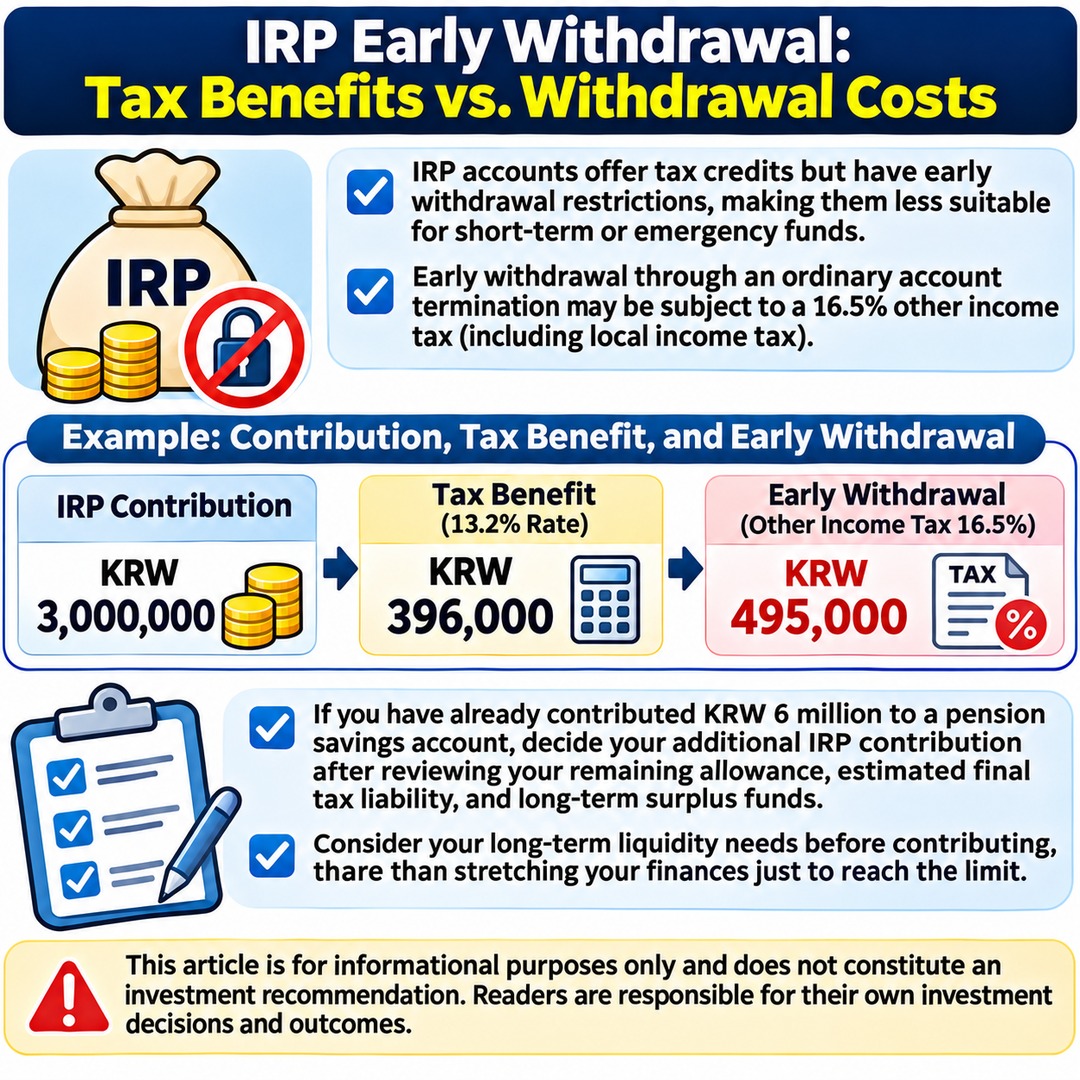
Although IRP accounts offer tax credit benefits, they have restrictions that make them less suitable for holding money needed for short-term living expenses or emergencies. If you expect to need a substantial amount of money in the near future, it may be better not to stretch your finances simply to reach the tax credit contribution limit.
Under South Korean law, early withdrawals from IRP accounts are restricted unless legally specified conditions are met. If personal contributions that previously qualified for tax credits and investment earnings are withdrawn through an ordinary early account termination, they may be subject to a 16.5% other income tax rate, including local income tax.
Suppose an employee with a gross annual salary exceeding KRW 55 million contributes KRW 3 million to an IRP and receives the full tax savings benefit at the 13.2% rate.
If the employee subsequently withdraws that amount through an ordinary early account termination, the following difference arises even when the calculation considers only the principal and excludes investment earnings.
| Category | Amount |
|---|---|
| Tax savings received at the time of contribution | KRW 396,000 |
| Tax on the principal upon early account termination | KRW 495,000 |
| Difference in tax amounts | KRW 99,000 |
These calculations were prepared by the author and exclude investment earnings, fees, and legally specified exceptions.
If you have already contributed KRW 6 million to a pension savings account, it is advisable to consider not only your remaining eligible contribution allowance for the year but also your estimated final tax liability and the surplus funds you can afford to keep invested over the long term before deciding how much more to contribute to an IRP.
*This article is provided for informational purposes to help readers understand market trends and does not constitute an investment recommendation for any particular security or asset. Readers are responsible for their own investment decisions and outcomes.*