
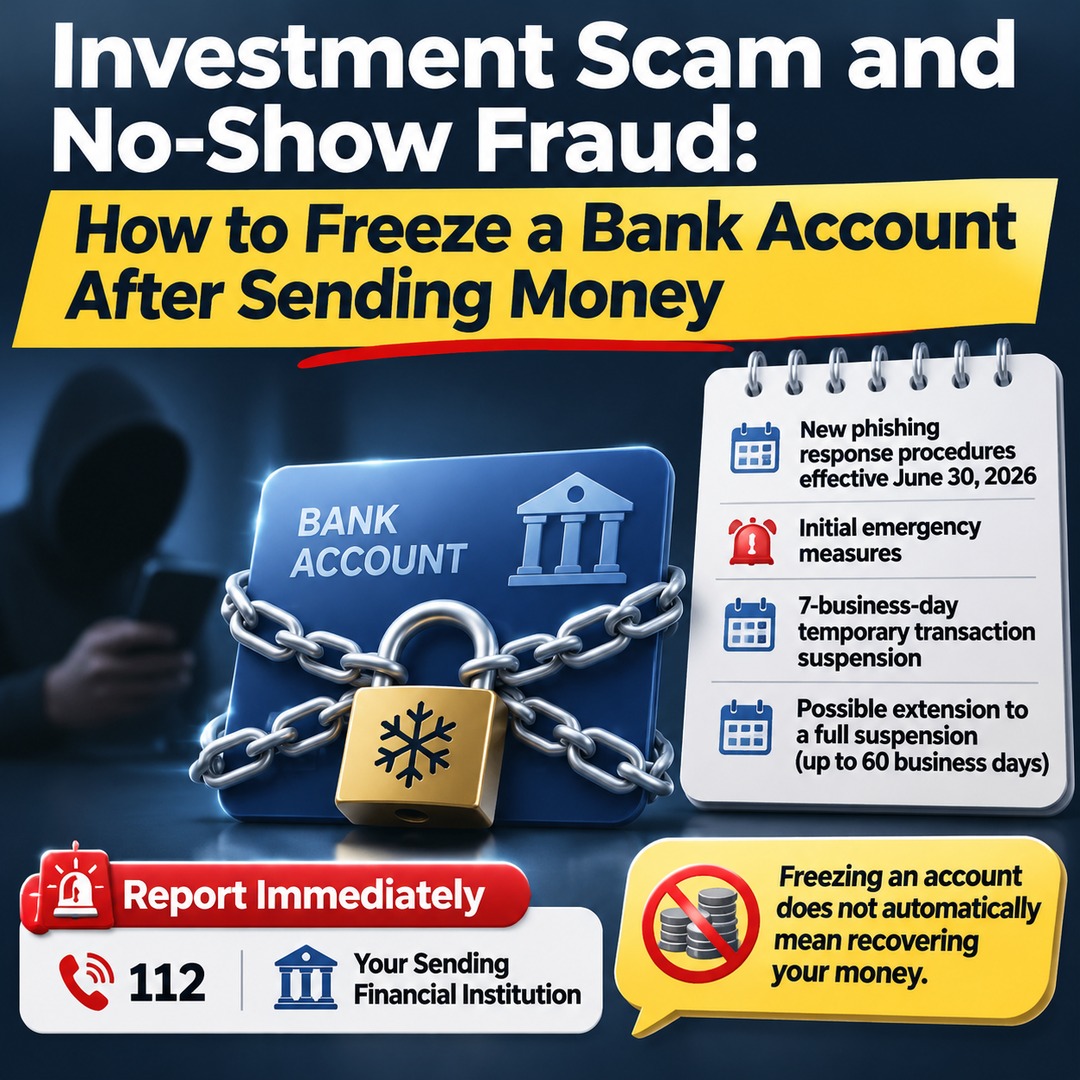
Even if you have already sent money to an investment scam operator or a no-show fraudster, you can request that the recipient's account be frozen. Since June 30, 2026, South Korea has implemented account transaction suspension procedures for suspected accounts involved not only in voice phishing but also in emerging phishing scams disguised as goods or service transactions. Victims should immediately report the incident to 112 or the financial institution from which they sent the money. If the case is confirmed as an emerging phishing scam, the account may be subject to a 7-business-day temporary transaction suspension, followed, where necessary, by an additional suspension process lasting up to 60 business days. However, freezing an account does not automatically mean that the victim will receive their money back.
Can an Account Be Frozen Even If the Scam Is Not Voice Phishing?
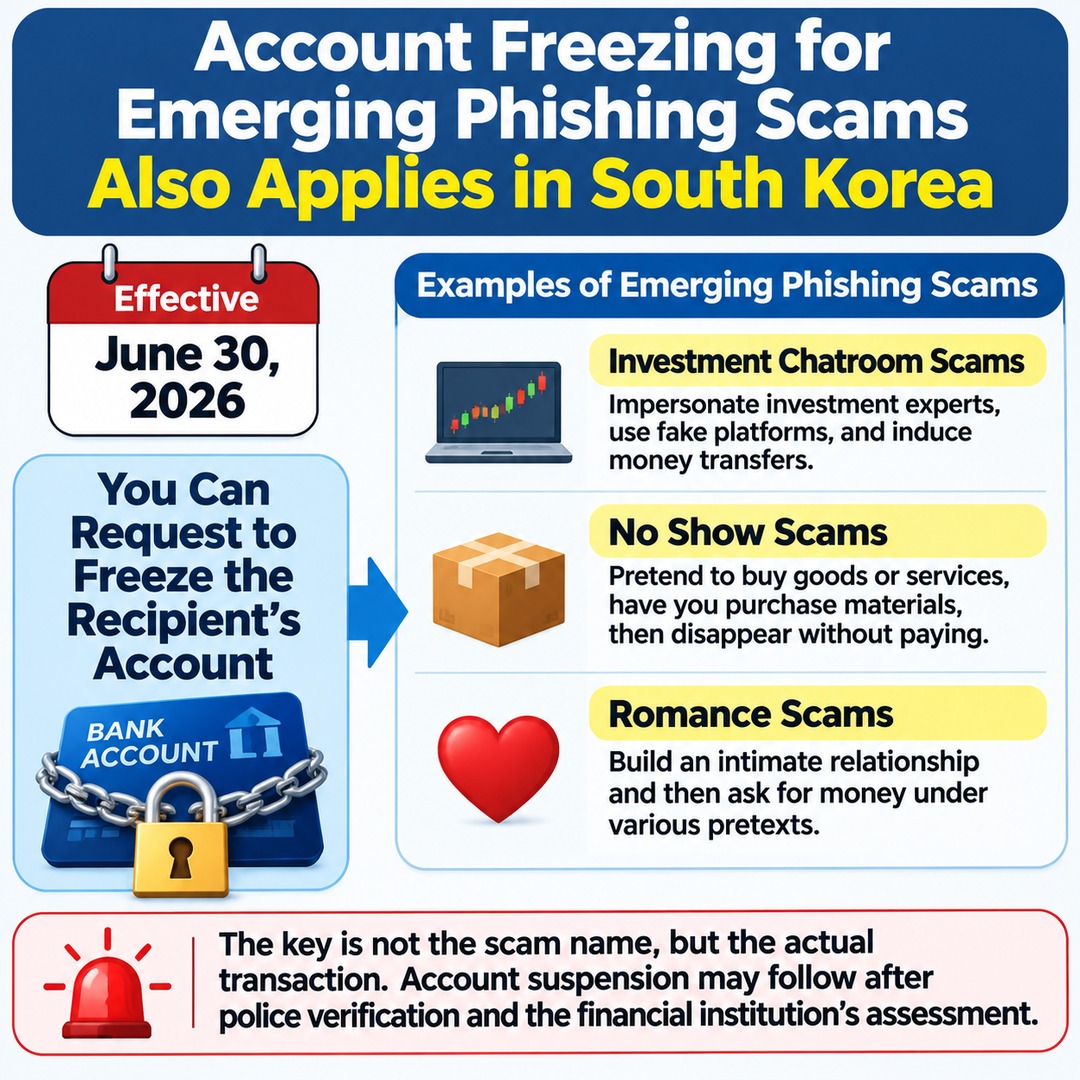
Yes. The suspicious-account transaction suspension measures for emerging phishing scams, introduced on June 30, 2026, cover certain types of fraud that were difficult to address through the existing voice phishing victim relief procedures alone.
Common examples include:
Investment chatroom scams: Scammers impersonate investment experts or securities firm representatives, direct victims to fake investment platforms, and persuade them to transfer money.
No-show scams: Fraudsters pretend to purchase goods or services, persuade victims to purchase materials on behalf of a particular business, and then disappear without paying.
Romance scams: Scammers establish an intimate relationship with victims and subsequently request investment funds or financial support.
Team mission scams: Fraudsters promote group assignments or profit-making activities and demand advance payments or additional deposits.
What matters here is not the name of the scam itself but how the actual transaction took place. In particular, emerging phishing scams that obtain money under the pretense of goods or service transactions may lead to account suspension after the police verify the type of crime and the financial institution makes its assessment.
Where Should You Report the Fraud Immediately After Sending Money?
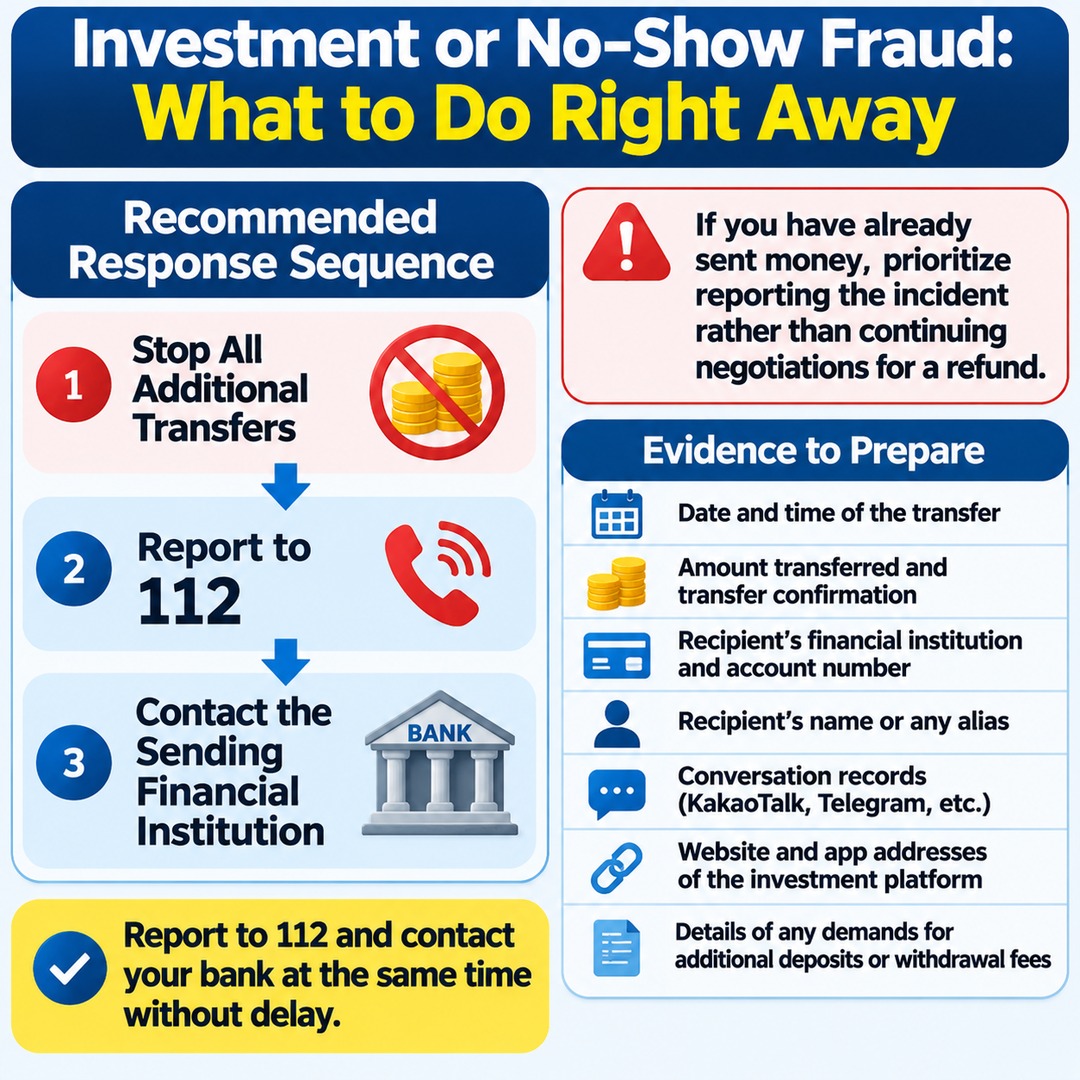
First, report the incident to 112. At the same time, notify the financial institution from which you sent the money. Do not delay contacting your bank after reporting the incident to the police, or postpone the police report until after contacting your bank.
The recommended response sequence is as follows:
1. Stop all additional transfers: Do not send any more money, even if the scammers demand withdrawal fees, taxes, deposits, or account recovery charges.
2. Report to 112: Explain that you have been the victim of investment fraud or an emerging phishing scam, and provide the recipient account details.
3. Contact the sending financial institution: Report the fraud to the bank or financial institution from which you transferred the money and request suspension of transactions on the recipient account and any necessary emergency measures.
4. Submit evidence: Collect transfer confirmations, the recipient's account number, conversation records, phone numbers, investment app screenshots, and payment demands, and provide them to the police and financial institution.
5. Check the processing status: Separately confirm whether the police have identified the type of crime and whether the financial institution has initiated temporary measures or a transaction suspension.
In particular, anyone who has already transferred money should prioritize reporting the incident rather than continuing negotiations with the scammer about a refund. Be alert to situations in which the fraudster promises to return your money but demands another payment first.
Evidence to Prepare When Reporting the Fraud
Date and time of the transfer
Amount transferred and transfer confirmation
Name of the recipient's financial institution and account number
Recipient's name or any alias used
Conversation records from KakaoTalk, Telegram, or other messaging services
Website and app addresses of the investment platform
Details of any demands for additional deposits or withdrawal fees
It is advisable to preserve evidence before leaving the chatroom or blocking the other person. However, do not delay reporting the incident just to collect every possible piece of evidence.
How Are Suspicious Accounts Suspended?
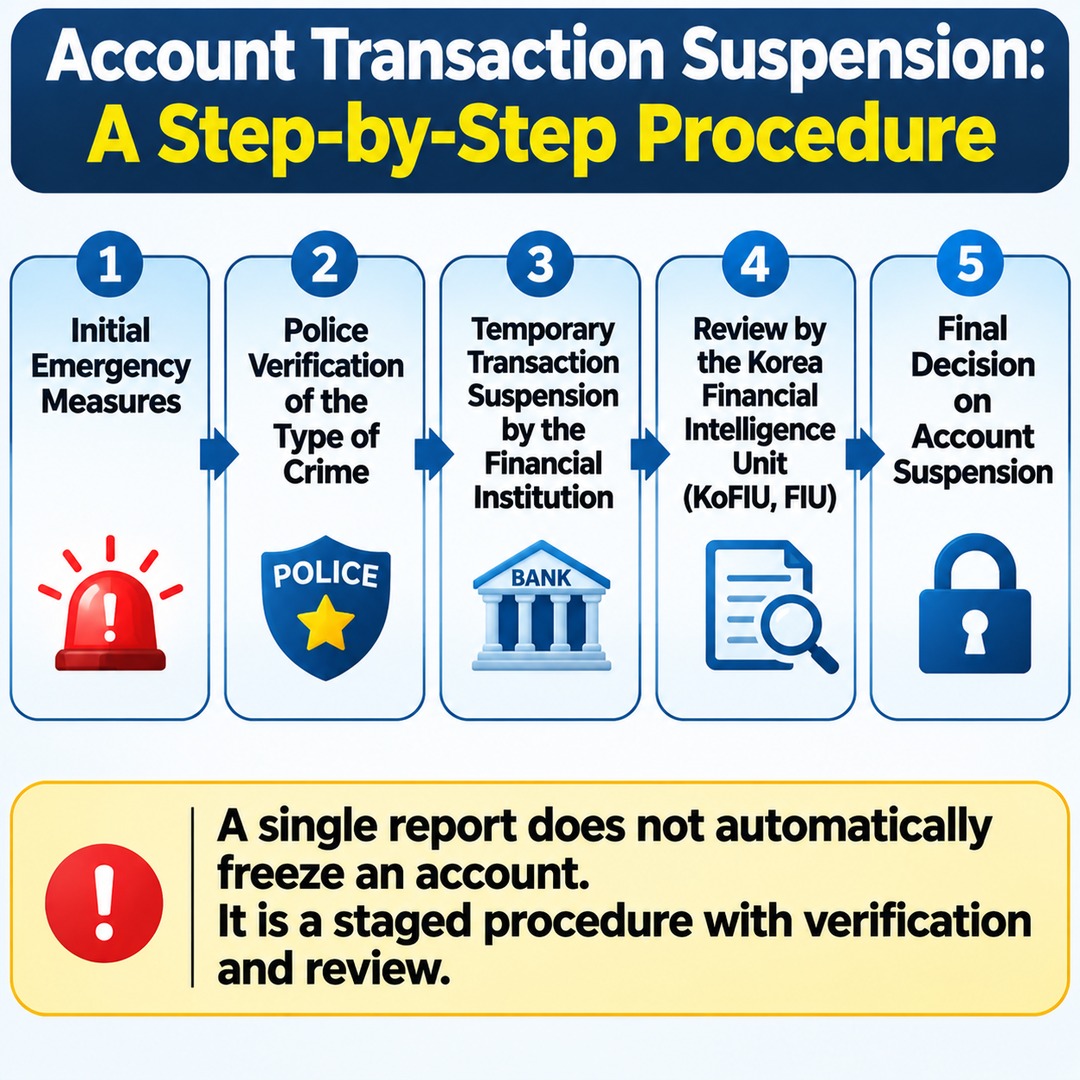
The transaction suspension process for accounts suspected of involvement in emerging phishing scams does not mean that every account is automatically frozen following a single report. It is a staged procedure involving initial emergency measures, police verification of the type of crime, temporary transaction suspension by the financial institution, and a review by the Korea Financial Intelligence Unit (KoFIU, or FIU).
The Account Suspension Process for Suspected Emerging Phishing Scams
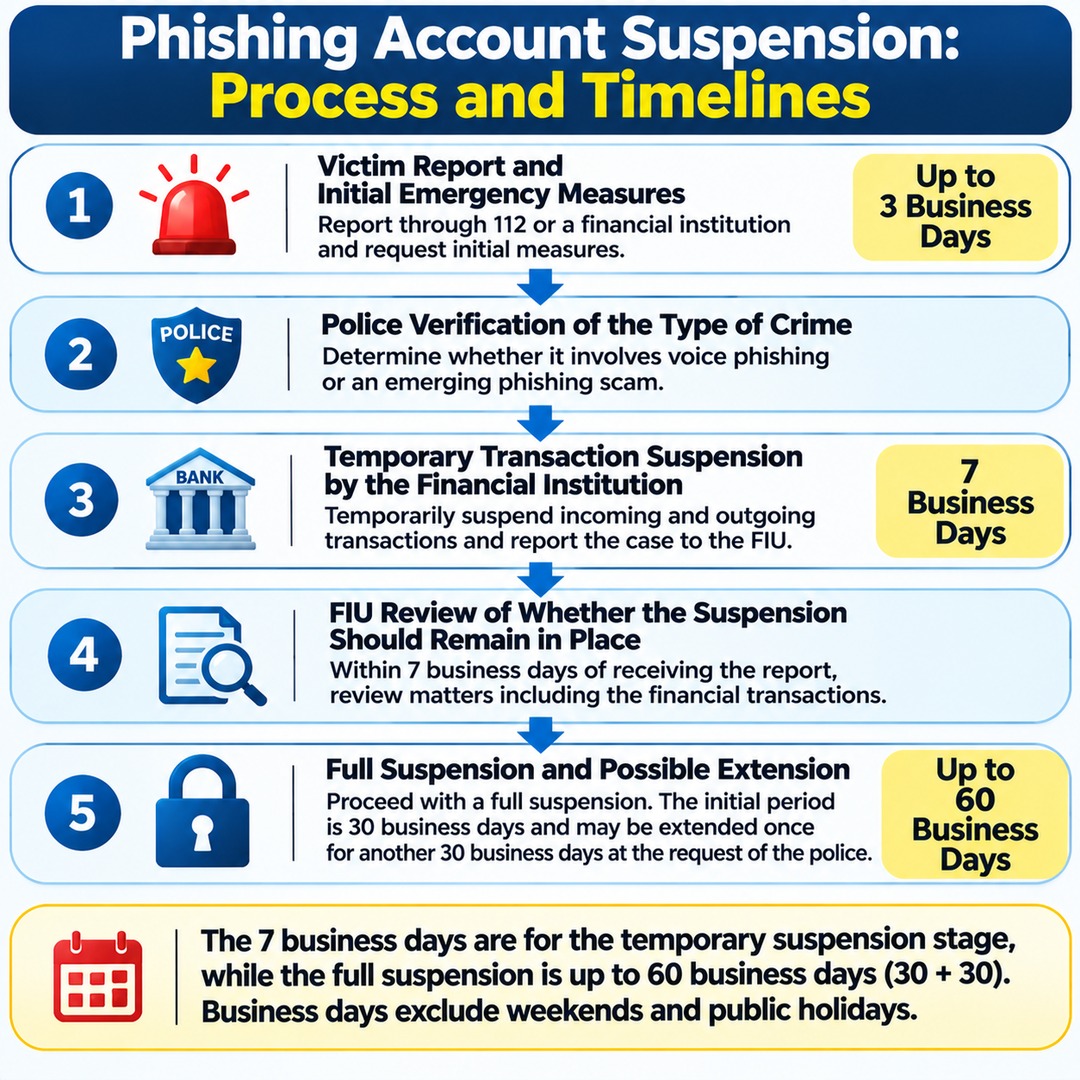
1. Victim report and initial emergency measures — Up to 3 business days
Report the incident through 112 or a financial institution and request initial measures concerning the suspicious account.
2. Police verification of the type of crime
The police determine whether the incident involves voice phishing or an emerging phishing scam disguised as a goods or service transaction.
3. Temporary transaction suspension by the financial institution — 7 business days
If the account is identified as one suspected of involvement in an emerging phishing scam, the financial institution temporarily suspends incoming and outgoing transactions under enhanced customer identification procedures and reports the case to the FIU.
4. FIU review of whether the suspension should remain in place
Within 7 business days of receiving the financial institution's report, the FIU reviews matters including the financial transactions between the victim and the account holder.
5. Full suspension and possible extension — Up to 60 business days
If continued transaction suspension is considered necessary, the financial institution proceeds with a full suspension. The initial full suspension lasts 30 business days and may be extended once for an additional 30 business days at the request of the police.
Initial emergency measures, temporary transaction suspension, and full suspension are separate stages. Whether they apply and how long they last depend on police verification and the financial institution's handling of the case.
It is particularly important to distinguish between the 7-business-day period and the 60-business-day period.
The 7-business-day period refers to the temporary transaction suspension stage, during which the FIU reviews whether maintaining the suspension is appropriate.
The initial full suspension lasts 30 business days and may be extended once by another 30 business days at the request of the police.
Therefore, the maximum period at the full suspension stage is 60 business days.
Business days exclude weekends and public holidays, so they are not the same as 7 or 60 calendar days. Furthermore, every stage does not automatically begin as soon as a report is filed.
What Changed Under South Korea's 2026 Emerging Phishing Account Suspension System?
An important change is the introduction of procedures that allow suspicious accounts to be suspended promptly even when the fraud does not take the form of traditional voice phishing.
Previously, when a fraud scheme was disguised as a transaction involving the purchase or sale of goods or services and did not fall within the existing voice phishing victim relief framework, financial institutions could face difficulties responding proactively with account suspensions.
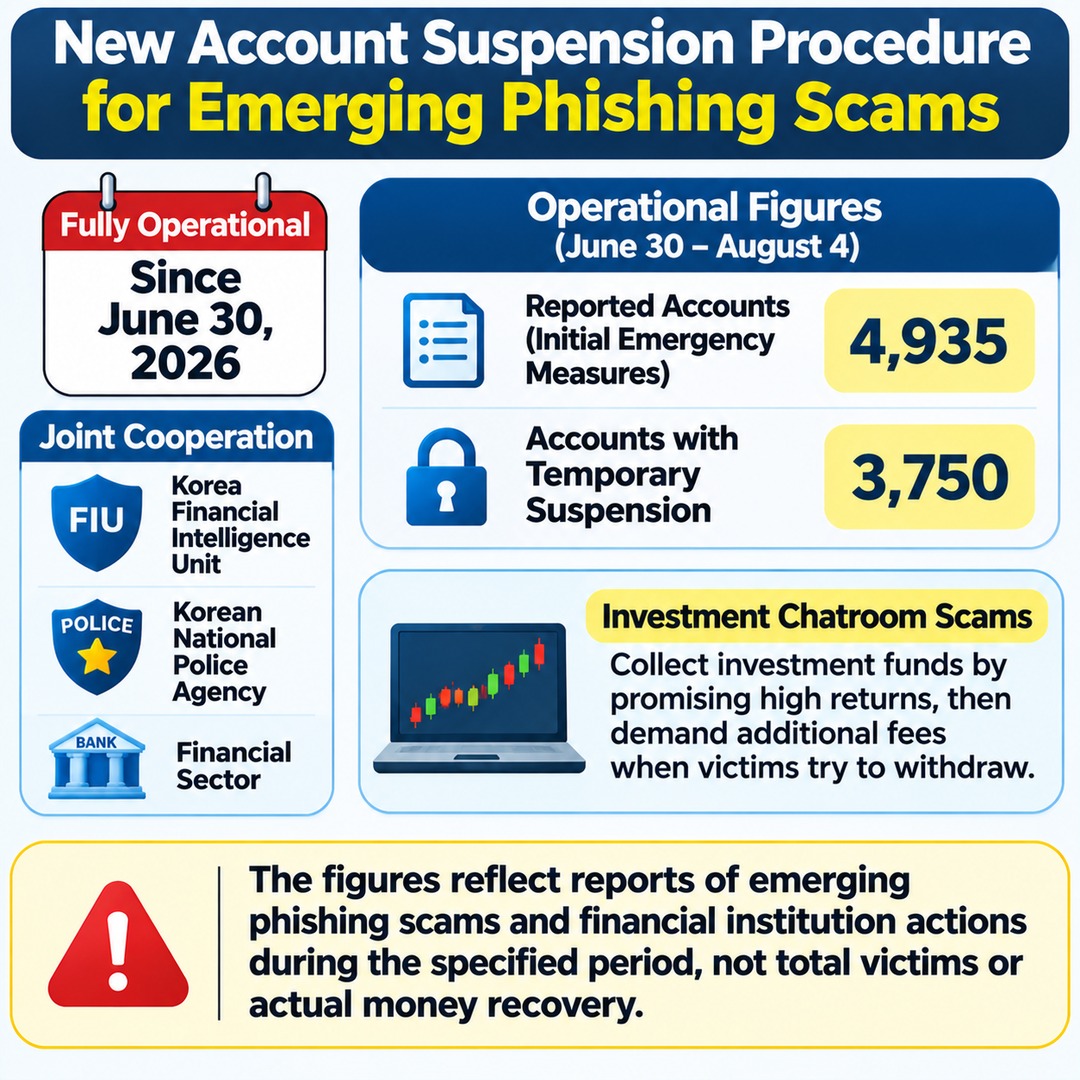
Since June 30, 2026, procedures for suspending accounts suspected of involvement in emerging phishing scams have been fully operational through cooperation among the Korea Financial Intelligence Unit, the Korean National Police Agency, and the financial sector.
The operational figures also provide an indication of how the system has been used.
According to materials released by South Korea's Financial Services Commission in August 2026, a total of 4,935 accounts suspected of involvement in emerging phishing scams were reported to financial institutions and received initial emergency measures between June 30 and August 4.
| Crime type | Number of reported cases receiving temporary measures | Share |
|---|---|---|
| Romance scams | 1,527 | Approximately 41% |
| No-show scams | 1,376 | Approximately 37% |
| Team mission scams | 847 | Approximately 22% |
During the same period, financial institutions temporarily suspended transactions on 3,750 accounts classified as requiring enhanced customer identification.
These figures do not represent the total number of fraud victims or the number of cases in which money was actually recovered. They reflect reports of emerging phishing scams and the measures taken by financial institutions during the specified period.
Investment chatroom scams were also featured in an administrative innovation case published by South Korea's Office for Government Policy Coordination in November 2026. The case described a new type of scam in which fraudsters collected investment funds by promising high returns and then demanded additional fees when victims attempted to withdraw their money.
If an Account Is Frozen, Can You Get Your Transferred Money Back?
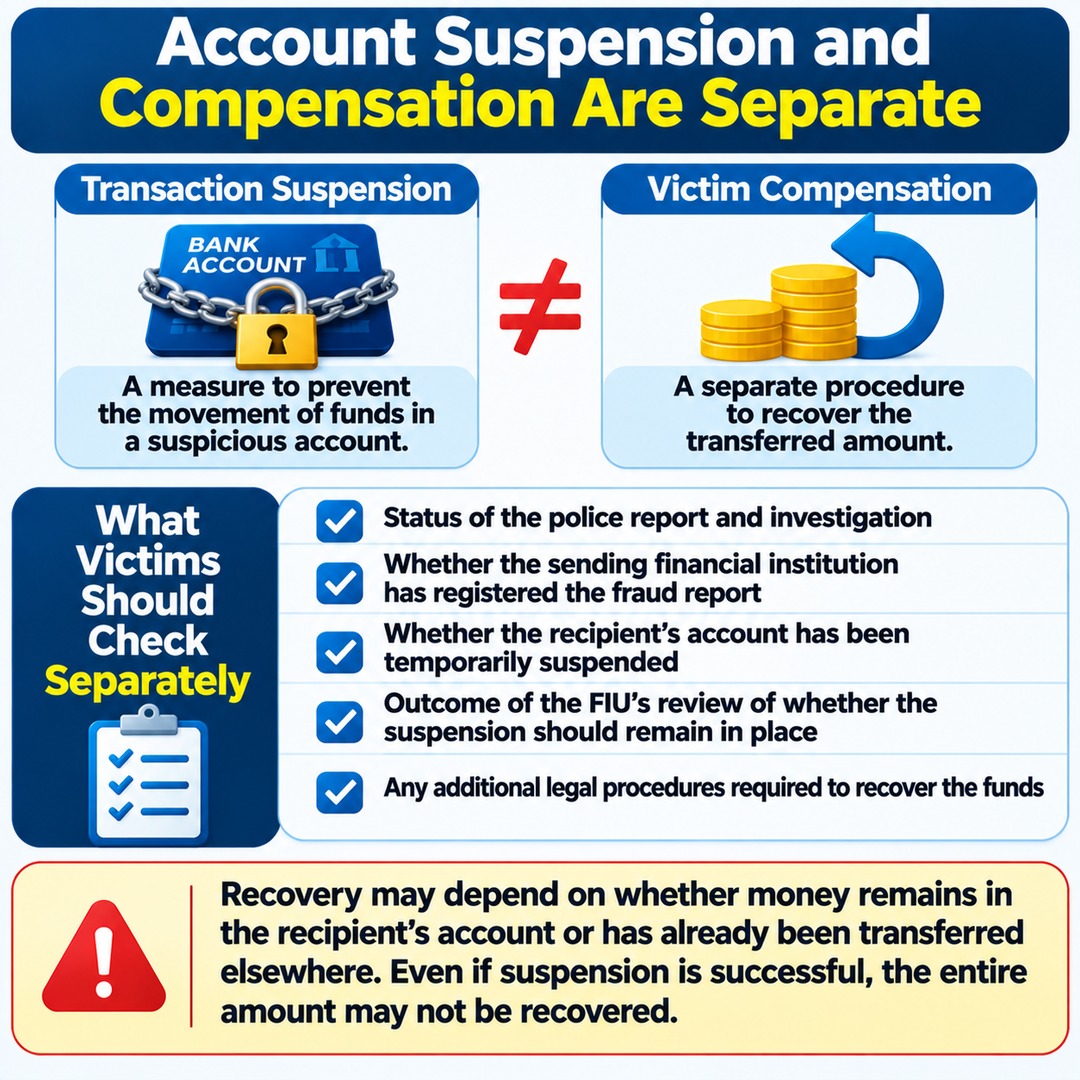
Account transaction suspension and victim compensation are separate procedures. A transaction suspension is a measure intended to prevent the movement of funds in an account suspected of being used for criminal activity. It does not automatically return the transferred amount to the victim.
This distinction matters because victims should not stop pursuing compensation procedures simply because they hear that the recipient's account has been frozen.
Victims should separately check the following:
The status of the police report and investigation
Whether the sending financial institution has registered the fraud report
Whether the recipient's account has been temporarily suspended
The outcome of the FIU's review of whether the transaction suspension should remain in place
Any additional legal procedures required to recover the funds
In particular, the actual possibility of recovery may depend on whether money remains in the recipient's account or has already been transferred to other accounts.
Even if the transaction suspension is successful, it cannot be assumed that the entire amount will be recovered. Conversely, there is no reason to give up reporting simply because the money has already been transferred.
Situations Requiring Particular Caution in Investment Chatroom Scams
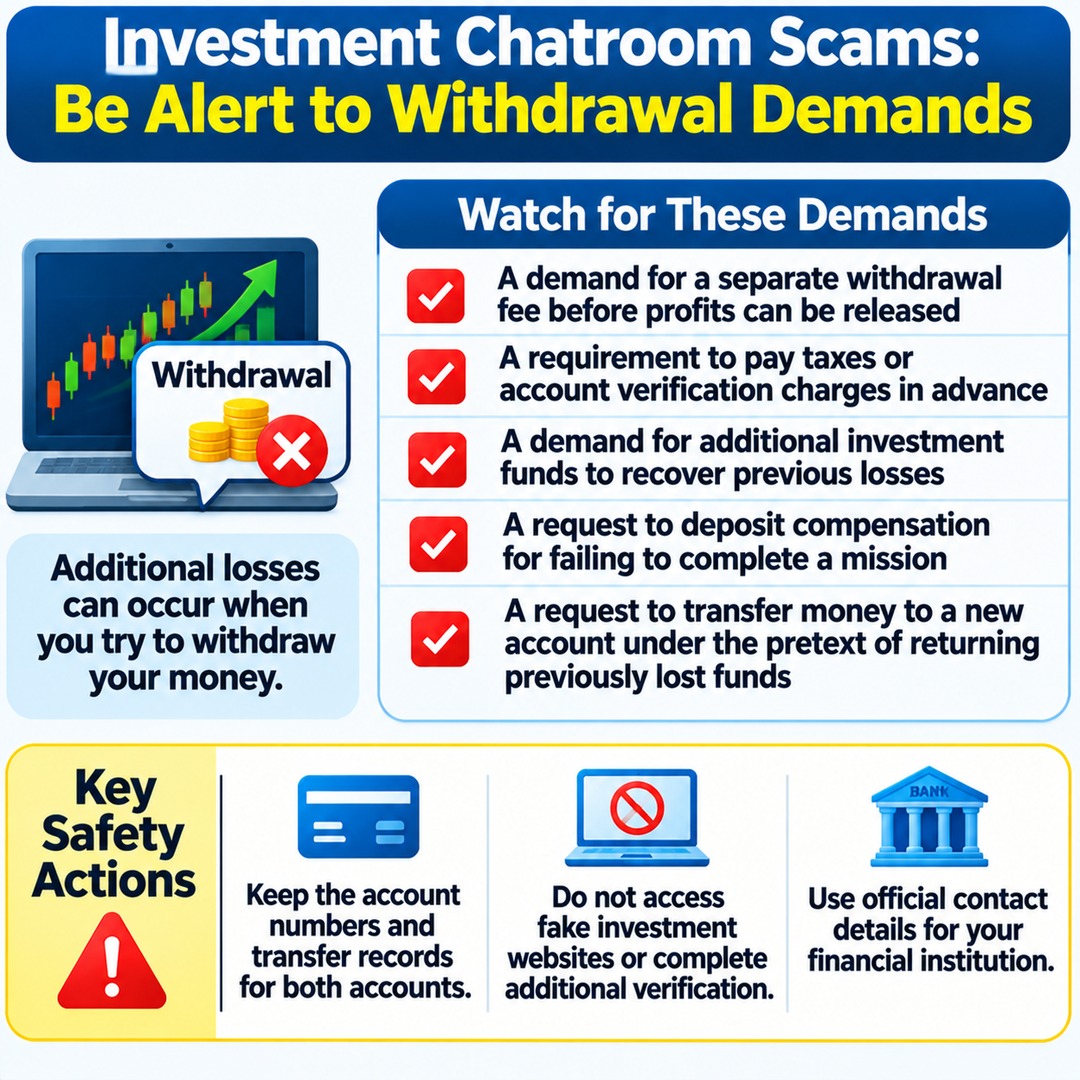
Investment chatroom scams can cause additional losses after the initial investment transfer, particularly when victims attempt to withdraw their money.
The scheme may initially appear to be a legitimate investment service. However, when victims request withdrawal of their supposed profits, the scammers introduce new conditions.
If you encounter any of the following demands, stop sending money and consider reporting the incident:
A demand for a separate withdrawal fee before profits can be released
A requirement to pay taxes or account verification charges in advance
A demand for additional investment funds to recover previous losses
A request to deposit compensation for failing to complete a mission
A request to transfer money to a new account under the pretext of returning previously lost funds
In particular, if the account used for the initial transfer differs from the account requesting additional payments, preserve the account numbers and transfer records for both accounts.
Do not access fake investment websites operated by scammers or complete additional verification procedures they request. Use official contact details for your financial institution rather than phone numbers supplied by the other party.
What to Check If You Have Already Transferred Money
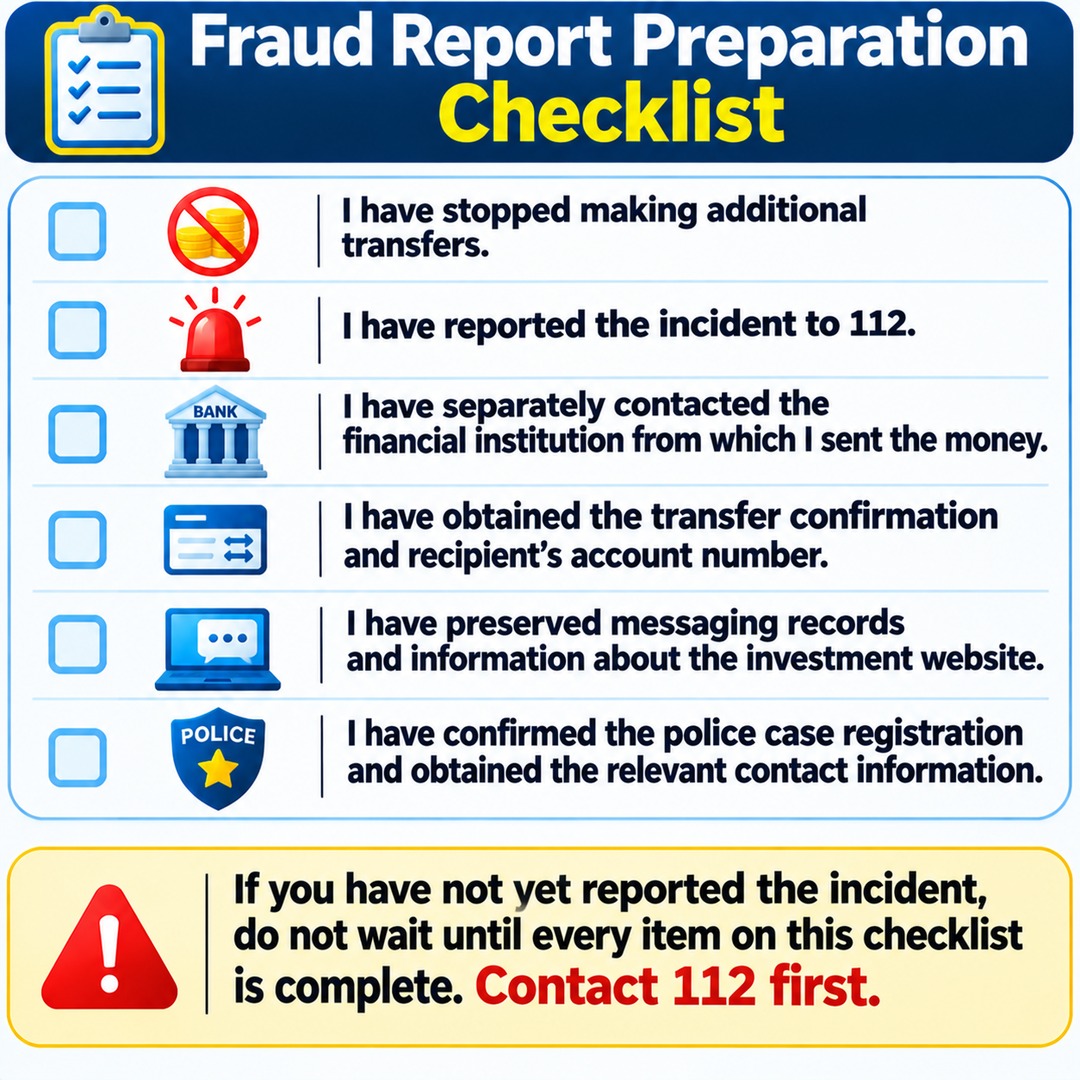
Use the following checklist to review whether you are prepared to report the incident:
I have stopped making additional transfers.
I have reported the incident to 112.
I have separately contacted the financial institution from which I sent the money.
I have obtained the transfer confirmation and recipient's account number.
I have preserved messaging records and information about the investment website.
I have confirmed the police case registration and obtained the relevant contact information.
I have asked the financial institution whether transaction suspension measures are being taken against the suspicious account.
If you have not yet reported the incident, do not wait until every item on this checklist is complete. Contact 112 first.
Frequently Asked Questions
Can an account be frozen if the scam involves an investment chatroom rather than voice phishing?
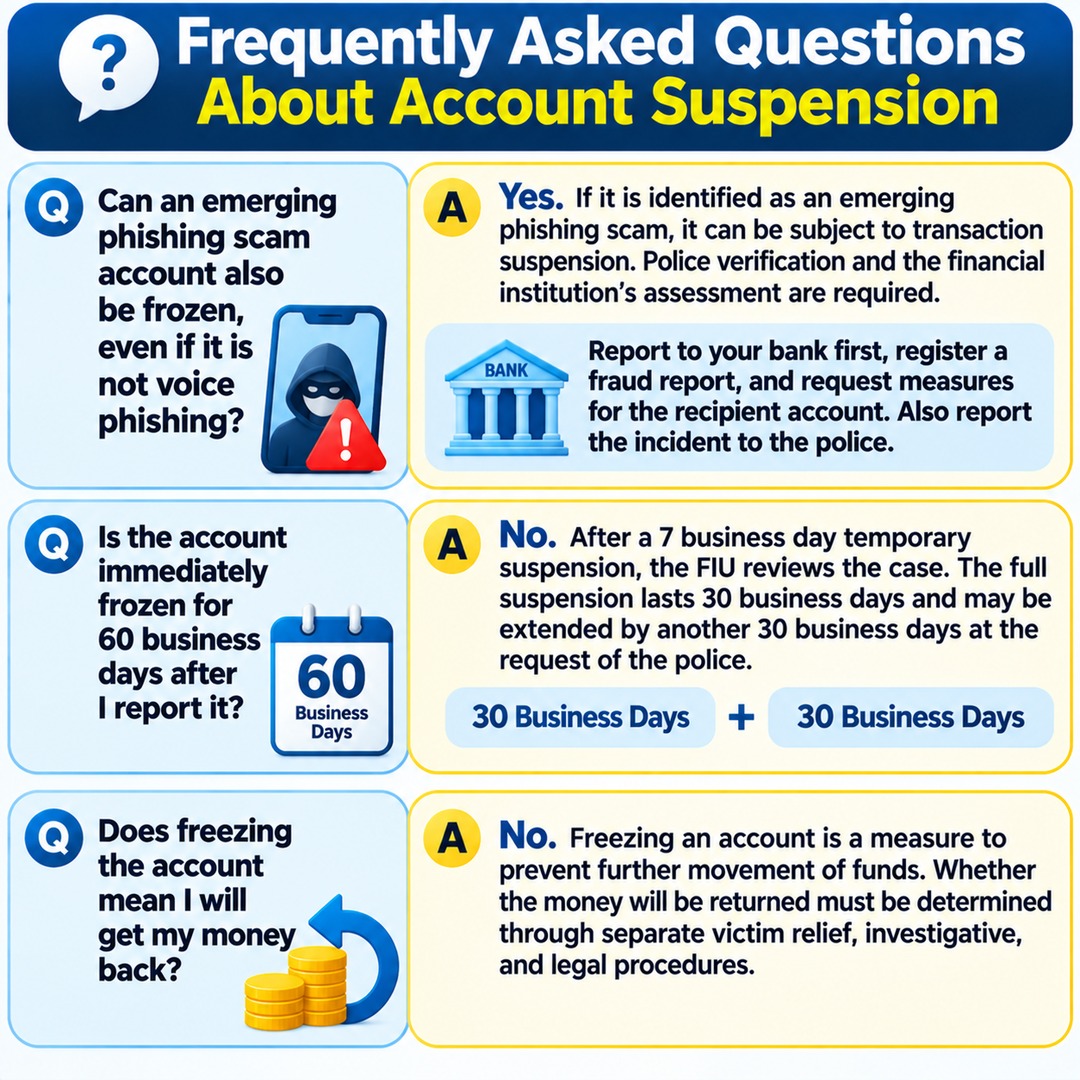
Yes. If the crime is identified as an emerging phishing scam, it is not automatically excluded from the transaction suspension process simply because it differs from traditional voice phishing. However, police verification and the financial institution's assessment are required.
Can I still report the fraud if several days have passed since I transferred the money?
You should still report the incident even if some time has passed since the transfer. However, the outcome of the account suspension and fund recovery process may vary depending on the remaining account balance and the circumstances of the financial transactions.
Where should I contact if the recipient's account is at a different bank?
First, contact the financial institution from which you sent the money, register a fraud report, and request measures concerning the recipient account held at the other financial institution. You should also report the incident to the police.
Is the account suspension period always 60 business days?
No. Following the 7-business-day temporary transaction suspension, the FIU reviews the case before a full suspension proceeds. The full suspension lasts 30 business days and may be extended by another 30 business days at the request of the police. Therefore, 60 business days is the maximum period at the full suspension stage, not a period automatically applied to every report.
Does receiving notification that an account has been frozen mean my money has been returned?
No. Freezing an account is a measure intended to prevent further movement of funds. Whether the money will be returned must be determined through separate victim relief, investigative, and legal procedures.