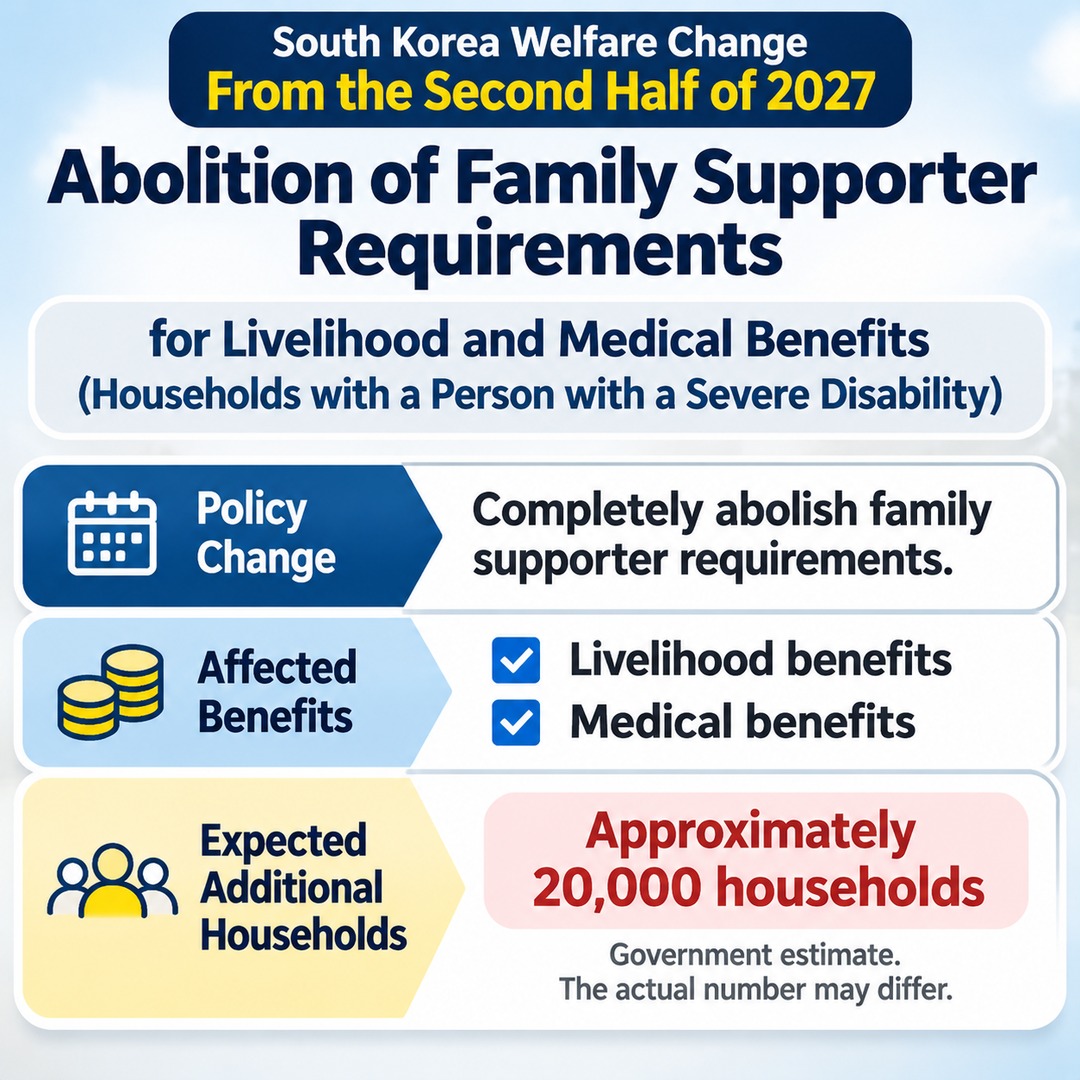

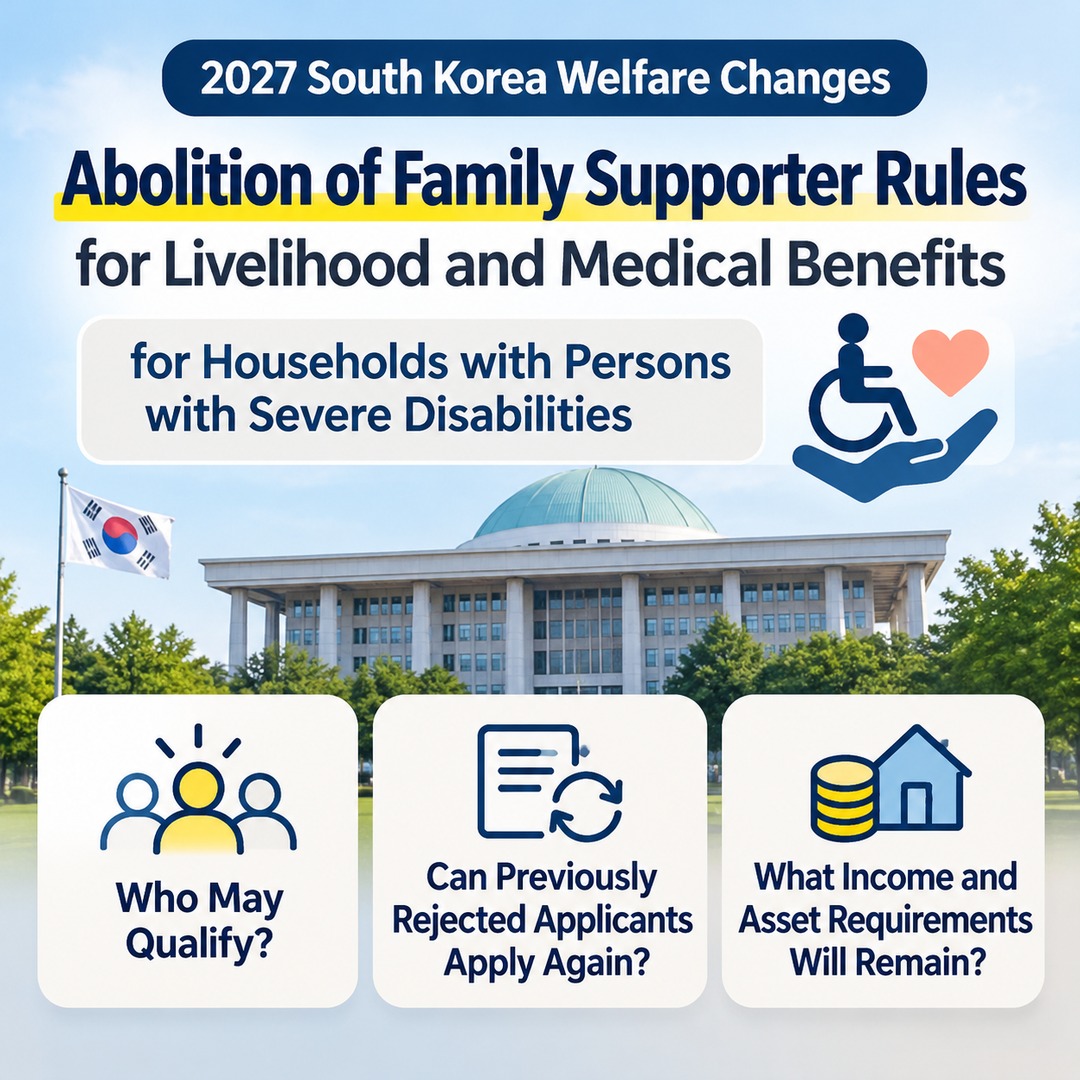
Starting in the second half of 2027, South Korea plans to completely abolish the family supporter eligibility requirements for livelihood benefits and medical benefits for households that include a person with a severe disability. The Ministry of Health and Welfare expects approximately 20,000 additional households to receive support as a result. However, eliminating assessments of family members' income and assets does not mean that an applicant's own household will automatically qualify for benefits.
The most important aspect of this change is that households with a person with a severe disability that previously could not receive support under the National Basic Livelihood Security System because of their parents' or adult children's financial circumstances may become newly eligible.
What Will Change in the Second Half of 2027?
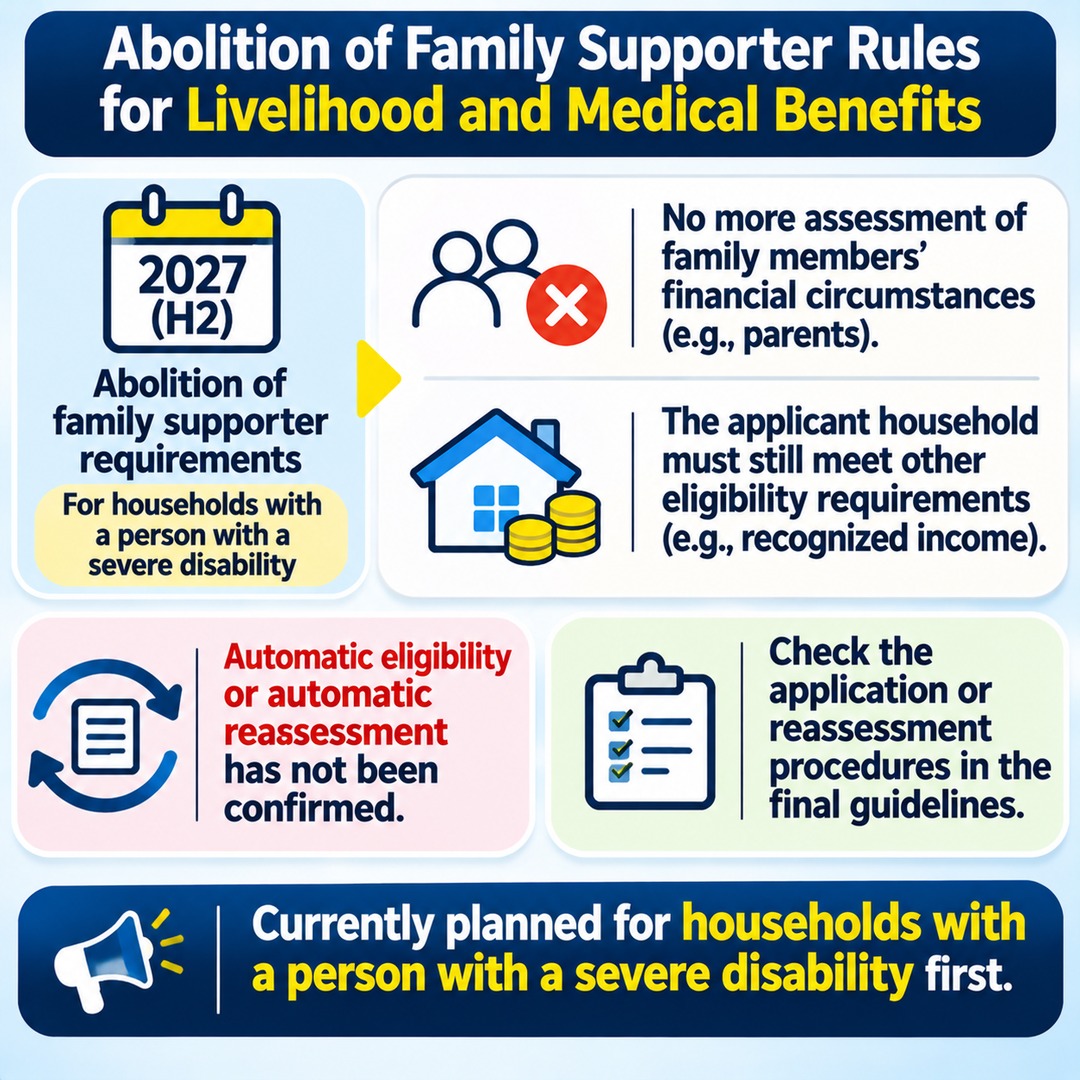
The changes apply to livelihood benefits and medical benefits for households that include a person with a severe disability. Under the Fourth Comprehensive Plan for Basic Livelihood Security (2027–2029), the government announced plans to completely abolish the family supporter requirements for both types of benefits starting in the second half of 2027.
In South Korea's welfare system, a family supporter generally refers to a first-degree lineal relative, such as a parent or child, who lives separately from the benefit applicant, or that relative's spouse.
Under the previous system, an applicant could be excluded from receiving benefits if a family member's income or assets exceeded certain thresholds, even when the applicant's own household was experiencing financial hardship.
The central purpose of this policy change is to remove restrictions based on family members' financial circumstances for households that include a person with a severe disability.
Key Changes Planned for the Second Half of 2027
Livelihood Benefits
Abolition of the family supporter requirements for households that include a person with a severe disability.
Medical Benefits
Abolition of the family supporter requirements for households that include a person with a severe disability.
Expected Additional Beneficiary Households
Approximately 20,000 households.
This is the government's estimate. The actual number of households selected may differ.
Which Households May Become Eligible for Support?
The most directly affected households are those that include a person with a severe disability and have limited financial resources but were previously unable to receive livelihood or medical benefits because their family supporters had relatively high incomes or substantial assets.
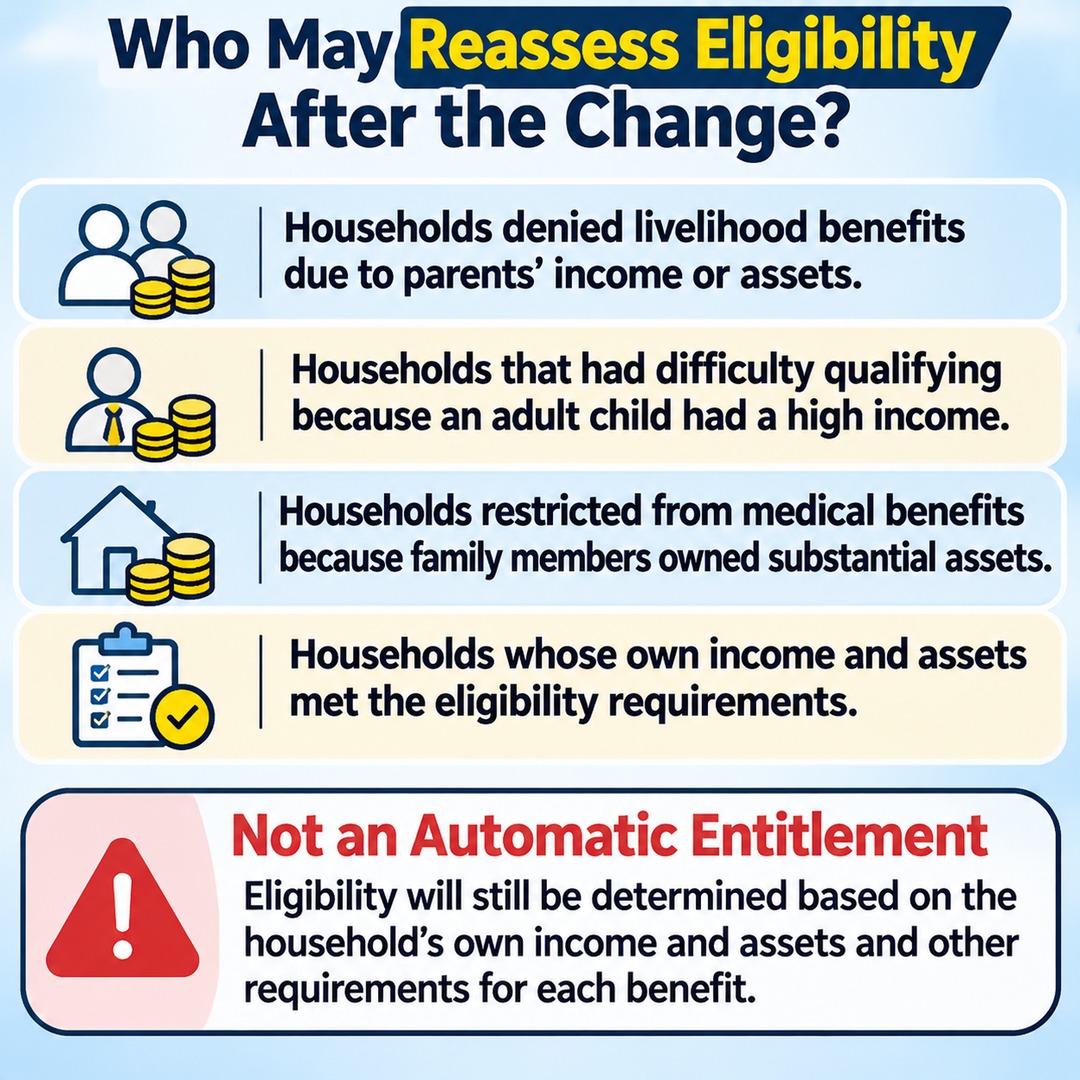
Households in the following situations may want to reassess their eligibility after the policy change:
Households that include a person with a severe disability and were denied livelihood benefits because of their parents' income or assets.
Households that had difficulty qualifying for livelihood benefits because an adult child had a high income.
Households that faced restrictions on medical benefit eligibility because family members owned substantial assets.
Households whose own income and assets met the eligibility requirements but were denied support because of the family supporter rules.
One important point is that the presence of a person with a severe disability in a household does not automatically guarantee payment of livelihood and medical benefits.
The household's own income and assets, along with the remaining eligibility requirements for each type of benefit, will still be assessed separately.
The detailed criteria for determining which households qualify as households that include a person with a severe disability, as well as the implementation procedures, will also need to be confirmed through subsequent government guidelines.
How Are Livelihood Benefits Different from Medical Benefits?
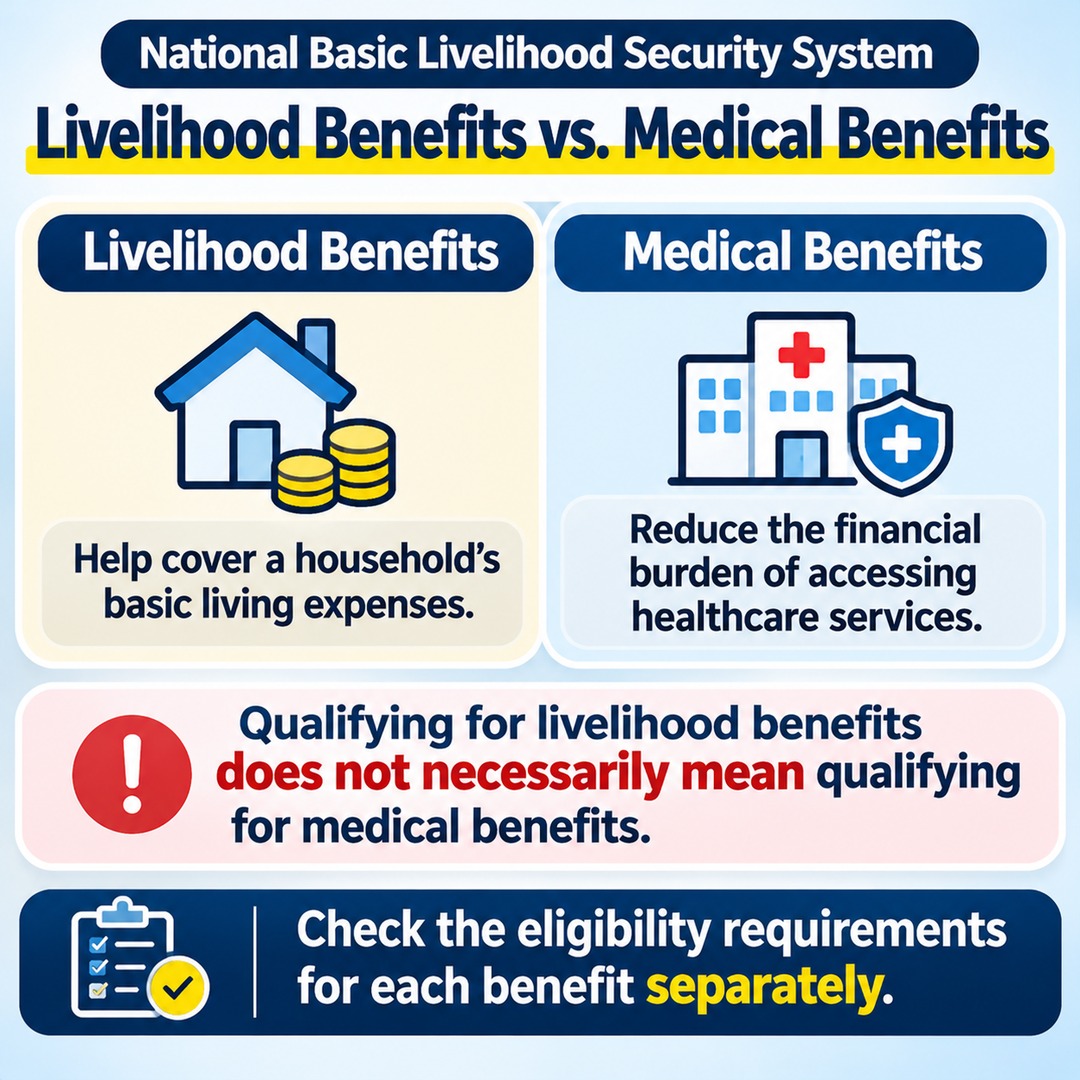
Both benefits are part of South Korea's National Basic Livelihood Security System, but they serve different purposes and have different eligibility requirements.
| Category | Livelihood Benefits | Medical Benefits |
|---|---|---|
| Purpose | Financial assistance for basic living expenses | Assistance with the cost of medical care |
| Households covered by the change | Households that include a person with a severe disability | Households that include a person with a severe disability |
| Policy change | Abolition of family supporter requirements | Abolition of family supporter requirements |
| Assessment of the applicant's household | Still required | Still required |
| Planned implementation | Second half of 2027 | Second half of 2027 |
Livelihood benefits help cover a household's basic living expenses. Medical benefits are designed to reduce the financial burden of accessing healthcare services.
Therefore, qualifying for livelihood benefits does not necessarily mean that a household will also qualify for medical benefits.
The eligibility requirements for each benefit must be checked separately.
In particular, medical benefits currently operate under a family supporter assessment framework that differs from the one used for livelihood benefits. It will therefore be important to check the detailed guidelines in effect when the policy change is implemented.
Will the Applicant's Own Assets Still Be Assessed if Family Members' Income and Assets Are Excluded?
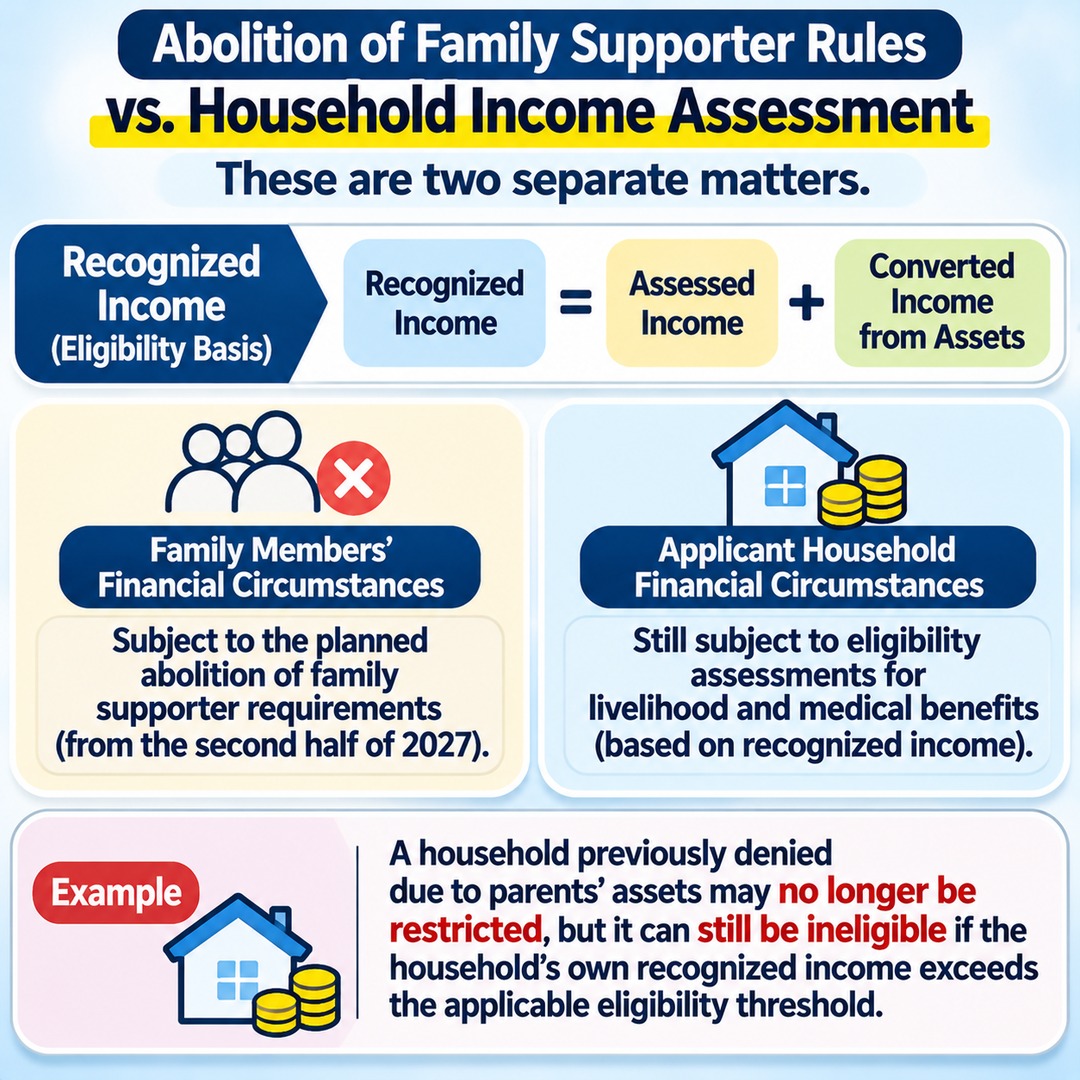
Yes. Abolishing the family supporter requirements and assessing the applicant's household income for benefit eligibility are two separate matters.
In South Korea's welfare system, recognized income (so-deuk-in-jeong-aek) includes not only actual income but also the amount calculated by converting household assets into an equivalent income value.
The basic calculation is:
Recognized Income = Assessed Income + Converted Income from Assets
Assessed income takes actual income into account after applying deductions such as household-specific expenses and earned-income deductions.
Converted income from assets is calculated by considering factors such as the type of assets, the basic asset allowance, debt, and applicable conversion rates.
It is therefore important to distinguish between the following:
Family members' financial circumstances: Subject to the planned abolition of family supporter requirements for households with a person with a severe disability in the second half of 2027.
The applicant's household financial circumstances: Still subject to eligibility assessments for livelihood and medical benefits.
For example, a household with a person with a severe disability that was previously denied benefits because the parents owned substantial assets may no longer be restricted on the basis of those parental assets after the policy change.
However, the household may still have difficulty qualifying if the applicant's own recognized household income exceeds the applicable eligibility threshold for the benefit concerned.
Can Households That Were Previously Rejected Apply Again?
Households that were previously denied benefits should reassess their eligibility after the new rules take effect.
However, the comprehensive plan announced in November 2026 does not, by itself, confirm whether previously rejected households will undergo automatic reassessment or whether a separate application period will be established.
Until the actual implementation procedures are announced, the following preparations may be useful:
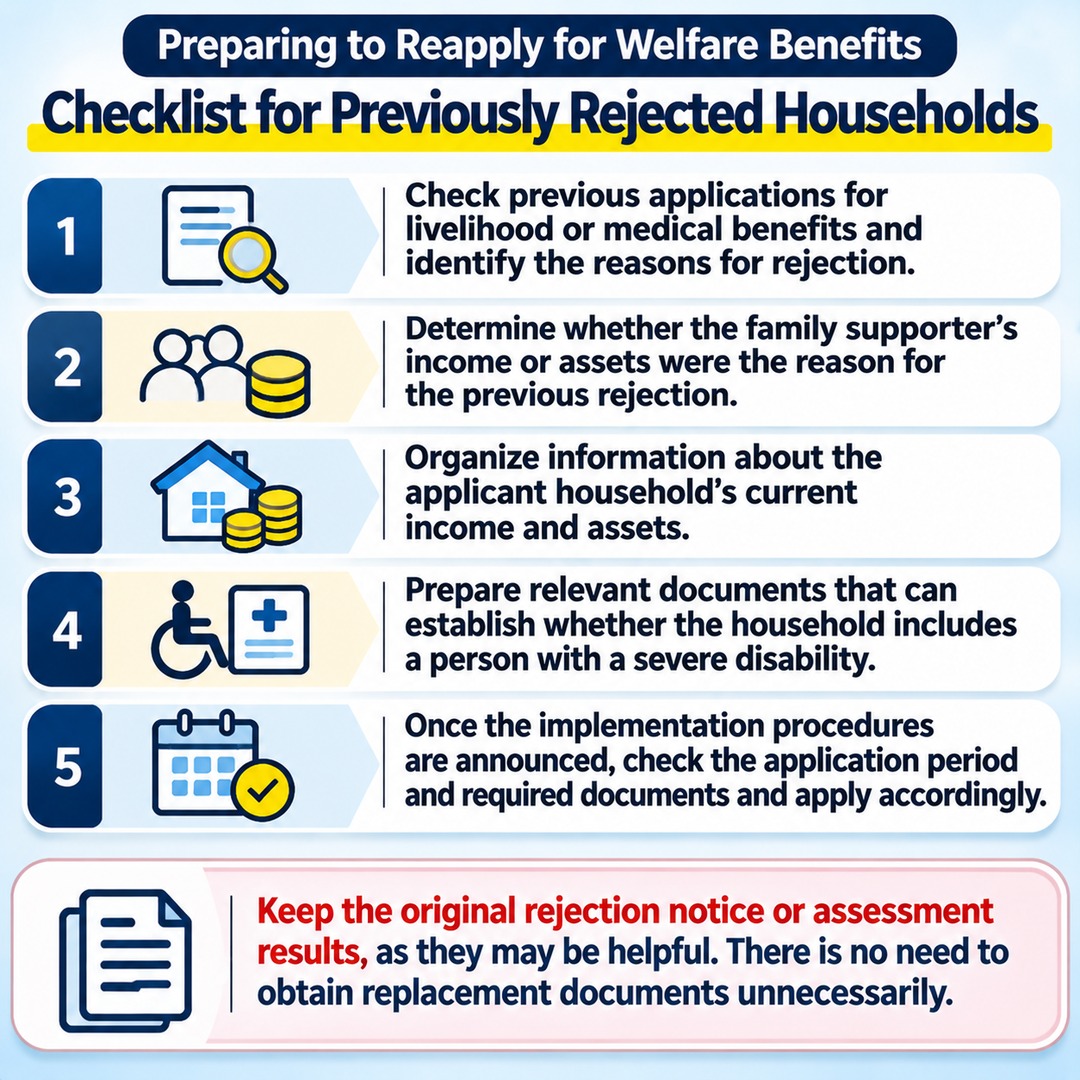
1. Check previous applications for livelihood or medical benefits and identify the reasons for rejection.
2. Determine whether the family supporter's income or assets were the reason for the previous rejection.
3. Organize information about the applicant household's current income and assets.
4. Prepare relevant documents that can establish whether the household includes a person with a severe disability.
5. Once the detailed implementation guidelines for the second half of 2027 are announced, check the procedures for reapplication or reassessment.
If an application was previously rejected because of the family supporter requirements, keeping the original rejection notice or assessment results may be helpful.
There is no need to obtain replacement documents unnecessarily before the application procedures and required paperwork have been finalized.
What Does the Expected Additional Support for Approximately 20,000 Households Mean?
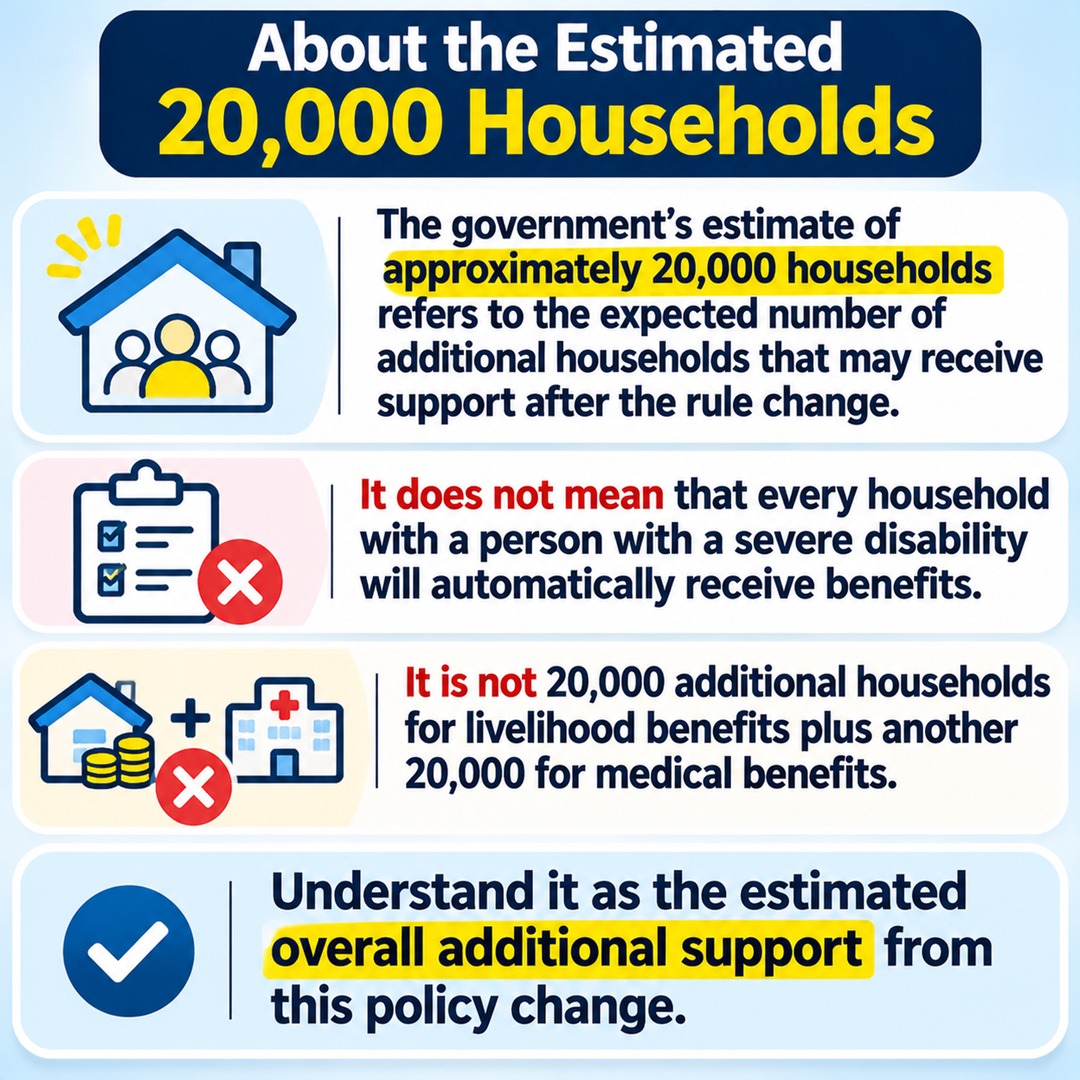
The government's estimate of approximately 20,000 households refers to the expected number of additional households that may receive support as a result of abolishing the family supporter requirements for households with a person with a severe disability.
It does not mean that every household with a person with a severe disability will automatically receive benefits.
The figure represents the government's estimate of households that may become eligible under the new system after previously being excluded because of the family supporter requirements.
It should also not be interpreted as 20,000 additional households receiving livelihood benefits plus another 20,000 receiving medical benefits. The approximately 20,000 figure should be understood as the estimated additional support associated with this overall policy change.
What Should Households Check Before and After Implementation in 2027?
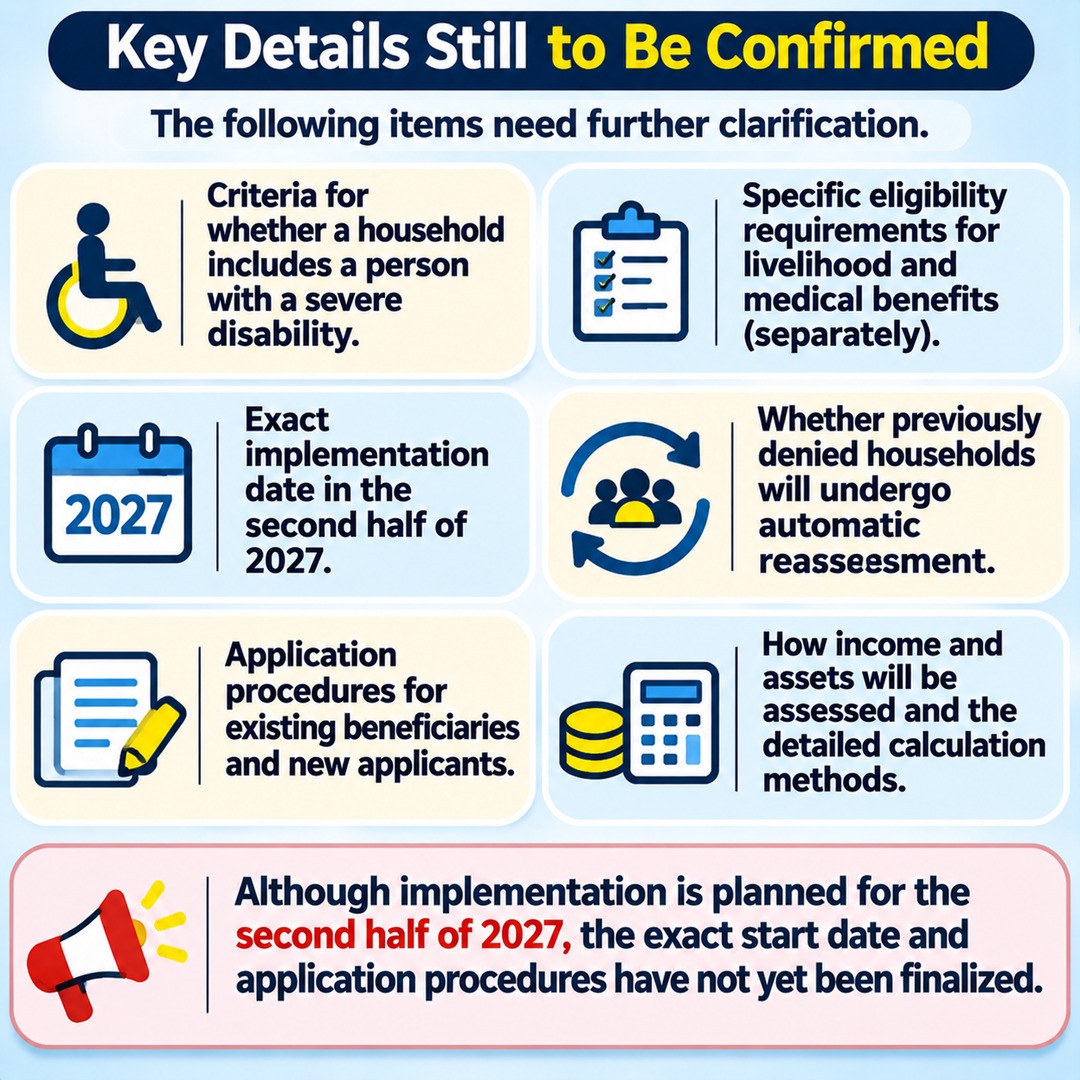
Several practical details of the policy still need to be confirmed:
The precise criteria for determining whether a household includes a person with a severe disability.
The specific eligibility requirements for livelihood and medical benefits separately.
The exact implementation date in the second half of 2027.
Whether households previously denied benefits will undergo automatic reassessment.
The application procedures for existing beneficiaries and new applicants.
The income and asset eligibility thresholds and required documents applicable when the policy takes effect.
Although implementation is planned for the second half of 2027, the exact start date and application procedures have not yet all been finalized.
Households currently unable to receive benefits should compare their previous reasons for rejection with the new requirements once the 2027 implementation guidelines are released.
Frequently Asked Questions
Will households with a person with a severe disability automatically receive livelihood benefits from 2027?
No. The family supporter requirements will be abolished, but other eligibility conditions, including the applicant household's recognized income, will still be assessed separately.
Will the family supporter requirements for medical benefits also be abolished at the same time?
Under the government's plan, the family supporter requirements for both livelihood and medical benefits will be abolished for households that include a person with a severe disability starting in the second half of 2027.
Can a household qualify if the parents have a high income?
The main purpose of this change is to remove restrictions based on the financial circumstances of family supporters, including parents. However, the applicant's household must still satisfy the other applicable eligibility requirements.
Will people who were previously rejected automatically become benefit recipients?
Automatic eligibility or automatic reassessment has not yet been confirmed in detail. Applicants will need to check the application or reassessment procedures under the final implementation guidelines.
Can low-income households without a person with a severe disability also receive these benefits under this change?
The priority abolition planned for the second half of 2027 applies to households that include a person with a severe disability. Any expansion to other households will need to be confirmed through separate government plans.