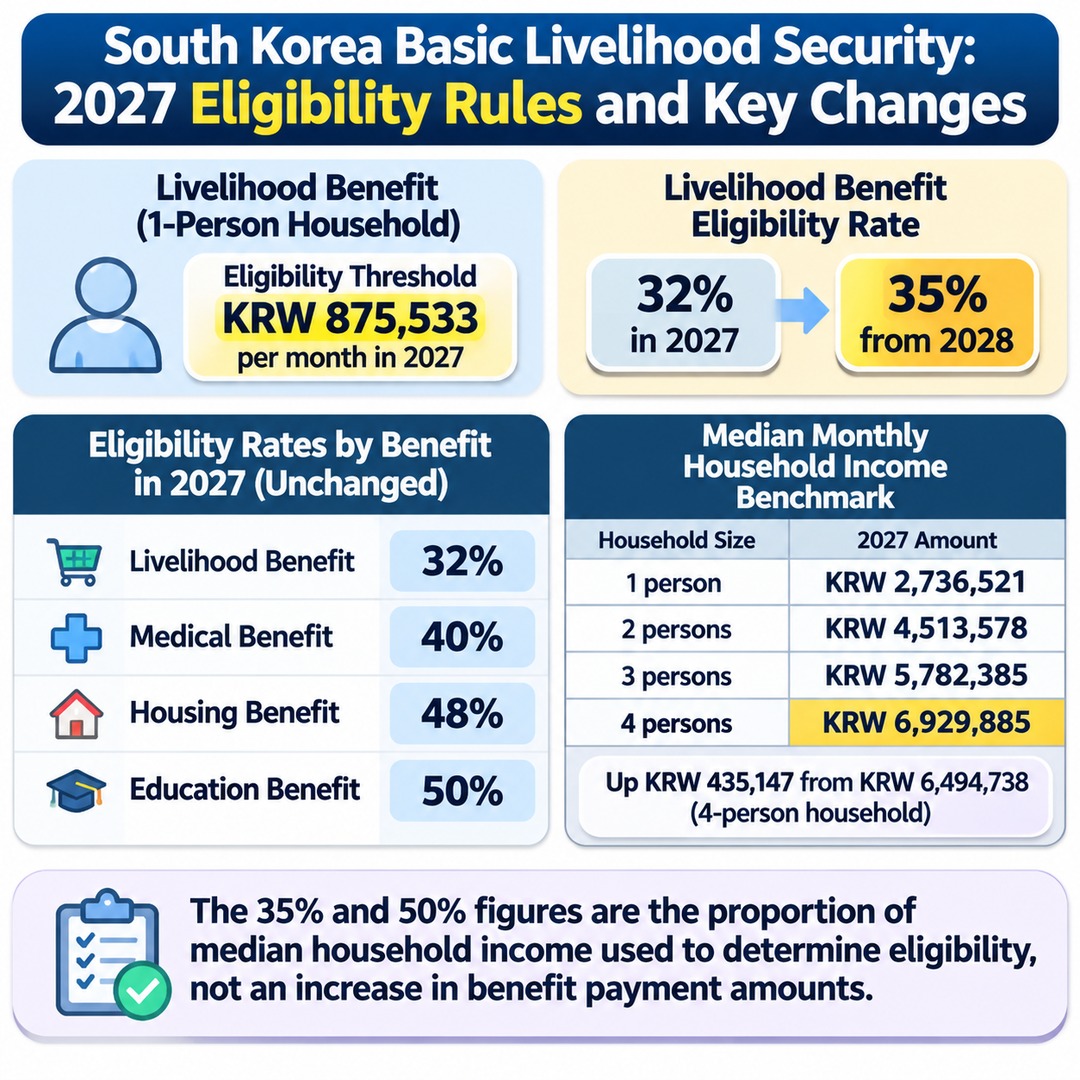

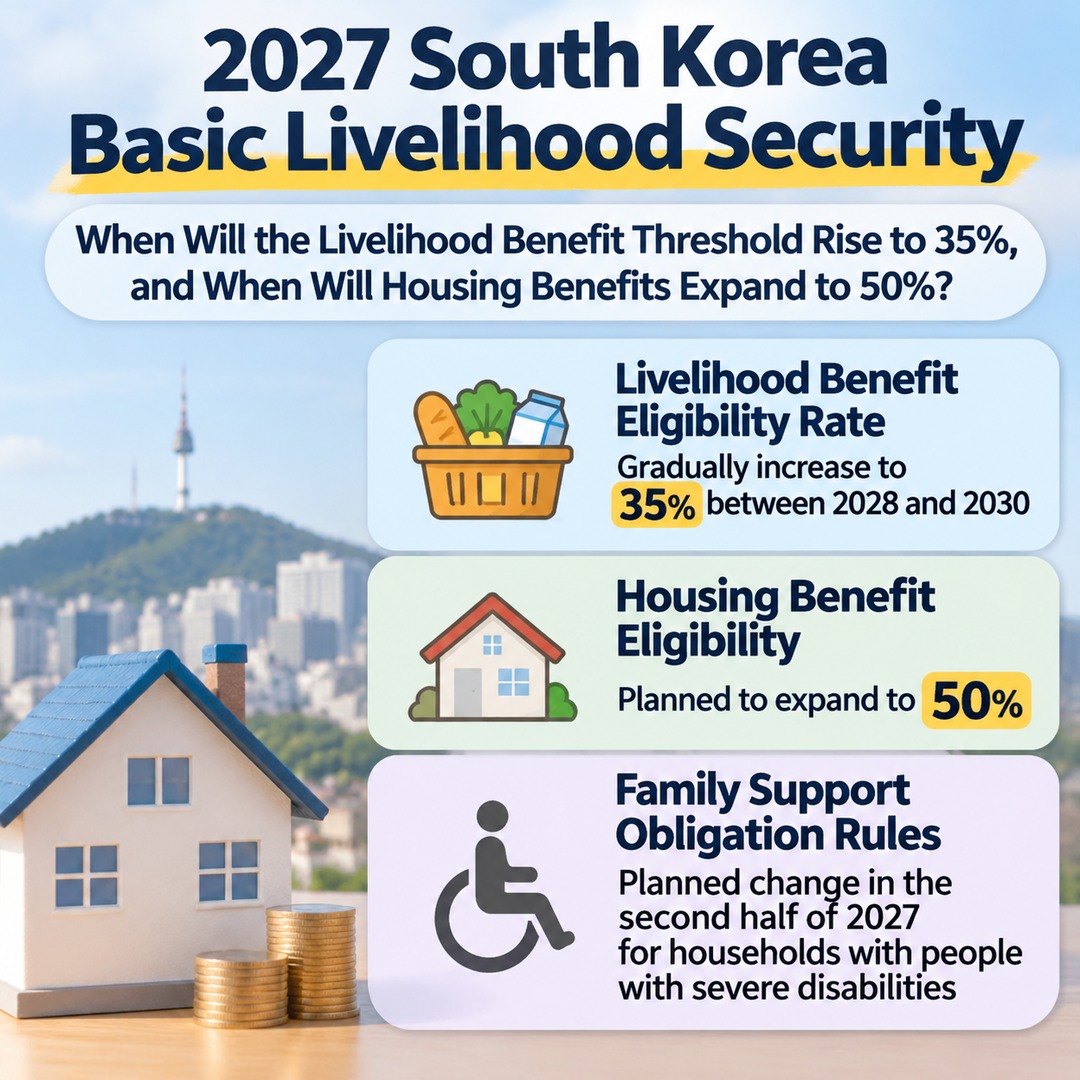
South Korea's 2027 Basic Livelihood Security eligibility rules will not change across all benefit categories at the same time. In 2027, the increase in median household income will raise the monthly livelihood benefit eligibility threshold for a single-person household to KRW 875,533. However, the measure to increase the livelihood benefit eligibility rate from 32% to 35% will not begin until 2028. Housing benefit eligibility is also planned to expand gradually to 50%, while the abolition of certain family support obligation exceptions for households with people with severe disabilities receiving livelihood and medical benefits is scheduled for the second half of 2027.
Anyone preparing to apply for benefits in 2027 should distinguish between the eligibility thresholds already established for that year and policy changes planned for the future. In particular, the 35% and 50% figures do not mean that benefit payments themselves will increase by those percentages. They refer to the proportion of median household income used to determine eligibility.
How Will South Korea's Basic Livelihood Security Eligibility Change in 2027?
In 2027, the median household income benchmark will increase, raising the actual monetary eligibility thresholds for each benefit category. However, the existing eligibility rates will remain unchanged in 2027: 32% for livelihood benefits, 40% for medical benefits, 48% for housing benefits, and 50% for education benefits.
The 2027 median monthly household income benchmarks are as follows:
| Household Size | Monthly Median Household Income |
|---|---|
| 1 person | KRW 2,736,042 |
| 2 people | KRW 4,480,645 |
| 3 people | KRW 5,718,091 |
| 4 people | KRW 6,929,885 |
| 5 people | KRW 8,063,019 |
| 6 people | KRW 9,129,201 |
Compared with 2026, the median monthly household income benchmark for a four-person household will increase by KRW 435,147, from KRW 6,494,738 to KRW 6,929,885.
These figures are reference amounts used to calculate eligibility for household welfare benefits. They do not mean that a household must have monthly wages or a bank balance equal to the corresponding amount.
2027 Eligibility Thresholds and Actual Amounts by Benefit Category
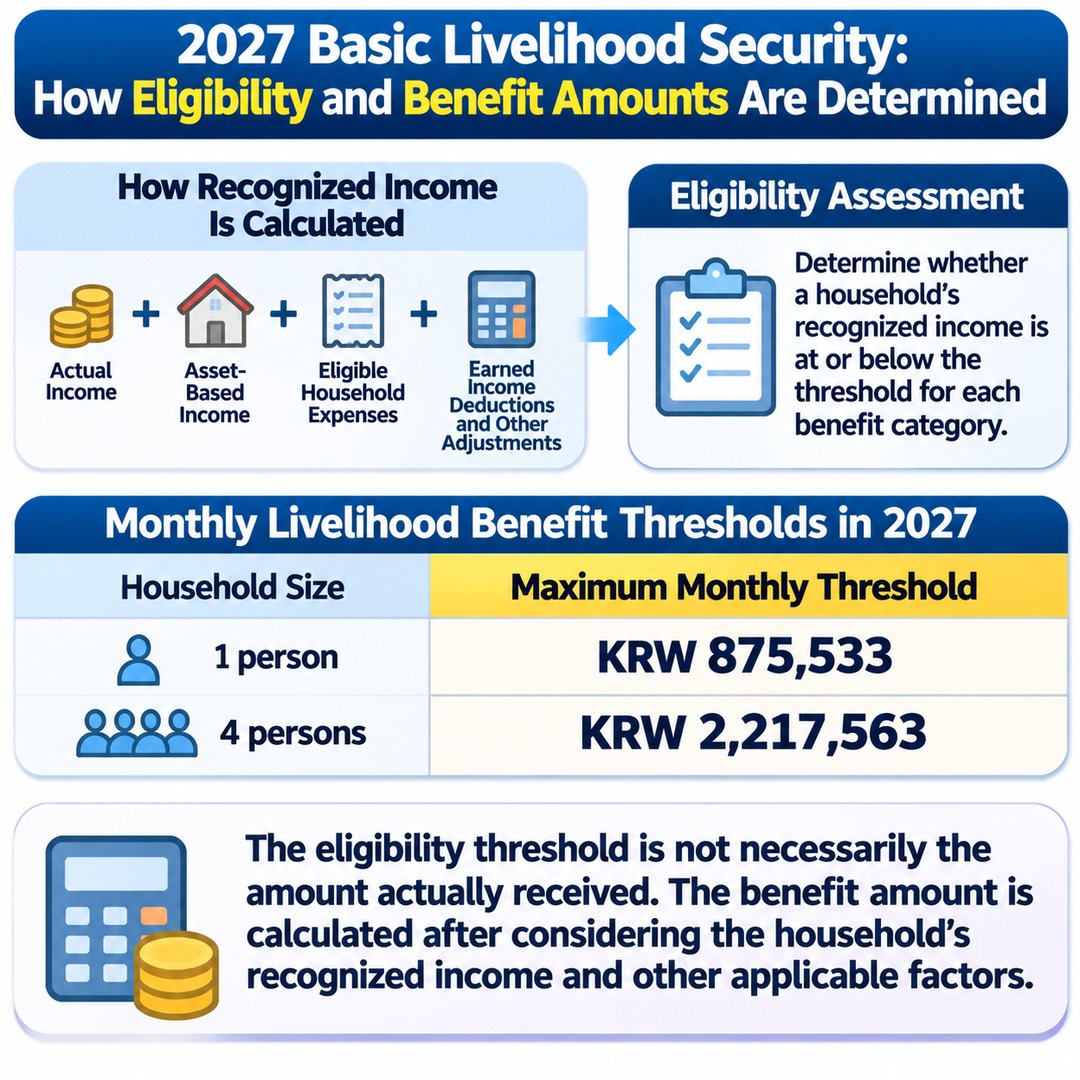
In 2027, eligibility will be determined by assessing whether a household's recognized income is at or below the applicable threshold for each benefit category.
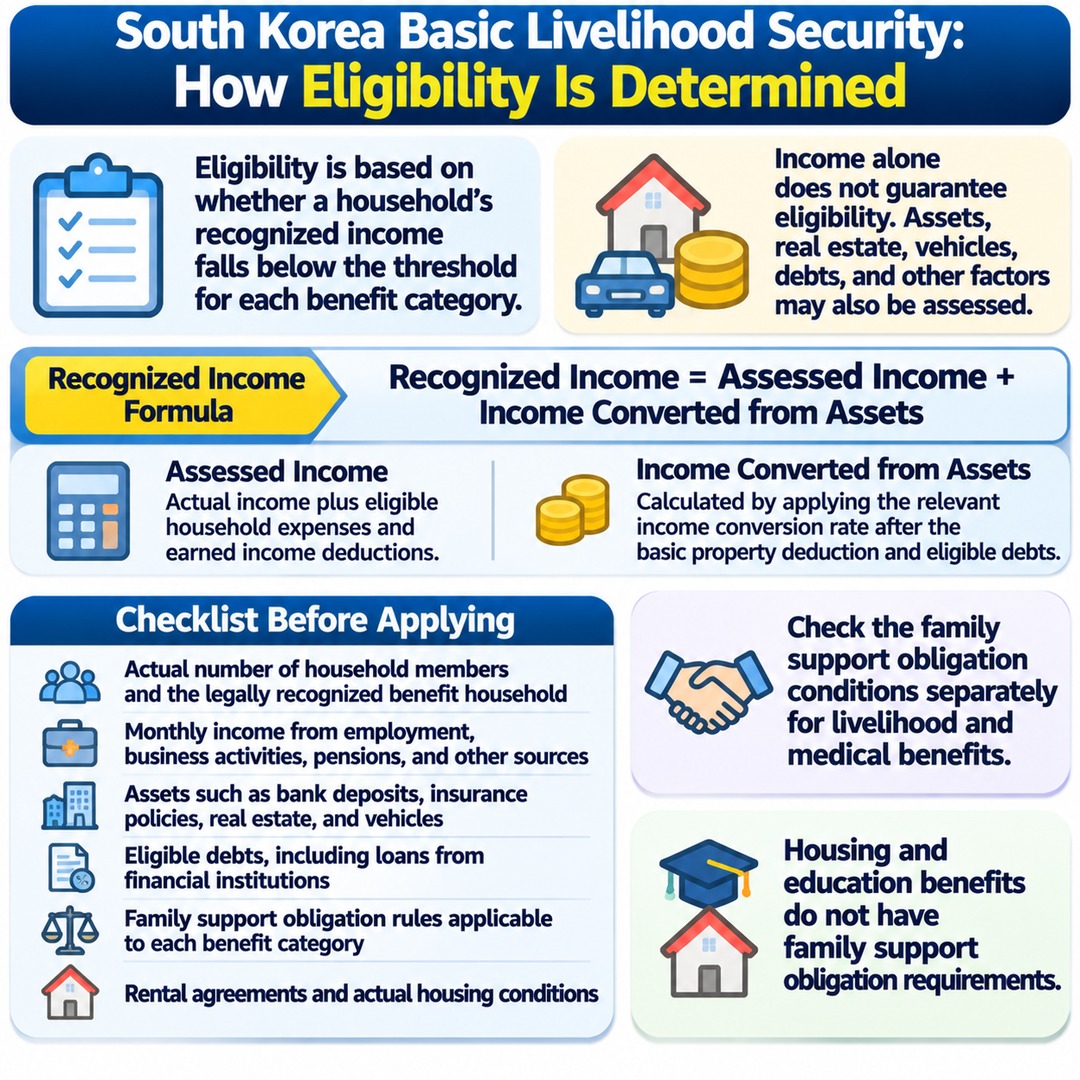
Recognized income is not simply the amount of a household's monthly salary. It is calculated by adding the income converted from assets to assessed income, which takes into account actual income, eligible household expenses, earned income deductions, and other applicable adjustments.
The monthly eligibility thresholds for one-person and four-person households in 2027 are as follows:
| Benefit Category | Percentage of Median Income | 1-Person Household | 4-Person Household |
|---|---|---|---|
| Livelihood benefits | 32% | KRW 875,533 | KRW 2,217,563 |
| Medical benefits | 40% | KRW 1,094,417 | KRW 2,771,954 |
| Housing benefits | 48% | KRW 1,313,300 | KRW 3,326,345 |
| Education benefits | 50% | KRW 1,368,021 | KRW 3,464,943 |
One important distinction is that the eligibility threshold is not necessarily the amount a recipient actually receives.
Livelihood benefits are not paid automatically at the full eligibility threshold. The actual payment is calculated after considering the household's recognized income and other applicable factors. Therefore, the amount received by a household with zero recognized income will differ from the amount received by a household with some recognized income.
The maximum monthly livelihood benefit thresholds in 2027 are KRW 875,533 for a one-person household and KRW 2,217,563 for a four-person household.
The Livelihood Benefit Eligibility Rate Will Rise to 35% Starting in 2028, Not 2027
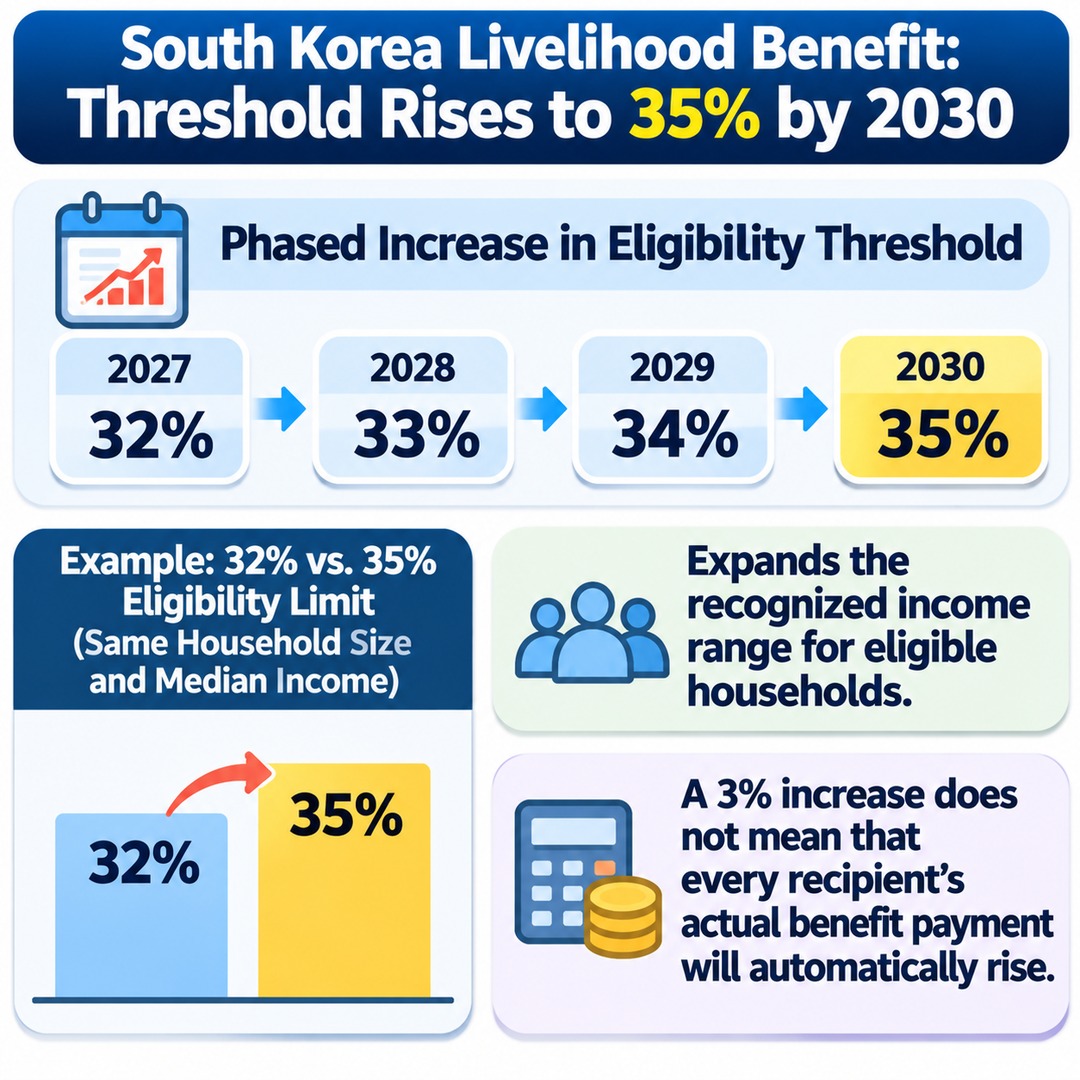
Starting in 2028, the livelihood benefit eligibility threshold will increase from 32% of median household income by one percentage point each year. The phased expansion is scheduled to reach 35% in 2030.
| Year | Eligibility Rate as a Percentage of Median Household Income |
|---|---|
| 2026 | 32% |
| 2027 | 32% |
| 2028 | 33% |
| 2029 | 34% |
| 2030 | 35% |
This means that applicants in 2027 will not immediately qualify under the 35% threshold.
The change will expand the recognized-income range for households eligible to receive livelihood benefits. For example, assuming the same household size and median income benchmark, a 35% threshold produces a higher monetary eligibility limit than a 32% threshold.
However, reaching 35% does not mean that every recipient's actual benefit payment will automatically increase by three percentage points. Livelihood benefit payments are calculated using the applicable annual eligibility threshold and the household's recognized income.
When Will Housing Benefit Eligibility Expand to 50%?
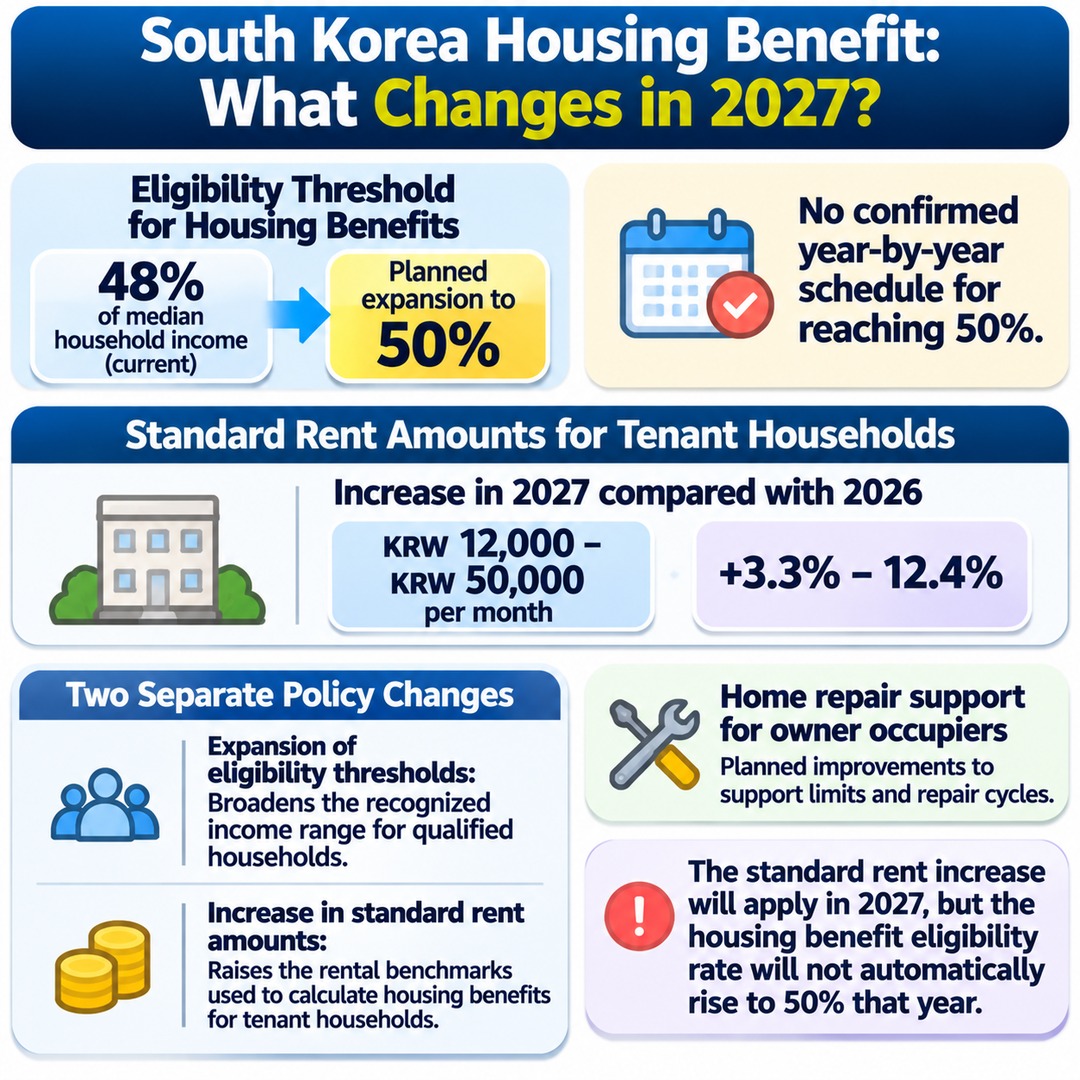
Housing benefit eligibility is currently set at 48% or less of median household income. The government plans to expand the threshold gradually to 50%. However, the announced plan does not specify a confirmed year-by-year schedule for reaching 50%.
There is one change that will already take effect in 2027.
The standard rent amounts used for tenant households' housing benefits will increase by between KRW 12,000 and KRW 50,000 per month compared with 2026. The increase will vary according to the housing region classification and household size, with rates ranging from 3.3% to 12.4%.
These are two separate policy changes and should not be confused:
Expansion of eligibility thresholds: Broadens the recognized-income range for households that can qualify for housing benefits.
Increase in standard rent amounts: Raises the rental benchmarks used to calculate housing benefits for tenant households.
Therefore, the standard rent increase will apply in 2027, but the housing benefit eligibility rate will not automatically rise to 50% that year.
The government also plans to improve home repair support limits and repair cycles for owner-occupier households. However, individual support amounts and detailed eligibility conditions should be checked separately.
Family Support Obligation Rules for Households with Severe Disabilities Will Change in the Second Half of 2027
One important policy change with a specified implementation period in 2027 concerns the family support obligation rules for households that include a person with a severe disability.
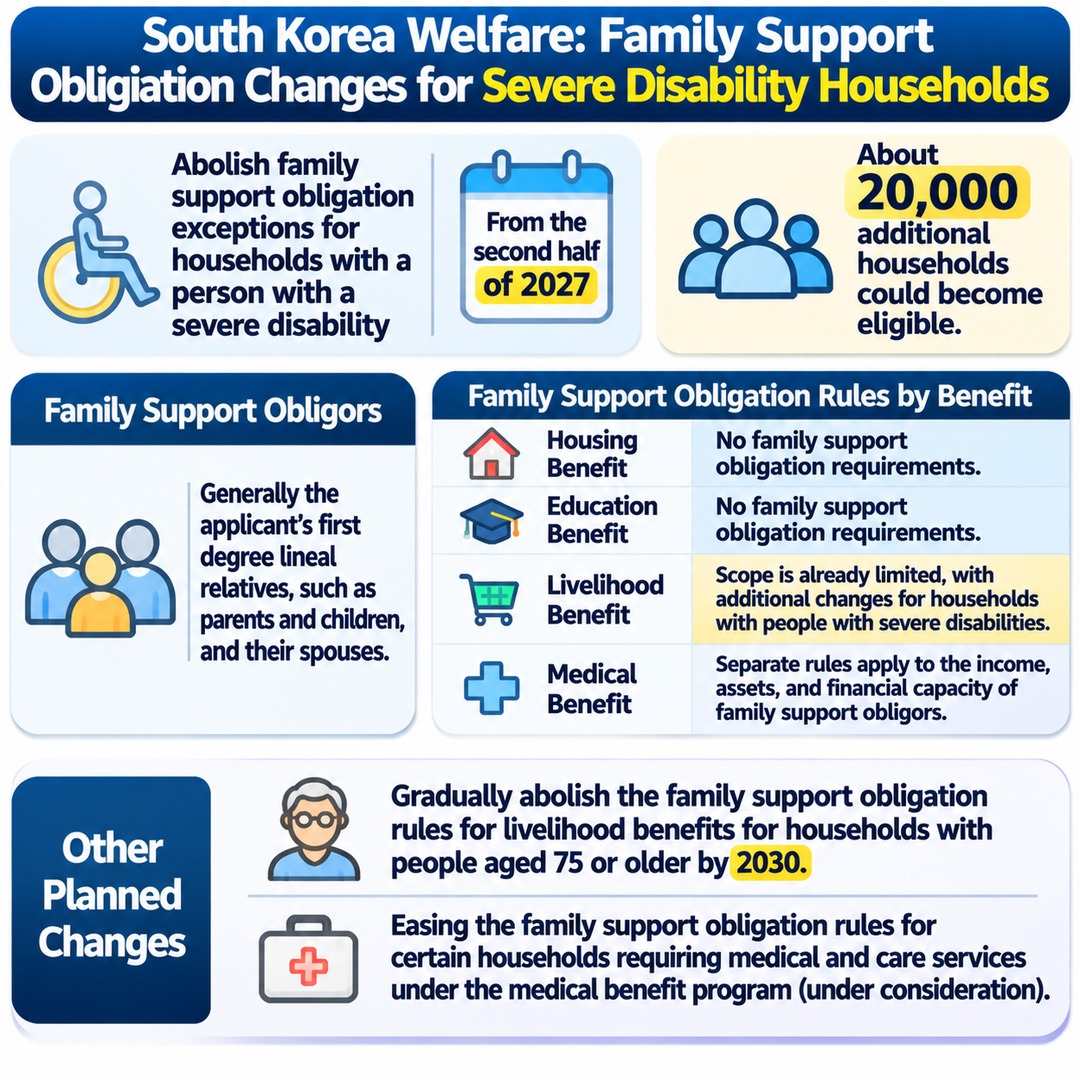
Starting in the second half of 2027, the government plans to abolish the family support obligation exceptions applicable to households with a person with a severe disability under the livelihood and medical benefit programs. The government estimated that approximately 20,000 additional households previously excluded because of the existing family support obligation rules could become eligible for support.
Under South Korea's welfare system, family support obligors generally refer to the applicant's first-degree lineal relatives, such as parents and children, and their spouses.
This does not mean that family support obligation rules will disappear simultaneously for every low-income household.
The scope of these rules differs by benefit category:
Housing and education benefits: There are no existing family support obligation requirements.
Livelihood benefits: The scope of the existing family support obligation rules is already limited, and additional changes to the exceptions concerning households with people with severe disabilities are planned.
Medical benefits: Separate rules apply to the income, assets, and financial capacity of family support obligors.
The government is also considering gradually abolishing the family support obligation rules for livelihood benefits for households with people aged 75 or older by 2030. However, the specific implementation method remains subject to further discussion.
Easing the family support obligation rules for certain households requiring medical and care services under the medical benefit program also remains under consideration. These proposals should not be confused with the already announced policy change for households with people with severe disabilities.
What Are the Eligibility Requirements for Basic Livelihood Security Benefits in 2027?
Eligibility for South Korea's Basic Livelihood Security program is determined by assessing whether a household's recognized income falls below the relevant threshold for each benefit category. Having a low income alone does not guarantee eligibility. Financial assets, real estate, vehicles, debts, and other factors may also be assessed.
Recognized income is calculated using the following formula:
\[
\text{Recognized Income} = \text{Assessed Income} + \text{Income Converted from Assets}
\]
Assessed income reflects actual income as well as eligible household-specific expenses and earned income deductions.
Income converted from assets is calculated by applying the relevant income conversion rate after taking into account the basic property deduction and eligible debts.
Consequently, a household may fail to qualify even if its monthly salary is below the eligibility threshold, depending on its assets and other income. Conversely, having earned income does not automatically disqualify a household from receiving benefits.
Items to check before applying include:
1. The actual number of household members and the legally recognized benefit household.
2. Monthly income from employment, business activities, pensions, and other sources.
3. Assets such as bank deposits, insurance policies, real estate, and vehicles.
4. Eligible debts, including loans from financial institutions.
5. Family support obligation rules applicable to each benefit category.
6. Rental agreements and actual living arrangements.
In particular, applicants should check the family support obligation conditions separately for livelihood and medical benefits. It is also important to understand that housing and education benefits do not have family support obligation requirements.
Where Can You Apply, and What Documents Should You Prepare?
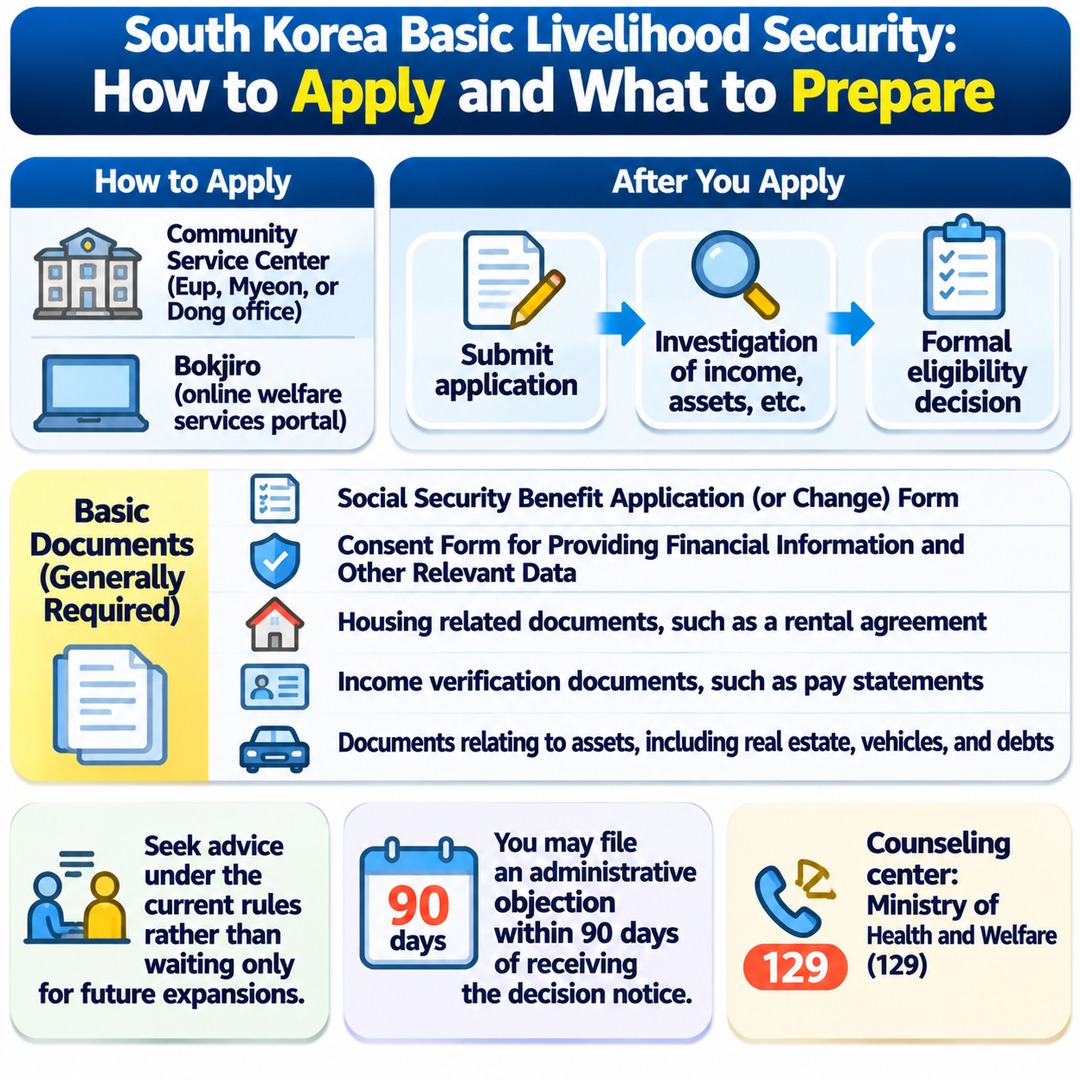
Applications for Basic Livelihood Security benefits can be submitted at the community service center (Eup, Myeon, or Dong office) responsible for the applicant's registered address in South Korea. For benefit categories that support online applications, applicants can also use Bokjiro, South Korea's online welfare services portal. After an application is submitted, the authorities investigate the household's income and assets before deciding whether benefits will be granted.
The basic documents generally include:
Social Security Benefit Application (or Change) Form
Consent Form for Providing Financial Information and Other Relevant Data
Housing-related documents, such as a rental agreement
Income verification documents, such as pay statements
Documents relating to assets, including real estate, vehicles, and debts
Additional documents may be requested depending on the household's circumstances. Some information can be verified through administrative records, so rather than obtaining every document in advance, applicants may find it more practical to ask their local community service center which documents are necessary.
Because applications require an investigation and a formal eligibility decision, people who need assistance should consider seeking advice under the current rules rather than waiting solely for future eligibility expansions.
If an applicant disagrees with the decision, they may file an administrative objection within 90 days of receiving the decision notice.
Advice is also available through the Ministry of Health and Welfare's counseling center at 129.
Who Should Consider Applying Under the Changes Taking Effect in 2027?
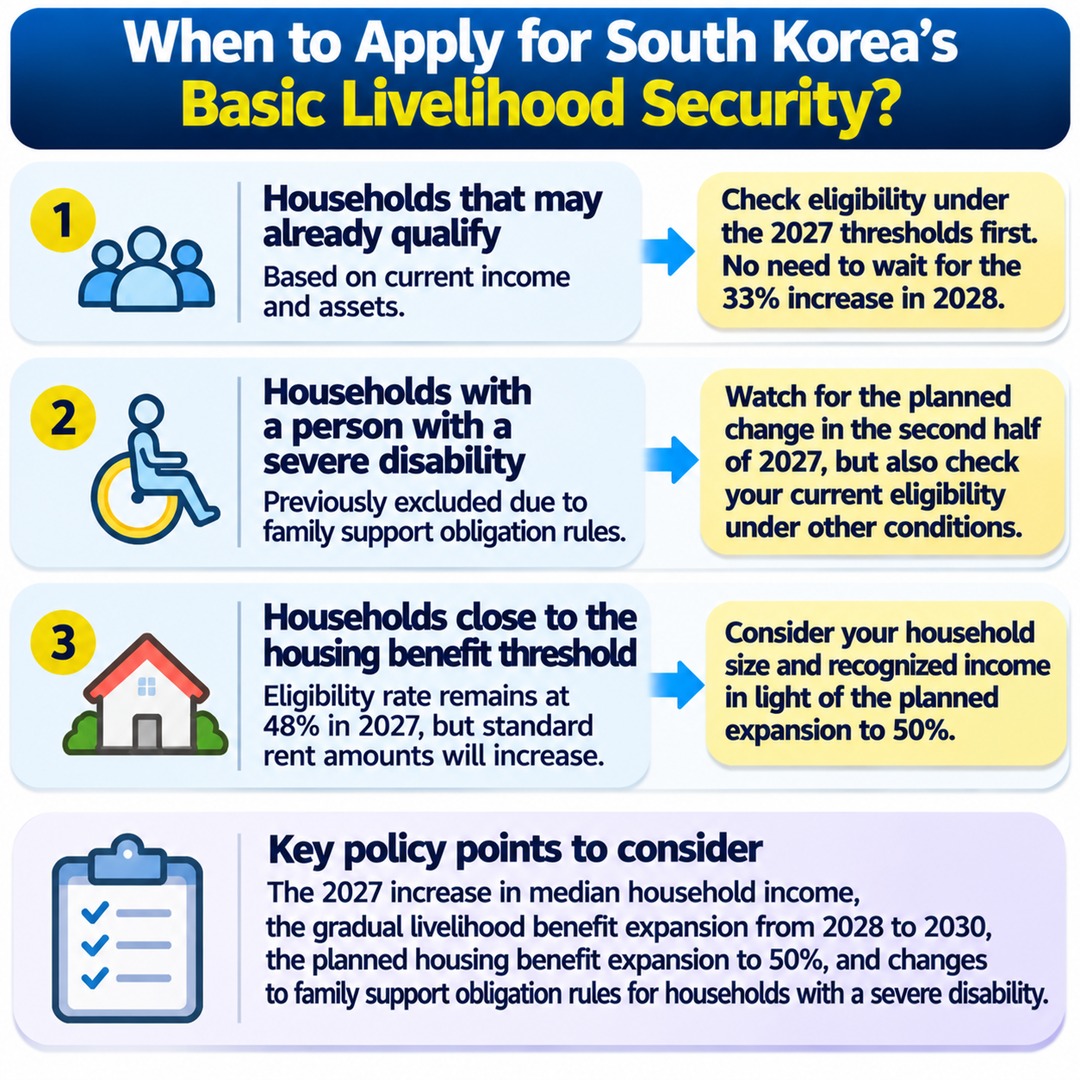
The policy changes create three situations that applicants should distinguish when deciding when to apply.
First, households that may already qualify based on their current income and assets.
As median household income increases in 2027, the monetary eligibility thresholds for each benefit category will also rise. It is advisable to check eligibility under the 2027 thresholds first. There is no need to wait for the livelihood benefit eligibility rate to increase to 33% in 2028.
Second, households that include a person with a severe disability.
Households previously excluded from livelihood or medical benefits because of family support obligation rules should pay attention to the planned policy change in the second half of 2027. However, they may also qualify under other conditions before the change takes effect, so their current eligibility should be checked as well.
Third, households close to the current housing benefit eligibility threshold.
The eligibility rate will remain at 48% in 2027, but standard rent amounts will increase. Since the government plans to expand eligibility to 50% in the future, households should consider their household size and recognized income when assessing whether they may qualify under the expanded rules.
South Korea's Basic Livelihood Security eligibility rules do not change across every benefit category at once following a single policy announcement. Applicants should assess the 2027 increase in median household income, the gradual expansion of livelihood benefit eligibility from 2028 to 2030, the planned expansion of housing benefit eligibility to 50%, and the changes to family support obligation rules for households with people with severe disabilities as separate policy developments.