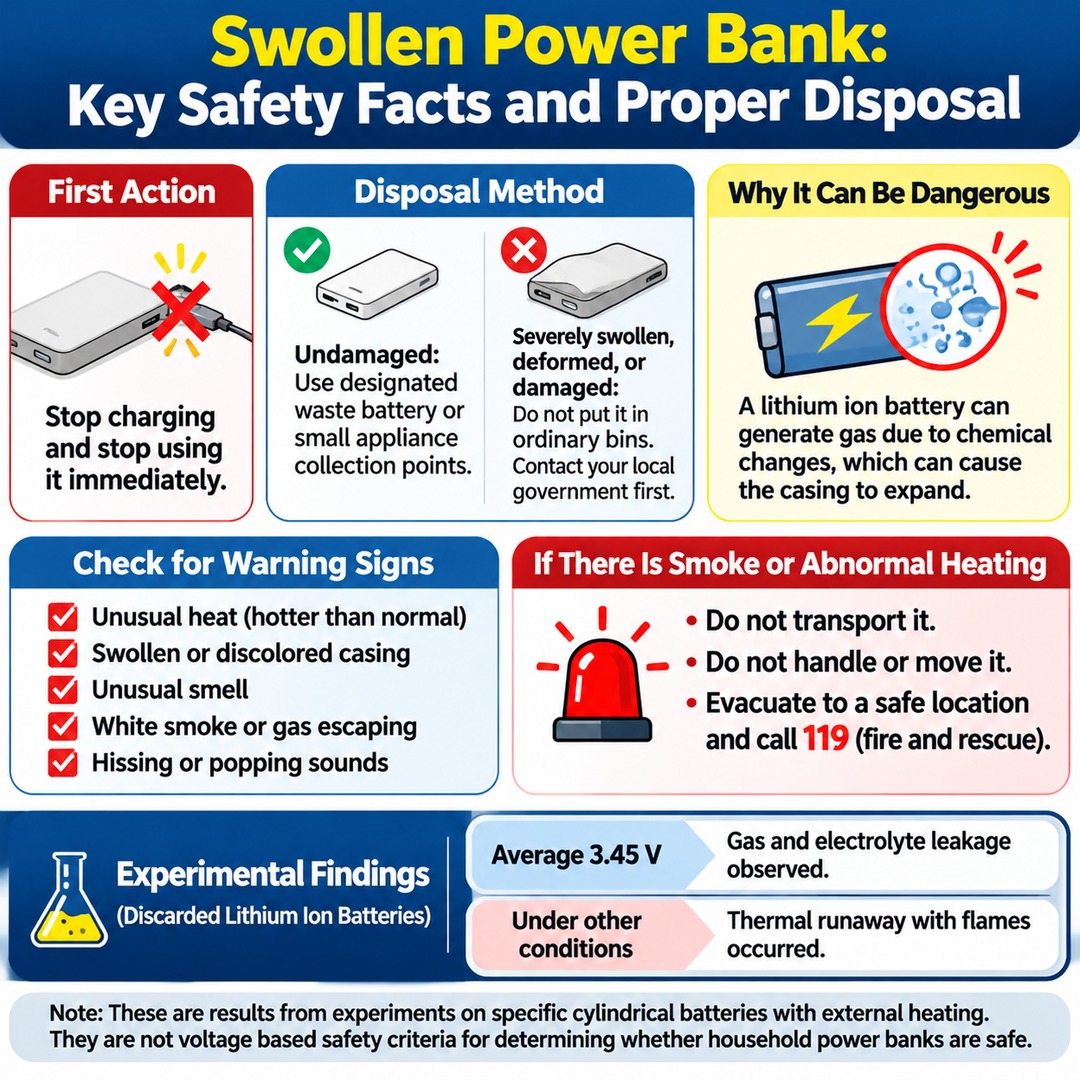

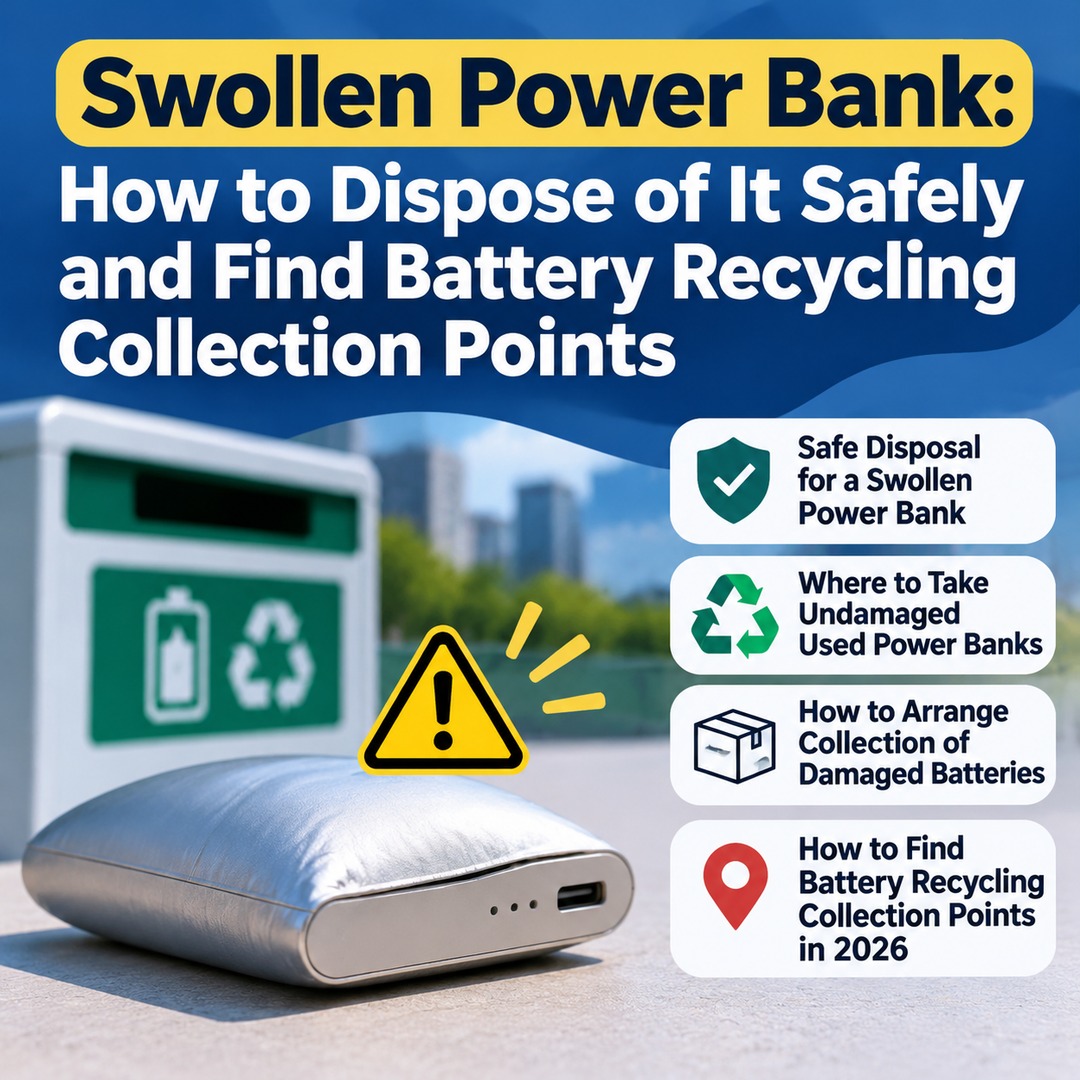
A swollen power bank should be disconnected from charging and taken out of service immediately. Undamaged used power banks should be disposed of through designated waste battery or small-appliance collection points. However, products that are severely swollen, deformed, or damaged should not be placed directly into ordinary collection bins. Contact your local government first to confirm how to hand over the damaged battery safely. Never mix power banks with general household waste or plastic recyclables.
Even though power banks are small, they contain lithium-ion batteries. Stopping use does not mean that all the electrical energy inside the battery has disappeared. An impact during storage or transportation can create a fire hazard.
Why Must Swollen Power Banks Be Handled Separately?
A swollen battery is no longer in normal operating condition. Chemical changes inside a lithium-ion battery can generate gas. When this gas accumulates inside the sealed casing, the exterior may expand and become visibly swollen.
The degree of swelling alone cannot determine whether a battery will catch fire. Check for other warning signs as well:
Unusual heat, with the product feeling hotter than normal
A swollen or discolored outer casing
An unusual smell
White smoke or gas escaping from the product
Hissing or popping sounds coming from inside the battery
If smoke or abnormal heating occurs, do not attempt to transport the product to a disposal location. Do not handle or move it. Evacuate to a safe location and call 119, South Korea's emergency fire and rescue number.
Experiments conducted by South Korea's National Fire Research Institute on discarded lithium-ion batteries also confirmed that residual electrical energy in used batteries can be associated with fire hazards. In experiments involving discarded cylindrical batteries, gas and electrolyte leakage were observed at an average residual voltage of 3.45 V, while thermal runaway accompanied by flames occurred under conditions of 3.94 V or higher.
These figures come from experiments involving specific cylindrical batteries exposed to external heating. They are not voltage-based safety criteria for determining whether household power banks are safe.
Where Should You Dispose of an Undamaged Used Power Bank?
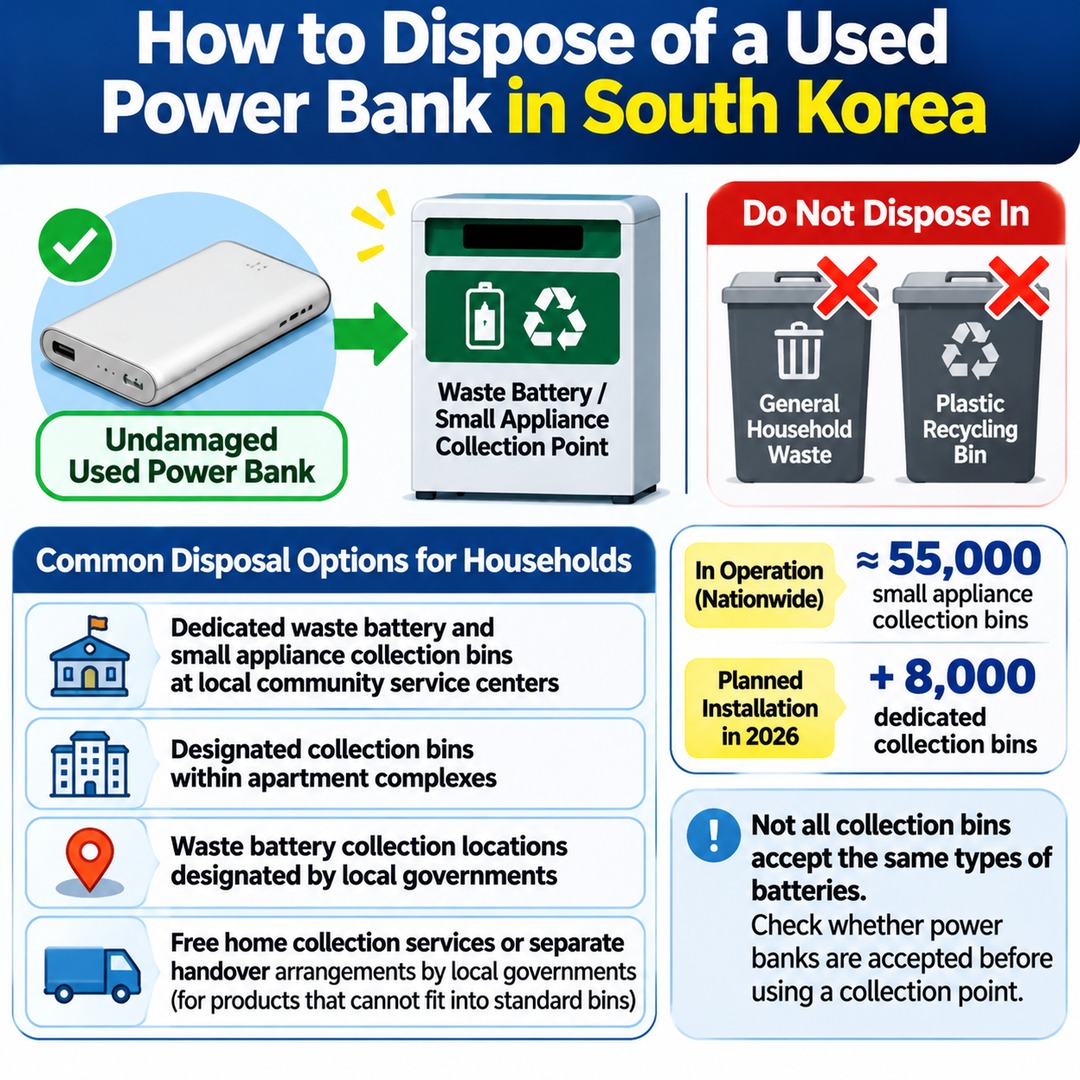
An undamaged used power bank should be taken to a designated waste battery or small-appliance collection point, not placed in general household waste or a plastic recycling bin.
South Korea's Ministry of Climate, Energy and Environment advises residents not to dispose of small discarded appliances containing built-in batteries, such as power banks and portable fans, in standard pay-as-you-throw garbage bags or together with other recyclable materials.
Common disposal options available to households include:
1. Dedicated waste battery and small-appliance collection bins at local community service centers
2. Designated collection bins within apartment complexes
3. Waste battery collection locations designated by local governments
4. Free home collection services or separate handover arrangements provided by local governments for products that cannot fit into standard collection bins
As of September 2026, approximately 55,000 small-appliance collection bins had been installed nationwide. The Ministry of Climate, Energy and Environment also announced plans to install an additional 8,000 dedicated collection bins during 2026.
However, not every collection bin nationwide accepts the same types of batteries. Accepted items may vary depending on the location and type of collection facility, so check whether power banks are accepted before using a collection point.
Can a Swollen Power Bank Be Placed in an Ordinary Used-Battery Collection Bin?
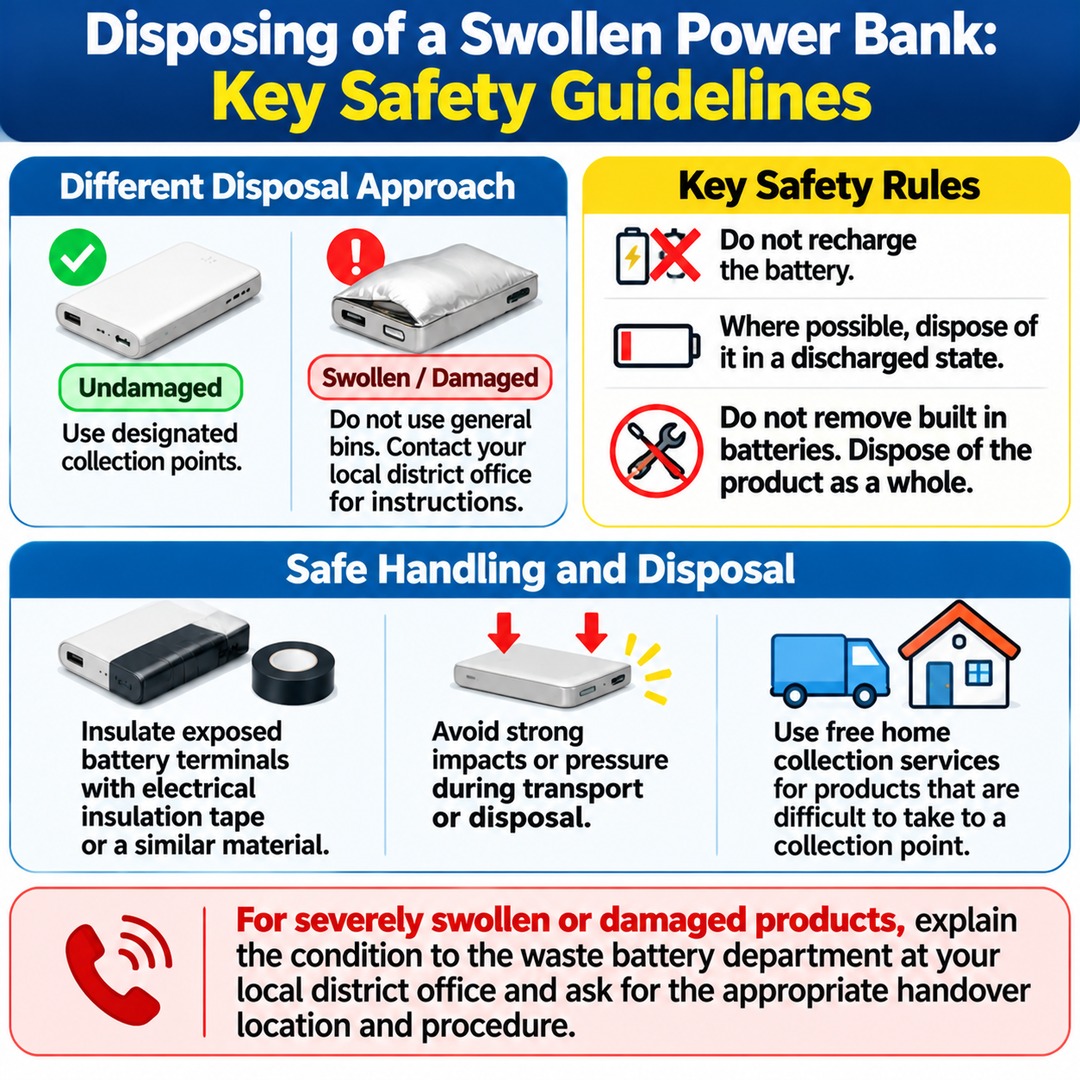
Swollen products must be treated differently from undamaged ones. Not all local governments necessarily follow the same disposal procedures for swollen batteries.
Do not recharge the battery. Where possible, dispose of it in a discharged state.
Do not attempt to remove built-in batteries from electronic products. Dispose of the product as a whole.
Insulate exposed battery terminals using electrical insulation tape or a similar insulating material.
Avoid applying strong impacts or pressure when transporting or disposing of the product.
Use free home collection services for products that are too large for dedicated collection bins.
However, these general disposal guidelines should not automatically be applied to severely swollen or damaged batteries. For damaged products, explain their condition to the department responsible for waste batteries at your local district office and ask for instructions on the appropriate handover location and procedure.
How to Find Waste Battery Collection Points in 2026
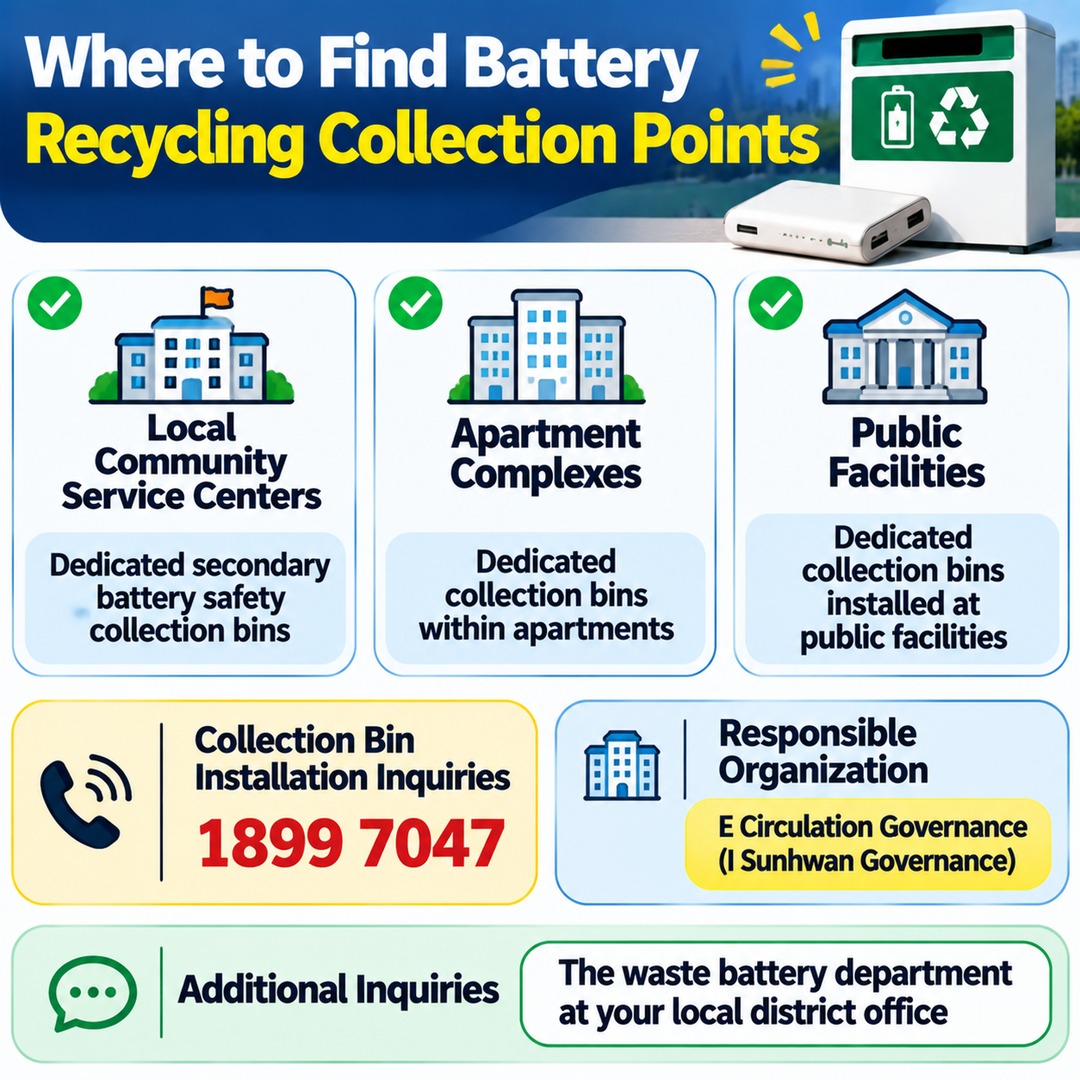
Dedicated secondary-battery safety collection bins at local community service centers
Dedicated collection bins within apartment complexes
Dedicated collection bins installed at public facilities
Collection bin installation inquiries: 1899-7047
Responsible organization: E-Circulation Governance (I-Sunhwan Governance)
Additional inquiries: The waste battery department at your local district office
How Should You Store a Power Bank at Home Before Disposal?
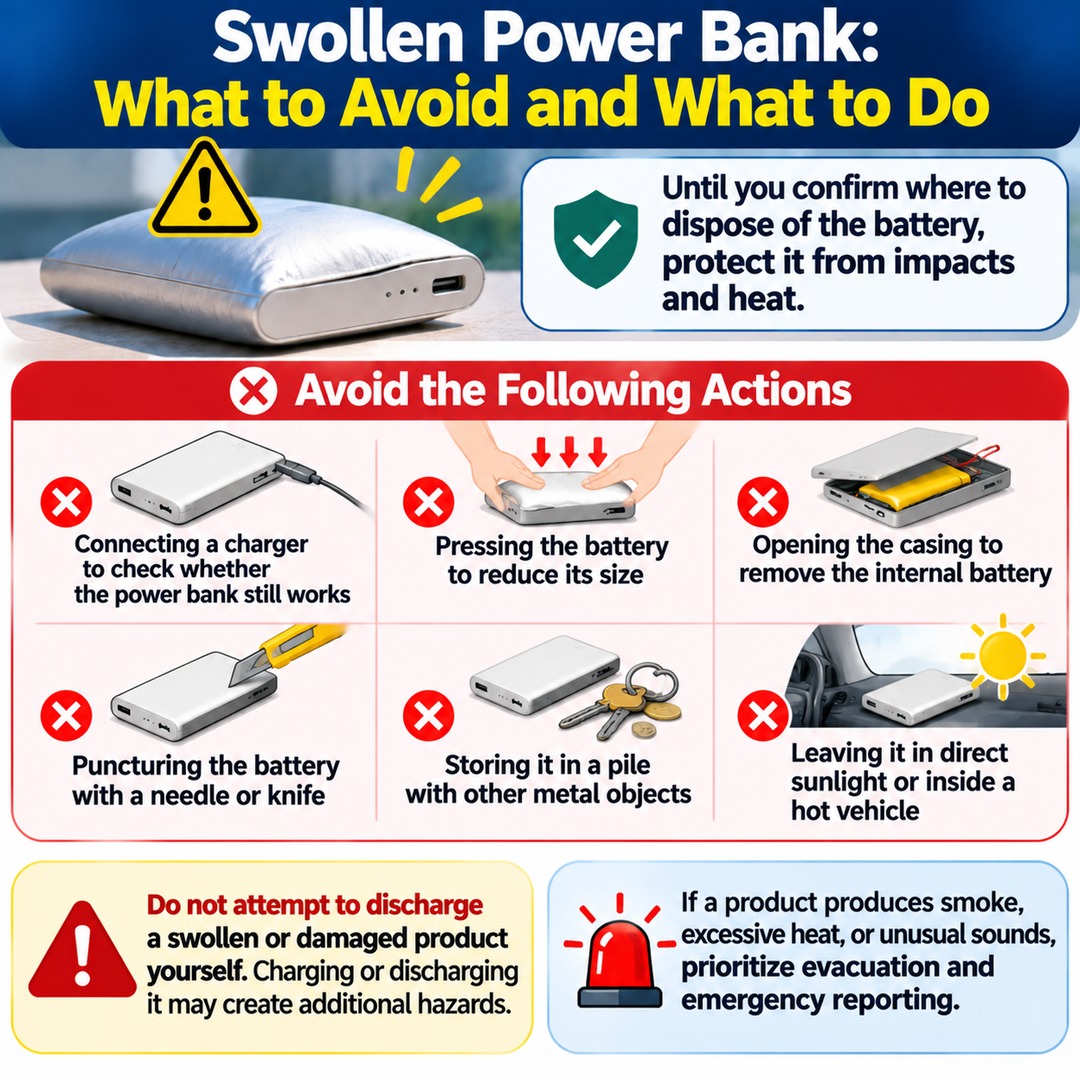
Until you confirm where to dispose of the battery, protect it from impacts and heat. In particular, never press or dismantle a swollen power bank in an attempt to restore its original shape.
Avoid the following actions:
Connecting a charger to check whether the power bank still works
Pressing the battery to reduce its size
Opening the casing to remove the internal battery
Puncturing the battery with a needle or knife
Storing it in a pile with other metal objects
Leaving it in direct sunlight or inside a hot vehicle
However, do not attempt to discharge a swollen or damaged product yourself. Charging or discharging it may create additional hazards.
If a product produces smoke, excessive heat, or unusual sounds, evacuation and emergency reporting take priority over finding a storage location or transporting it to a collection bin.
What Should Not Be Disposed of Together with Used Power Banks?
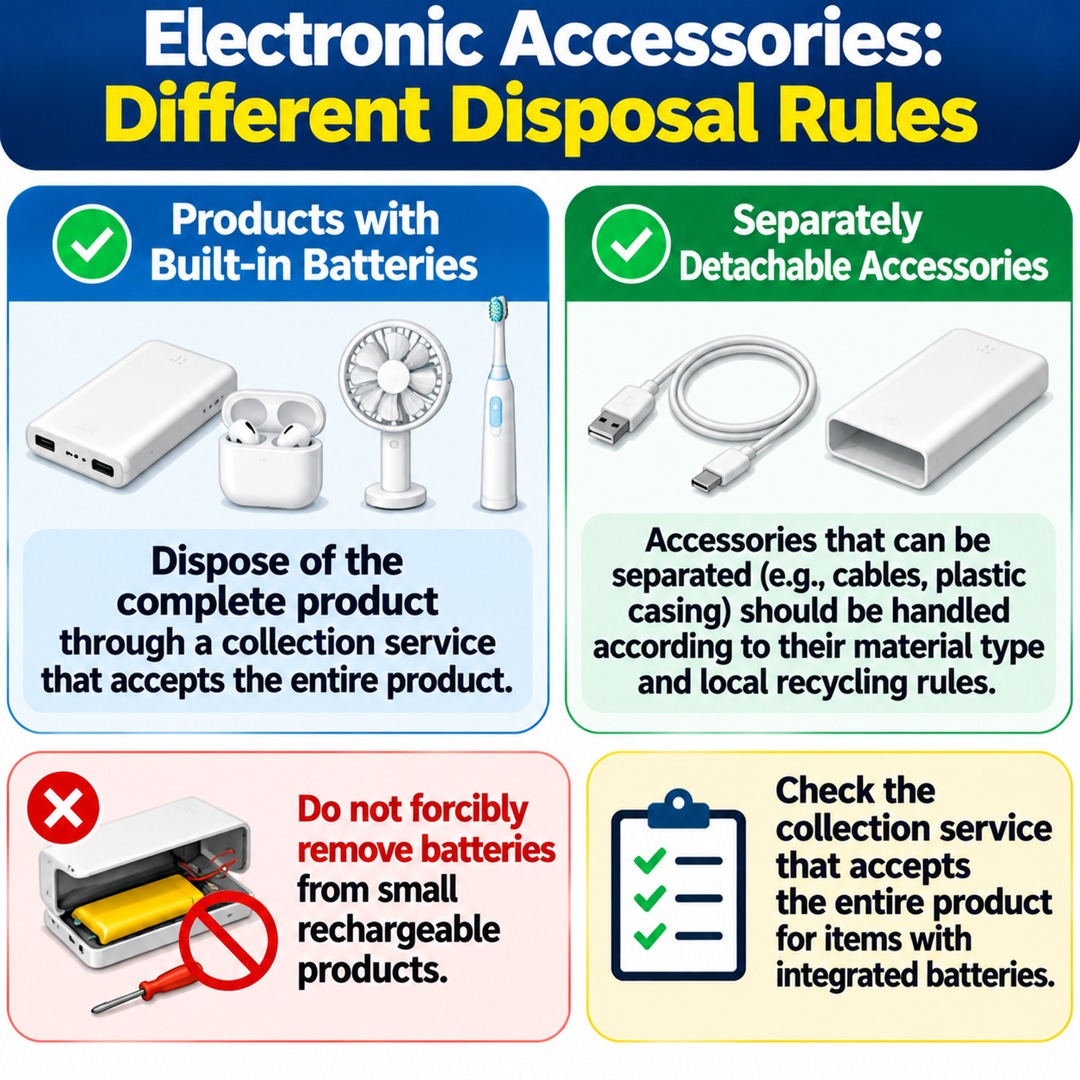
Power banks and ordinary electronic accessories may have different disposal requirements.
The fact that a charging cable or ordinary plastic casing is attached does not mean that everything should be placed in a waste battery collection bin. Products with built-in batteries should follow the disposal requirements for the complete product. Accessories that can be separated should be handled according to their material type and the local recycling rules.
It is particularly important not to forcibly remove batteries from small rechargeable products such as wireless earbuds, portable fans, and electric toothbrushes.
For products with integrated batteries, check the collection service that accepts the entire product rather than attempting to dismantle it.
Frequently Asked Questions
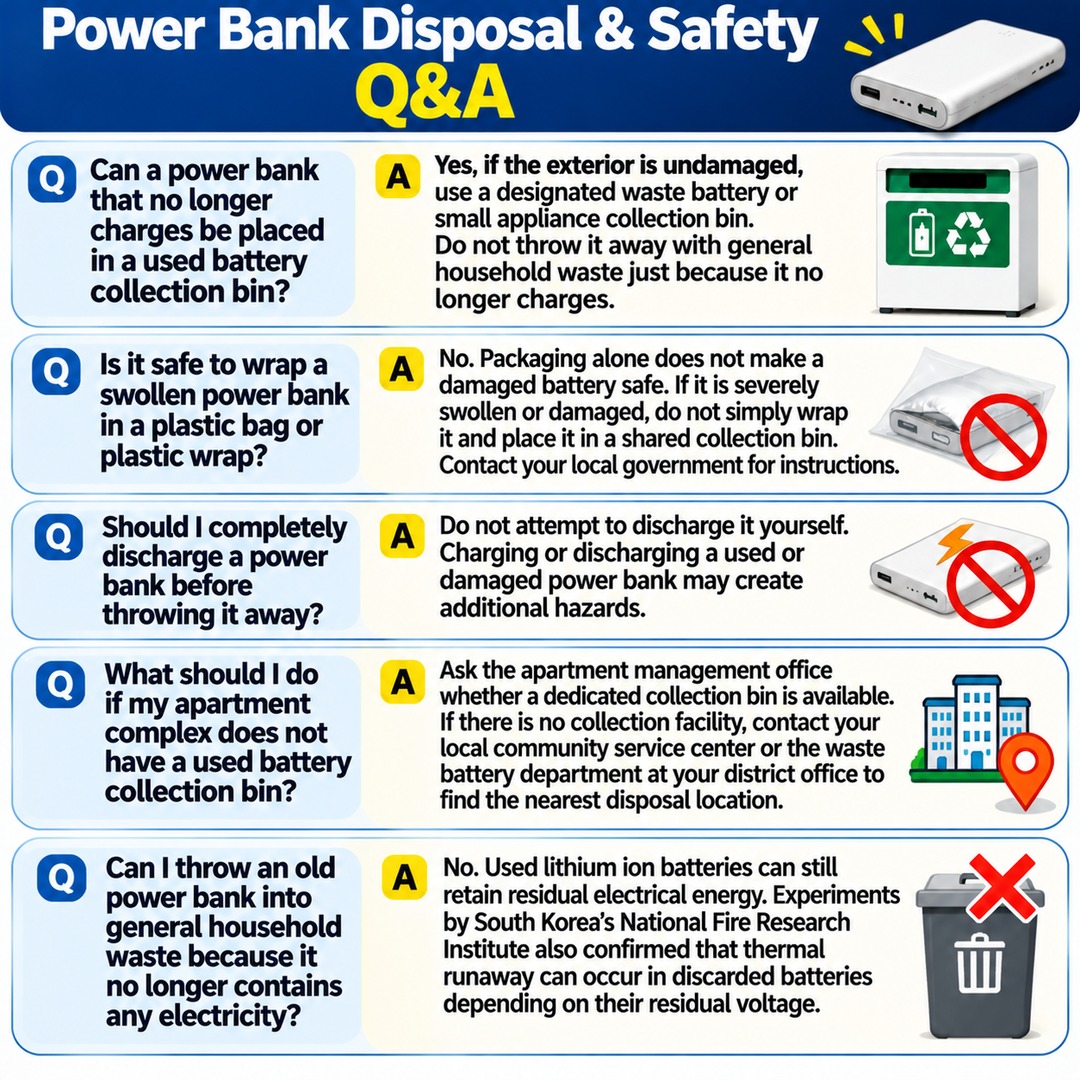
Q. Can a power bank that no longer charges be placed in a used-battery collection bin?
If its exterior is undamaged, you can use a designated waste battery or small-appliance collection bin. The fact that it no longer charges does not mean it can be thrown away with general household waste.
Q. Is it safe to wrap a swollen power bank in a plastic bag or plastic wrap?
Packaging alone does not make a damaged battery safe. Preventing external impacts and contact is a separate issue from ensuring safe disposal. If the battery is severely swollen or damaged, do not simply wrap it and place it in a shared collection bin. Contact your local government for instructions.
Q. Should I completely discharge a power bank before throwing it away?
Q. What should I do if my apartment complex does not have a used-battery collection bin?
Ask the apartment management office whether a dedicated collection bin is available. If there is no collection facility, contact your local community service center or the waste battery department at your district office to find the nearest disposal location.
Q. Can I throw an old power bank into general household waste because it no longer contains any electricity?
No. Used lithium-ion batteries can still retain residual electrical energy. Experiments conducted by South Korea's National Fire Research Institute also confirmed that thermal runaway can occur in discarded batteries depending on their residual voltage.