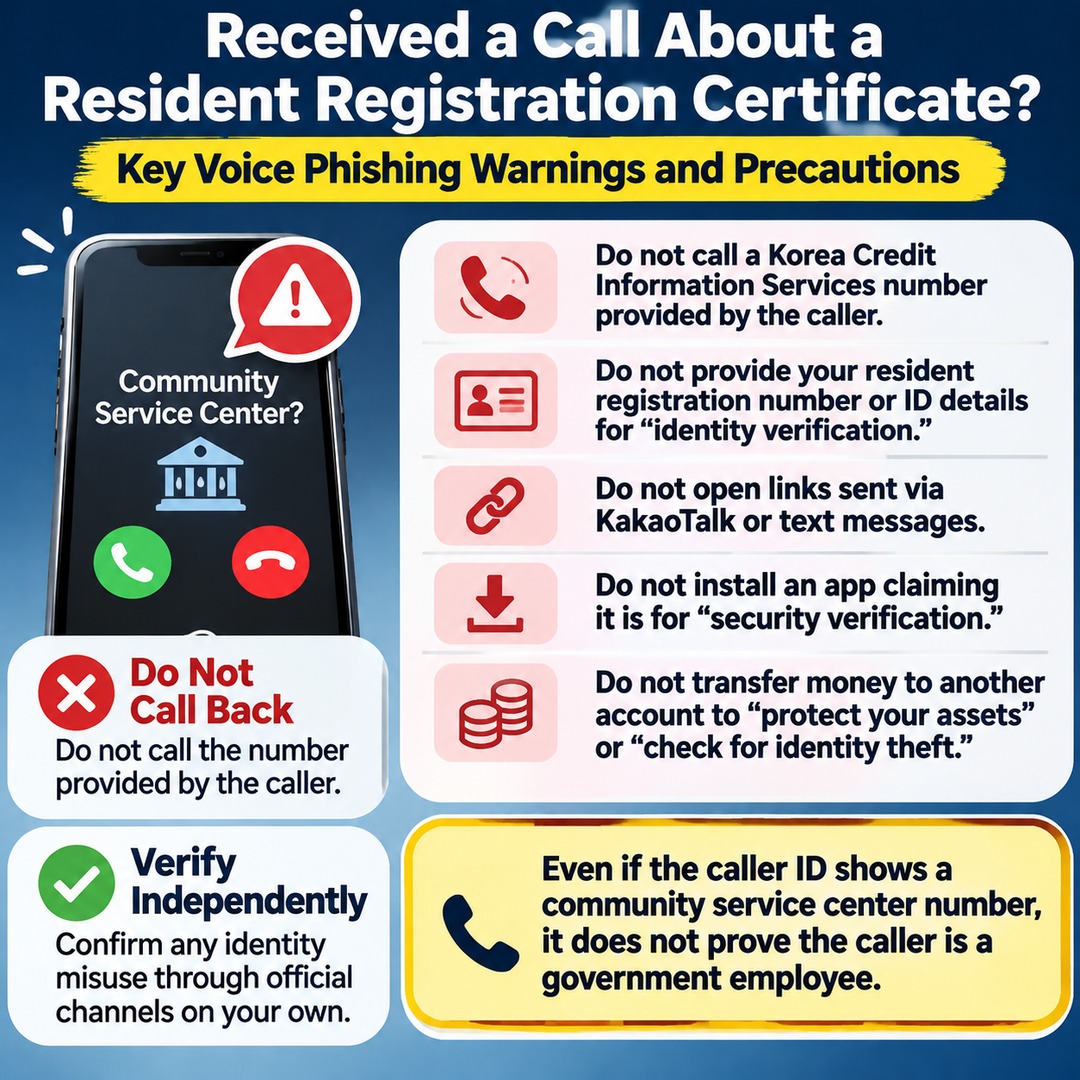

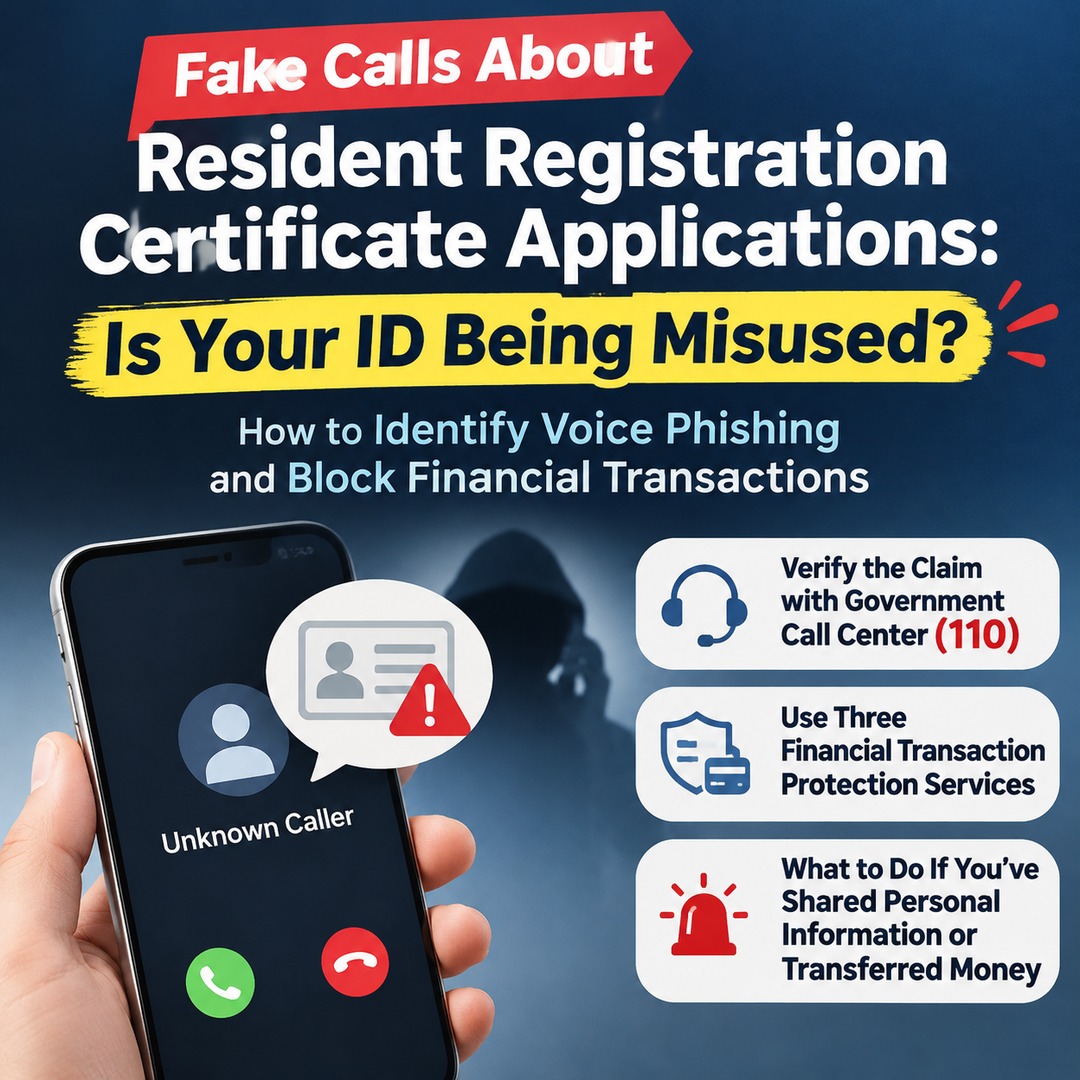
If you receive a phone call claiming that someone tried to obtain your Korean resident registration certificate using your identification card and a power of attorney at a local community service center, do not call back the number provided by the caller. You must independently verify whether your identity has actually been misused through official channels. A confirmed voice phishing scheme involves callers impersonating community service centers and subsequently posing as representatives of the Korea Credit Information Services, the Financial Supervisory Service, or law enforcement agencies.
Be particularly cautious if the caller encourages you to make a direct call to a number they provide. The fact that you initiated the return call does not establish the caller's identity.
Is a Phone Call Claiming Someone Tried to Obtain Your Resident Registration Certificate Genuine?
The caller may not be a community service center employee but a voice phishing criminal impersonating one. In a documented scam, criminals make their caller ID appear to show a community service center's telephone number and claim that someone attempted to obtain official documents using the victim's identification card and a power of attorney.
The Korea Internet & Security Agency (KISA) issued security warnings in April and August 2026 about schemes involving impersonation of community service center telephone numbers and attempts to direct victims to call the Korea Credit Information Services.
Pay particular attention to the following suspicious requests:
Calling a Korea Credit Information Services telephone number provided by the caller.
Providing your resident registration number or identification details under the pretext of identity verification.
Opening links received through KakaoTalk or text messages.
Installing an application supposedly required for security verification.
Transferring money to another account to protect your assets or check whether you are involved in a crime.
Even if the caller ID displays what appears to be an actual community service center telephone number, this does not prove that the person on the other end is a government employee.
Where Can You Verify Whether Someone Actually Applied for Your Resident Registration Certificate?
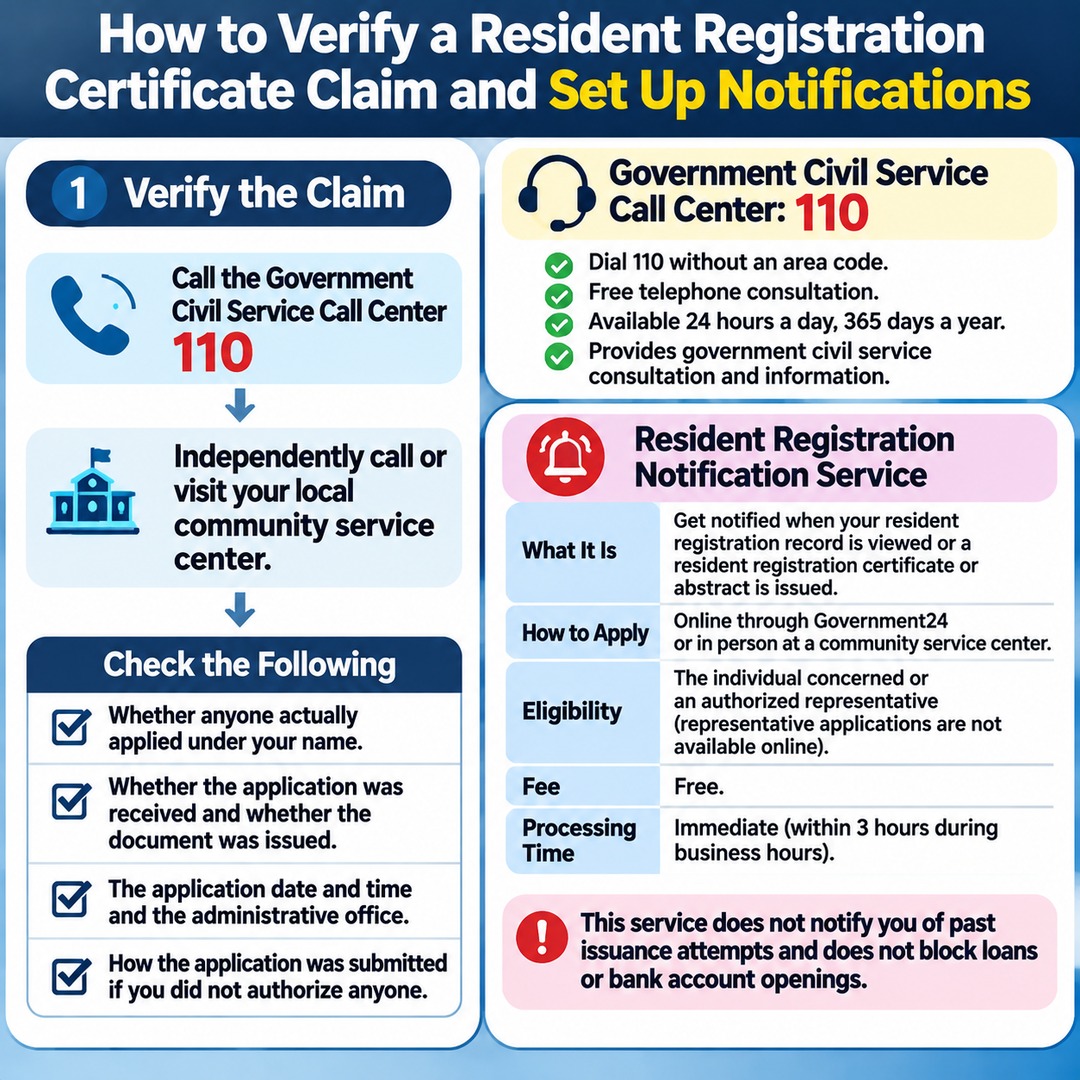
First, contact the Government Civil Service Call Center at 110 to obtain the official contact details for your local community service center and guidance on how to verify the claim. Then, independently call the official number or visit the community service center to check the records of applications to view your resident registration record or obtain a resident registration certificate or abstract under your name.
Check the following details:
1. Whether anyone actually applied for a resident registration certificate or abstract under your name.
2. Whether the application was received and whether the document was actually issued.
3. The application date and time and the administrative office that processed it.
4. How the application was submitted if you did not authorize anyone to apply on your behalf.
You can request verification even if you have never lost your identification card. Whether an actual document issuance attempt occurred and whether the caller's claims are true are two separate questions.
Government Civil Service Call Center: 110
Dial 110 without an area code.
Free telephone consultation.
Available 24 hours a day, 365 days a year, as a government civil service information channel.
The 110 call center provides government civil service consultation and information. Actual document issuance records must be verified with the relevant community service center.
Can You Receive Text Notifications When Someone Obtains Your Resident Registration Certificate?
Yes. You can apply for the Resident Registration Notification Service through Korea's Government24 portal. This service can notify you by mobile phone text message or other available notification methods when another person or organization views your resident registration record or obtains a resident registration certificate or abstract.
Service: Notification of Resident Registration Record Access and Certificate or Abstract Issuance
Application: Online through Government24 or in person at a community service center.
Eligibility: The individual concerned or an authorized representative. Representative applications are not available online.
Fee: Free.
Processing time: Immediate (within 3 hours during business hours).
Notifications: Access to resident registration records and issuance of resident registration certificates or abstracts by the individual concerned or another person or organization.
This service does not retrospectively notify you of every document issuance attempt that occurred before you applied. It should be understood as a preventive notification service that provides alerts after registration.
Apply for the Resident Registration Notification Service through Government24.
This notification service is different from financial transaction blocking services. It helps you become aware of resident registration document access or issuance, but it does not prevent loans or bank account openings.
Can the Korea Credit Information Services Confirm Whether Your Identity Has Been Stolen?
The Korea Credit Information Services is not an agency that receives identity theft reports through the procedure described in this community service center impersonation scam. The Financial Supervisory Service has also warned people to be cautious of callers who encourage them to contact telephone numbers they provide.
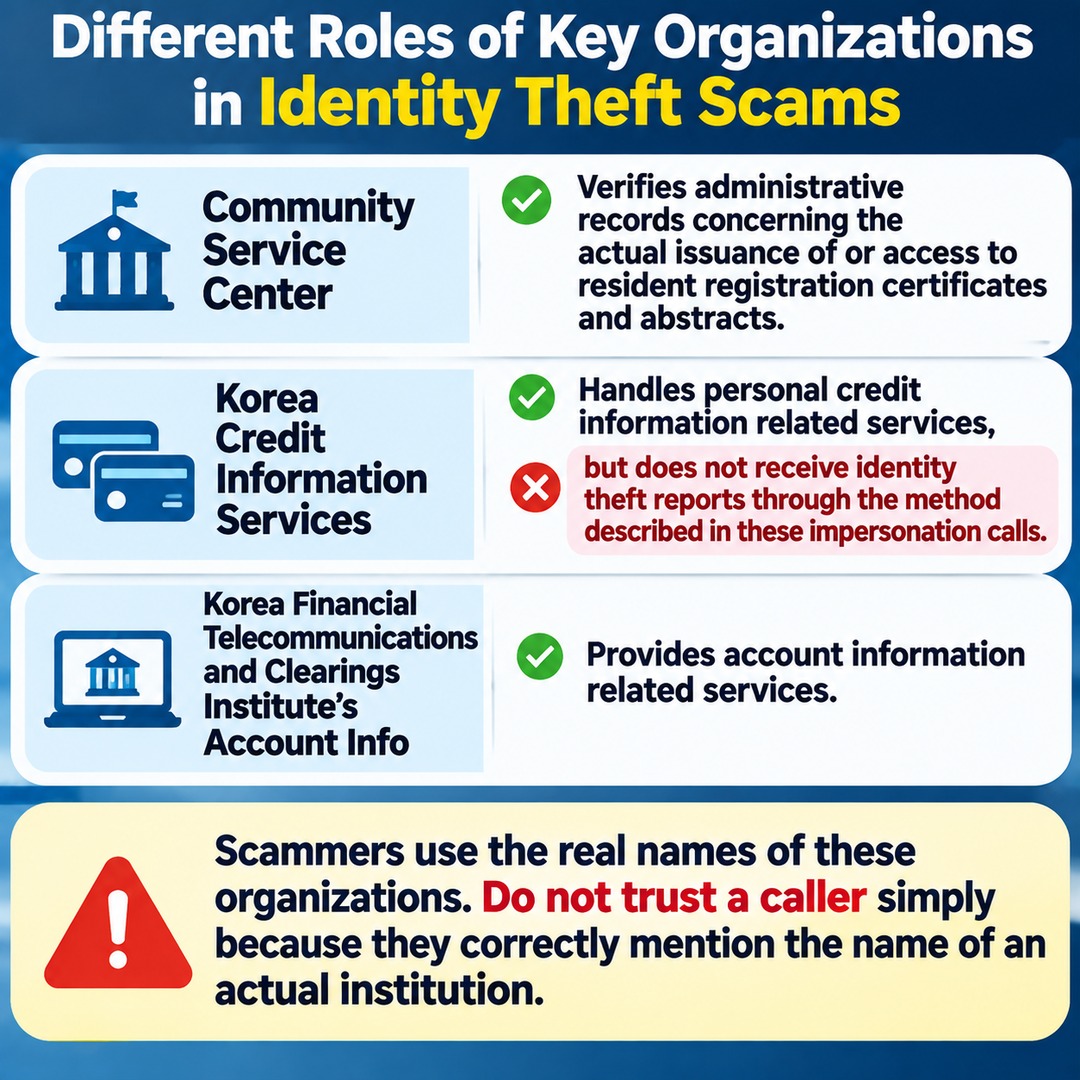
It is important to distinguish between the following organizations and services:
Community service center: Verifies administrative records concerning the actual issuance of or access to resident registration certificates and abstracts.
Korea Credit Information Services: Handles personal credit information-related services, but does not receive identity theft reports through the method described in these impersonation calls.
Korea Financial Telecommunications and Clearings Institute's Account Info service: Provides access to information about financial accounts under your name and services for applying for financial transaction protection.
Msafer: Allows you to check mobile telecommunications subscriptions under your name and review restrictions on new mobile subscriptions.
Scammers use the real names of these organizations. Do not trust a caller simply because they correctly mention the name of an actual institution.
Three Ways to Prevent Loans and Bank Accounts from Being Opened in Your Name
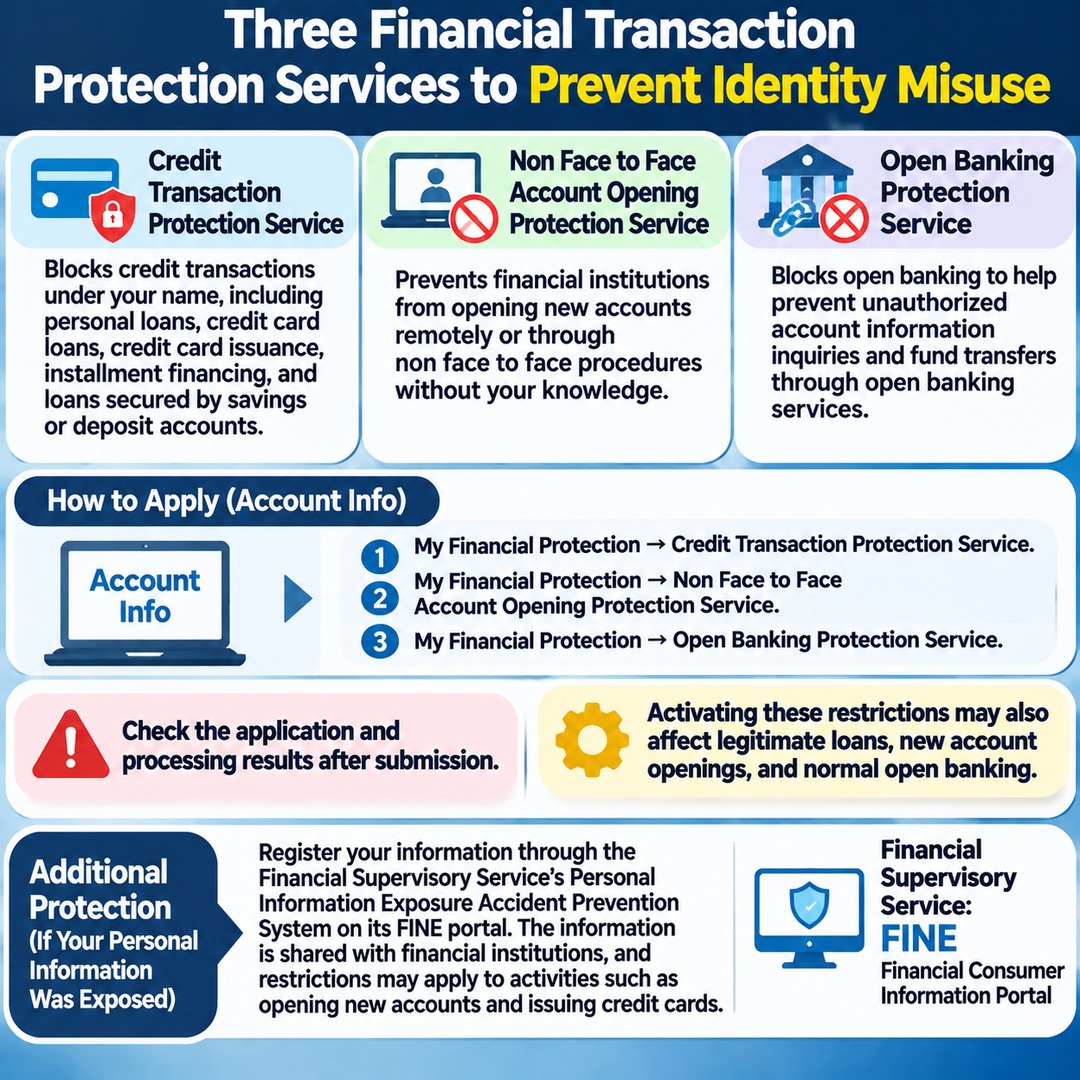
If your identification card or personal information may have been exposed, consider applying for all three financial transaction protection services. Each service blocks a different type of financial activity, so you should review and apply for them individually according to your circumstances.
1. Prevent Unauthorized Loans and Credit Transactions
Credit Transaction Protection Service
This service blocks credit transactions under your name across financial institutions, including personal loans, credit card loans, credit card issuance, installment financing, and loans secured by savings or deposit accounts.
2. Prevent Unauthorized Online Account Openings
Non-Face-to-Face Account Opening Protection Service
This service prevents financial institutions from opening new accounts remotely or through non-face-to-face procedures without your knowledge.
3. Prevent Unauthorized Access Through Open Banking
Open Banking Protection Service
This service blocks open banking to help prevent unauthorized account information inquiries and fund transfers through open banking services.
The three services were introduced on different dates.
| Service | Launch Date |
|---|---|
| Credit Transaction Protection Service | August 23, 2024 |
| Non-Face-to-Face Account Opening Protection Service | March 12, 2025 |
| Open Banking Protection Service | November 14, 2025 |
Where Can You Apply for All Three Protection Services?
You can use the Account Info website or mobile app operated by the Korea Financial Telecommunications and Clearings Institute, your bank's mobile banking service, or a financial institution's branch.
Access Account Info through the Korea Financial Telecommunications and Clearings Institute.
In Account Info, locate and apply for each of the following options:
My Financial Protection → Credit Transaction Protection Service.
My Financial Protection → Non-Face-to-Face Account Opening Protection Service.
My Financial Protection → Open Banking Protection Service.
Make sure to check the actual application and processing results after submitting your requests. Activating these restrictions may also affect legitimate loan applications, new account openings, and normal open banking transactions. If you need to conduct these transactions later, check the relevant financial institution's procedure for lifting the restrictions.
Should You Also Register for the Personal Information Exposure Accident Prevention System?
Consider this additional protection if you have actually disclosed a copy of your identification card, resident registration number, or other personal information that could be used for financial transactions.
If you register your information through the Financial Supervisory Service's Personal Information Exposure Accident Prevention System on its FINE portal, the information is shared with financial institutions. Restrictions may then apply to activities such as opening new accounts and issuing credit cards.
This is a separate protective measure from the financial transaction protection services described above.
Financial Supervisory Service: FINE Financial Consumer Information Portal
What You Should Do After a Call Impersonating a Community Service Center Depends on What Information You Shared
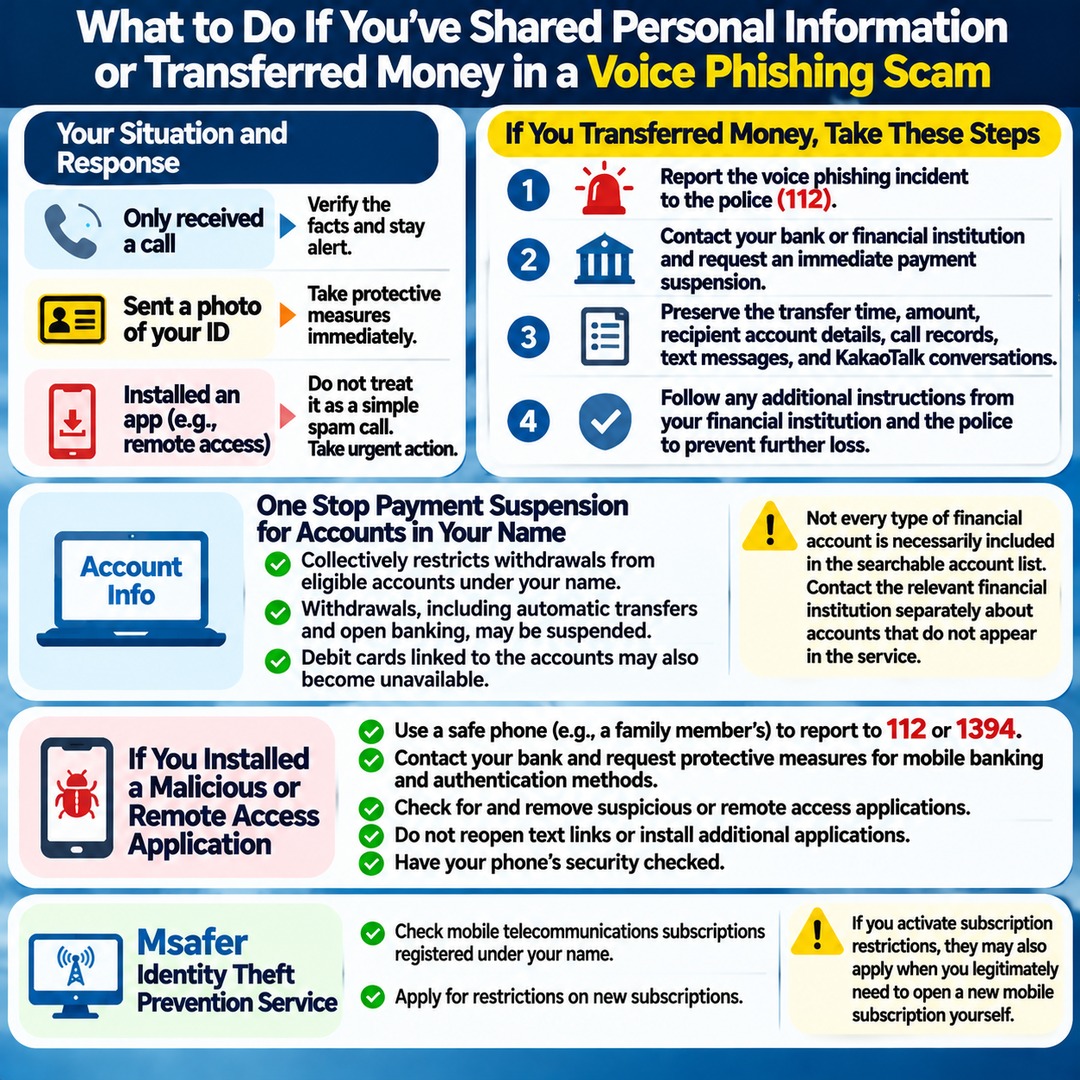
The appropriate response depends on whether you simply received a call, sent a photograph of your identification card, or installed an application. In particular, if you installed a remote access application or disclosed financial information, you should not treat the incident as an ordinary spam call.
| What Happened | Immediate Action |
|---|---|
| You only received the call | End the call and independently verify the claims through official institutions. |
| You disclosed your resident registration number or sent a photo of your identification card | Notify your financial institutions and consider registering with the Personal Information Exposure Accident Prevention System. |
| You disclosed your account number, password, or authentication information | Immediately contact the relevant financial institution to protect your account and authentication methods. |
| You installed a malicious or remote access application | Use another person's safe telephone to report the incident to 112 or 1394, and contact your financial institution. |
| You transferred money | Immediately report the incident to 112 and request a payment suspension from the financial institution that processed the transfer. |
What Should You Do First If You Have Already Transferred Money?
If you have transferred money, do not delay reporting the incident to the police or requesting that your financial institution suspend the payment.
1. Report the voice phishing incident to the police by calling 112.
2. Contact the bank or financial institution from which you sent the money and request an immediate payment suspension.
3. Preserve the transfer time, amount, recipient account details, call records, text messages, and KakaoTalk conversations.
4. Follow any additional instructions from your financial institution and the police to prevent further losses.
If you are concerned about unauthorized withdrawals from multiple accounts under your name, you can also check the One-Stop Payment Suspension for Accounts in Your Name service through Account Info.
This service allows you to collectively restrict withdrawal transactions from eligible accounts under your name when financial fraud has occurred or is suspected. Withdrawals, including automatic transfers and open banking transactions, may be suspended. Debit cards linked to the affected accounts may also become unavailable.
Not every type of financial account is necessarily included in the searchable account list. Contact the relevant financial institution separately about accounts that do not appear in the service.
What Should You Do If You Installed an Application on Your Phone?
If you installed a malicious application or remote access application, do not assume it is safe to contact your bank or the police using that same phone.
The Korea Internet & Security Agency has warned that malicious applications can lead to remote control of a mobile phone, personal information theft, fraudulent mobile phone subscriptions, unauthorized loans, and fraudulent account transfers.
Use a safe mobile phone belonging to a family member or another person to report the incident to 112 or 1394.
Contact your bank and request protective measures for mobile banking and authentication methods.
Check whether suspicious applications or remote access applications have been installed.
Do not reopen text message links or follow additional application installation instructions.
Have your phone's security checked and, if necessary, contact your mobile carrier to check for unauthorized subscriptions under your name.
Through Msafer, Korea's identity theft prevention service, you can check mobile telecommunications subscriptions registered under your name and apply for restrictions on new subscriptions.
Msafer Identity Theft Prevention Service
If you activate subscription restrictions, they may also apply when you legitimately need to open a new mobile phone subscription yourself. Check the procedure for temporarily or permanently lifting the restrictions before arranging a legitimate new subscription.
What Statements Should Make You Especially Suspicious During a Call Impersonating a Community Service Center?
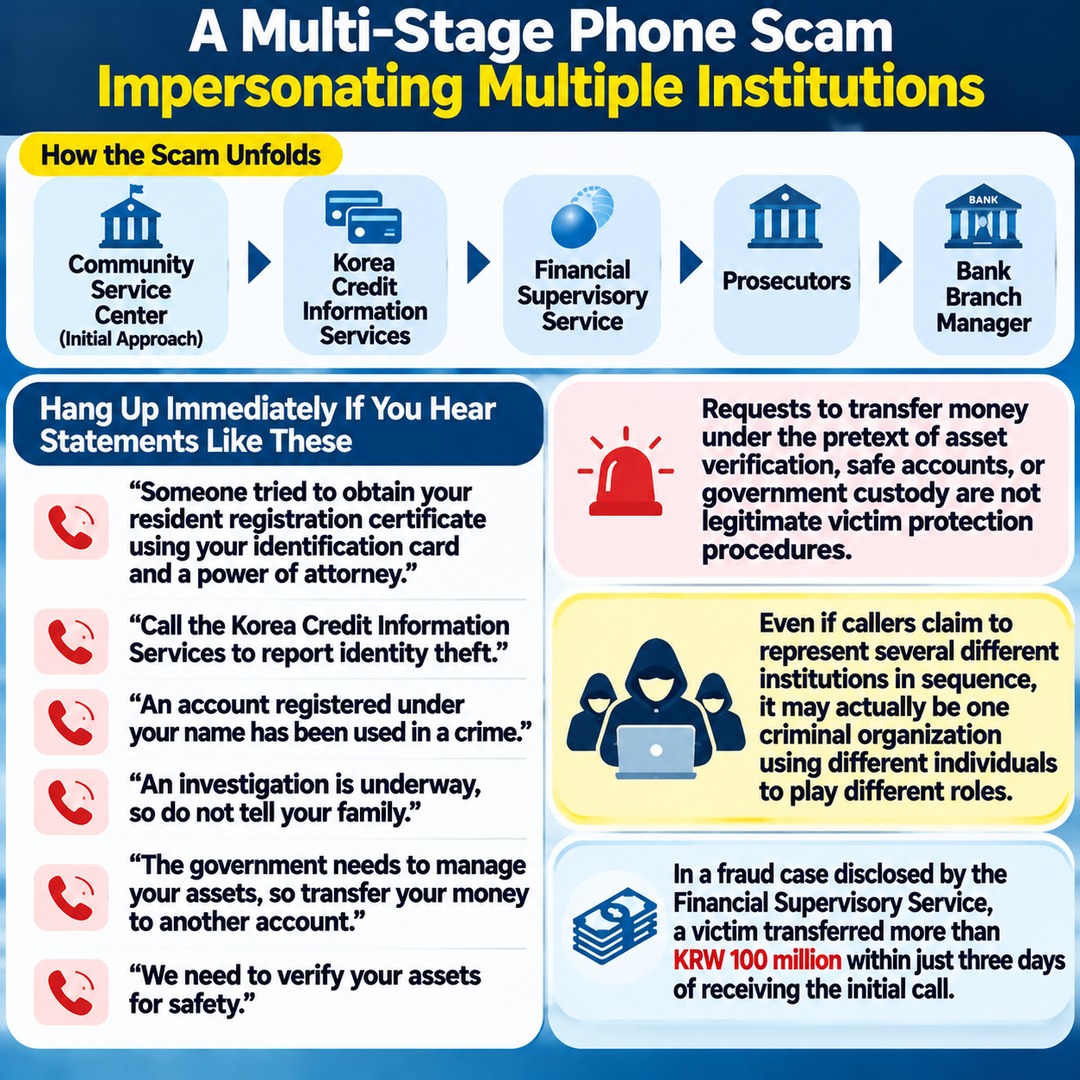
One of the most dangerous aspects of this scam is that several institutions appear one after another. The caller may initially approach you as though they are a community service center employee offering assistance. Later, the criminals may impersonate representatives of the Korea Credit Information Services, the Financial Supervisory Service, prosecutors, or bank branch managers.
In a fraud case disclosed by the Financial Supervisory Service, a victim transferred more than KRW 100 million within just three days of receiving the initial call.
Immediately end the call if you hear statements such as:
"Someone tried to obtain your resident registration certificate using your identification card and a power of attorney."
"Call the Korea Credit Information Services to report identity theft."
"An account registered under your name has been used in a crime."
"An investigation is underway, so do not tell your family."
"The government needs to manage your assets, so transfer your money to another account."
"We need to verify that your account is safe, so close your savings account."
In particular, requests to transfer money under the pretext of asset verification, safe accounts, or government custody are not legitimate victim protection procedures, even when the caller claims to represent law enforcement or the Financial Supervisory Service.
Even if a call that initially appears to come from a community service center continues with people claiming to represent several different institutions, it may actually be one criminal organization using different individuals to play different roles.
What If You Already Receive Notifications About Resident Registration Certificate Issuance?
Check whether you have already applied for the Resident Registration Notification Service through Government24. If you have not, consider applying to receive notifications about access to your resident registration record and the issuance of resident registration certificates or abstracts.
A separate article also explains how to check the existing notification service.
-
If a financial institution has notified you of a personal information breach or your identification details have been exposed, you can also review the following related information.
-
Verifying whether someone actually attempted to obtain your resident registration certificate and blocking financial transactions are two separate tasks. After checking the administrative records with the relevant government office, you should independently review your financial accounts, loan activity, and mobile phone subscriptions to make sure your identity has not been misused.