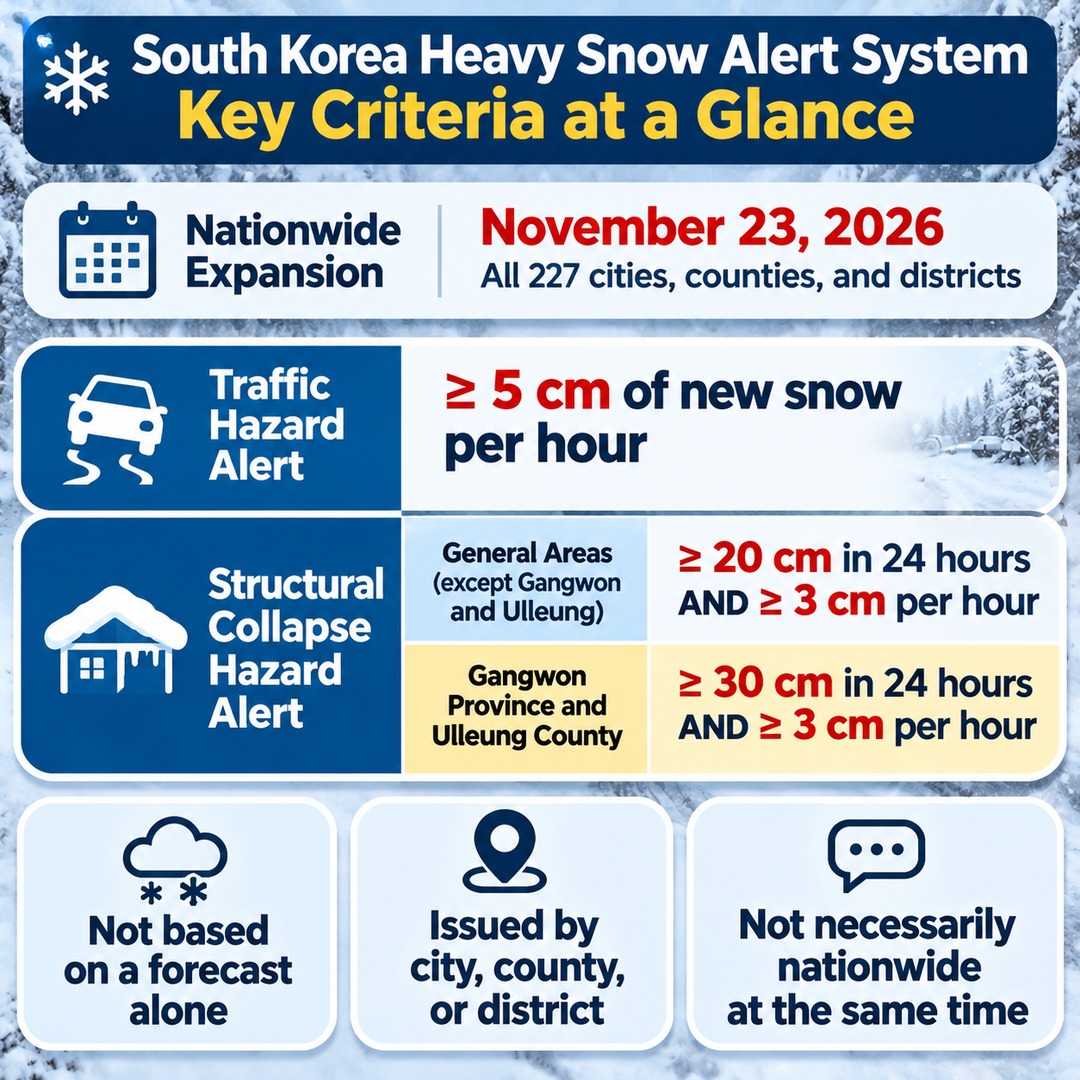

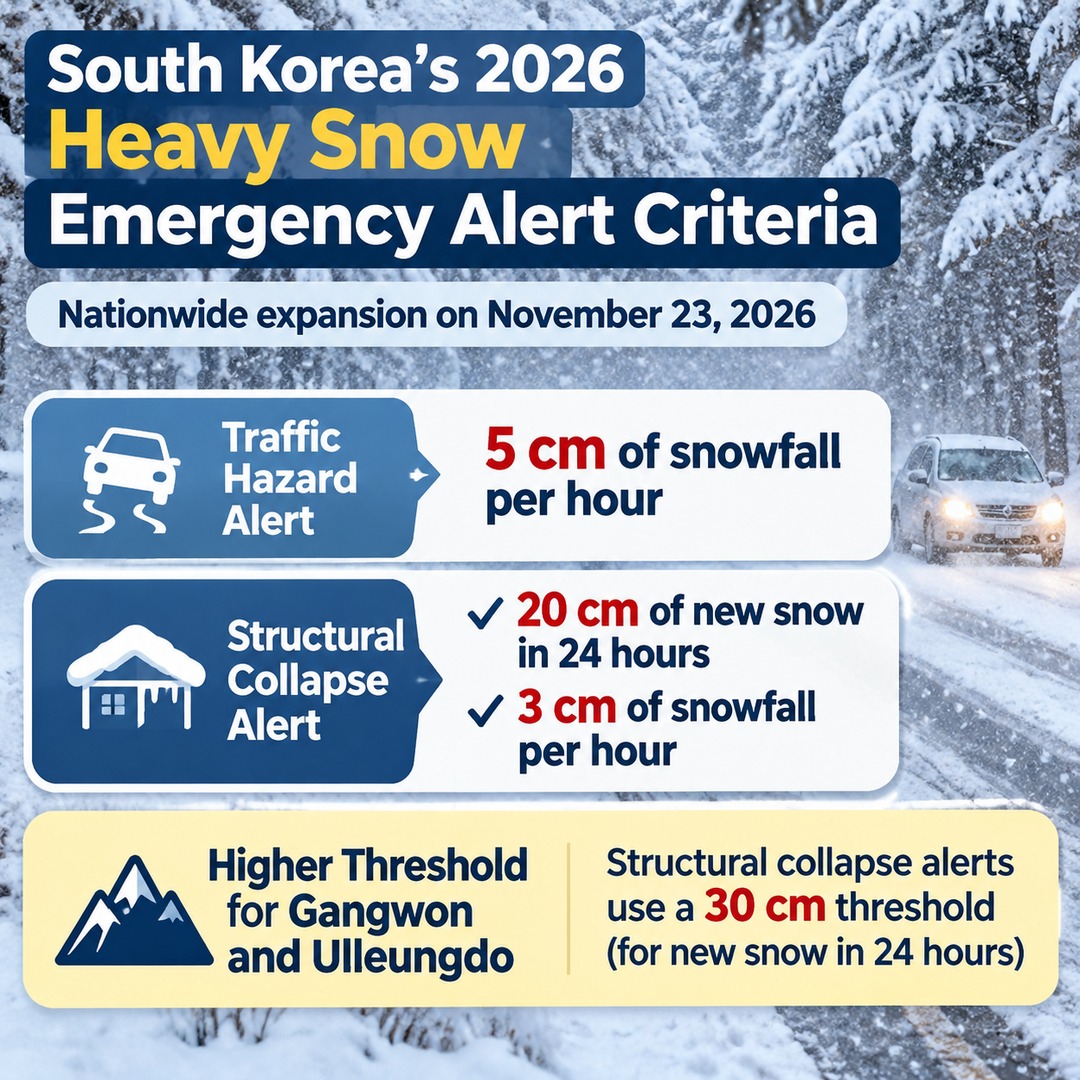
South Korea expanded its heavy snow safety alert system to all 227 cities, counties, and districts nationwide on November 23, 2026. Traffic hazard alerts are issued when at least 5 cm of new snow is observed falling per hour. Structural collapse hazard alerts consider both the 24-hour snowfall accumulation and the hourly snowfall rate. Gangwon Province and Ulleung County in North Gyeongsang Province have a higher threshold for structural collapse alerts.
A forecast of heavy snowfall alone does not automatically trigger an alert. What matters is whether actual snowfall observations meet the specified issuance criteria. Traffic hazards and structural collapse hazards use different thresholds, so it is important to understand them separately.
When Did Heavy Snow Safety Alerts Become Available Nationwide?
Alerts are issued at the city, county, or district level. Because the system uses real-time regional snowfall observations, alerts are not necessarily sent nationwide at the same time or with identical messages.
Therefore, even if a heavy snow advisory is in effect in another region, you may not receive a heavy snow safety alert in your area if the local snowfall threshold has not been met.
Does 5 cm of Snow per Hour Automatically Trigger an Emergency Alert?
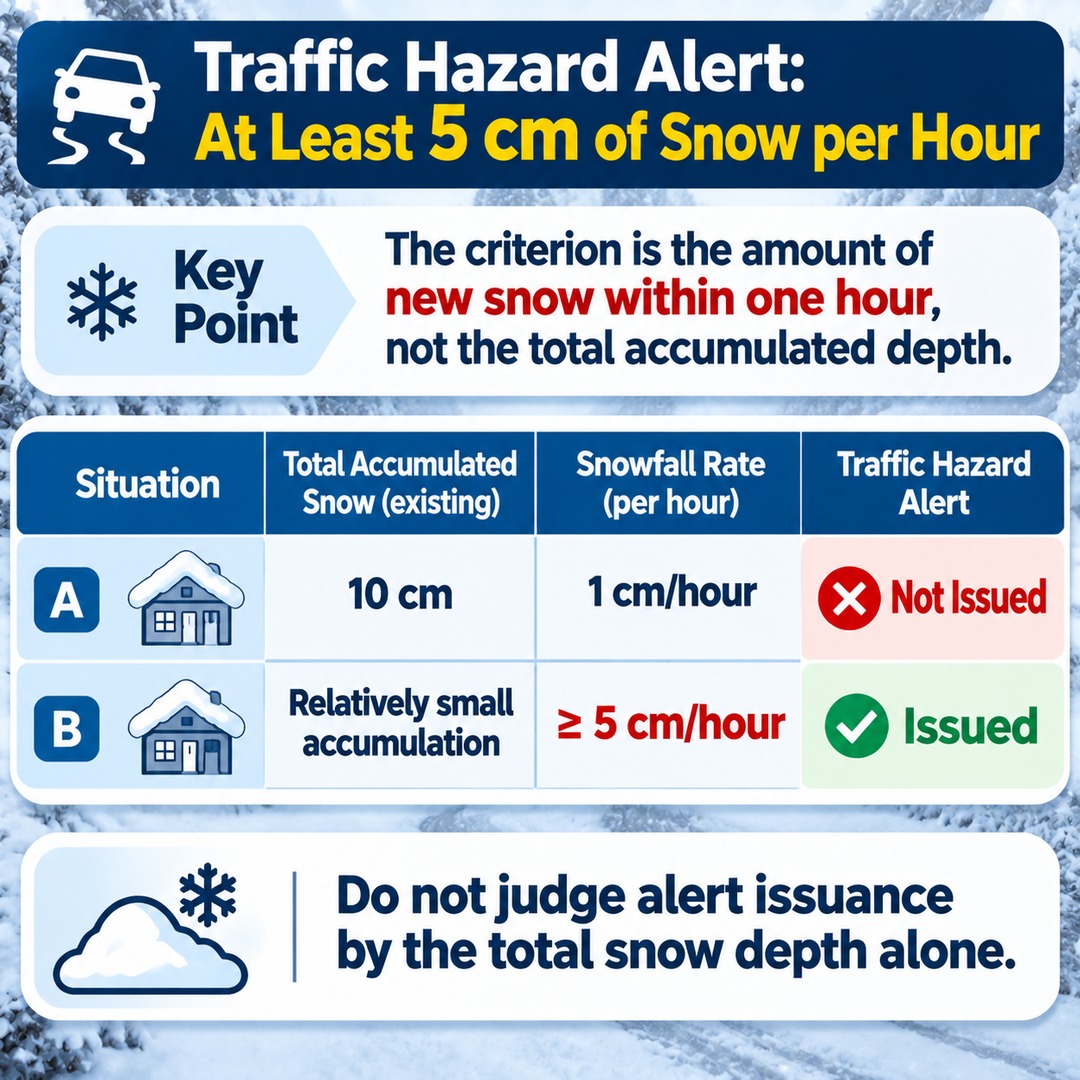
The nationwide criterion for issuing a traffic accident hazard alert is an observed snowfall rate of at least 5 cm per hour.
The important distinction is that this refers to newly fallen snow during one hour, not the total accumulated snow depth.
Consider the following two situations:
10 cm of snow accumulated overnight, but the current snowfall rate is only 1 cm per hour.
The existing snow accumulation is relatively small, but at least 5 cm of snow falls within one hour.
The second situation meets the traffic hazard alert criterion.
In other words, you should not determine whether an alert will be issued solely by looking at the total snow depth measured in the morning.
Why Do Structural Collapse Alerts Require Both 20 cm and 3 cm?
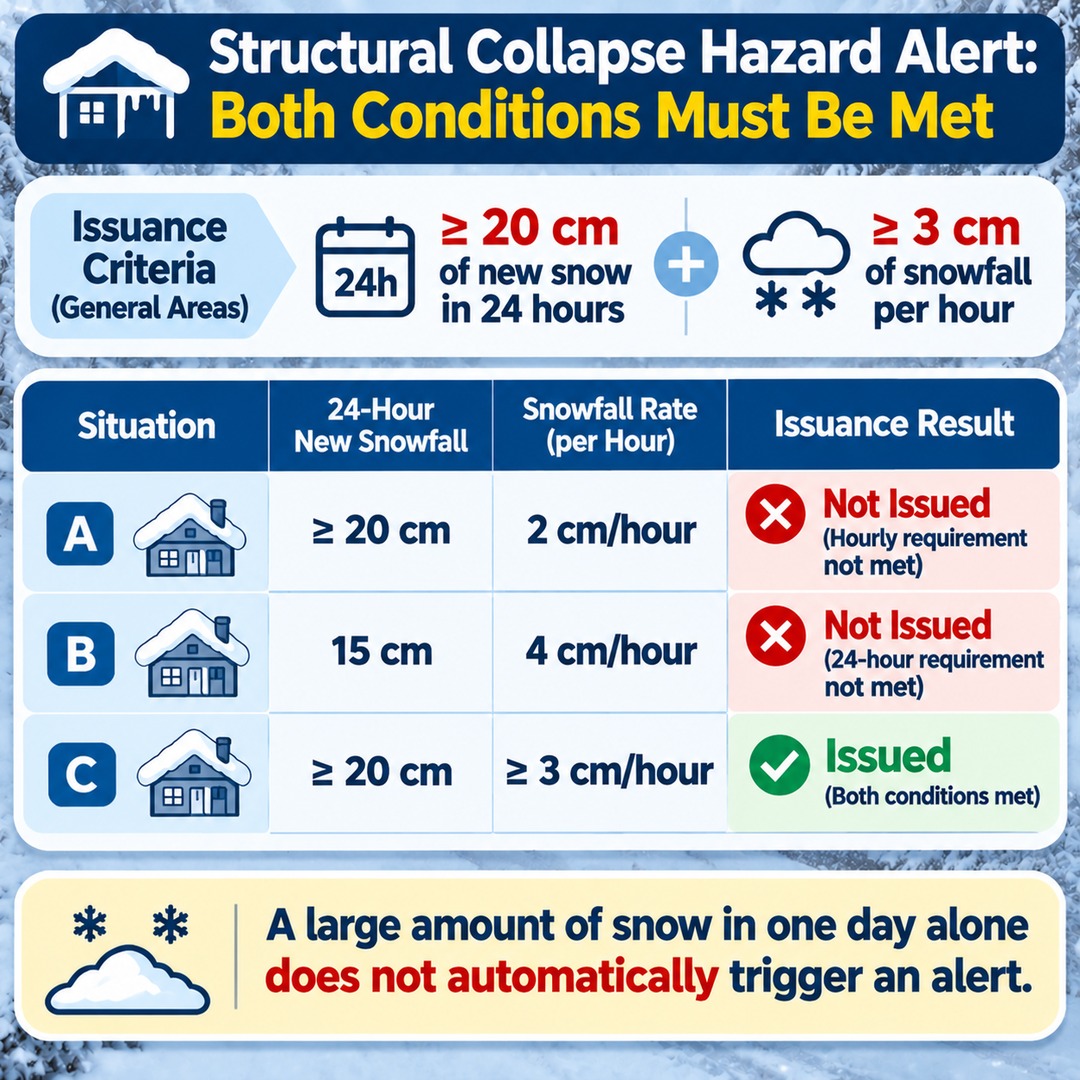
Structural collapse hazard alerts are issued when the amount of newly accumulated snow over 24 hours reaches a specified threshold and the current hourly snowfall rate also meets its threshold. In general areas, both of the following conditions must be satisfied simultaneously:
At least 20 cm of new snowfall accumulated over 24 hours.
A current snowfall rate of at least 3 cm per hour.
New snowfall refers to the amount of snow that has accumulated recently, rather than the total depth of snow already on the ground.
Here is how the two conditions work together:
24-hour new snowfall of at least 20 cm, but an hourly snowfall rate of 2 cm: Both conditions are not satisfied.
24-hour new snowfall of 15 cm, with an hourly snowfall rate of 4 cm: The 24-hour requirement is not satisfied.
24-hour new snowfall of at least 20 cm, with an hourly snowfall rate of at least 3 cm: Both issuance conditions are satisfied.
Therefore, heavy snowfall accumulation over a single day does not automatically trigger a structural collapse hazard alert. Both the 24-hour accumulation of new snow and the amount falling within one hour must be considered.
Why Is the Threshold 30 cm in Gangwon Province and Ulleungdo?
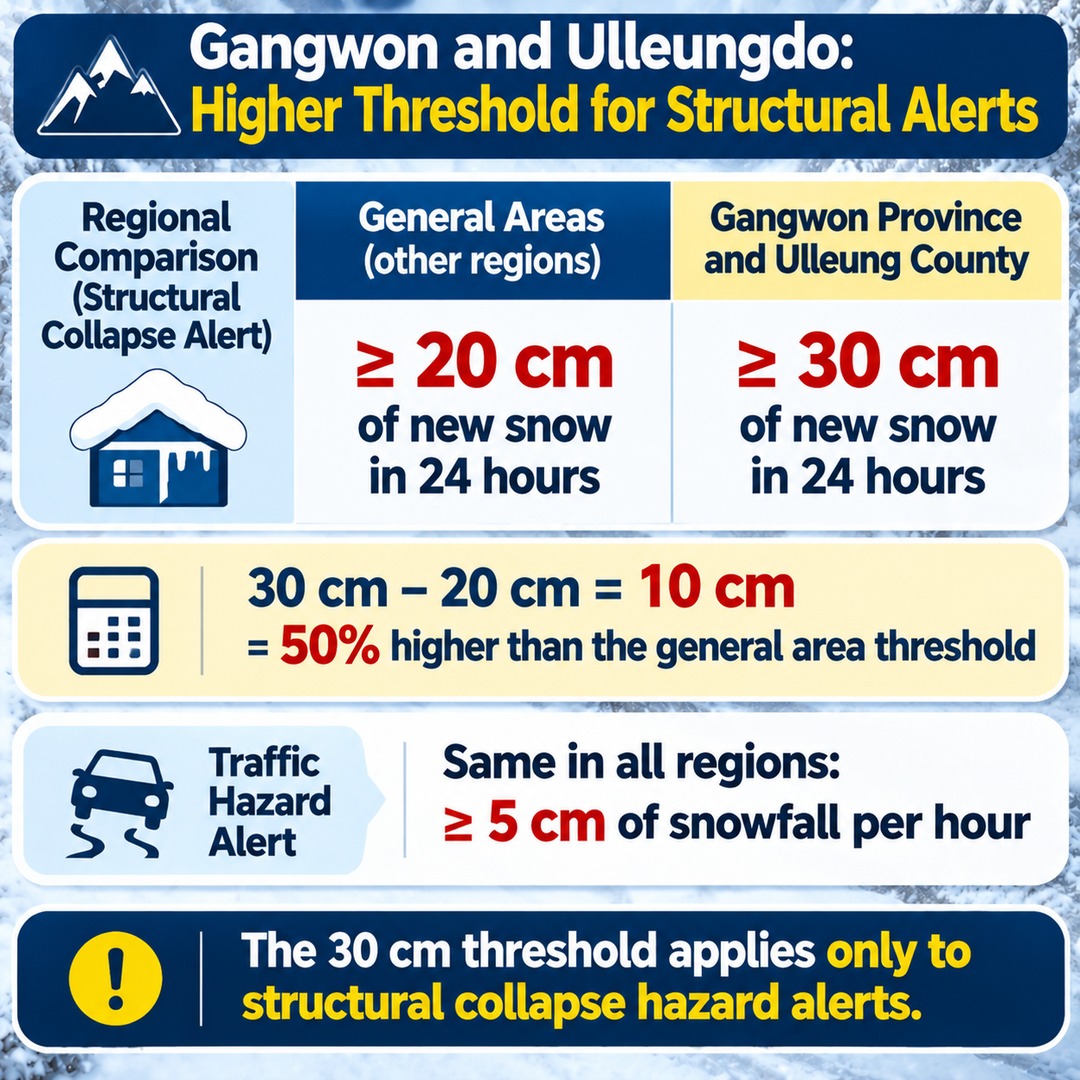
Gangwon Province and Ulleung County in North Gyeongsang Province have a 24-hour new snowfall threshold for structural collapse hazard alerts that is 10 cm higher than the threshold for general areas.
Comparison of Regional Structural Collapse Alert Criteria
| Region | 24-hour new snowfall threshold | Additional hourly requirement |
|---|---|---|
| General areas | 20 cm or more | At least 3 cm per hour, simultaneously |
| Gangwon Province and Ulleung County, North Gyeongsang Province | 30 cm or more | At least 3 cm per hour, simultaneously |
Difference between regional thresholds
Calculation: 30 cm − 20 cm = 10 cm, which is 50% higher than the threshold for general areas.
It is important to understand that this regional difference does not apply to every type of heavy snow emergency alert.
For traffic accident hazard alerts, Gangwon Province and Ulleung County follow the same criterion as other regions: at least 5 cm of snowfall per hour. The 30 cm threshold is a regional adjustment that applies specifically to structural collapse hazard alerts.
Why Didn't I Receive an Emergency Alert Despite a Heavy Snow Forecast?
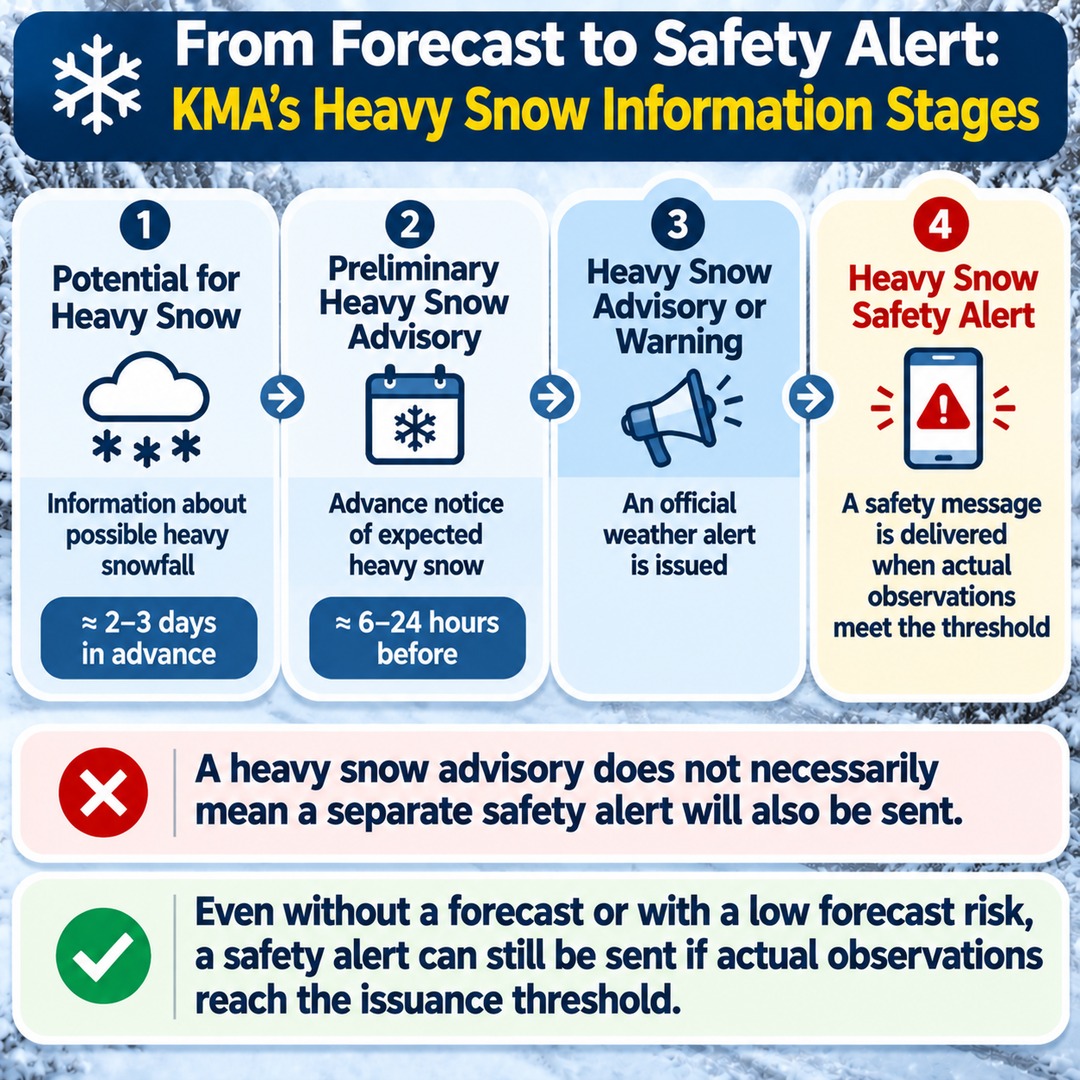
A heavy snow forecast and a heavy snow safety alert provide information at different stages of a developing weather situation.
The Korea Meteorological Administration (KMA) provides advance information about the possibility of snowfall. As the actual risk develops, it provides more specific information through observations and weather advisories.
The KMA's information stages are as follows:
1. Potential for Heavy Snow: Information about possible heavy snowfall, approximately 2–3 days in advance.
2. Preliminary Heavy Snow Advisory: Advance notice approximately 6–24 hours before the expected event.
3. Heavy Snow Advisory or Warning: An official weather alert is issued.
4. Heavy Snow Safety Alert: A safety message is delivered when actual observed snowfall reaches the specified issuance threshold.
Therefore, the activation of a heavy snow advisory does not necessarily mean that a separate safety alert will also be sent.
Conversely, even if there was no heavy snow forecast or the forecast indicated only a low risk, you may still receive a safety alert if actual observations reach the issuance threshold.
What Should Drivers and Facility Managers Do After Receiving an Alert?
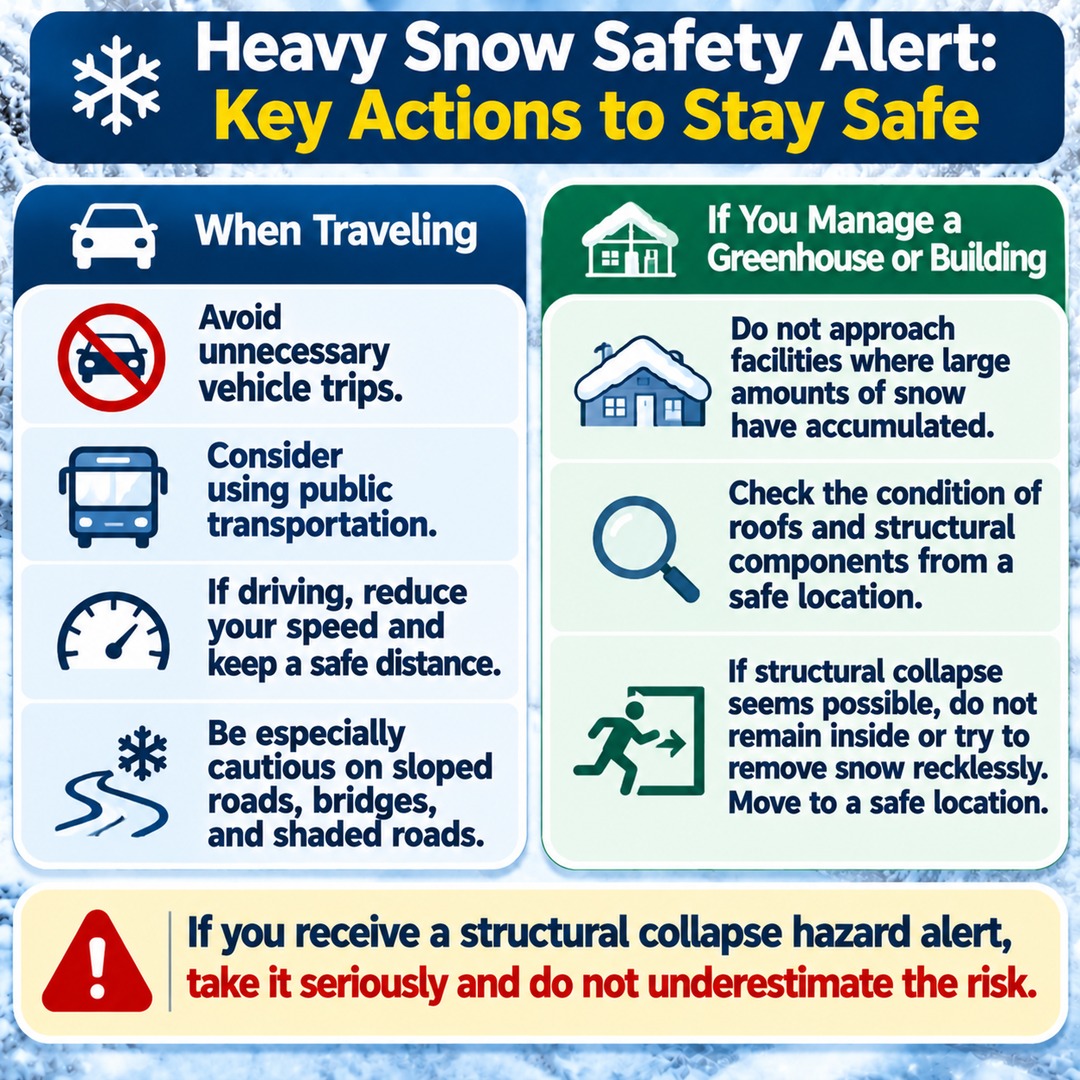
Heavy snow safety alerts are sent to residents in areas where specified risk thresholds have been reached. After receiving one, prioritize safe travel and precautions around buildings and other structures.
If You Are Driving
Avoid unnecessary vehicle trips and consider using public transportation.
If driving is necessary, reduce your speed and maintain a sufficient safe distance from the vehicle ahead.
Watch for icy conditions on sloped roads, bridges, and shaded roads.
If You Manage a Greenhouse or Building
Do not approach facilities where large amounts of snow have accumulated.
Check the condition of roofs and structural components from a safe location.
If structural collapse appears possible, do not remain inside or attempt to remove snow recklessly. Move to a safe location instead.
In particular, if you receive a structural collapse hazard alert, take the warning seriously and do not underestimate the risk described in the message.
Where Can You Check Heavy Snow Risks in Your Area?
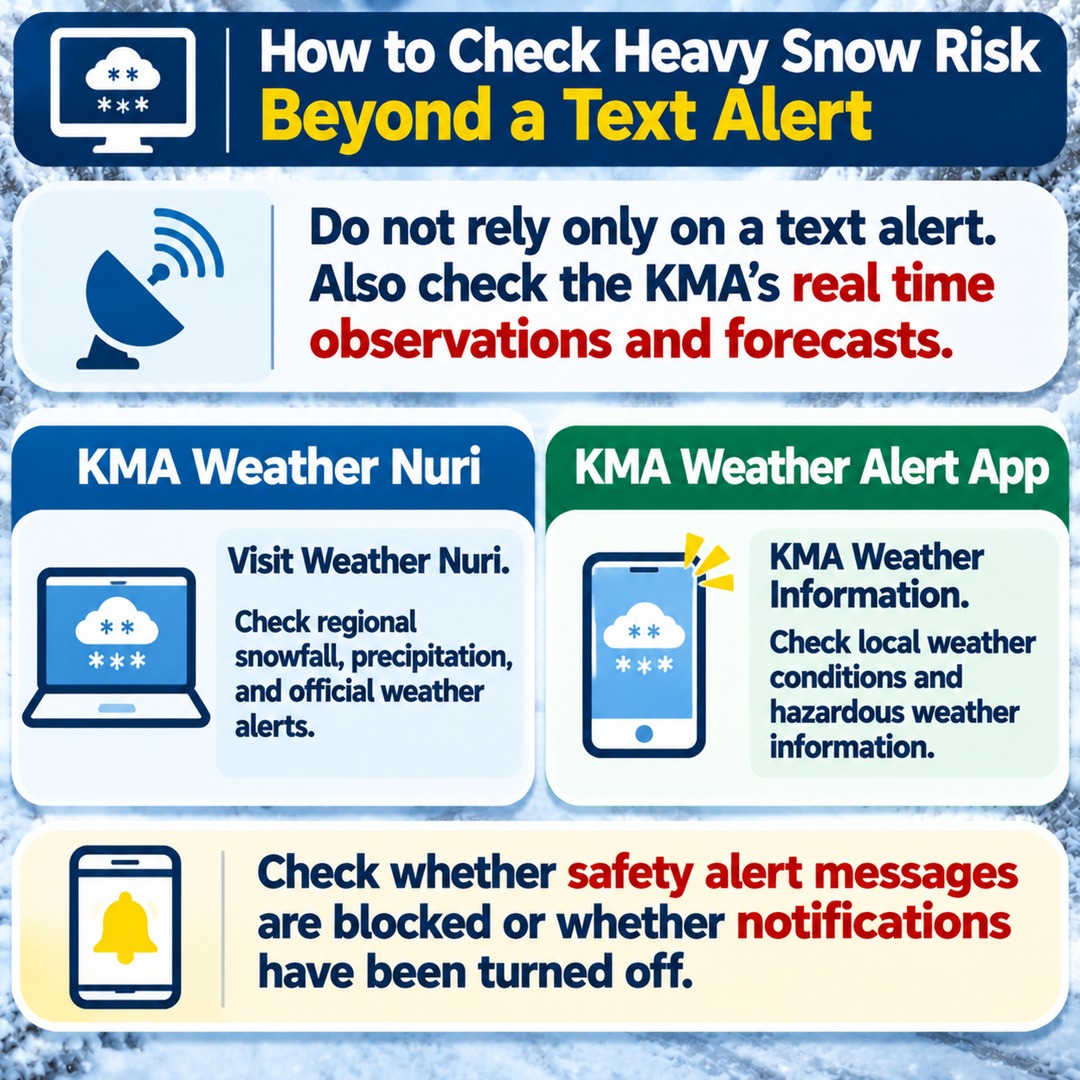
Rather than waiting only for a text alert, it is advisable to check the Korea Meteorological Administration's real-time observations and forecasts as well.
KMA Weather Nuri: Visit Weather Nuri — Check regional snowfall, precipitation, and official weather alerts.
KMA Weather Alert App (Nalssiallim): KMA Weather Information — Check local weather conditions and hazardous weather information.
Also check whether safety alert messages are blocked on your mobile phone or whether notifications have been turned off.