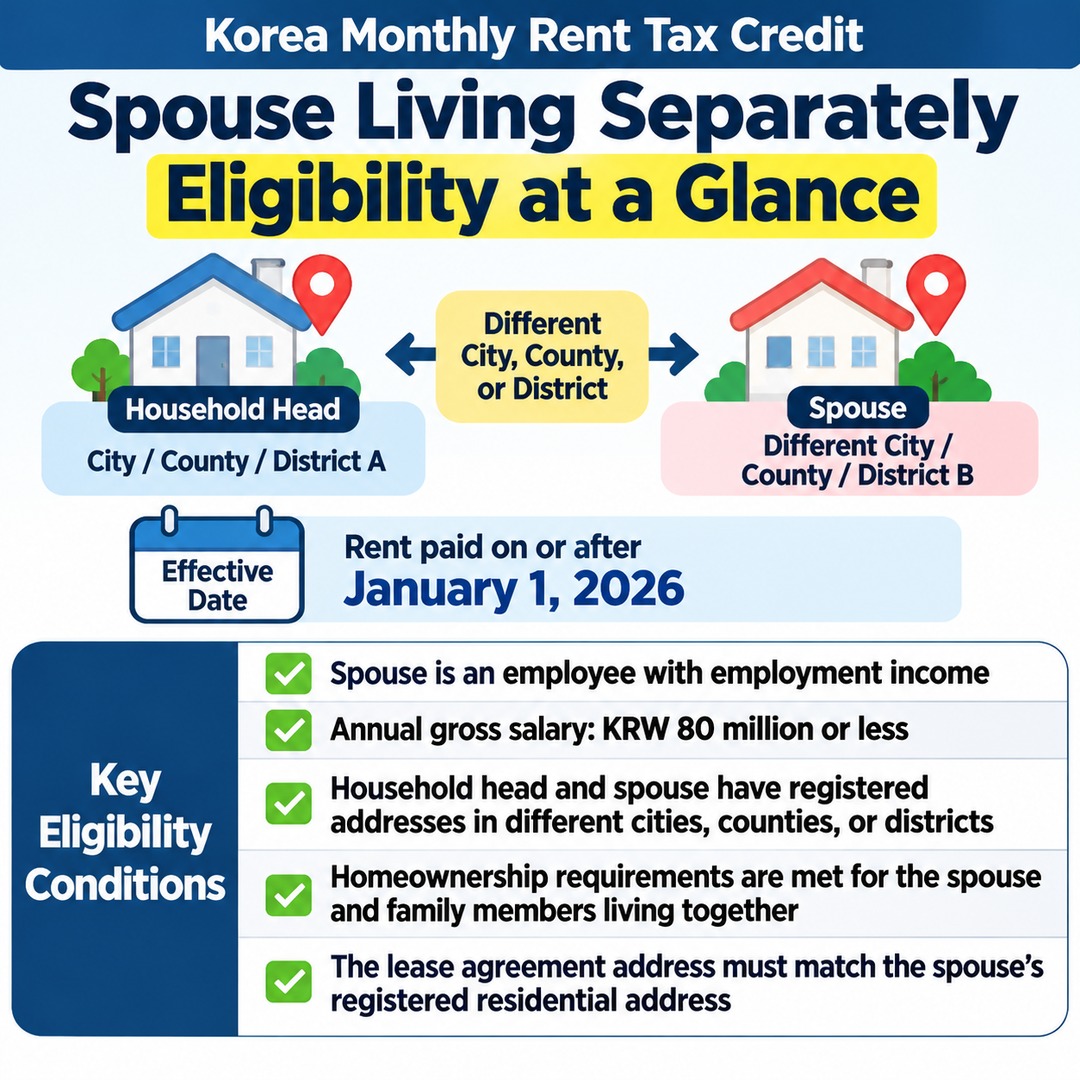

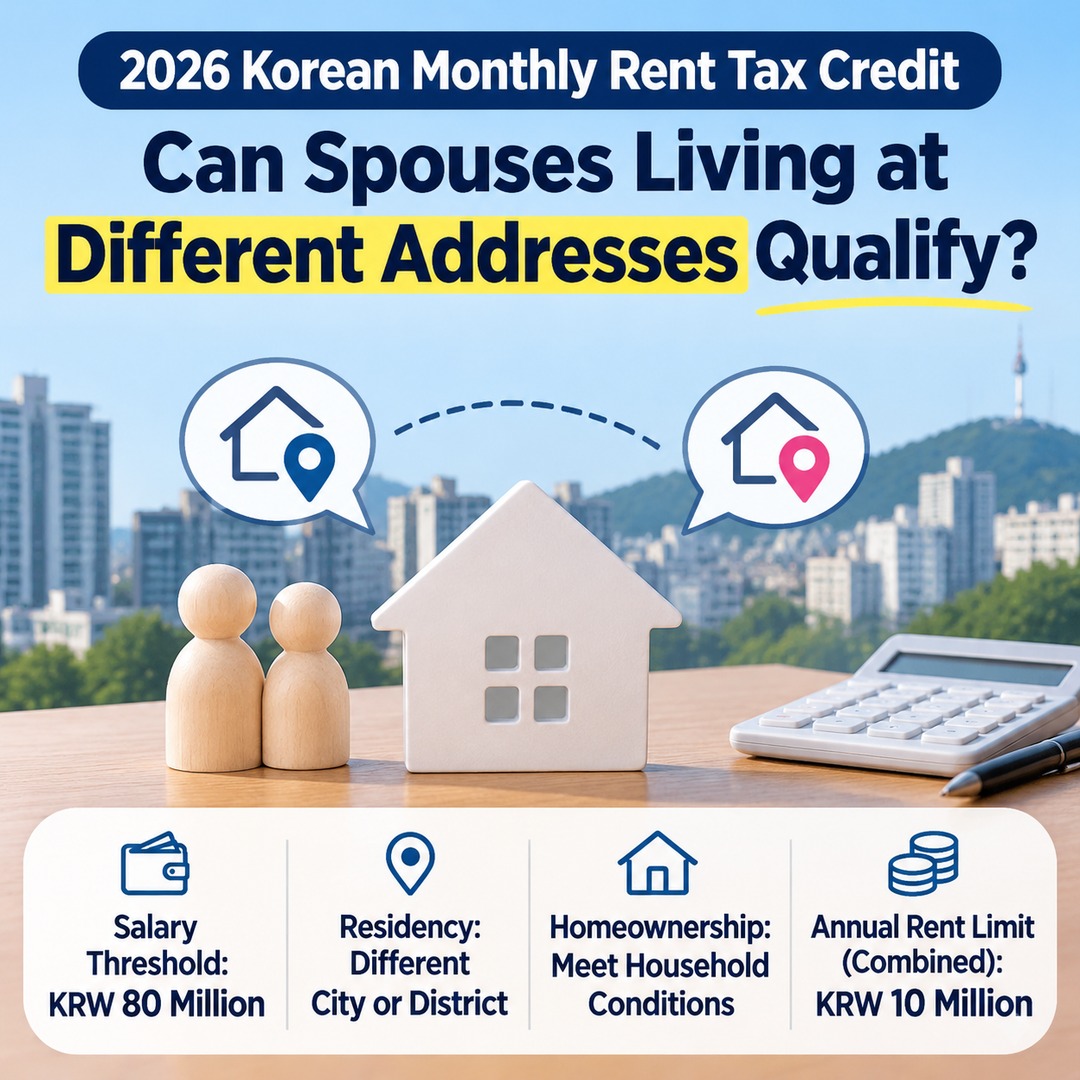
For monthly rent paid on or after January 1, 2026, a spouse whose registered residential address differs from that of the household head may also qualify for South Korea's monthly rent tax credit, provided separate eligibility requirements are met. The spouse must have annual gross salary of KRW 80 million or less, and the two spouses must reside in different cities, counties, or districts (si, gun, or gu). However, even if both spouses pay rent separately, their eligible monthly rent payments are subject to a combined annual limit of KRW 10 million.
Previously, spouses were generally treated as belonging to the same household even when they maintained separate finances. As a result, dual-income couples living apart because of work or weekend commuting arrangements often found it difficult to claim separate rent tax credits. Starting in 2026, additional eligibility provisions apply to spouses living separately. However, simply registering different residential addresses does not automatically establish eligibility.
Spouses Living at Different Addresses Can Qualify Starting in 2026
A spouse who is not the household head may also apply for a tax credit on rent personally paid, provided the separate-residence requirements are satisfied. The key considerations are whether the household head and spouse have registered addresses in different cities, counties, or districts, and whether the spouse meets the income and household homeownership requirements.
This change was introduced through South Korea's 2025 tax reform and applies to rent paid on or after January 1, 2026.
All of the following conditions must be checked:
The spouse living separately must be an employee with employment income.
The spouse's annual gross salary must not exceed KRW 80 million.
The household head and spouse must have registered residential addresses in different cities, counties, or districts.
The homeownership requirements for qualifying lineal relatives and other family members living with the spouse must be satisfied.
The address on the lease agreement must match the address on the resident registration certificate.
Whose Homeownership Status Must Be Checked?
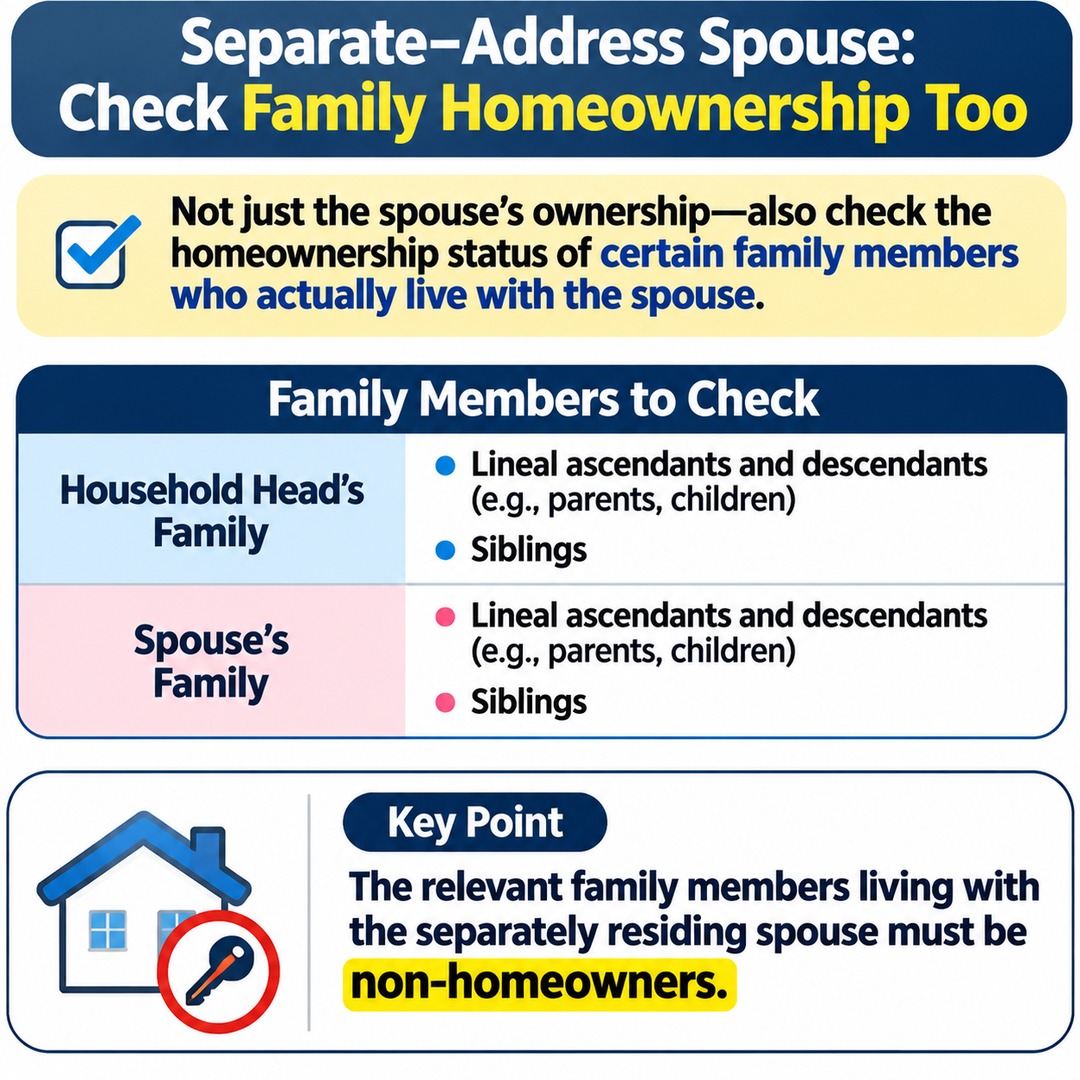
For a spouse living at a separate address, checking only whether the spouse personally owns a home is not enough. The homeownership status of certain family members living with that spouse must also be considered.
The family members identified in South Korea's 2025 tax reform proposal include:
The household head's lineal ascendants and descendants, and siblings
The spouse's lineal ascendants and descendants, and siblings
The relevant family members living with the separately residing spouse must be non-homeowners.
Therefore, if you live with your parents or siblings, you should not apply after checking only whether you and your spouse own property. You must also verify the actual cohabitation arrangements and the applicable family-member categories.
In particular, living separately from your spouse does not mean that the homeownership status of both sides of the family must automatically be assessed in exactly the same way. An important factor is which family members actually live with the spouse claiming the credit.
What Are the Income Requirements for Dual-Income Couples?
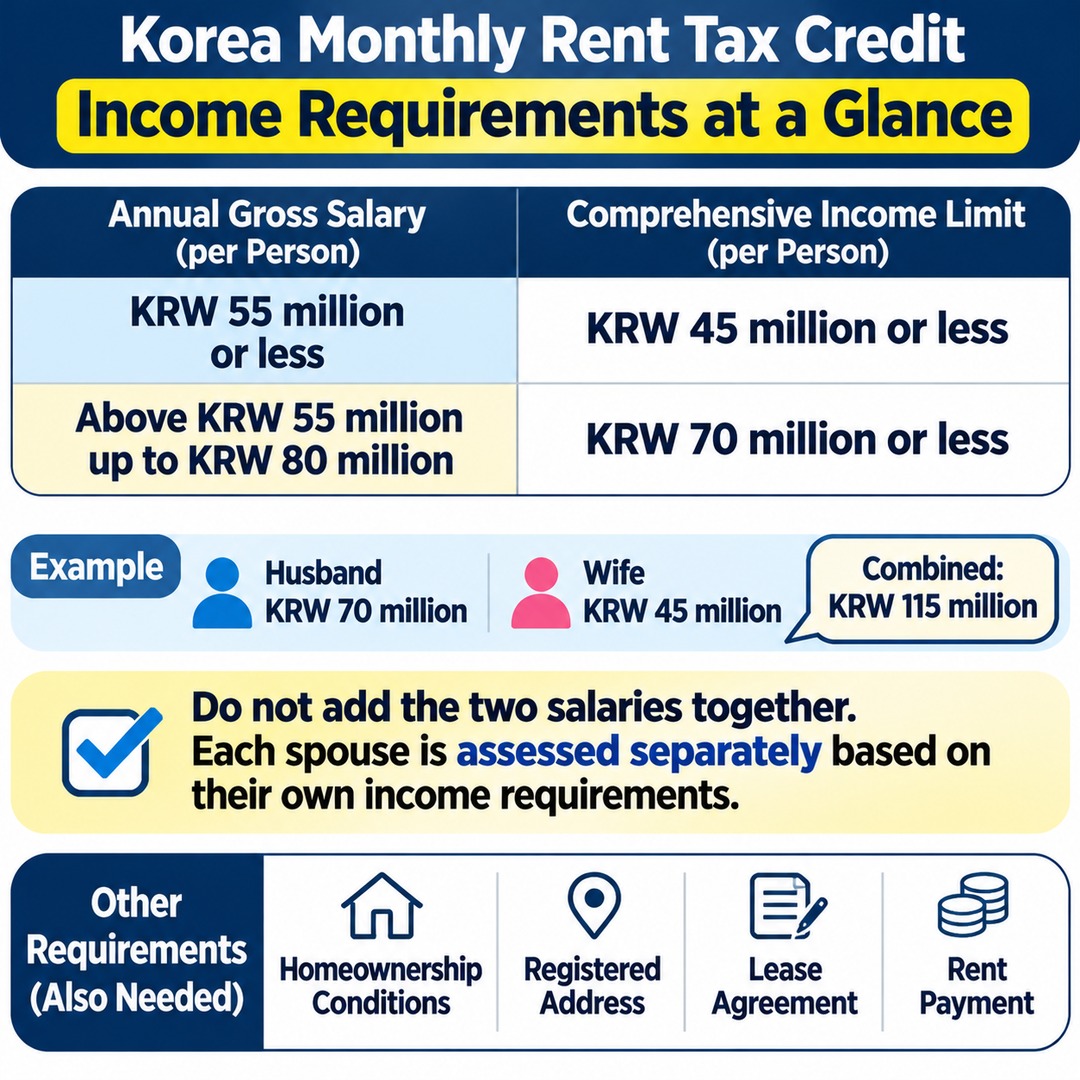
South Korea's monthly rent tax credit is subject to income requirements based on an employee's annual gross salary and comprehensive income amount. A spouse living at a separate address must also satisfy the gross salary ceiling of KRW 80 million.
| Income category | Income requirement | Tax credit rate |
|---|---|---|
| Lower-income bracket | Annual gross salary of KRW 55 million or less | 17% |
| Standard bracket | Annual gross salary above KRW 55 million and up to KRW 80 million | 15% |
Separate comprehensive income limits also apply:
Gross salary of KRW 55 million or less: Comprehensive income of KRW 45 million or less
Gross salary above KRW 55 million and up to KRW 80 million: Comprehensive income of KRW 70 million or less
This means that a dual-income couple does not simply add the husband's and wife's salaries together to determine whether their combined income is below KRW 80 million. Each spouse's eligibility and income requirements must be assessed separately.
For example, suppose the husband's annual gross salary is KRW 70 million and the wife's is KRW 45 million. Even though their combined salary exceeds KRW 80 million, eligibility may be assessed separately according to whether each spouse meets the applicable individual income requirements.
However, meeting the income requirements alone is not sufficient. The homeownership, registered-address, lease-agreement, and rent-payment requirements must also be satisfied.
Can Each Spouse Claim a KRW 10 Million Rent Deduction?
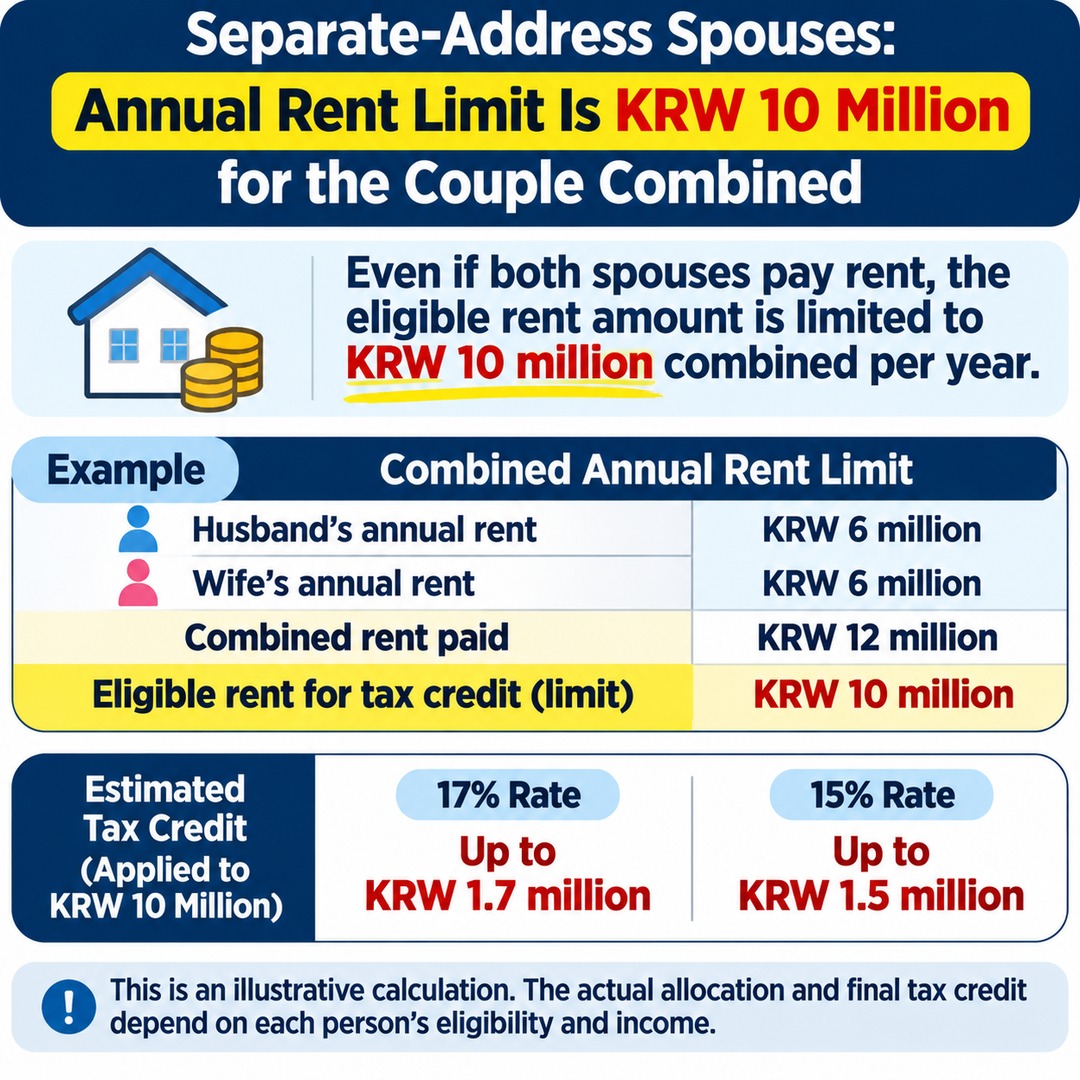
No. Although eligibility was expanded to include spouses living separately starting in 2026, the annual eligible rent limit is KRW 10 million combined for the couple.
Even if the husband and wife each pay rent, they cannot claim KRW 10 million apiece, resulting in a combined eligible rent amount of KRW 20 million.
For example, suppose the husband pays KRW 6 million in annual rent and the wife also pays KRW 6 million. Their combined annual rent expenditure is KRW 12 million. However, the rent amount eligible for the tax credit calculation is limited to KRW 10 million for the couple combined.
Example: Combined Annual Rent Limit
| Item | Amount |
|---|---|
| Husband's annual rent | KRW 6 million |
| Wife's annual rent | KRW 6 million |
| Total actual rent paid | KRW 12 million |
| Maximum eligible rent for the tax credit | KRW 10 million |
This is an illustrative calculation applying only the couple's combined limit. The actual allocation of eligible rent and final tax credit between the spouses depends on each person's eligibility and income.
Applying the tax credit rates to KRW 10 million in eligible annual rent produces a calculated credit of up to KRW 1.7 million at the 17% rate or KRW 1.5 million at the 15% rate.
These figures are calculated by simply applying the applicable rates. They do not guarantee that the actual tax refund or reduction in tax payable will equal those amounts.
What If the Lease Agreement and Registered Address Do Not Match?
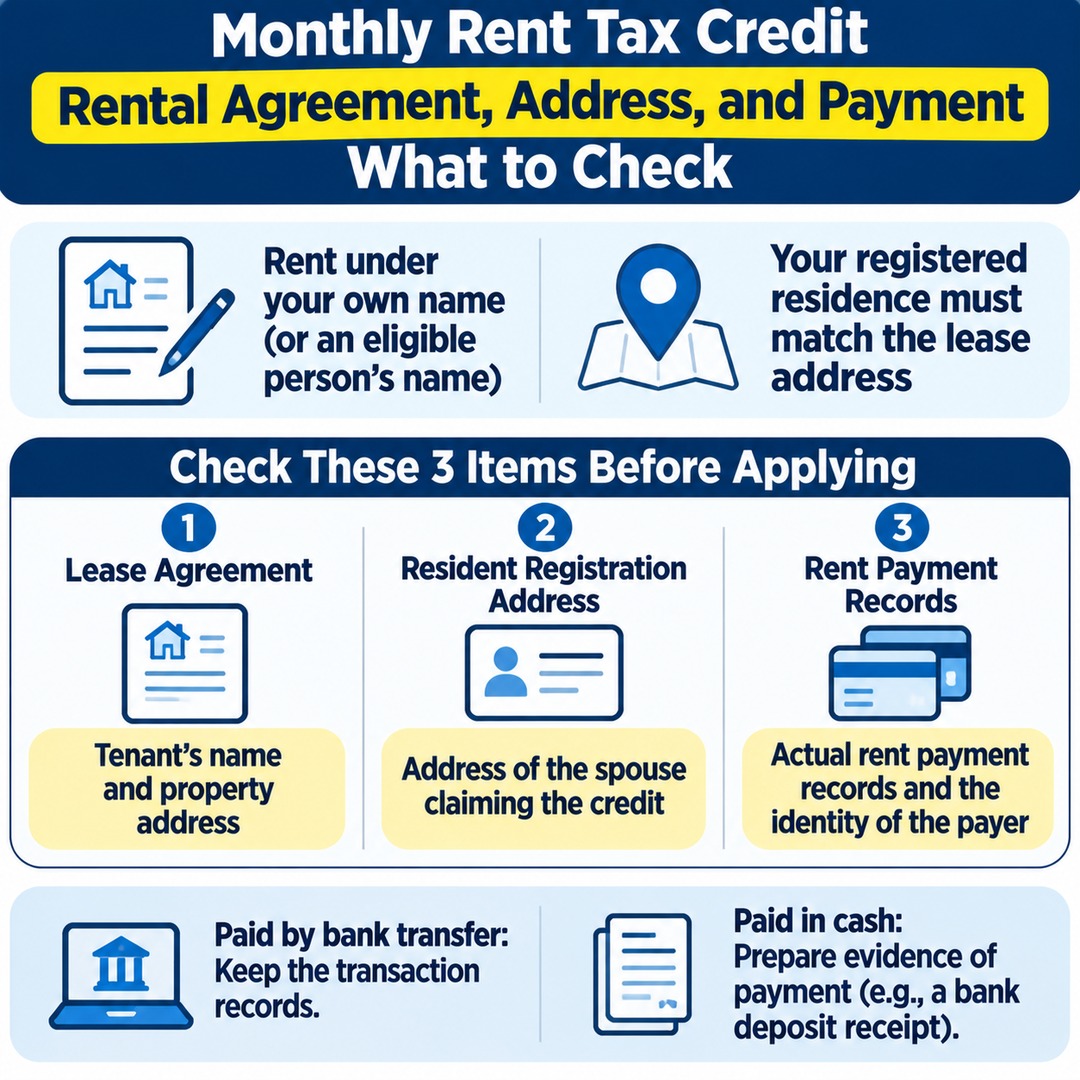
To qualify, the separately residing spouse must rent the home under their own name or the name of an individual eligible for their basic personal deduction. In addition, the employee claiming the credit must register their residence at the address stated in the lease agreement. The address on the resident registration certificate must match the lease address.
Having a separate rental agreement alone does not guarantee eligibility.
Before applying, compare the following three items:
1. The tenant's name and property address stated in the lease agreement
2. The address on the resident registration certificate of the spouse claiming the credit
3. The actual rent payment records and the identity of the payer
If rent is paid by bank transfer, retain the transaction records. If it is paid in cash, prepare evidence demonstrating payment, such as a bank deposit receipt.
Rental Properties Must Also Meet Separate Eligibility Requirements
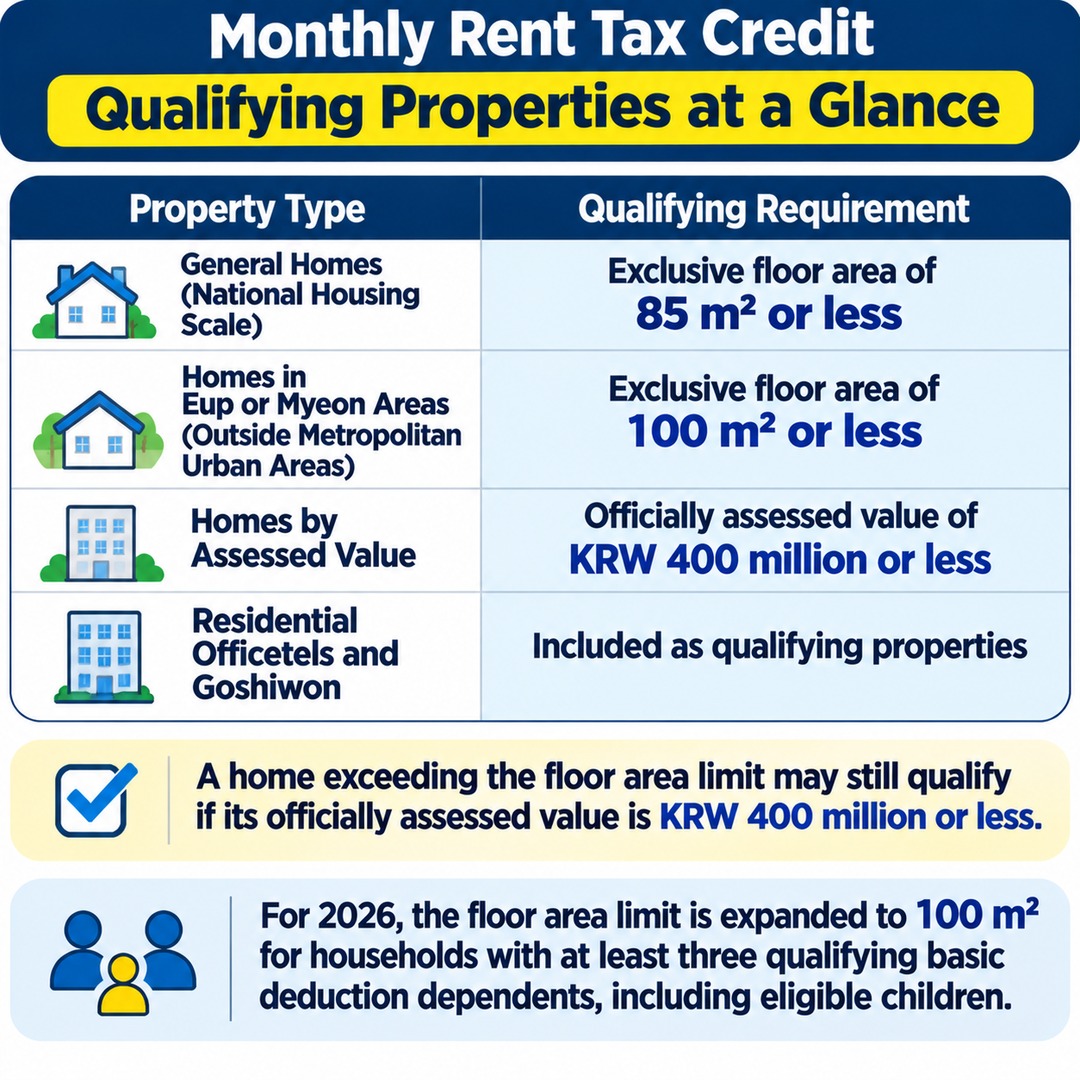
Not every property used as a residence qualifies simply because rent is being paid. The property must satisfy either the applicable exclusive floor-area requirement or the assessed-value requirement. Residential officetels and goshiwon accommodations are also included.
The general qualifying property requirements are:
Homes with an exclusive floor area of 85 m² or less, meeting the National Housing Scale standard
Homes with an exclusive floor area of 100 m² or less in eup or myeon areas outside metropolitan urban areas
Homes with an officially assessed value of KRW 400 million or less
Residential officetels and goshiwon accommodations
A home exceeding the National Housing Scale floor-area limit may still qualify if its officially assessed value is KRW 400 million or less.
For 2026, the floor-area limit is also expanded to 100 m² for households with at least three qualifying basic-deduction dependents, including eligible children. Families with multiple children should check this provision separately.
What Documents Should You Submit for Year-End Tax Settlement?
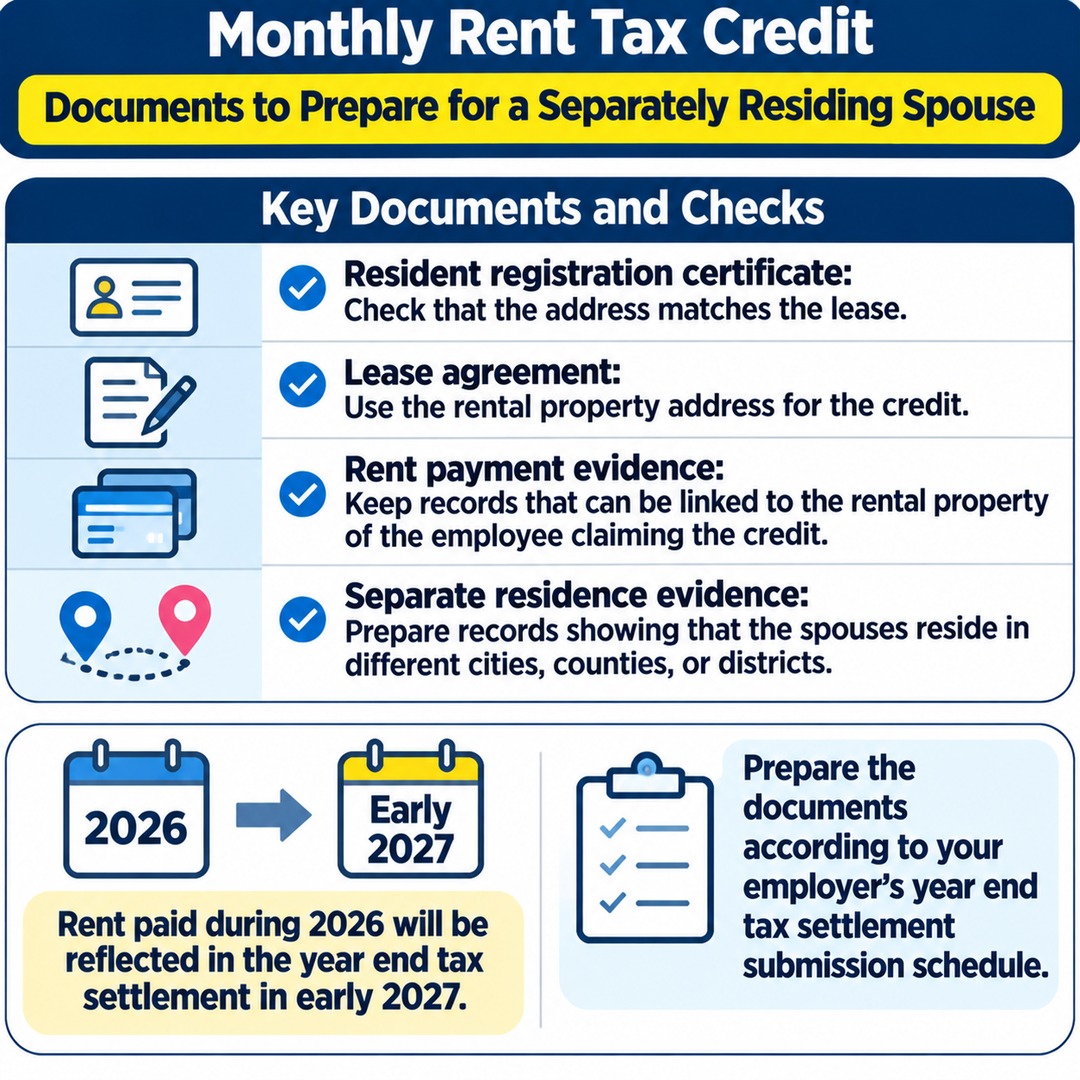
A spouse living separately should prepare the standard monthly rent tax credit supporting documents, along with address-related records demonstrating that the spouses reside in different cities, counties, or districts.
The basic documents include:
| Document | What it verifies |
|---|---|
| Resident registration certificate | The spouse's registered residential address |
| Copy of the lease agreement | The tenant and rental property address |
| Monthly rent transfer records | Evidence that rent was actually paid |
| Family relationship certificate or equivalent | Verification of the spousal relationship, when required |
First, check that the address on the resident registration certificate matches the address on the lease agreement. Keep rent payment evidence in a form that can be linked to the rental property of the employee claiming the credit.
Rent paid during 2026 will be reflected in the year-end tax settlement process in early 2027. Prepare the documents according to your employer's year-end tax settlement submission schedule.
If You Receive Youth Monthly Rent Support, Check for Overlapping Benefits
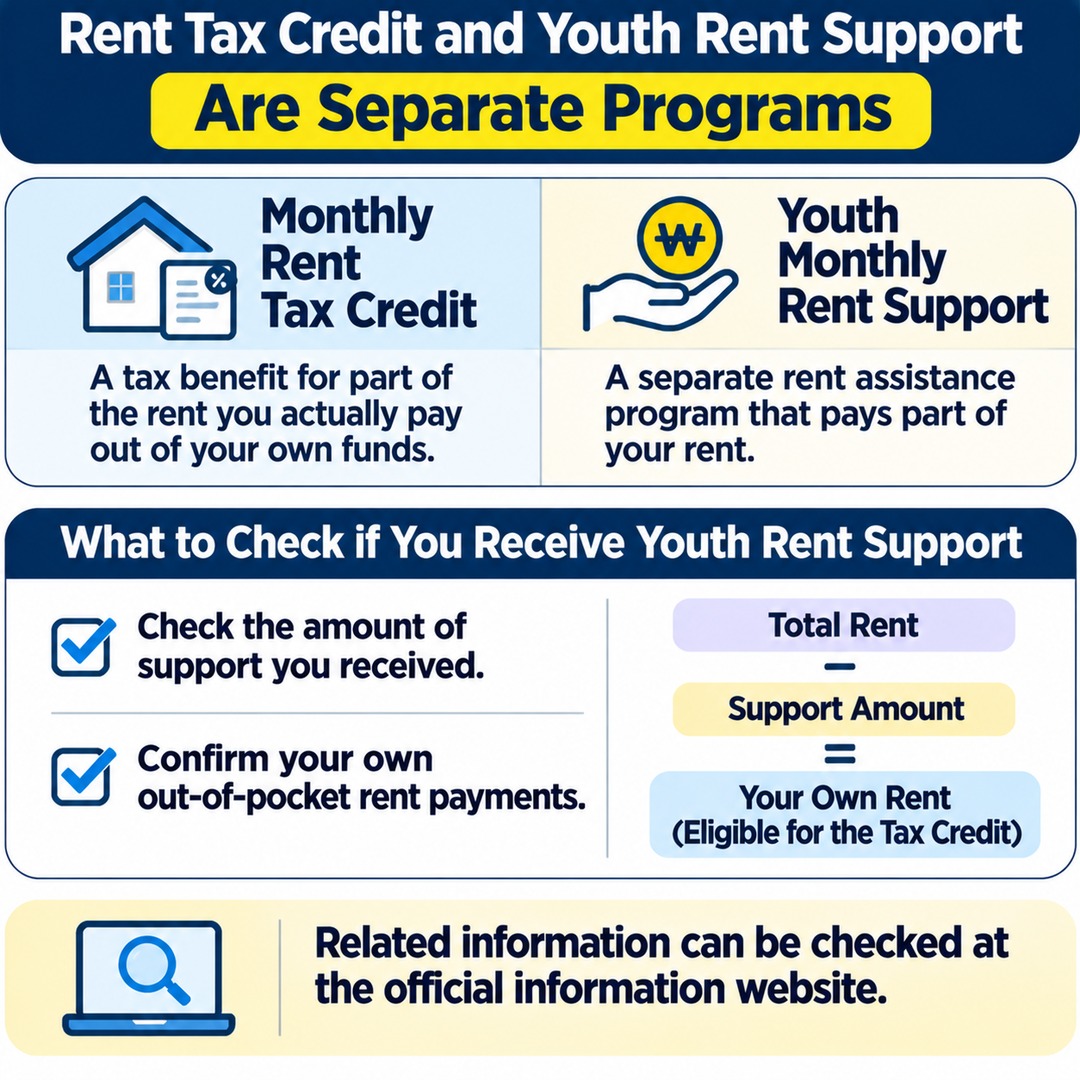
South Korea's monthly rent tax credit and Youth Monthly Rent Support are separate programs. You must distinguish between rent covered by the support payment and rent actually paid out of your own funds.
If you receive Youth Monthly Rent Support, check the amount of support received and your own out-of-pocket rent payments before determining the amount eligible for the tax credit.
Related information can be checked at.
How Can You Determine Whether Your Spouse and You Qualify?
South Korea's 2026 monthly rent tax credit expands eligibility to spouses living separately, but not every weekend couple or dual-income couple automatically qualifies.
Before applying, follow these steps:
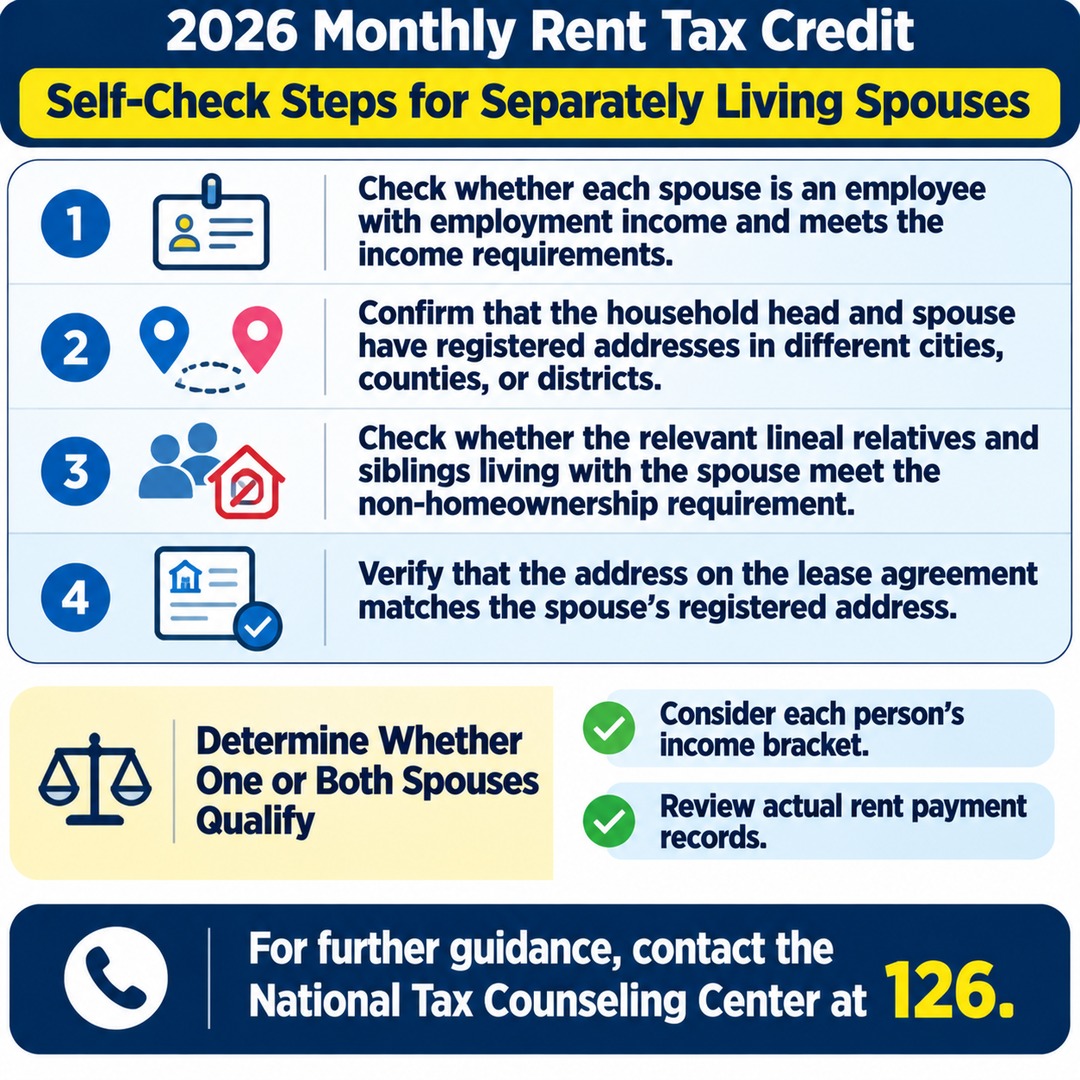
1. Check whether each spouse is an employee with employment income and meets the applicable income requirements.
2. Confirm that the household head and spouse have registered addresses in different cities, counties, or districts.
3. Check whether the relevant lineal relatives and siblings living with the spouse meet the non-homeownership requirement.
4. Verify that the address on the lease agreement matches the address on the resident registration certificate.
5. Check the property's floor-area or officially assessed-value requirements.
6. Add together the rent paid by both spouses and apply the combined annual limit of KRW 10 million.
It is particularly important to distinguish between cases in which only one spouse qualifies for the tax credit and cases in which both spouses qualify. The actual amount claimed must be assessed by considering each person's income bracket and rent payment records.
If you are unsure whether your separately residing spouse qualifies for the monthly rent tax credit, you can contact South Korea's National Tax Counseling Center at 126 to check how the rules apply to your lease agreement and family circumstances.