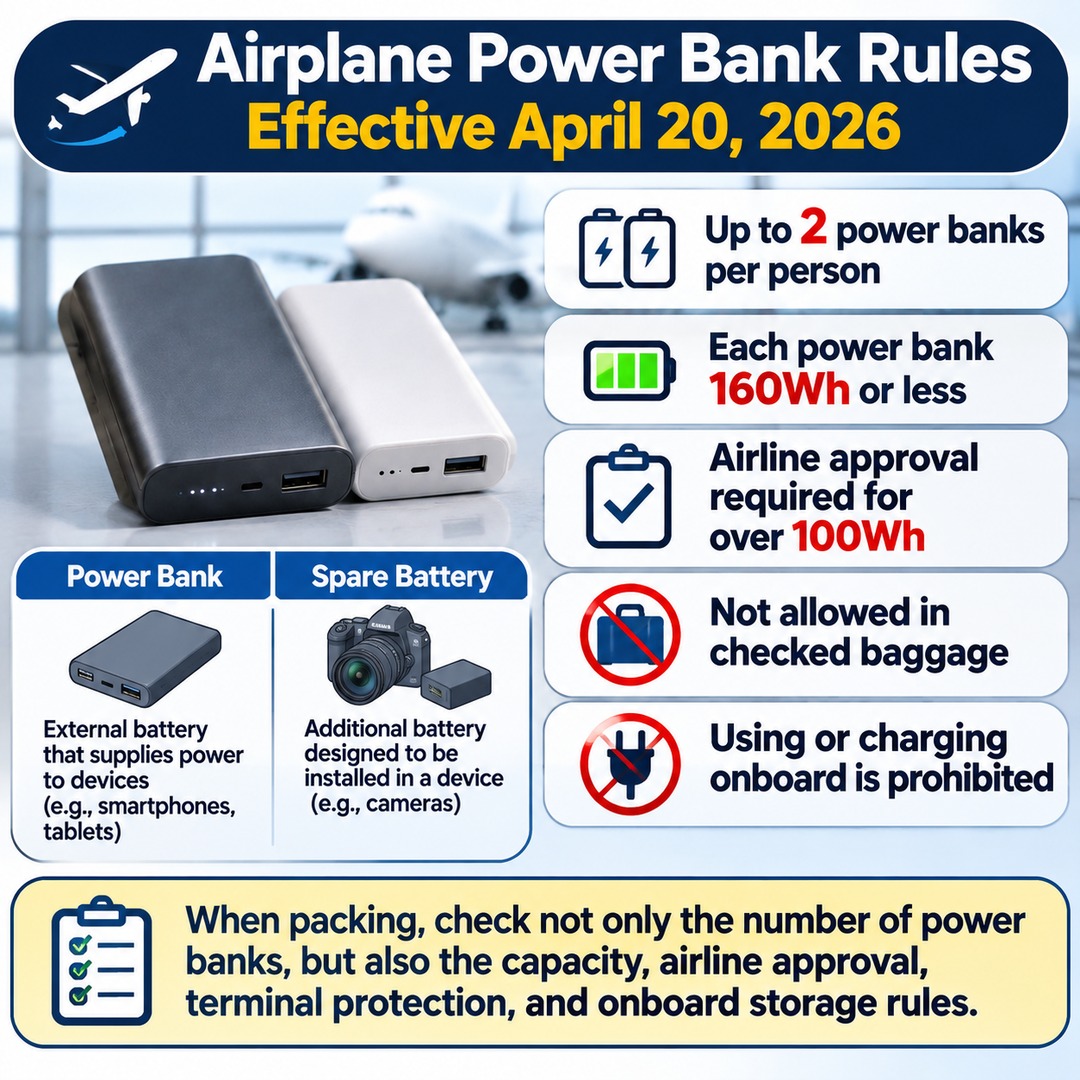

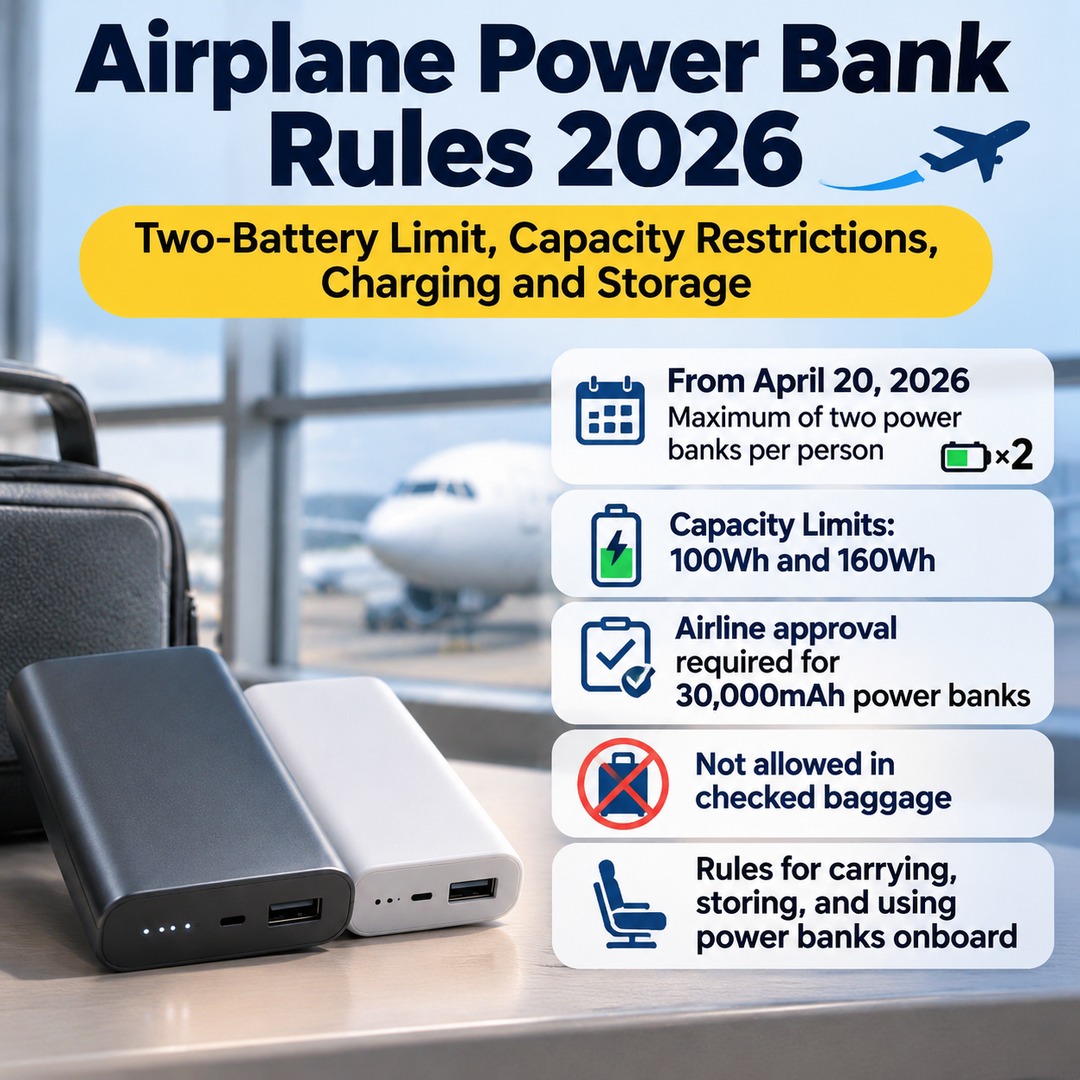
From April 20, 2026, passengers may carry a maximum of two power banks per person on flights. Each power bank must have a capacity of 160Wh or less, and airline approval is required for units exceeding 100Wh. Power banks cannot be placed in checked baggage, and using or charging them during a flight is also prohibited.
Checking how many power banks you can bring is not enough when packing for a trip. You must also comply with capacity limits, airline approval requirements, terminal protection, and onboard storage rules.
Why Are Airplane Power Banks Limited to Two Per Passenger?
The rules effective April 20, 2026, limit the number of power banks passengers can carry onboard to a maximum of two per person. If you are still relying on the previously announced allowance of five power banks rated at 100Wh or less, be aware that the rules have changed.
It is important to distinguish between power banks and spare batteries under these rules.
Power banks: External batteries used to supply power to devices such as smartphones and tablets.
Spare batteries: Additional batteries designed to be installed directly into electronic devices, such as cameras.
Even power banks rated at 100Wh or less are limited to two per passenger. Spare batteries are subject to separate quantity limits, so the two categories must not be counted under the same rules.
How Many Power Banks Can You Bring Based on Their Capacity?
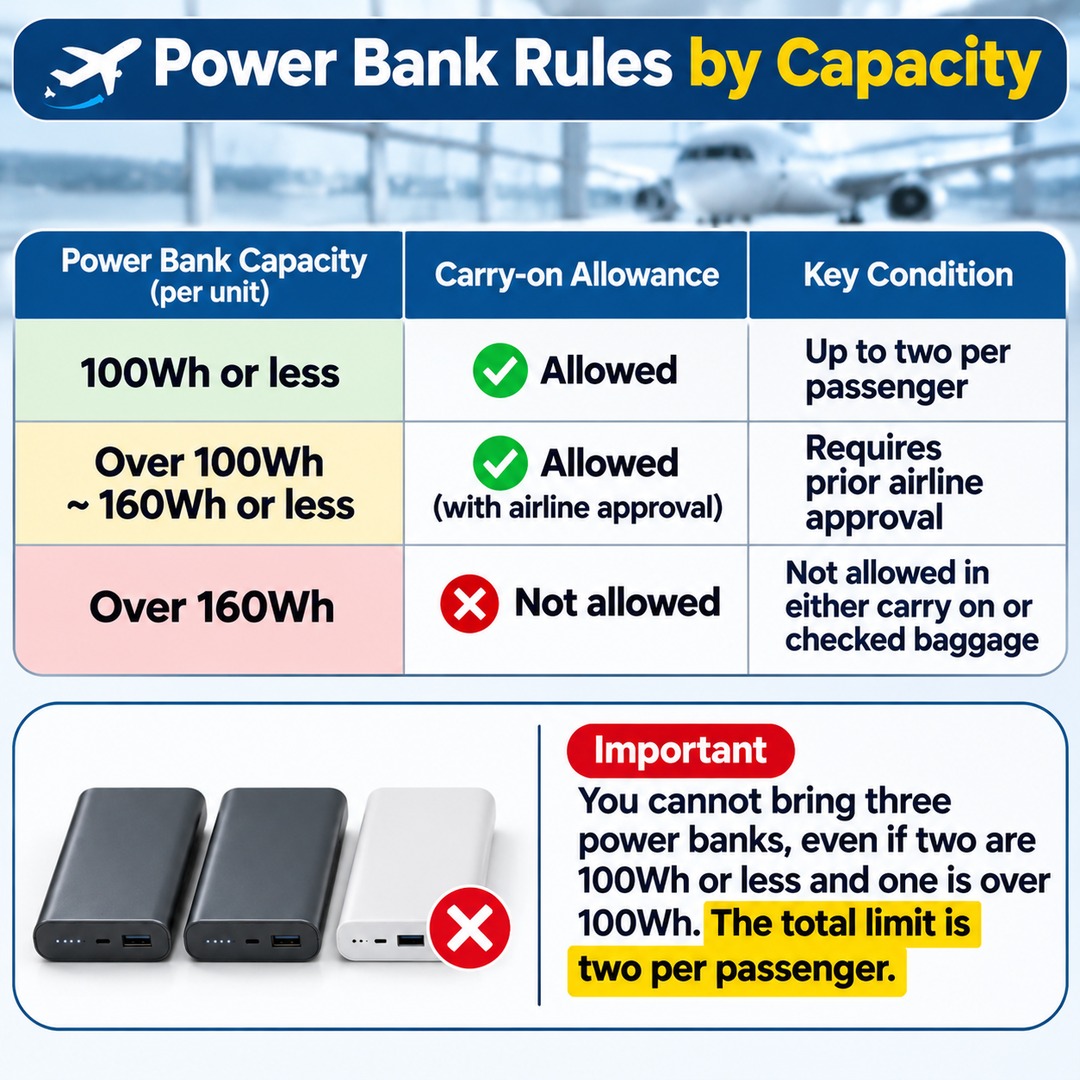
The conditions for carrying a power bank depend on its individual energy capacity.
| Battery capacity | Carry-on allowance |
|---|---|
| 100Wh or less | Maximum of 2 per passenger |
| Over 100Wh up to 160Wh | Maximum of 2 with airline approval |
| Over 160Wh | Not permitted for transport |
Power banks exceeding 100Wh require prior airline approval. Units exceeding 160Wh are not permitted in either carry-on or checked baggage.
In particular, you cannot assume that you may bring three power banks by counting two units rated at 100Wh or less separately from one unit exceeding 100Wh. The total allowance for power banks is two per passenger.
Can You Bring 20,000mAh and 30,000mAh Power Banks on a Plane?
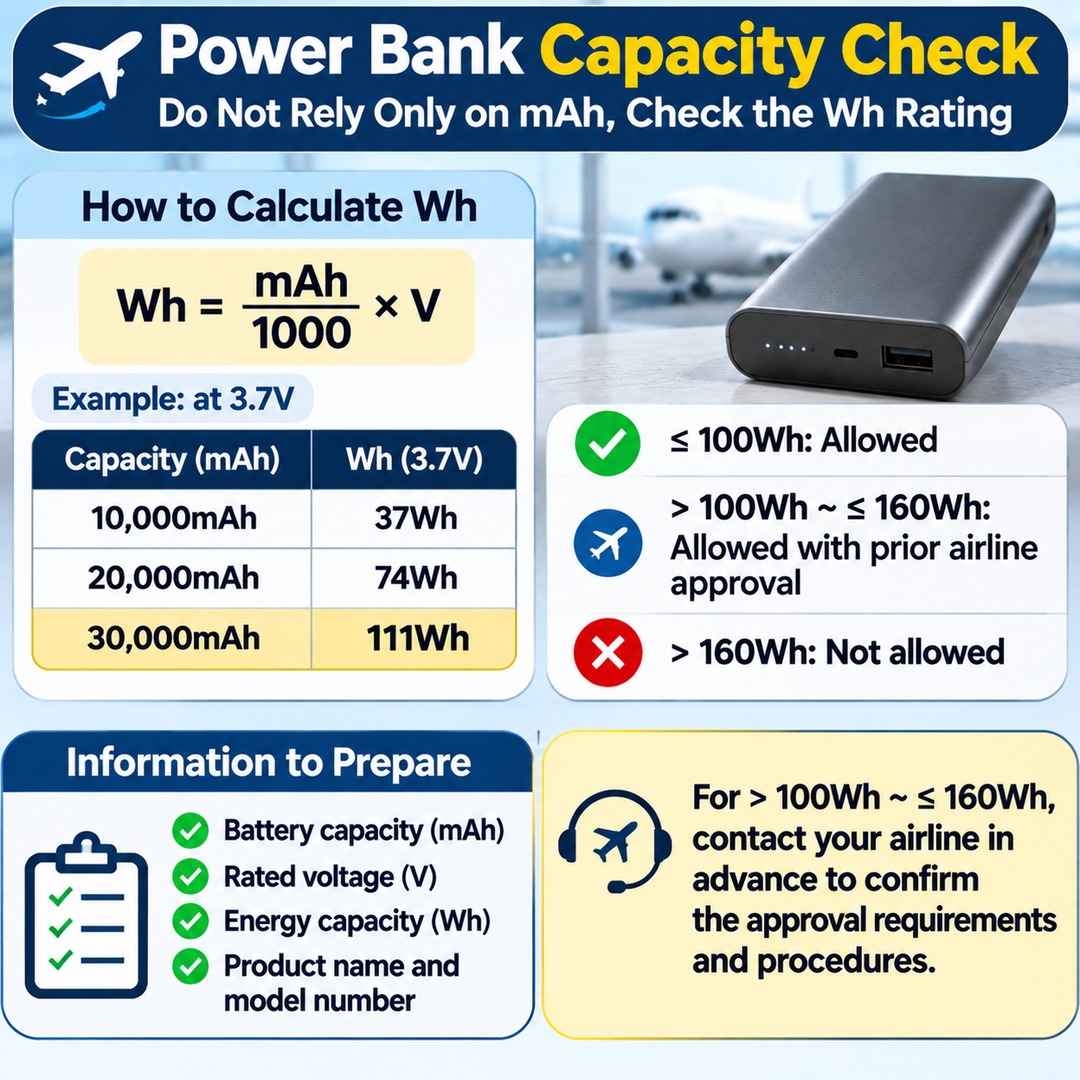
Do not rely solely on the mAh rating printed on the product. Check its Wh (watt-hour) rating as well. Wh indicates the amount of energy stored in a battery and can be calculated using its voltage and capacity.
The calculation is:
\[
Wh = \frac{mAh}{1000} \times V
\]
Assuming a battery voltage of 3.7V, the results are as follows.
| Product capacity | Calculated energy | Carry-on requirements |
|---|---|---|
| 10,000mAh | 37Wh | Permitted |
| 20,000mAh | 74Wh | Permitted |
| 30,000mAh | 111Wh | Airline approval required |
| 40,000mAh | 148Wh | Airline approval required |
| 50,000mAh | 185Wh | Not permitted for transport |
*Author's calculations. These are illustrative examples assuming 3.7V. Always give priority to the voltage and Wh rating printed on the actual product.*
The important point is that a 30,000mAh power bank is not automatically prohibited. At 3.7V, it has a capacity of 111Wh, which falls below the 160Wh maximum. However, prior airline approval is required.
Conversely, a product may be refused if its capacity is not marked or its voltage cannot be verified.
How Do You Get Airline Approval?
For power banks exceeding 100Wh but not exceeding 160Wh, it is safer to contact your airline before arriving at the airport rather than attempting to bring the product onboard without prior approval.
Prepare the following information printed on the product:
Battery capacity (mAh)
Rated voltage (V)
Energy capacity (Wh)
Product name and model number
You should confirm the approval requirements and procedures directly with the airline operating your flight. For codeshare flights and international departures, it is also advisable to check any additional restrictions imposed by the departure airport and operating carrier.
Can You Charge Your Phone Using a Power Bank During a Flight?
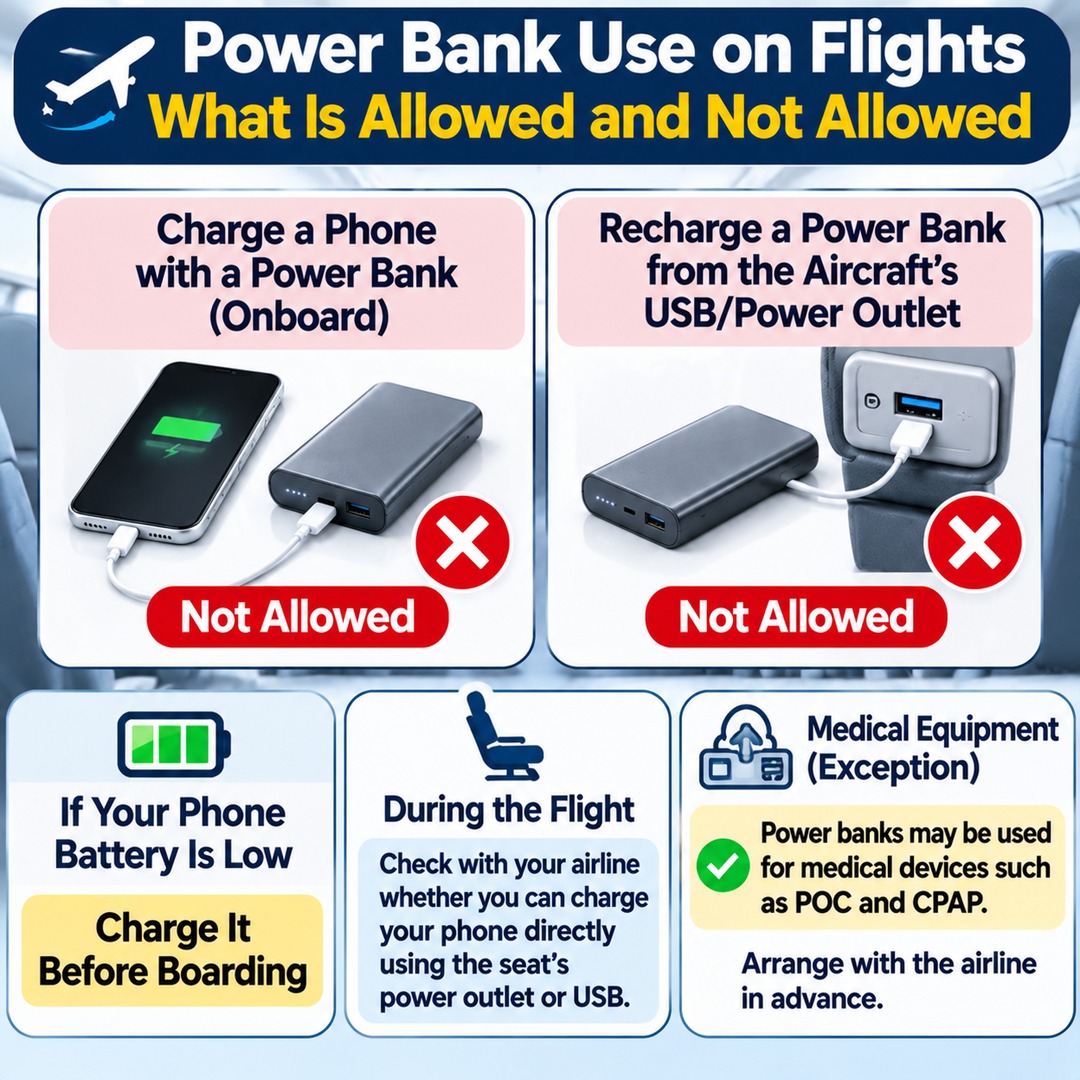
Ordinary passengers are not permitted to charge smartphones using power banks during a flight. Charging the power bank itself is also prohibited.
There are two separate activities to distinguish:
Connecting a smartphone to a power bank with a cable to charge the phone.
Connecting a power bank to a USB port or charging outlet in an aircraft seat to recharge the power bank itself.
Neither activity is permitted under the general onboard usage rules.
If your phone battery is running low, charge it before boarding. During the flight, you can check whether the airline permits you to use the aircraft's seat power outlets or USB charging ports to charge the phone directly.
There is a separate exception involving medical equipment. Korean Air provides specific guidance permitting power bank use for medical purposes involving devices such as POC and CPAP equipment. This does not mean that ordinary smartphone charging is also exempt. Passengers using medical devices should always make arrangements with the airline in advance.
Why Power Banks Cannot Go in Checked Baggage and Where to Store Them Onboard
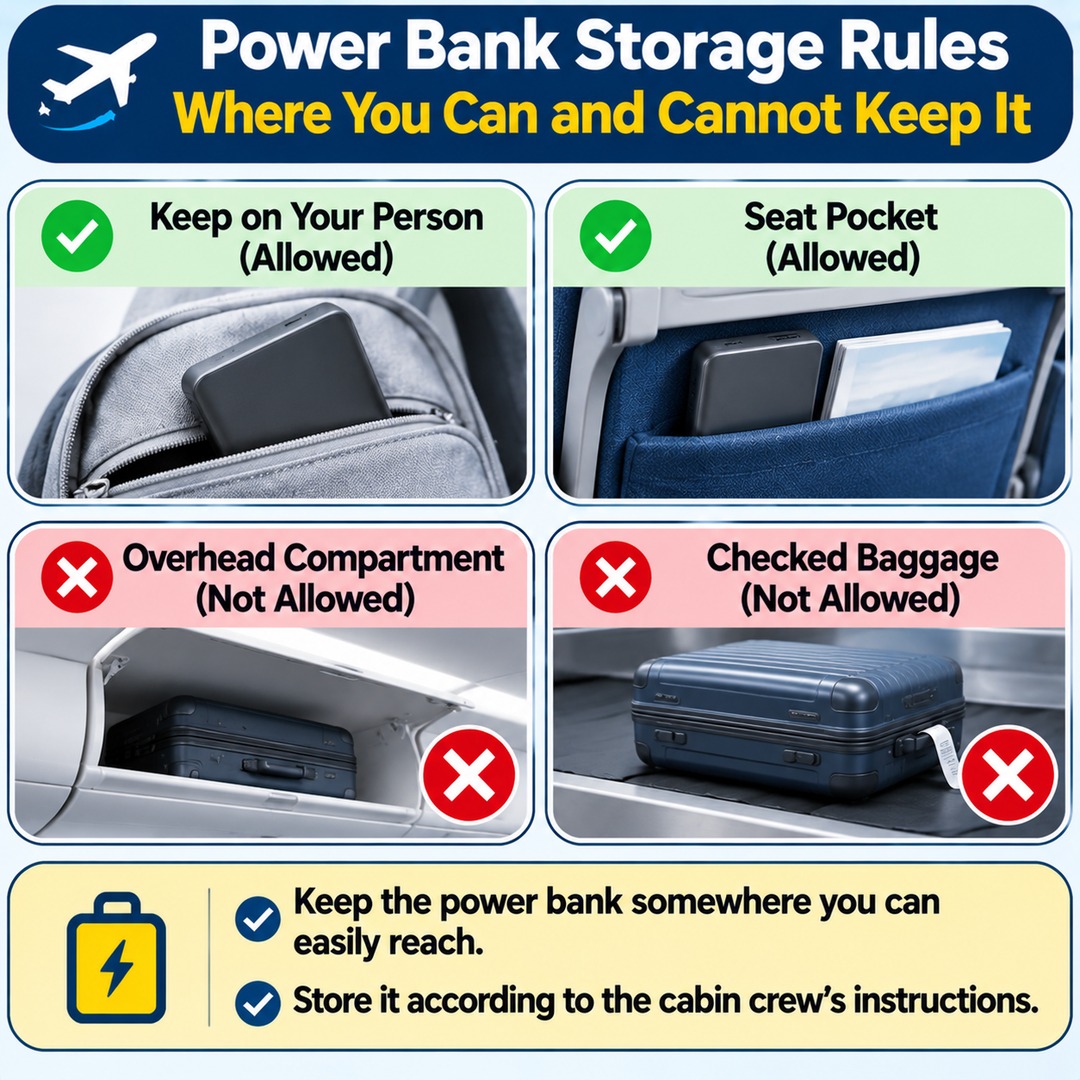
Power banks cannot be transported in checked baggage, including suitcases placed in the aircraft's cargo hold. They must be carried into the cabin.
However, this does not mean you can put them in the overhead baggage compartment. Even inside the cabin, power banks must be kept on your person or stored in the seat pocket in front of you.
The permitted and prohibited storage locations are as follows.
On your person
Permitted
Keep the power bank somewhere you can easily reach.
Front seat pocket
Permitted
Store it according to the cabin crew's instructions.
Overhead compartment
Prohibited
Do not place power banks in the overhead compartment.
Checked suitcase
Prohibited
Do not put power banks in checked baggage.
These rules distinguish between simply carrying a power bank and keeping it in a location where you can respond appropriately if an emergency occurs.
How Can You Prevent Power Bank Short Circuits?
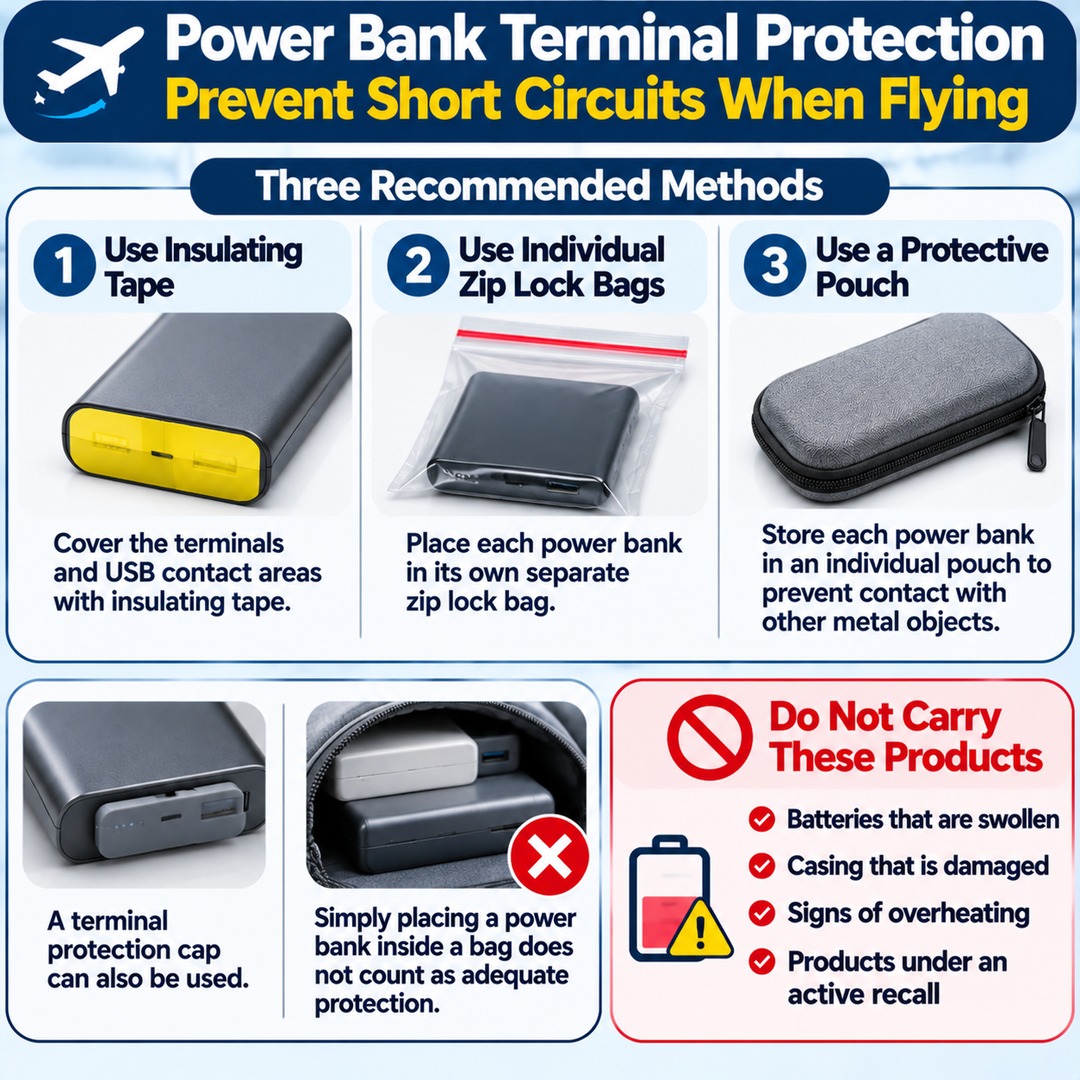
Power banks carried onboard must be protected against short circuits caused by their terminals coming into contact with metal objects. Avoid putting multiple power banks together in a pocket without any protection.
Three commonly accepted methods are available.
1. Apply insulating tape
Protect the terminals and USB contact areas with insulating tape.
2. Use individual zip-lock bags
Place each power bank in its own separate zip-lock bag.
3. Use protective pouches
Store each power bank in an individual pouch to prevent contact with other metal objects.
If the product comes with a terminal protection cap, you can use that as well. Simply placing a power bank inside a bag does not count as taking adequate precautions against short circuits.
Products with swollen batteries, damaged casings, signs of overheating, or active product recalls may be refused for carriage. It is best not to carry such products even if you apply the recommended storage precautions.
Airline-Specific Differences to Check Before Departure
Although the basic carriage requirements may be similar, actual transport procedures can vary depending on the airline and departure country.
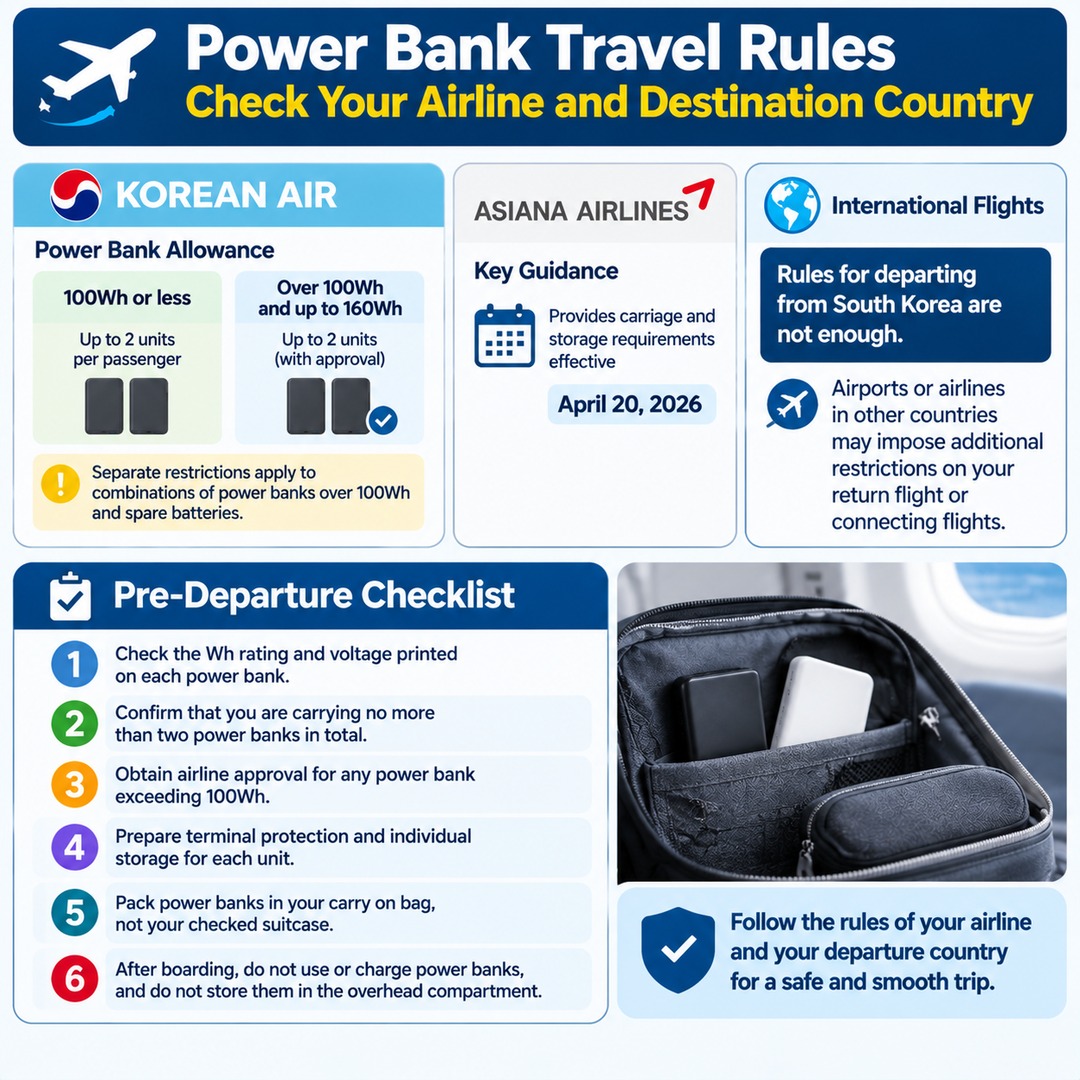
Korean Air specifies an allowance of two power banks rated at 100Wh or less per passenger, or two units rated over 100Wh and up to 160Wh with approval. It also imposes separate restrictions on combinations of power banks exceeding 100Wh and spare batteries.
Asiana Airlines also provides guidance on the carriage and storage requirements effective April 20, 2026.
For international flights, checking only the rules that apply when departing from South Korea is not sufficient. Airports or airlines in other countries may impose additional restrictions on your return flight or connecting flights.
Before departure, follow this checklist:
1. Check the Wh rating and voltage printed on each power bank.
2. Confirm that you are carrying no more than two power banks in total.
3. Obtain airline approval for any power bank exceeding 100Wh.
4. Prepare terminal protection and individual storage for each unit.
5. Pack power banks in your carry-on bag, not your checked suitcase.
6. After boarding, do not use or charge power banks, and do not store them in the overhead compartment.
Frequently Asked Questions
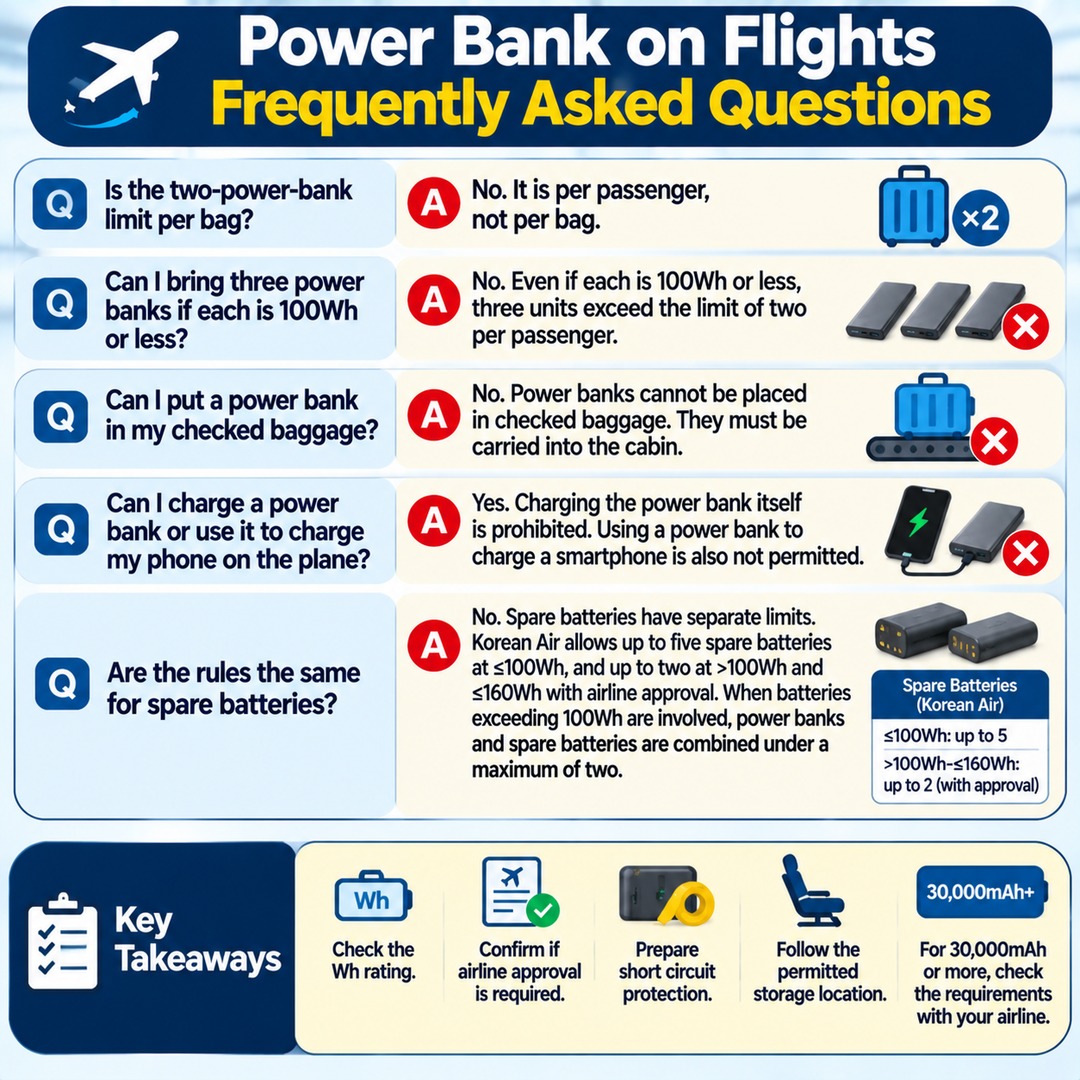
Can I bring four power banks if I put two in each of two different bags?
No. The maximum of two applies per passenger, not per bag.
Can I bring three 10,000mAh power banks?
No. Even if each individual product is rated at 100Wh or less, three units exceed the general limit of two power banks per passenger.
Can I put a power bank in my checked suitcase?
No. Power banks cannot be placed in checked baggage. They must be carried directly into the cabin.
Is charging a power bank during a flight also prohibited?
Yes. Charging the power bank itself is prohibited. Using a power bank to charge a smartphone is also not permitted.
Do power banks and spare batteries have the same quantity limits?
No. Spare batteries are subject to separate quantity limits. Under Korean Air's guidance, spare batteries rated at 100Wh or less are limited to five per passenger, while units exceeding 100Wh and up to 160Wh are limited to two with airline approval. However, when batteries exceeding 100Wh are involved, power banks and spare batteries are combined under a maximum allowance of two.
Rather than remembering only the two-power-bank limit, make sure you also check the Wh rating printed on each product, whether airline approval is required, short-circuit protection, and the permitted storage location. In particular, power banks rated at 30,000mAh or more may require approval depending on their voltage, so confirming the requirements with your airline before departure is the safest approach.