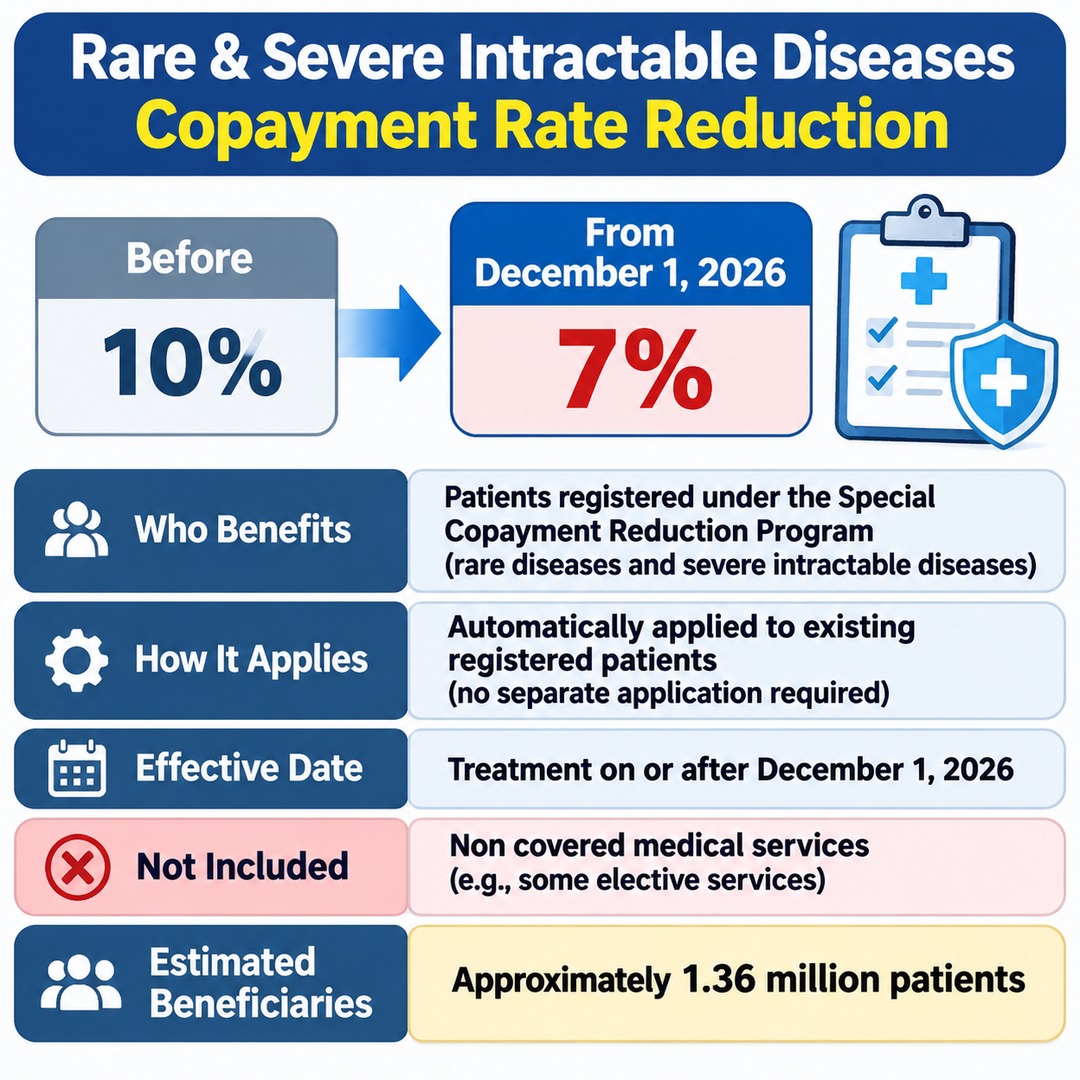

Patients registered under South Korea's Special Copayment Reduction Program for rare and severe intractable diseases will see their health insurance copayment rate for covered medical services decrease from 10% to 7% for treatment received on or after December 1, 2026. Existing registered patients will receive the reduced rate automatically without submitting a separate application. However, non-covered medical services and inpatient meal costs are excluded from this reduction.
The change follows an amendment to the Enforcement Decree of the National Health Insurance Act, approved at a Cabinet meeting on November 24, 2026. Approximately 1.36 million patients registered under the program for rare and severe intractable diseases are eligible for the measure.
Rather than requiring patients to submit new applications, the change adjusts the copayment rate based on their existing special program registration. The important consideration is not simply whether treatment takes place after December 1, but whether the treatment is related to the disease covered by the patient's registration.
Who Qualifies for the 7% Copayment Rate Starting December 1?
The reduction applies to patients registered under South Korea's National Health Insurance Special Copayment Reduction Program for rare diseases and severe intractable diseases. When they receive treatment for their registered conditions, their copayment for National Health Insurance-covered medical services will decrease from 10% to 7%.
The Special Copayment Reduction Program is a South Korean health insurance scheme that lowers patients' out-of-pocket expenses for certain medical conditions that can involve substantial treatment costs. Patients registered with rare or severe intractable diseases will benefit from the reduced rate under this change.
| Category | Previous Rate | From December 1, 2026 |
|---|---|---|
| Covered medical services for rare and severe intractable diseases | 10% | 7% |
| Reduction in copayment rate | - | 3 percentage points |
| Eligible patients | Patients registered under the special program | Unchanged |
| Effective date | Previous rules | Treatment received on or after December 1 |
Approximately 1.36 million patients are expected to benefit from this measure. However, it does not automatically apply to everyone suspected of having a rare disease or everyone who has received a diagnosis. Patients must check whether they are registered under the special program and whether their treatment is related to the registered condition.
Do Existing Registered Patients Need to Apply Again?
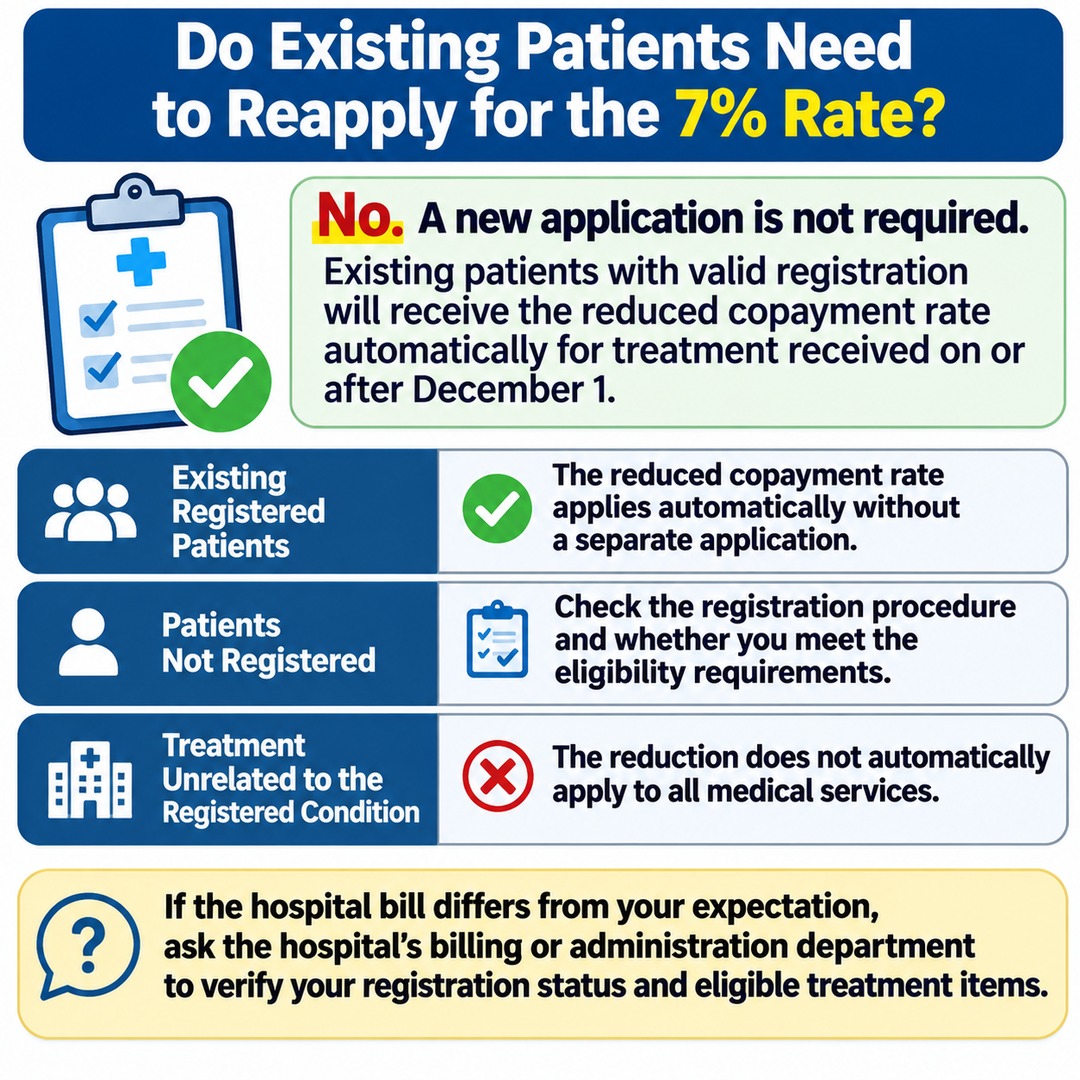
No. A new application is not required. Patients with valid registration under the Special Copayment Reduction Program for rare or severe intractable diseases will receive the reduced copayment rate automatically for treatment received on or after December 1, without submitting a separate application.
Therefore, patients who have already completed their registration and are receiving treatment do not need to submit another application just to qualify for the 7% rate.
However, the following situations should be distinguished:
Existing patients with valid registration: The reduced copayment rate applies automatically without a separate application.
Patients not registered under the special program: They must check the registration procedure and whether they meet the eligibility requirements.
Treatment unrelated to the registered condition: The reduction does not automatically apply to all medical services.
If the amount shown on a hospital bill differs from expectations, patients should ask the hospital's billing or administration department to verify their special program registration status and whether the relevant treatment items qualify.
How Much Will Actual Hospital Bills Decrease?
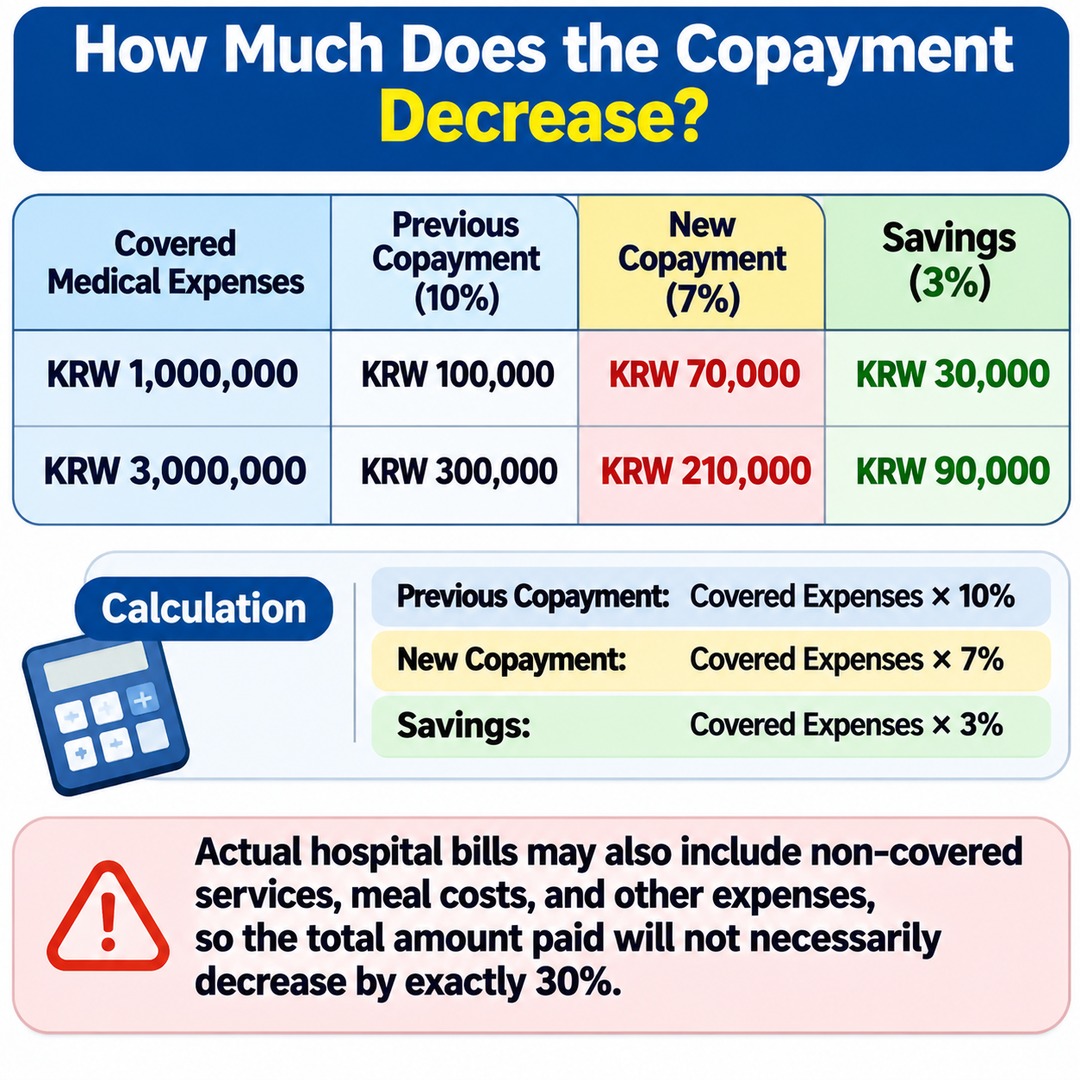
If covered medical expenses total KRW 1 million, the patient's copayment will decrease from KRW 100,000 at the previous 10% rate to KRW 70,000 at the new 7% rate. This represents a reduction of KRW 30,000 for the same amount of covered treatment.
Illustrative calculation — assuming KRW 1 million in National Health Insurance-covered medical expenses:
| Item | Previous Rate: 10% | New Rate: 7% |
|---|---|---|
| Covered medical expenses | KRW 1,000,000 | KRW 1,000,000 |
| Patient copayment | KRW 100,000 | KRW 70,000 |
| Reduction in patient payment | - | KRW 30,000 |
If covered medical expenses total KRW 3 million, the previous copayment would be KRW 300,000, compared with KRW 210,000 under the new rate. In this case, the patient saves KRW 90,000.
The calculation is straightforward:
Previous copayment: Covered medical expenses × 10%
New copayment: Covered medical expenses × 7%
Savings: Covered medical expenses × 3%
Actual hospital bills may also include non-covered services, meal costs, and other expenses in addition to covered medical services. Therefore, the total amount paid at the hospital will not necessarily decrease by exactly 30%.
Will Non-Covered Services and Inpatient Meals Also Be Charged at 7%?
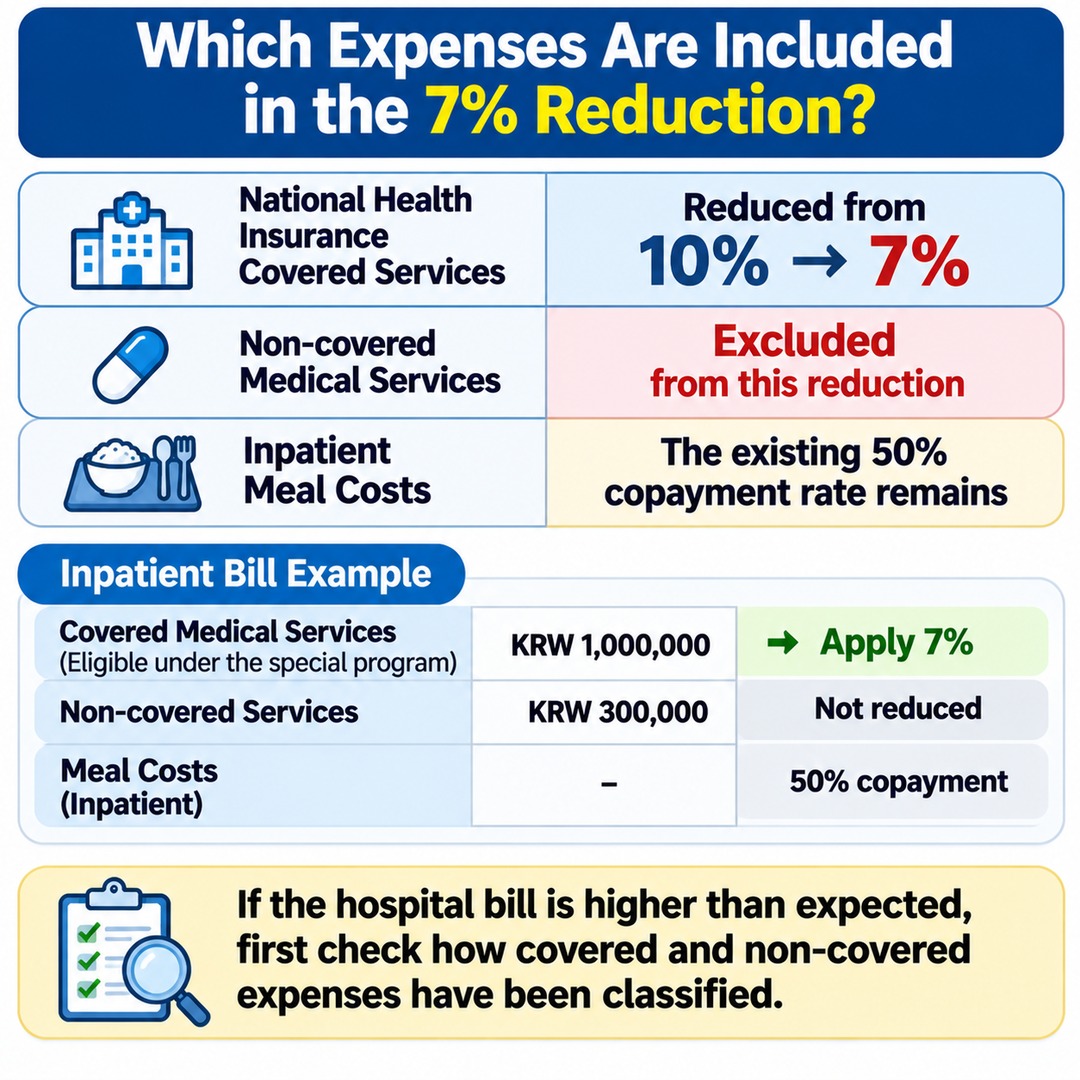
No. The reduction applies to National Health Insurance-covered medical services for conditions eligible under the special program. Non-covered medical services and inpatient meal costs remain subject to their existing rules.
In particular, hospitalized patients should not calculate their entire medical bill using a single copayment rate.
National Health Insurance-covered medical services: Reduced from 10% to 7%.
Non-covered medical services: Excluded from this reduction.
Inpatient meal costs: The existing 50% patient copayment rate remains in effect.
For example, suppose an inpatient bill includes KRW 1 million in covered medical services eligible for the special program, KRW 300,000 in non-covered services, and separately charged meal costs. Only the KRW 1 million in eligible covered medical services receives the 7% rate. The remaining expenses are calculated under the rules applicable to each category.
Therefore, if a hospital bill is higher than expected, the first step is to check how covered and non-covered expenses have been classified.
Will the Copayment Rate Fall Further to 5% in 2028?
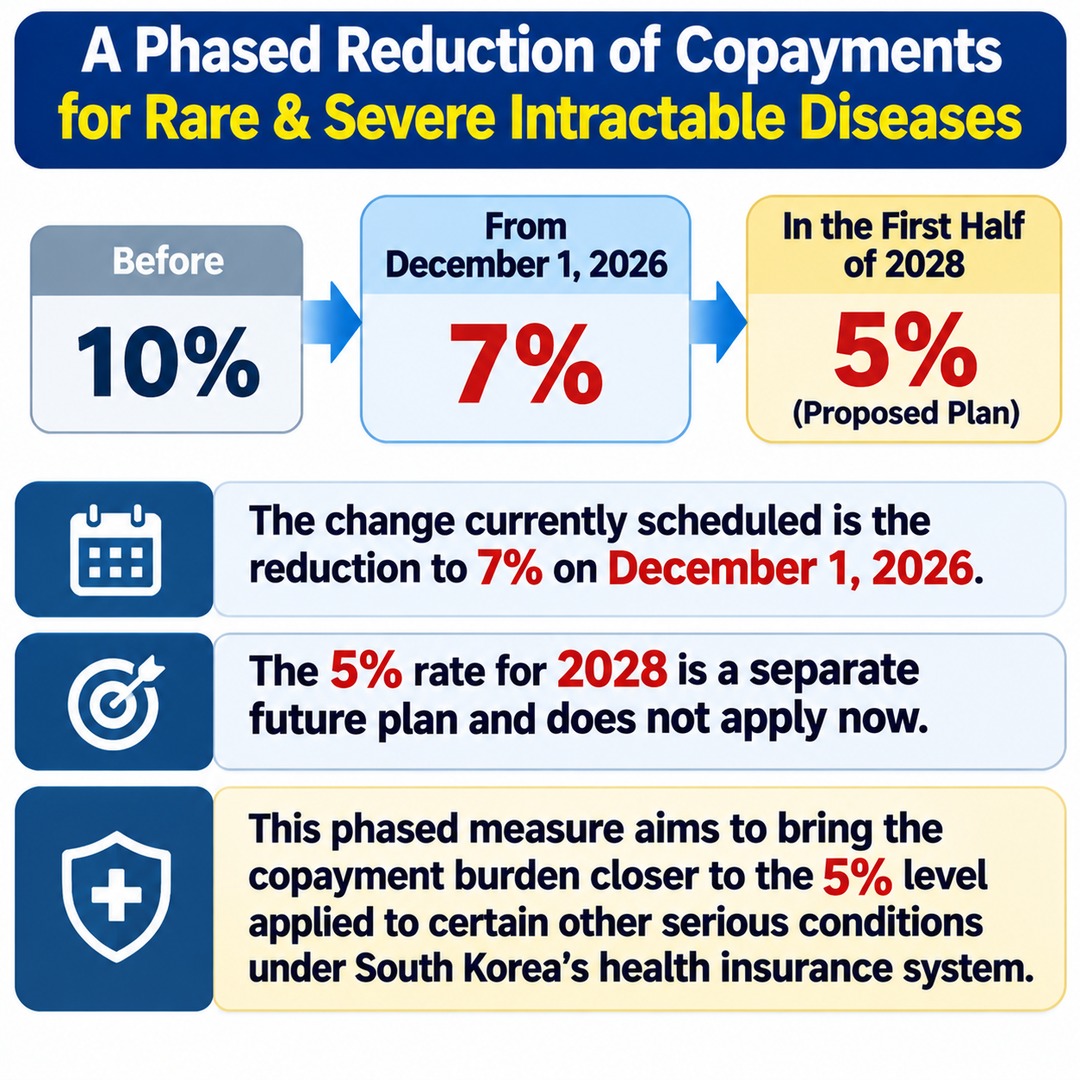
The South Korean government has announced plans to further reduce the copayment rate to 5% in the first half of 2028, following the current reduction to 7%.
However, the change currently scheduled to take effect is the reduction to 7% on December 1, 2026. The proposed 5% rate for 2028 should be treated as a separate future plan. It does not mean that the 5% rate applies now.
This measure is part of a phased improvement intended to bring the copayment burden for patients with rare and severe intractable diseases closer to the 5% level applied to certain other serious medical conditions under South Korea's health insurance system.
What Should Patients Check Before Their First Appointment in December?
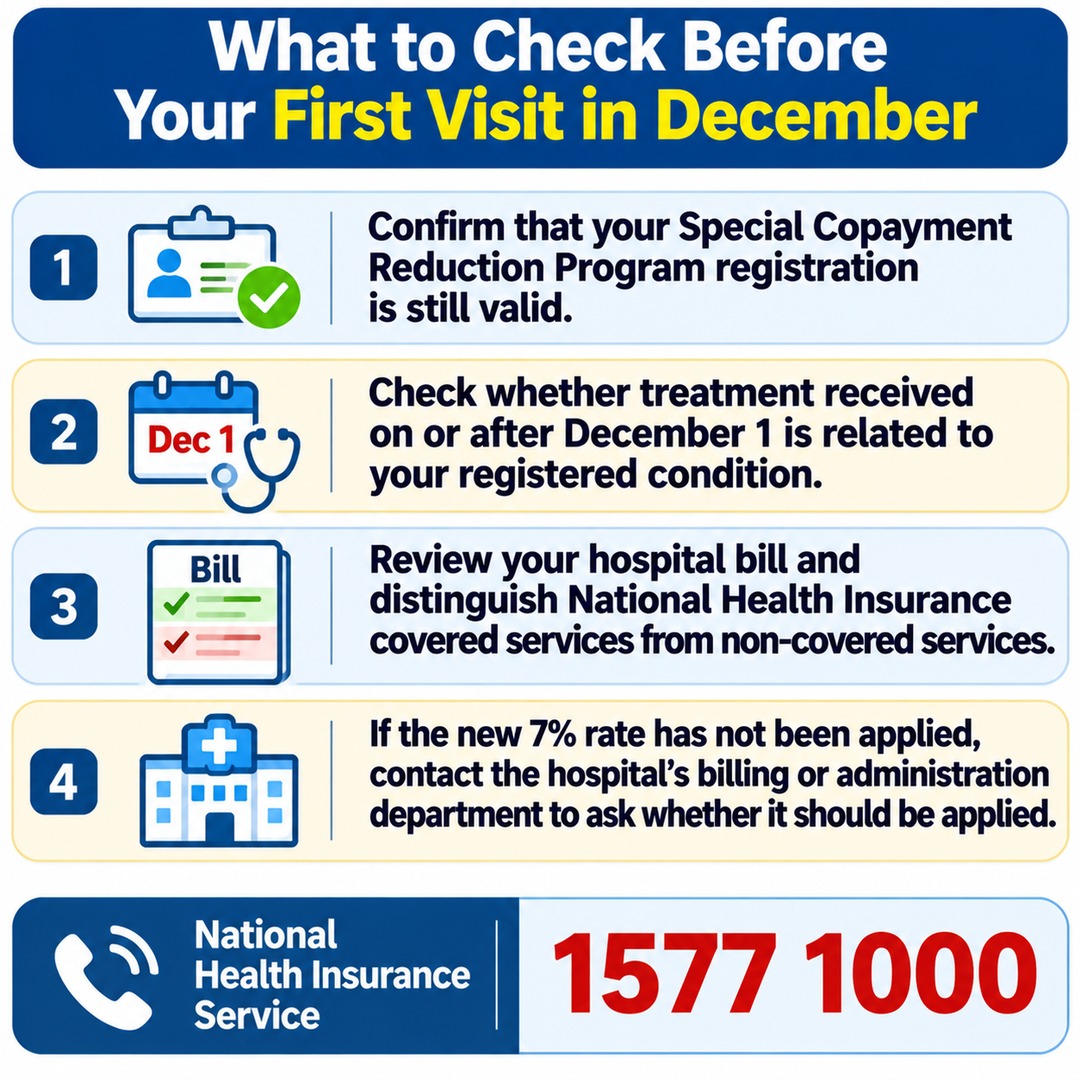
For patients already registered under the Special Copayment Reduction Program, checking their registration status and the medical expenses eligible for the reduced rate is more important than submitting a new application.
1. Confirm that your Special Copayment Reduction Program registration is still valid.
2. Check whether treatment received on or after December 1 is related to your registered condition.
3. Review your hospital bill and distinguish National Health Insurance-covered services from non-covered services.
4. If the new 7% rate has not been applied, contact the hospital's billing or administration department to ask whether the treatment qualifies.
If you need further assistance checking your eligibility or registration status, you can contact the National Health Insurance Service of South Korea at 1577-1000.
Because the reduction also applies automatically to existing registered patients, there is no need to worry about submitting another application solely to receive the new rate. Instead, check which items on your actual hospital bill are calculated at 7% for treatment received on or after December 1.