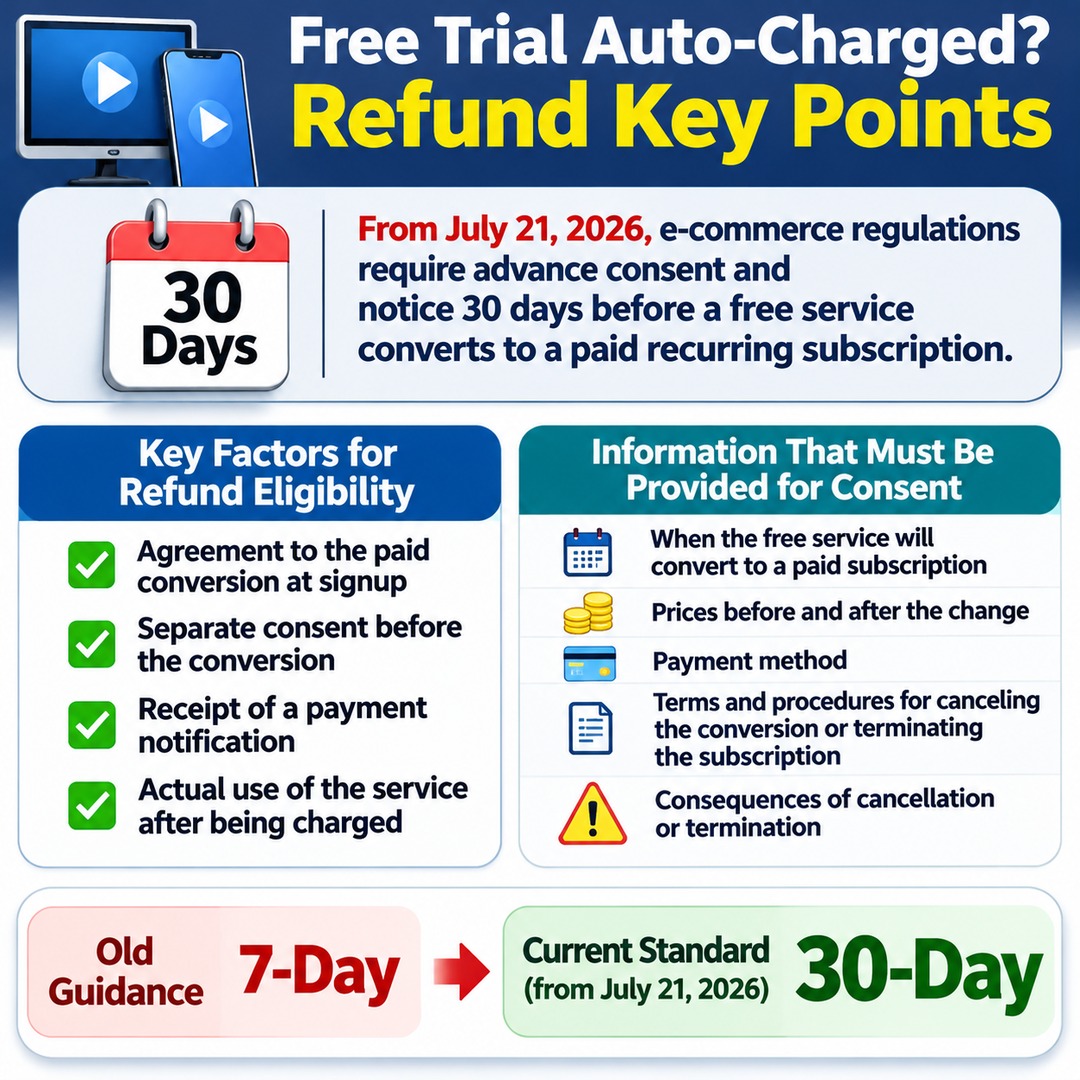

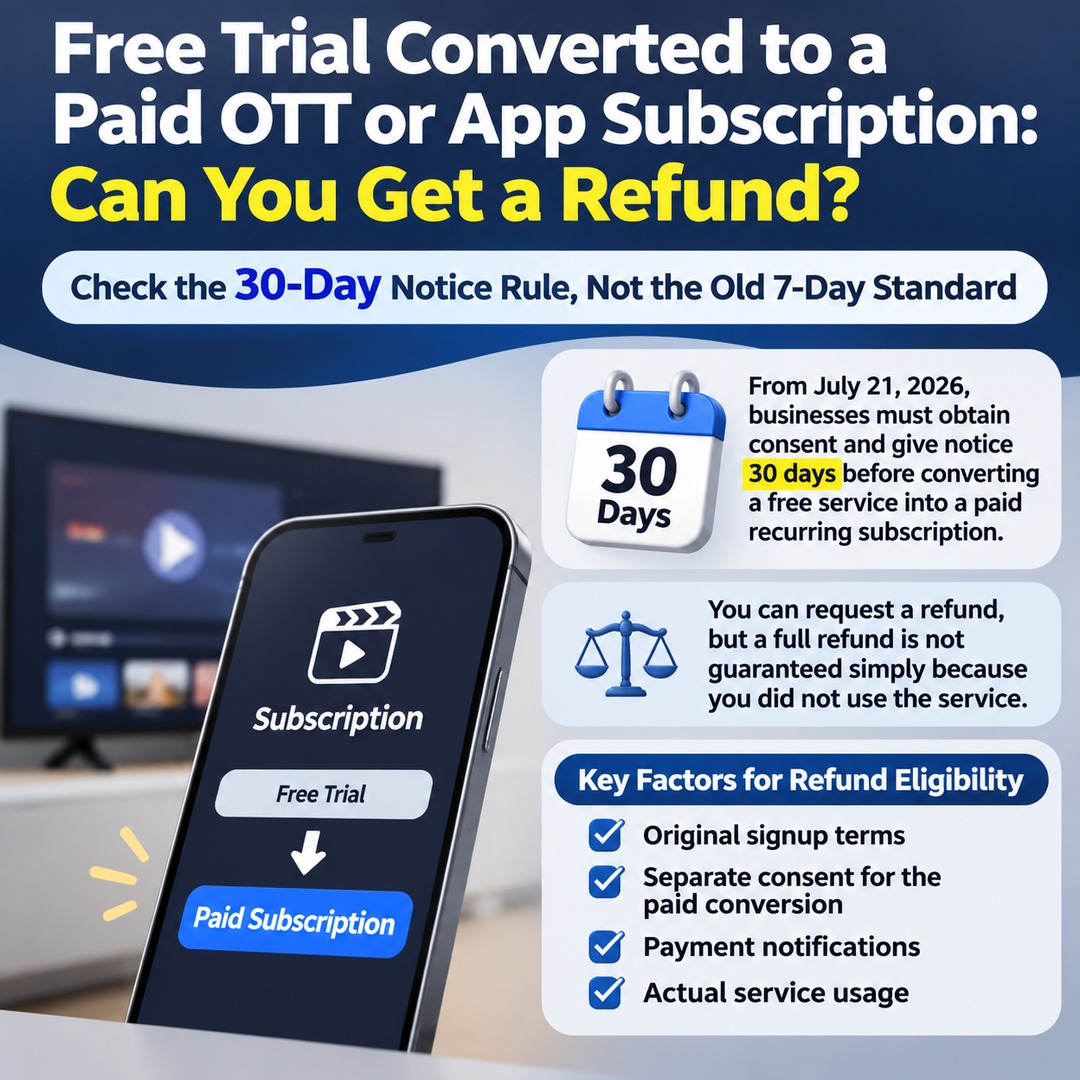
If an OTT platform or paid app automatically charges you after a free trial ends, you can request a refund. However, a full refund is not guaranteed simply because you did not use the service. In particular, the e-commerce regulations that took effect on July 21, 2026, establish a 30-day period for advance consent and notification before a free service converts into a paid recurring subscription. This must be distinguished from the previously cited 7-day period.
Important factors in determining refund eligibility include whether you agreed to the paid conversion when signing up for the free trial, whether the business obtained separate consent before the conversion, whether you actually received a payment notification, and whether you used the service after being charged.
Why Should You Check the 30-Day Rule Instead of the Old 7-Day Rule for Free-Trial Auto-Renewals?
Article 20-2 of the Enforcement Decree of South Korea's Act on the Consumer Protection in Electronic Commerce, which took effect on July 21, 2026, establishes a 30-day advance consent and notification period when recurring subscription prices increase or a free service changes into a paid recurring subscription.
The important question is not simply whether the business sent a notification once.
Under Article 13(6) of South Korea's Act on the Consumer Protection in Electronic Commerce, businesses must obtain consumer consent and provide information about the following:
When the free service will convert into a paid recurring subscription
The prices before and after the change
The payment method
The terms and procedures for canceling the paid conversion or terminating the subscription
The consequences of cancellation or termination
In particular, even if you agreed when signing up for a free trial that the service could later become paid, that initial agreement does not necessarily replace all separate consent procedures required for the subsequent paid conversion.
Do not confuse the old 7-day notice explanation with the current 30-day standard.
Some OTT-related guidance in Korea's Easy-to-Find Practical Legal Information service still refers to notification seven days in advance. However, the legislation effective July 21, 2026, specifies a 30-day standard. Therefore, when assessing transactions subject to the rules after July 21, 2026, you should consult the legislation currently in force.
If You Agreed When Signing Up for a Free Trial, Is the Automatic Charge Always Valid?
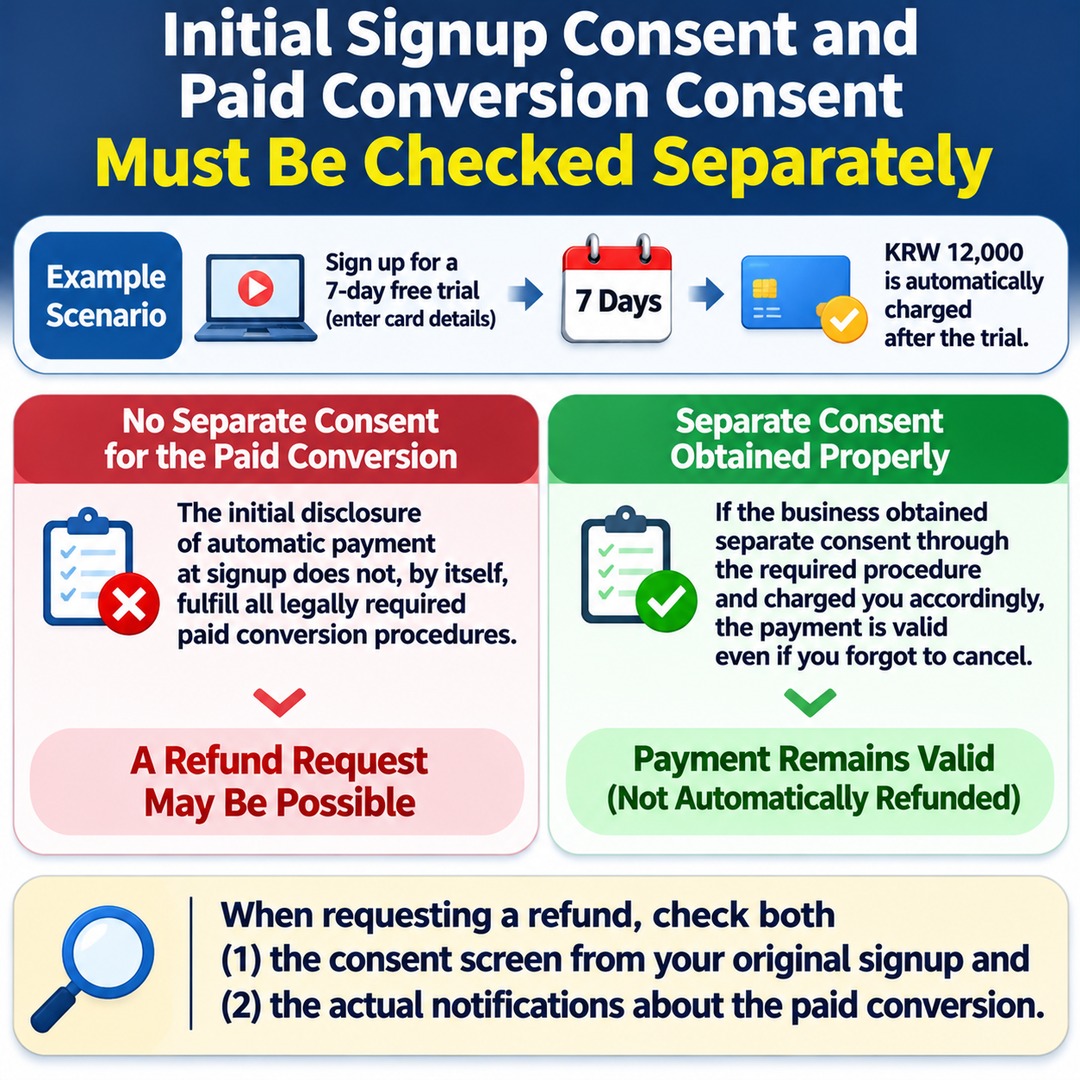
No. Your initial signup consent and your consent to the paid conversion after the free trial ends must be examined separately.
Consider the following example:
You sign up for a 7-day free trial and enter your card details.
The signup screen states that you will be charged KRW 12,000 per month after the free trial ends.
The business does not obtain separate consent before converting the subscription to a paid plan.
After the free trial ends, KRW 12,000 is automatically charged to your card.
In this situation, the fact that the business disclosed the possibility of automatic payment on the original signup screen does not, by itself, establish that it fulfilled all the paid-conversion procedures required under current law.
The Korea Fair Trade Commission's explanations concerning dark patterns also distinguish between the initial contract and separate consent for a paid conversion.
Conversely, if the business obtained separate consent through the legally required procedure and charged you accordingly, the payment does not become invalid simply because you forgot to cancel the free trial.
Therefore, when requesting a refund, check both the consent screen from your original signup and the actual notifications concerning the paid conversion.
Can You Get a Full Refund If You Never Used the Service?
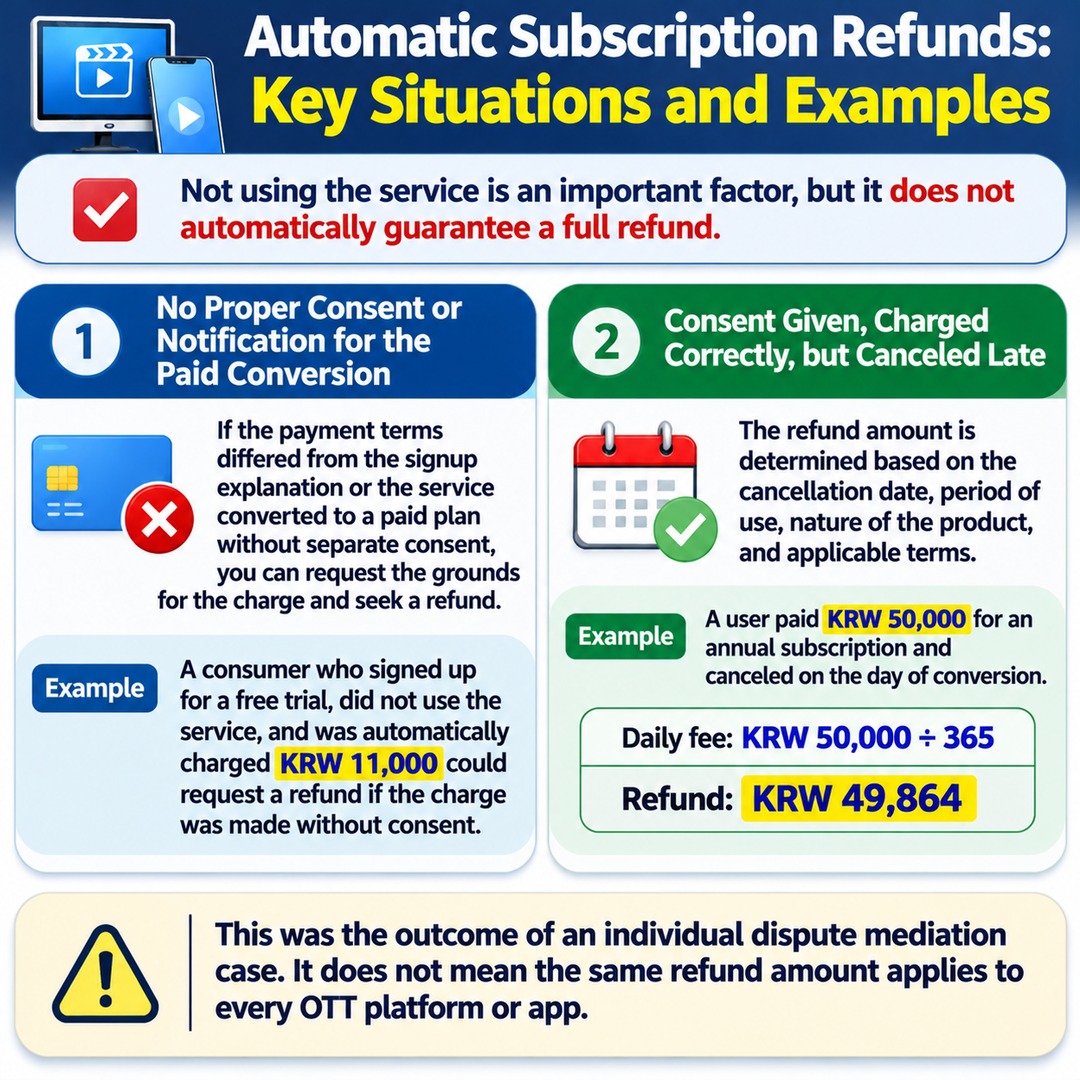
Non-use is an important consideration when requesting a refund, but it does not automatically guarantee a full refund.
The amount refunded for a recurring subscription may vary depending on the contract type and the date of cancellation. In particular, for content contracts involving continuous use for one month or longer, you should also consider the applicable consumer dispute resolution standards concerning charges up to the cancellation date and fees for the remaining subscription period.
The following two situations must be distinguished.
1. Required consent or notification for the paid conversion was not properly obtained or provided
If the actual payment terms differed from what was explained at signup, or the service converted to a paid subscription without separate consent, you can request the grounds for the charge and seek a refund.
In one consultation example provided by Korea's Content Dispute Resolution Committee, a consumer who had signed up for a free trial but had not used the service was automatically charged KRW 11,000. The guidance explained that the consumer could request a refund if the amount had been charged without their consent.
2. You consented to the paid conversion and were charged correctly, but canceled late
In this case, the refund amount is determined based on the cancellation date, period of use, nature of the product, and applicable terms and conditions.
In an actual dispute mediation case handled by the Korea Consumer Agency, a user of an app who had paid KRW 50,000 for an annual subscription requested cancellation on the day the paid conversion occurred. The mediation resulted in a refund of KRW 49,864.
The calculation was as follows:
| Item | Amount |
|---|---|
| Annual subscription fee | KRW 50,000 |
| Daily usage fee | Approximately KRW 136 |
| Mediated refund | KRW 49,864 |
The refund was calculated by deducting one day's usage fee, obtained by dividing KRW 50,000 by 365 days.
This was the outcome of an individual dispute mediation case. It does not mean that the same refund amount applies to every OTT platform or app.
Does Canceling Within 7 Days of Payment Change the Refund Conditions?
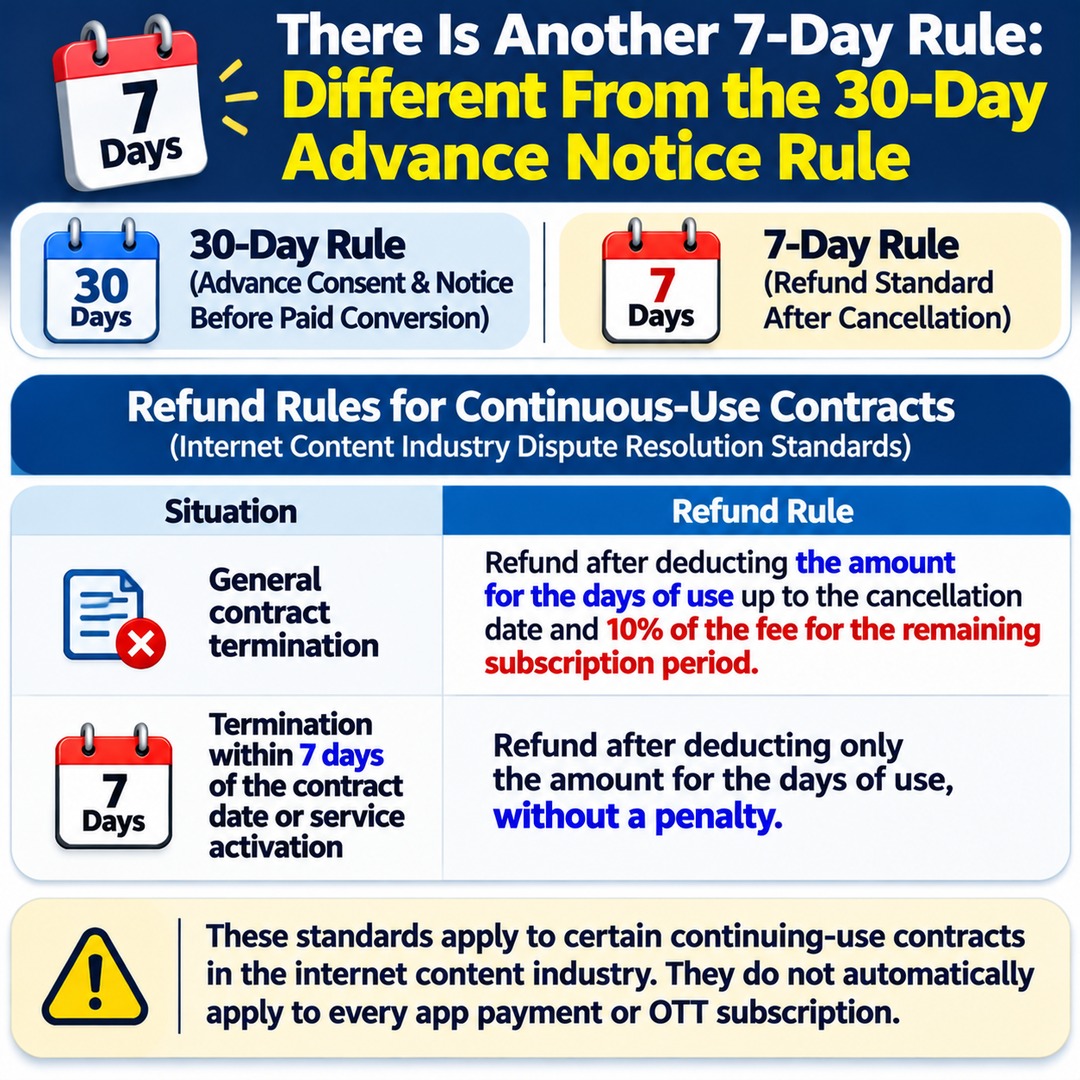
There is another 7-day rule that you need to distinguish here.
The advance consent and notification period before a paid conversion is a separate issue from the standards used to calculate refunds after a service contract is terminated.
South Korea's consumer dispute resolution standards for the internet content industry provide the following refund rules for contracts involving continuous use for one month or longer:
General contract termination: A refund is issued after deducting the amount corresponding to the days of use up to the cancellation date and 10% of the fee for the remaining subscription period.
Termination within 7 days of the contract date or the date the service became available: A refund is issued after deducting only the amount corresponding to the days of use, without a penalty.
Therefore, you should also check whether you requested cancellation within seven days after the paid subscription began.
However, these standards apply to certain continuing-use contracts in the internet content industry. They cannot automatically be applied to every app payment or OTT subscription. You must check the type of contract and the applicable consumer dispute resolution standards.
What Should You Do First to Get a Refund for an Automatic Charge?
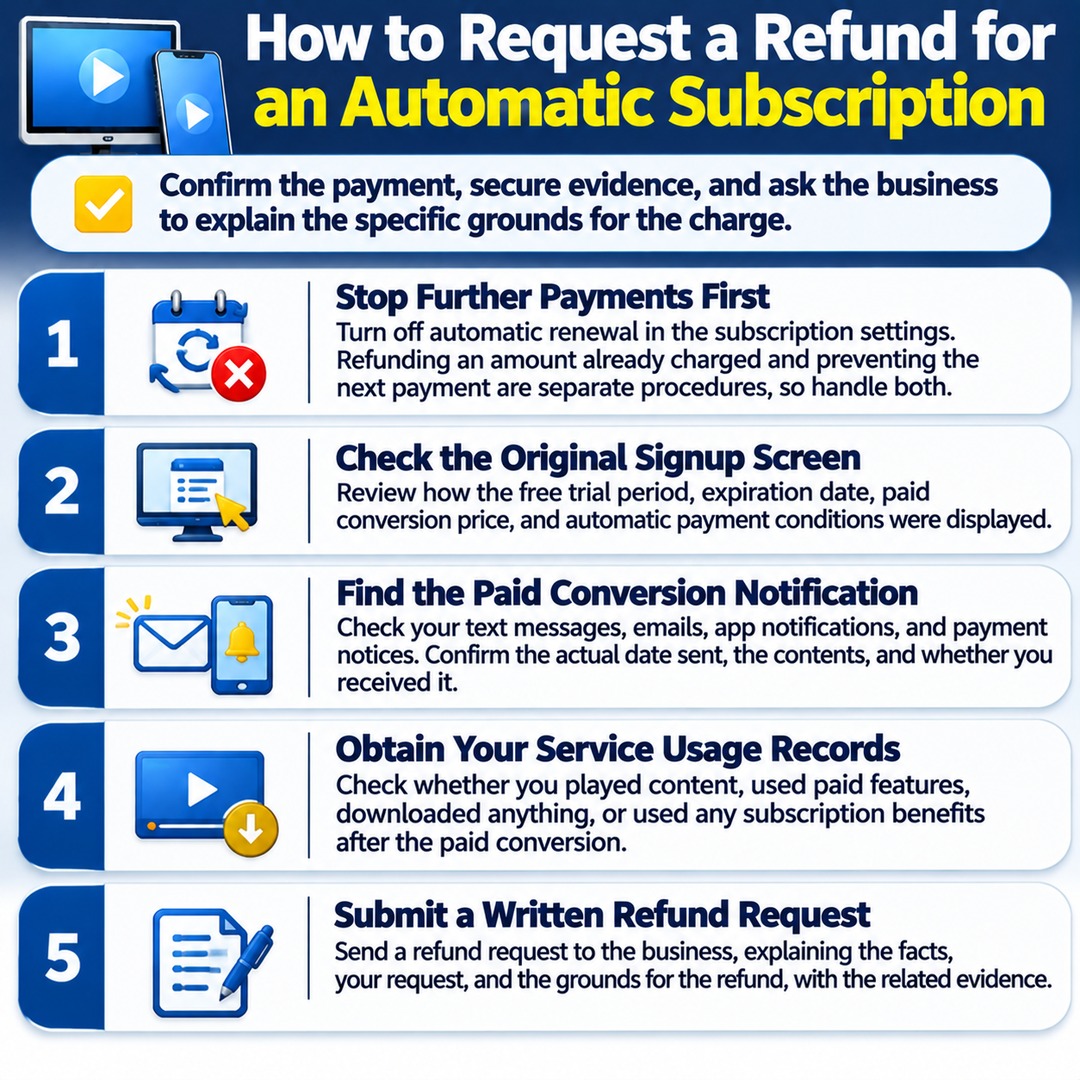
The best approach is to confirm the payment, secure evidence, and then ask the business to explain the specific grounds for the charge.
1. Stop further payments first.
Turn off automatic renewal in the service's subscription management settings. Requesting a refund for an amount already charged and preventing the next payment are separate procedures, so make sure you handle both.
2. Check the original signup screen.
Review how the free-trial period, expiration date, paid-conversion price, and automatic payment conditions were displayed.
3. Find the paid-conversion notification.
Check your text messages, emails, app notifications, and payment notices.
Rather than simply accepting a claim that notification was provided, distinguish between the actual sending date, the contents of the notice, and whether it was received.
4. Obtain your service usage records.
Check whether you played content, used paid features, downloaded anything, or used any subscription benefits after the paid conversion.
5. Submit a written refund request to the business.
You can make your request as follows.