When installing or replacing a gas boiler in South Korea, the requirement to install a carbon monoxide (CO) alarm depends on the boiler's manufacturing date and installation location. Applicable boilers manufactured or imported on or after August 5, 2020, generally require an alarm when installed. However, the requirement does not automatically apply retroactively to every existing boiler in an ordinary home. Separate rules apply to outdoor installations and lodging facilities.
If you are installing a new gas boiler or replacing an existing one with an applicable model manufactured or imported on or after August 5, 2020, a carbon monoxide alarm is required, subject to the relevant effective dates and statutory exemptions. South Korea has established requirements for both city-gas boilers and liquefied petroleum gas (LPG) boilers. The obligation may differ where a legally recognized exemption applies.
A carbon monoxide alarm is a safety device that detects carbon monoxide from leaking gas boiler exhaust and warns occupants of the danger.
Because carbon monoxide is difficult to detect by sight or smell, early detection through an alarm is important.
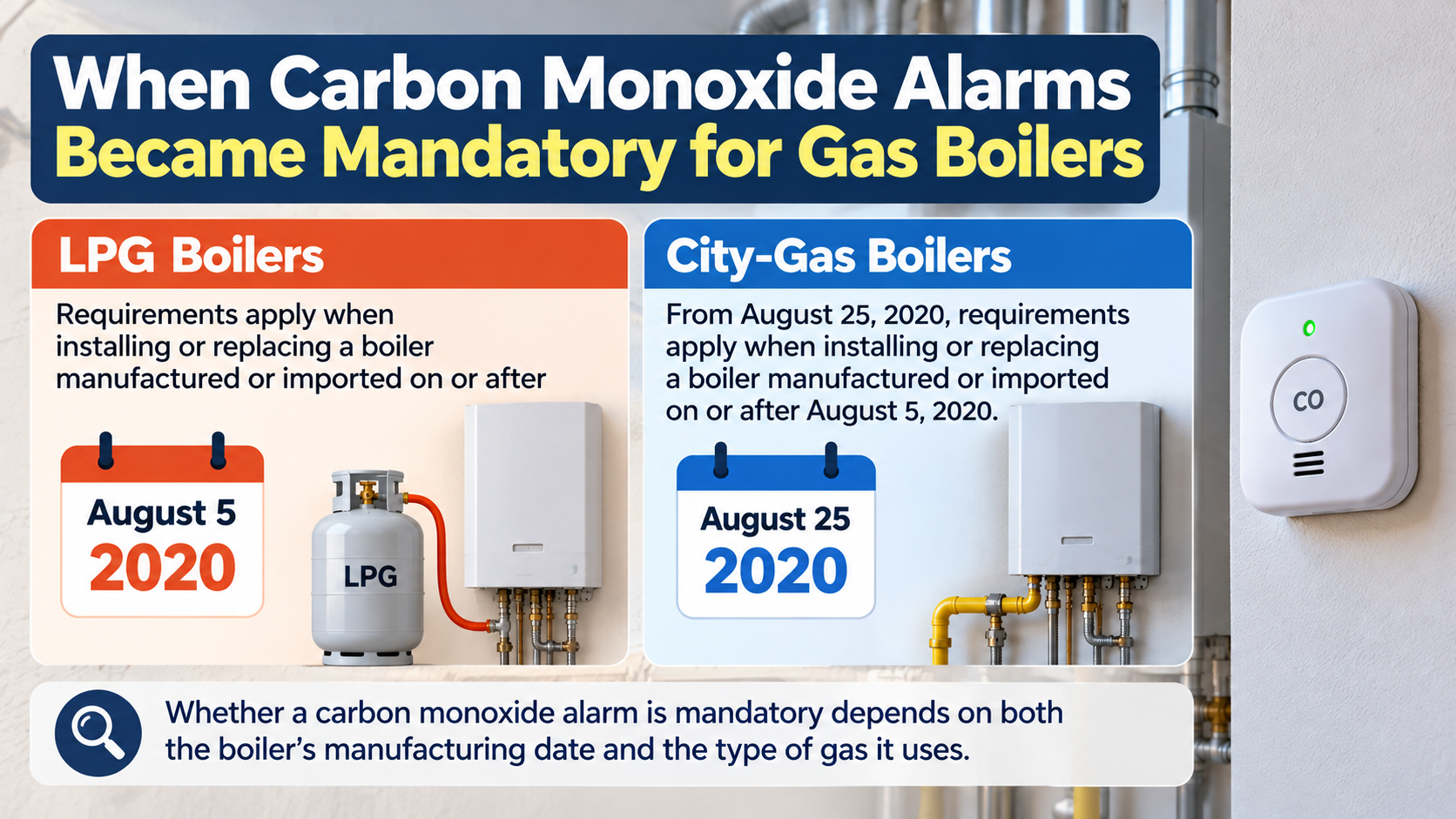
When Did Carbon Monoxide Alarms Become Mandatory for Gas Boilers?
KGS GC208, a South Korean technical standard governing gas boiler installation, specifies different implementation dates depending on the type of fuel.
LPG boilers: The requirements apply when installing or replacing a boiler manufactured or imported on or after August 5, 2020.
City-gas boilers: From August 25, 2020, the requirements apply when installing or replacing a boiler manufactured or imported on or after August 5, 2020.
Therefore, the fact that a boiler is being replaced is not enough to determine whether an alarm is mandatory. You must also check the manufacturing date of the replacement boiler and the type of gas it uses.
Do Existing Gas Boilers Also Require Carbon Monoxide Alarms?
The carbon monoxide alarm requirement does not apply retroactively across the board to existing gas boilers installed in ordinary homes under the previous standards.
The transitional provisions of KGS GC208 recognize boilers installed in accordance with the standards in effect when the revised requirements were introduced as compliant with the amended alarm installation requirements.
However, continuing to use an existing boiler and replacing it with a new boiler are two different situations.
For example, if a boiler installed in 2018 remains in use without replacement, the transitional provisions for existing installations may apply.
By contrast, if that boiler is removed and replaced with an applicable model manufactured on or after August 5, 2020, the requirements governing the new installation must be considered.
In other words, an older building is not automatically exempt from the carbon monoxide alarm requirements that apply to a newly installed boiler.
Even where an alarm is not legally mandatory, the risk of exhaust gas leakage still exists. It is also advisable to inspect the condition of the existing boiler's exhaust connections and verify that its safety devices are operating properly.
Are Outdoor Gas Boiler Installations Exempt?
A carbon monoxide alarm may not be required when a gas boiler is installed outdoors, depending on the applicable South Korean installation standards. However, whether a particular location legally qualifies as an outdoor installation must be determined by examining its actual structure.
The technical standards for city-gas installations specify two exceptions to the carbon monoxide alarm requirement:
1. The gas boiler is installed outdoors.
2. The gas boiler is not classified as a gas appliance subject to the alarm installation requirements under the relevant legislation.
An important distinction is that a space cannot be classified as outdoors solely because it is called a veranda, balcony, or boiler room.
Even if a boiler is located near an exterior wall, the installation conditions must be examined if the surrounding space is enclosed by windows or walls.
When requesting a boiler replacement quotation, it is advisable to ask the installation contractor to confirm both the legal classification of the installation location and whether a carbon monoxide alarm is required.
Do Gas Water Heaters and Gas Boilers Follow the Same Rules?
Gas water heaters and gas-fired hot-water boilers must be distinguished when determining whether the carbon monoxide alarm installation requirement applies.
The gas appliances covered by the relevant boiler alarm provisions include hot-water boilers and multifunction boilers. Separately classified gas water heaters are not covered by those same provisions.
| Appliance type | Carbon monoxide alarm requirement |
|---|---|
| Gas-fired hot-water boiler | Applies depending on manufacturing and installation dates and applicable exemptions |
| Gas-fired multifunction boiler | Classified as a gas appliance covered by the requirements |
| Gas-fired instantaneous water heater | Excluded from the specific alarm installation provisions for boilers |
The exclusion of instantaneous gas water heaters refers specifically to the scope of the carbon monoxide alarm requirement established for boilers.
It does not mean that gas water heaters pose no exhaust gas hazards. Separate safety standards and the manufacturer's installation instructions must still be checked for the relevant appliance.
Even when two appliances look similar, different requirements may apply depending on whether the appliance is a hot-water boiler with a space-heating function or a gas water heater intended to supply hot water.
Are Carbon Monoxide Alarms Mandatory in Hotels, Guesthouses, and Other Lodging Facilities?
Unlike ordinary homes, lodging facilities in South Korea were also subject to carbon monoxide alarm installation requirements for existing gas boilers.
The relevant technical standards established a transitional period requiring carbon monoxide alarms to be installed for existing gas boilers in lodging facilities by August 4, 2021.
This differs from the transitional provisions applicable to existing boilers in ordinary residential properties.
In addition, lodging facilities using individual heating systems for separate guest rooms or buildings must check the carbon monoxide alarm installation requirements applicable inside or near guest rooms.
Therefore, operators of pensions, guesthouses, or other lodging establishments should not assume that an alarm is unnecessary solely because of the boiler's manufacturing date.
The type of lodging business, heating system, and boiler installation location must all be considered. The required alarm location may also vary depending on the layout of the guest rooms and heating equipment.
What Type of Carbon Monoxide Alarm Meets the Legal Requirements?
To satisfy the statutory installation obligation, a carbon monoxide alarm must have passed the relevant product inspection and be installed in an appropriate location.
Not every device capable of measuring carbon monoxide automatically meets the legal requirements for an alarm.
South Korea's gas boiler installation standards require alarms to be positioned near the boiler or in another suitable location where carbon monoxide from an exhaust gas leak can be detected promptly.
When replacing a boiler, it is advisable to check the following:
Whether the alarm has passed the relevant product inspection.
Whether its installation location is appropriate for the configuration of the boiler and exhaust pipe.
Whether the installation meets the conditions specified by the manufacturer.
Whether the alarm has been tested for proper operation after installation.
The precise mounting height and location should be determined according to the product manual and the applicable installation standards.
Installing a carbon monoxide alarm does not eliminate the need to inspect exhaust pipes or maintain adequate ventilation.
It is particularly important not to rely solely on an alarm when heating equipment is used in an enclosed space. Related safety considerations should also be reviewed.
What Should You Check Before Replacing a Gas Boiler?
Before replacing a boiler, check the new appliance's manufacturing date, fuel type, installation location, and whether a carbon monoxide alarm is included.
If an alarm is legally required, you should also confirm that the replacement quotation includes both the alarm and its installation.
Follow these six steps:
1. Identify the boiler type: Determine whether the boiler uses city gas or LPG.
2. Check the manufacturing date: Confirm when the replacement appliance was manufactured or imported.
3. Verify the installation location: Determine whether the boiler is installed indoors or qualifies as an outdoor installation under the applicable legal standards.
4. Identify the facility type: Distinguish between an ordinary residential property and a lodging establishment.
5. Check alarm compliance: Confirm that the alarm has passed the relevant product inspection and that its proposed location meets installation requirements.
6. Inspect the completed installation: Check the alarm's installation condition and verify that it operates properly.
If the replacement quotation does not include a carbon monoxide alarm, ask the contractor whether the installation is legally exempt or whether the alarm was omitted from the quotation.
Frequently Asked Questions
Is a Carbon Monoxide Alarm Required When Replacing a Boiler in an Older Apartment?
If the replacement boiler is covered by the applicable requirements, the alarm installation standards must be checked regardless of when the apartment building was constructed.
The transitional provisions for existing boilers do not automatically extend to newly installed replacement appliances.
Do I Need to Buy a New Alarm if One Is Already Installed?
You must check whether the existing alarm meets the relevant product and installation standards.
The mere presence of an alarm does not establish that it satisfies the applicable requirements.
Is an Alarm Always Unnecessary if the Boiler Is Outside?
No. Although the relevant South Korean regulations provide an exemption for outdoor installations, the actual installation space must qualify as outdoors under the applicable legal standards.
Can the Boiler Purchaser Install the Carbon Monoxide Alarm Personally?
The alarm must be installed in accordance with the applicable gas boiler installation standards and the product manual.
When replacing a boiler, it is advisable to consult a qualified gas installation contractor or the manufacturer's service center to confirm the correct alarm location and proper operation.
Final Checklist Before Signing a Boiler Replacement Contract
If you plan to replace a gas boiler, first confirm the new appliance's manufacturing date and whether carbon monoxide alarm installation is included in the contract.
Distinguishing between transitional provisions for existing boilers, exemptions for outdoor installations, and the separate requirements for lodging facilities will help you determine more accurately which obligations apply to your property in South Korea.