
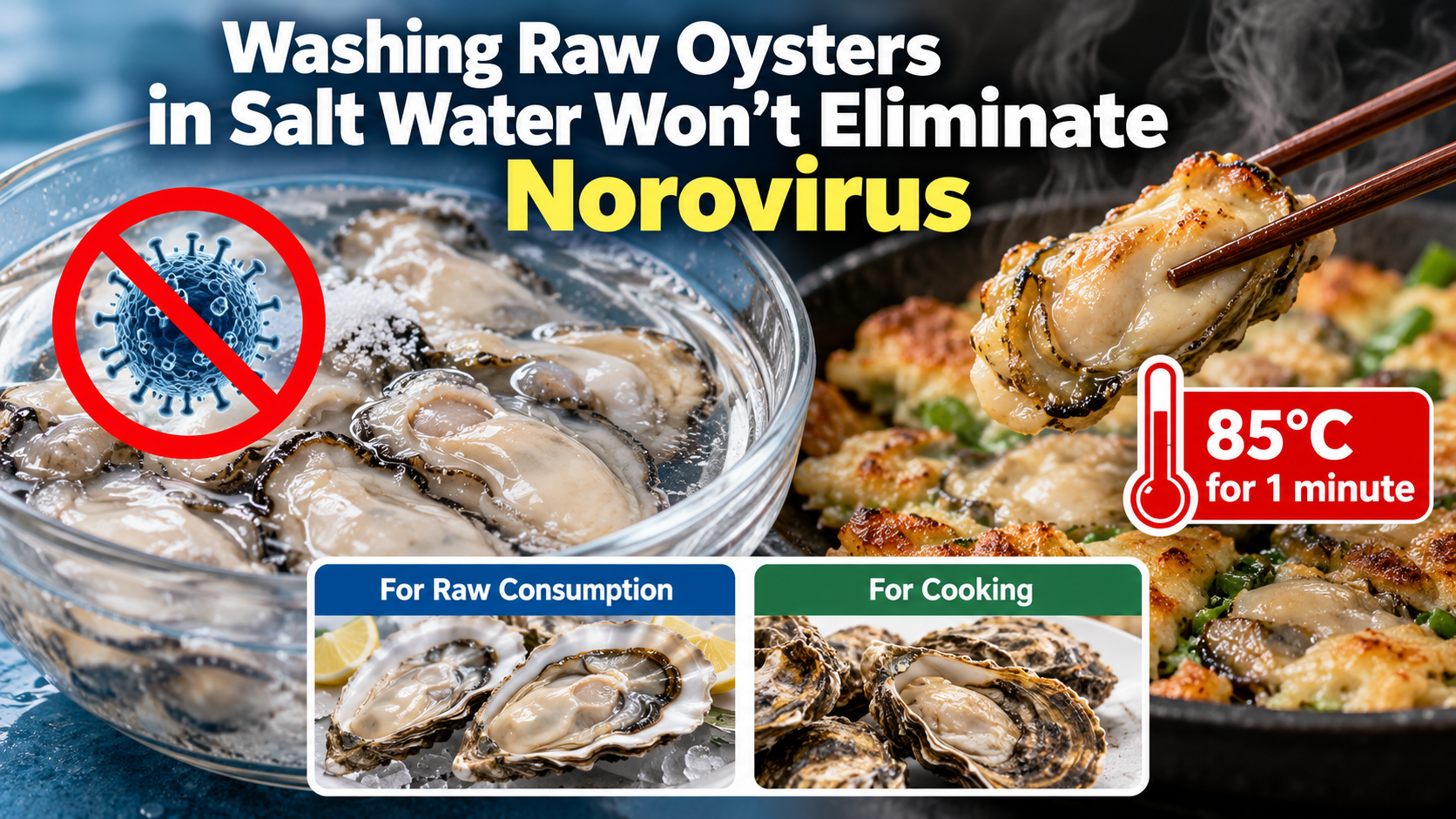
Washing raw oysters in salt water or soaking them to remove impurities does not eliminate norovirus. Soaking them in vinegar or freezing them also cannot eliminate the risk of infection. Caution is necessary even with oysters sold in supermarkets for raw consumption, as norovirus has been detected in such products. In particular, oysters labeled as intended for cooking must be heated to an internal temperature of at least 85°C (185°F) for at least one minute.
If you are buying oysters to add to kimjang (the traditional Korean process of preparing large batches of kimchi), or planning to make seasoned raw oysters, oyster pancakes, or oyster rice soup, first check the intended-use label on the packaging. What matters more than how thoroughly the oysters have been washed is whether they are intended to be eaten raw and whether they have been cooked thoroughly all the way through.
Why Washing Oysters in Salt Water Does Not Remove Norovirus
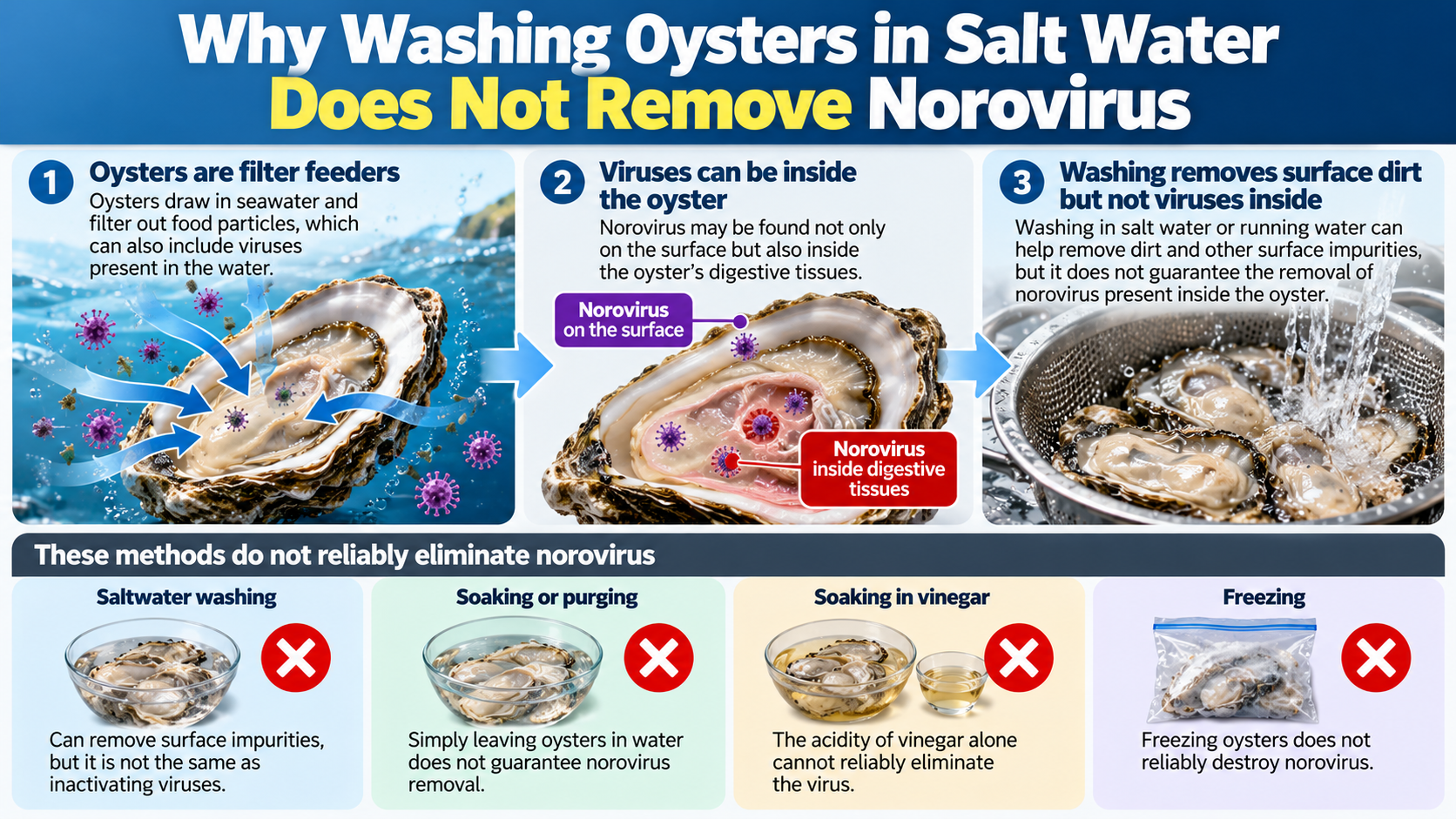
Washing oysters in salt water can help remove dirt and other surface impurities, but it does not guarantee the removal of norovirus. The same applies to rinsing oysters repeatedly under running water or soaking them in clean seawater.
Oysters are filter feeders, meaning they draw in seawater and filter out food particles. During this process, they can accumulate viruses present in the water. The problem is that norovirus may be found not only on the surface of an oyster but also inside its digestive tissues.
This explains why removing surface impurities does not necessarily eliminate viruses present inside the oyster.
In particular, the following methods should not be considered reliable ways to eliminate norovirus:
Saltwater washing: Removing surface impurities is not the same as inactivating viruses.
Soaking or purging: Simply leaving oysters in water does not guarantee norovirus removal.
Soaking in vinegar: The acidity of vinegar alone cannot reliably eliminate the virus.
Freezing: Freezing oysters does not reliably destroy norovirus.
Making a seasoned raw oyster dish by washing the oysters in salt water and then adding vinegar does not provide the same level of safety as thoroughly cooking them.
Raw-Consumption Oysters vs. Cooking-Only Oysters: What Is the Difference?
Oysters labeled for raw consumption are sold for eating without additional heat treatment. Oysters labeled for cooking must be cooked before consumption. However, a label indicating that oysters are suitable for raw consumption does not guarantee that they are completely free of norovirus.
| Category | Oysters for Raw Consumption | Oysters for Cooking |
|---|---|---|
| Intended use | Intended to be eaten raw | Intended to be eaten after cooking |
| Can they be eaten raw? | Sold for raw consumption, but infection risk remains | Must not be eaten raw |
| Norovirus risk | Norovirus has been detected in some samples | Thorough heating is required |
| Recommended preparation | Cook whenever possible | Heat to an internal temperature of at least 85°C for at least one minute |
In February 2024, the Gyeonggi-do Institute of Health and Environment in South Korea announced that norovirus had been detected in one submitted sample of oysters intended for raw consumption.
This case demonstrates that norovirus can be present even in oysters marketed for raw consumption. However, a single positive sample does not establish that all oysters sold for raw consumption are contaminated.
There is another important distinction.
A label indicating that oysters are intended for cooking does not mean norovirus has necessarily been detected in that particular product. The label identifies how the product is intended to be consumed. Rather than making assumptions about the test results of individual products, consumers should follow the preparation instructions indicated on the packaging.
When choosing oysters at a supermarket in South Korea, check the packaging for labels such as 'For Raw Consumption,' 'For Cooking,' or 'Cook Before Eating' before comparing prices or sizes.
What Does Heating Oysters to 85°C for One Minute Actually Mean?
The recommended cooking standard is to heat oysters until their internal temperature reaches at least 85°C (185°F) and maintain that temperature for at least one minute. This does not mean that the water in the pot merely needs to reach 85°C. Nor does it mean that cooking oysters for one minute after turning on the heat is sufficient.
South Korea's Ministry of Food and Drug Safety advises that oysters intended for cooking should be heated to an internal temperature of at least 85°C for at least one minute.
Here, internal temperature refers to the temperature inside the oyster, not on its surface.
For example, when cold oysters are added to boiling broth, the broth and the oysters do not immediately reach the same temperature. Even if the broth is boiling, it is necessary to determine whether sufficient heat has reached the center of the oysters.
The rate at which oysters heat through can vary depending on their size, initial temperature, the quantity added at once, and the cooking method.
Therefore, rather than applying the same cooking time to every oyster dish, it is important to ensure that the oysters are thoroughly heated all the way to the center.
Oyster pancakes and fried oysters may also be insufficiently cooked if only their surfaces are heated. This is especially important when oysters are large or covered in thick batter. The exterior may turn golden brown before enough heat reaches the center.
Oyster Pancakes and Fried Oysters: Why a Golden Exterior Is Not Enough
Different oyster dishes require slightly different precautions.
Oyster Pancakes
Oyster pancakes, a Korean dish commonly known as guljeon, begin cooking on the side touching the pan, so both sides must be heated thoroughly.
Do not stop cooking simply because the exterior has browned. Continue cooking until heat has reached the center of the oysters. For larger oysters, pay particular attention to how thoroughly the interior has been heated rather than relying on surface color.
Fried Oysters
The color of the batter does not necessarily correspond to the internal temperature of the oysters.
Even when the coating becomes crispy, check whether the center of the oyster has been heated sufficiently. When cooking oysters of different sizes together, do not assume that larger oysters are fully cooked just because the smaller ones are ready.
Oyster Soup and Oyster Rice Soup
The fact that the broth is boiling does not establish the internal temperature of the oysters.
Oysters must be heated sufficiently after being added to the broth. The larger the oysters or the greater the quantity added, the more important it is to ensure that they are cooked all the way through.
Using a cooking thermometer to measure the center of the thickest oyster can help confirm whether the recommended heating standard has been met.
Can Raw Oysters Be Safely Added to Kimchi or Seasoned Oyster Salad?
Washing raw oysters intended for kimjang does not eliminate the risk of norovirus. Mixing oysters into kimchi seasoning or salting them does not have the same effect as thoroughly cooking them.
When preparing kimchi, first check the intended-use label on the oyster packaging.
Avoid using cooking-only oysters directly in seasoned raw oyster dishes or kimchi containing raw oysters. Even when oysters labeled for raw consumption are used, the risk of infection does not disappear completely.
If reducing the risk of norovirus is the priority, eating oysters in thoroughly cooked dishes is the safer choice.
When handling raw oysters, it is also important to prevent hands and cooking utensils that have touched the oysters from coming into contact with other foods.
Even if the oysters themselves are cooked, contamination of other foods during preparation can create a separate infection risk.
Cross-Contamination: Why Cooking Oysters Is Not the Only Precaution
Properly heating oysters can reduce the risk of norovirus infection, but it does not automatically prevent other foods from becoming contaminated during preparation.
For example, if you handle raw oysters and then use the same cutting board or utensils to prepare ready-to-eat side dishes, cross-contamination may occur. Cross-contamination means that contaminants, including viruses, are transferred from one food to another through hands, utensils, or other surfaces.
For this reason, both thorough cooking and hygienic food handling are essential.
Wash your hands with soap after handling raw oysters, and clean any utensils used during preparation. It is also important to prevent water used to wash raw oysters from coming into contact with food that has already been cooked.
Norovirus can also spread through contaminated foods other than oysters or through the hands of infected individuals. Avoiding oysters does not eliminate every possible source of norovirus infection.
What Symptoms Can Occur After Eating Raw Oysters?
Norovirus infection can cause symptoms such as vomiting, diarrhea, and abdominal pain. However, experiencing stomach pain after eating raw oysters does not necessarily mean that you have contracted norovirus.
The incubation period for norovirus is generally considered to be 12–48 hours.
If symptoms develop, replacing lost fluids and electrolytes is important. Seek medical attention if vomiting or diarrhea is severe enough to make it difficult to retain fluids or if dehydration is suspected.
Children, older adults, and people with weakened immune systems need to be particularly careful about dehydration and complications.
Anyone who may have a norovirus infection should avoid preparing food for others. Because the virus may continue to spread even after symptoms disappear, maintaining proper handwashing and food preparation hygiene remains important.
How to Choose and Prepare Oysters More Safely
If you purchase oysters at a supermarket, start by checking the intended-use label on the packaging.
If the packaging says 'For Cooking' or 'Cook Before Eating,' do not add the oysters directly to seasoned raw oyster dishes or kimchi containing raw oysters. Instead, cook them until their internal temperature reaches at least 85°C (185°F) and remains at that temperature for at least one minute.
Even oysters labeled for raw consumption are not completely free of norovirus risk. Do not assume that washing them in salt water, soaking them, adding vinegar, or freezing them will eliminate that risk.
The key factors in eating oysters more safely are not the number of times they have been washed, but the product's intended-use label, sufficient heating all the way to the center, and preventing cross-contamination during food preparation.