
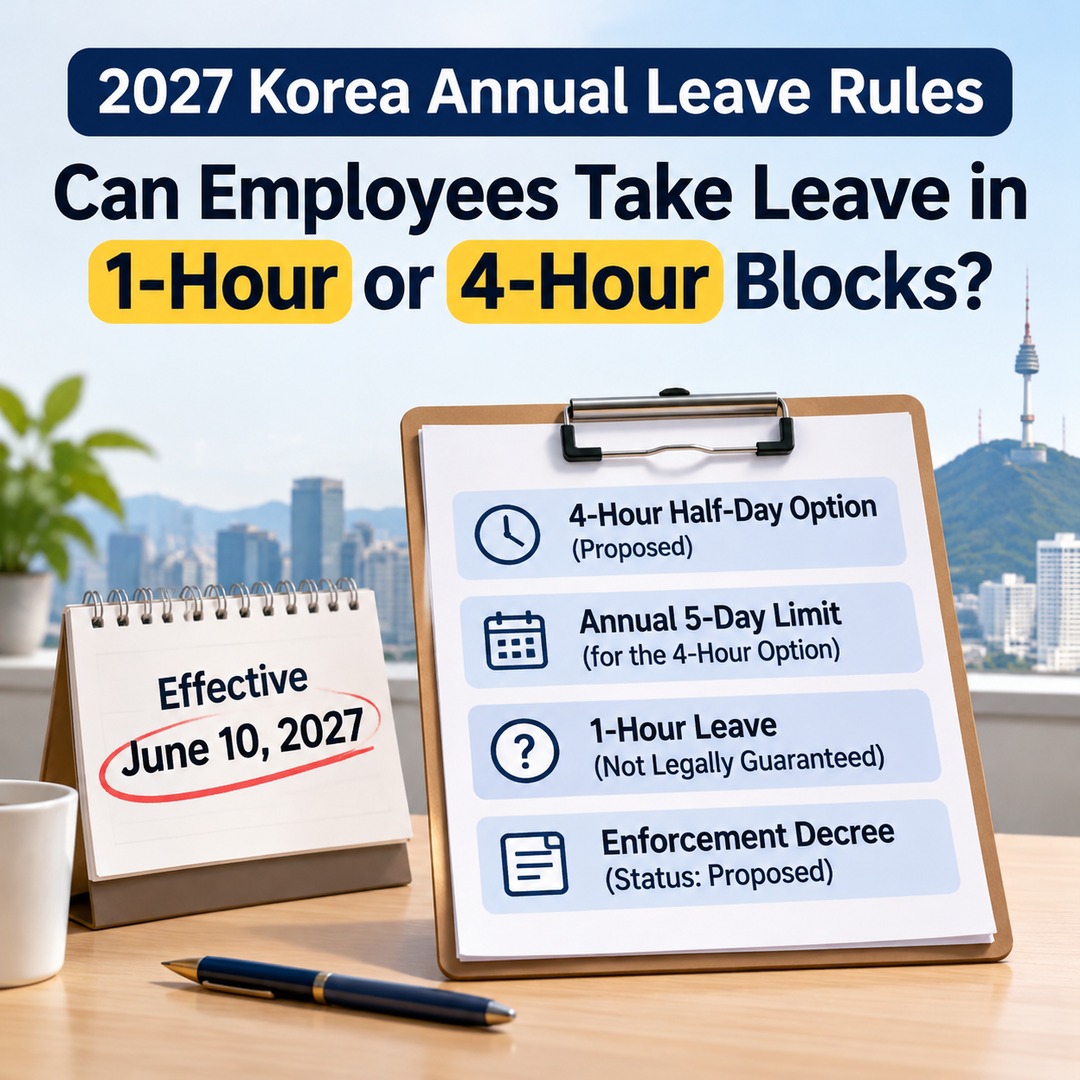
South Korea is introducing a system that allows employees to divide their annual leave into smaller time-based units starting in 2027. However, this does not mean that all employees will be guaranteed the right to take annual leave in 1-hour increments. The amended Labor Standards Act takes effect on June 10, 2027, while the proposed enforcement decree specifies half-day increments within an annual limit of 5 days. Therefore, 1-hour annual leave and 4-hour half-day leave must be understood as legally distinct arrangements.
When Will the New Annual Leave Rules Take Effect in 2027?
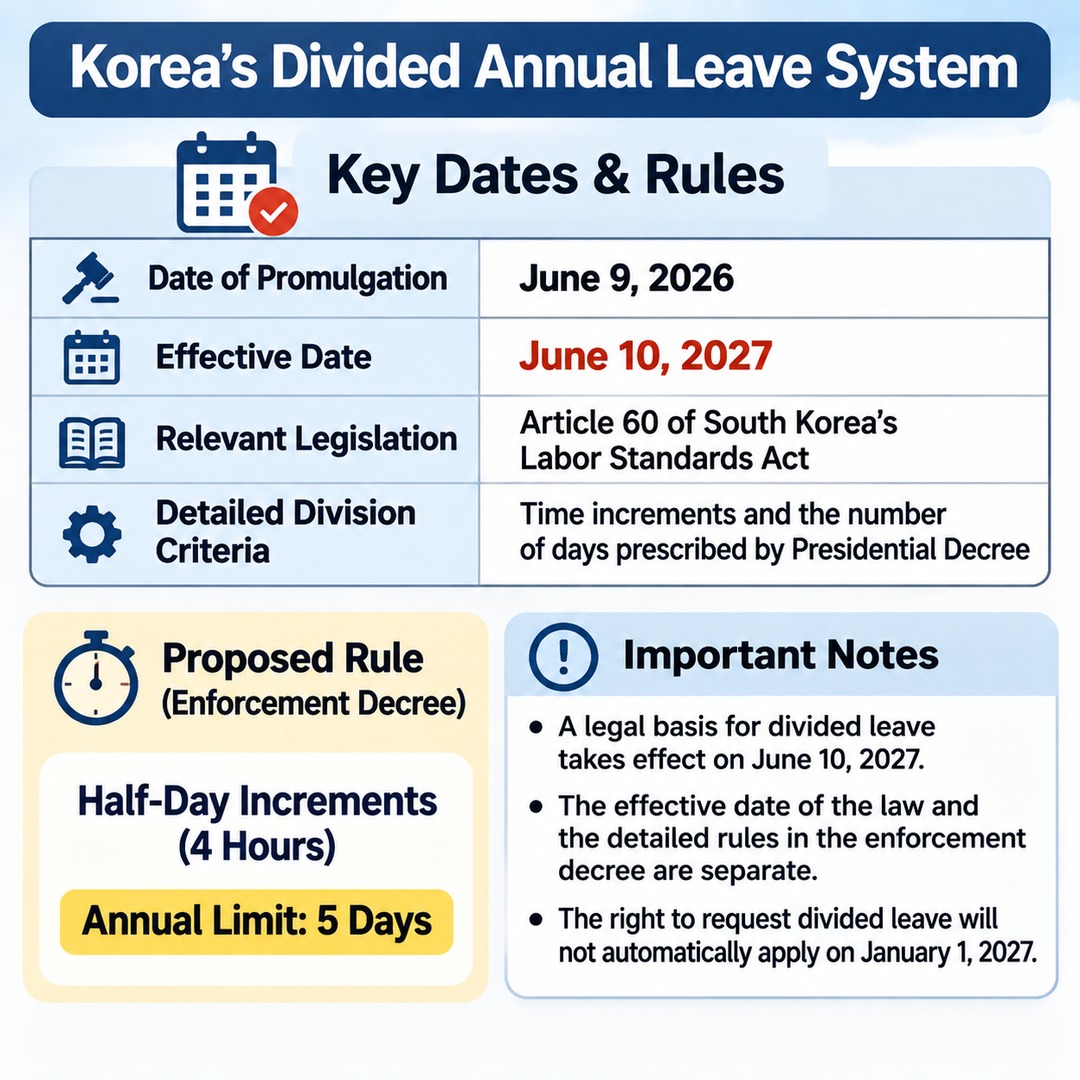
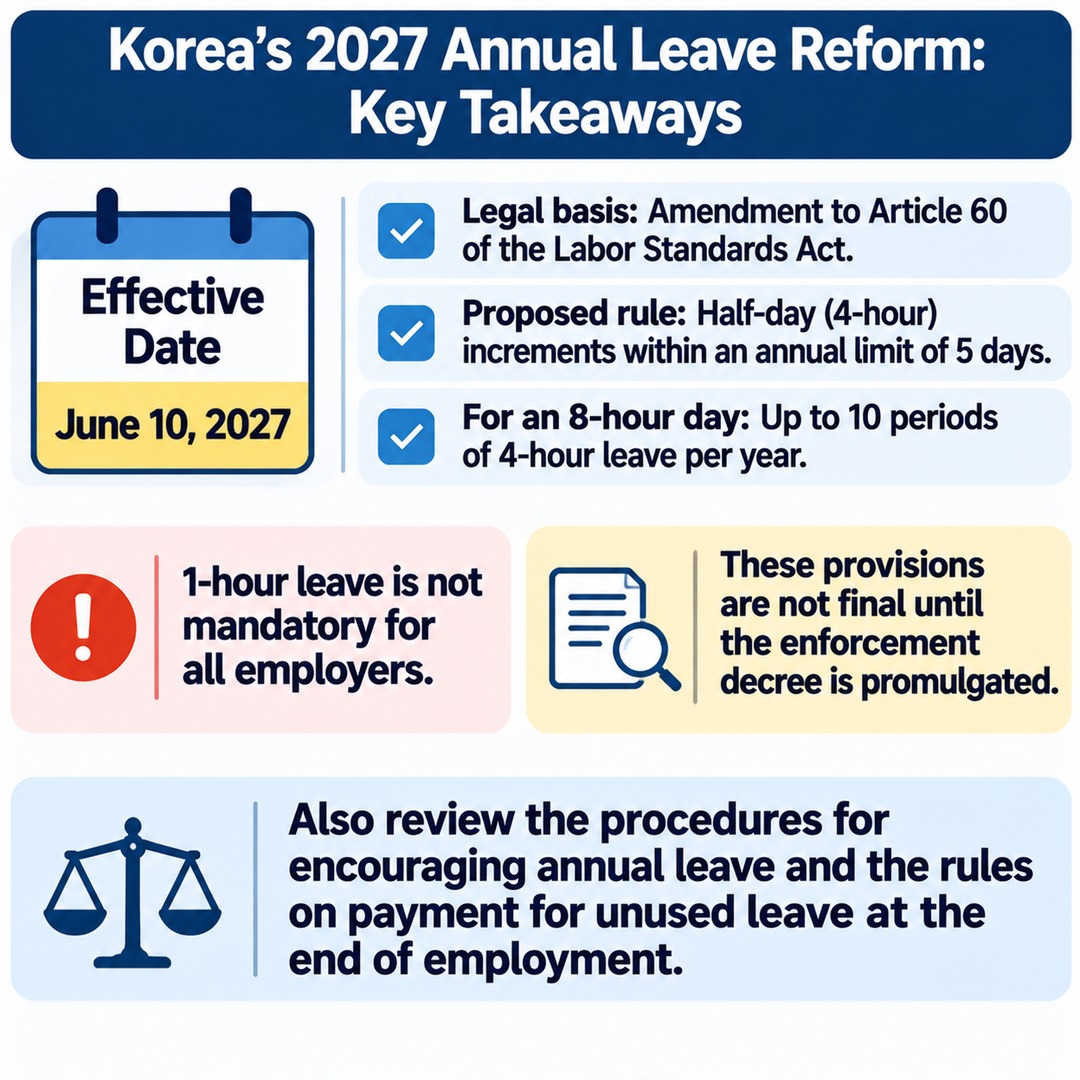
The legal basis for requesting annual leave in specified time-based increments will take effect on June 10, 2027.
An amendment to the Labor Standards Act, promulgated on June 9, 2026, introduced a new provision under Article 60 concerning requests to divide annual leave into smaller units. Previously, annual leave was generally structured around full-day use. The amendment adds a legal basis for dividing annual leave into time-based increments.
An important distinction is that the effective date of the amended law and the detailed rules established by its enforcement decree are separate matters.
Date of promulgation: June 9, 2026
Effective date: June 10, 2027
Relevant legislation: Article 60 of South Korea's Labor Standards Act
Detailed division criteria: Time increments and the number of days prescribed by Presidential Decree
Therefore, the new right to request divided annual leave will not automatically take effect on January 1, 2027.
What Do the Proposed Annual Limit of 5 Days and Half-Day Leave Mean?
The publicly announced draft amendment to the Enforcement Decree of South Korea's Labor Standards Act proposes allowing employees to divide annual leave into half-day units, subject to an annual limit of 5 days.
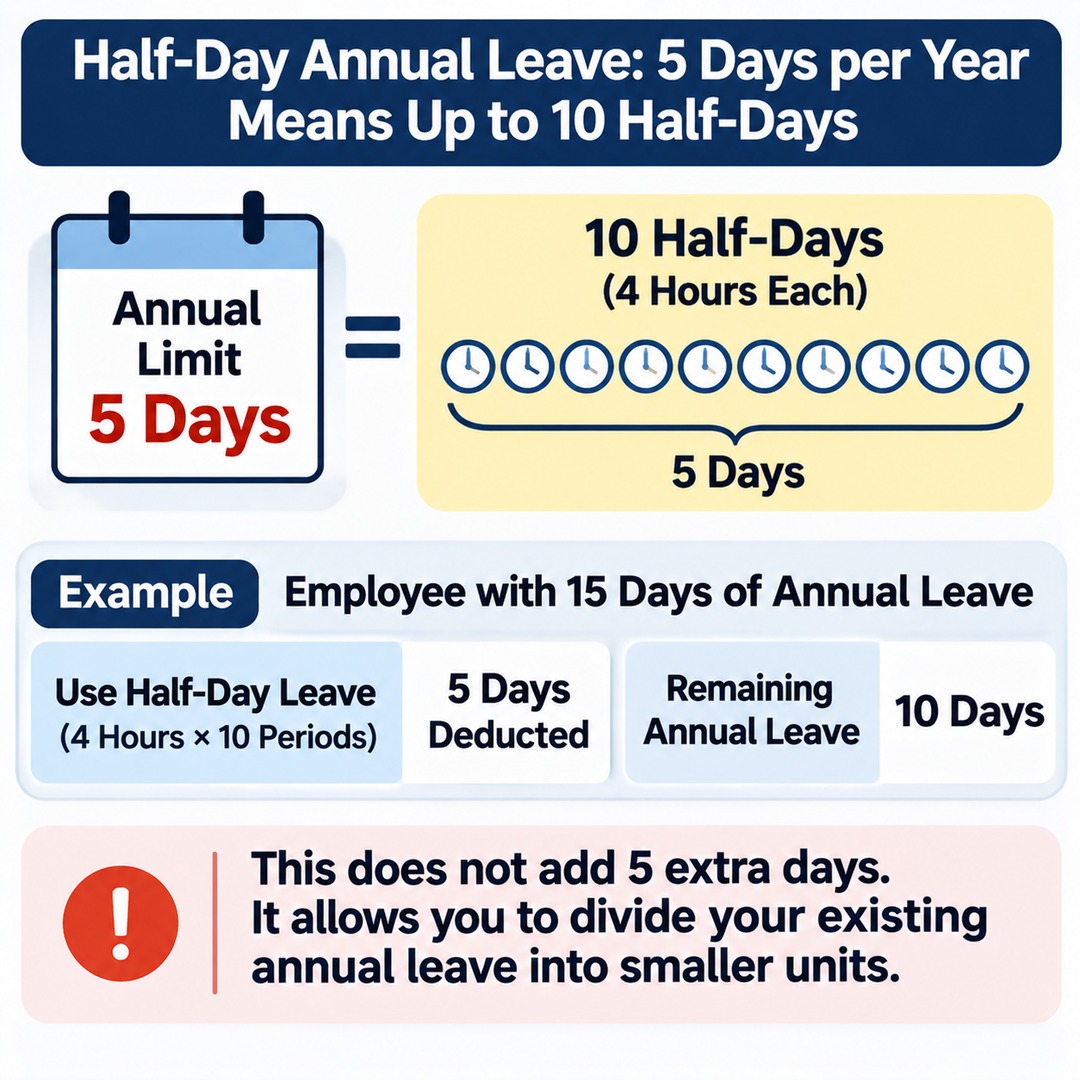
The annual limit of 5 days does not mean that employees can use only five half-days. Because one full day can be divided into two half-days, the proposed arrangement would allow up to 10 half-day leave periods per year if finalized as proposed.
For employees working a standard 8-hour day, the calculation is as follows:
| Category | Leave duration | Annual allowance or scope |
|---|---|---|
| Full-day annual leave | 8 hours | Based on the employee's existing remaining leave balance |
| Half-day annual leave | 4 hours | Within an annual limit of 5 days |
| Number of half-day periods | 4 hours each | Up to 10 periods |
| 1-hour annual leave | 1 hour | No guaranteed entitlement specified in the draft enforcement decree |
For example, consider an employee with 15 days of annual leave, assuming the new divided-leave rules apply.
Using 10 periods of 4-hour leave would deduct a total of 5 days from the annual leave balance.
The remaining 10 days could be used under the existing arrangements.
This does not mean that employees receive an additional 5 days on top of their existing 15 days. It concerns the ability to divide their existing annual leave entitlement into smaller units.
What Is the Difference Between 1-Hour Leave and 4-Hour Half-Day Leave?
The most important difference is the scope of the legal obligation requiring employers to recognize an employee's request.
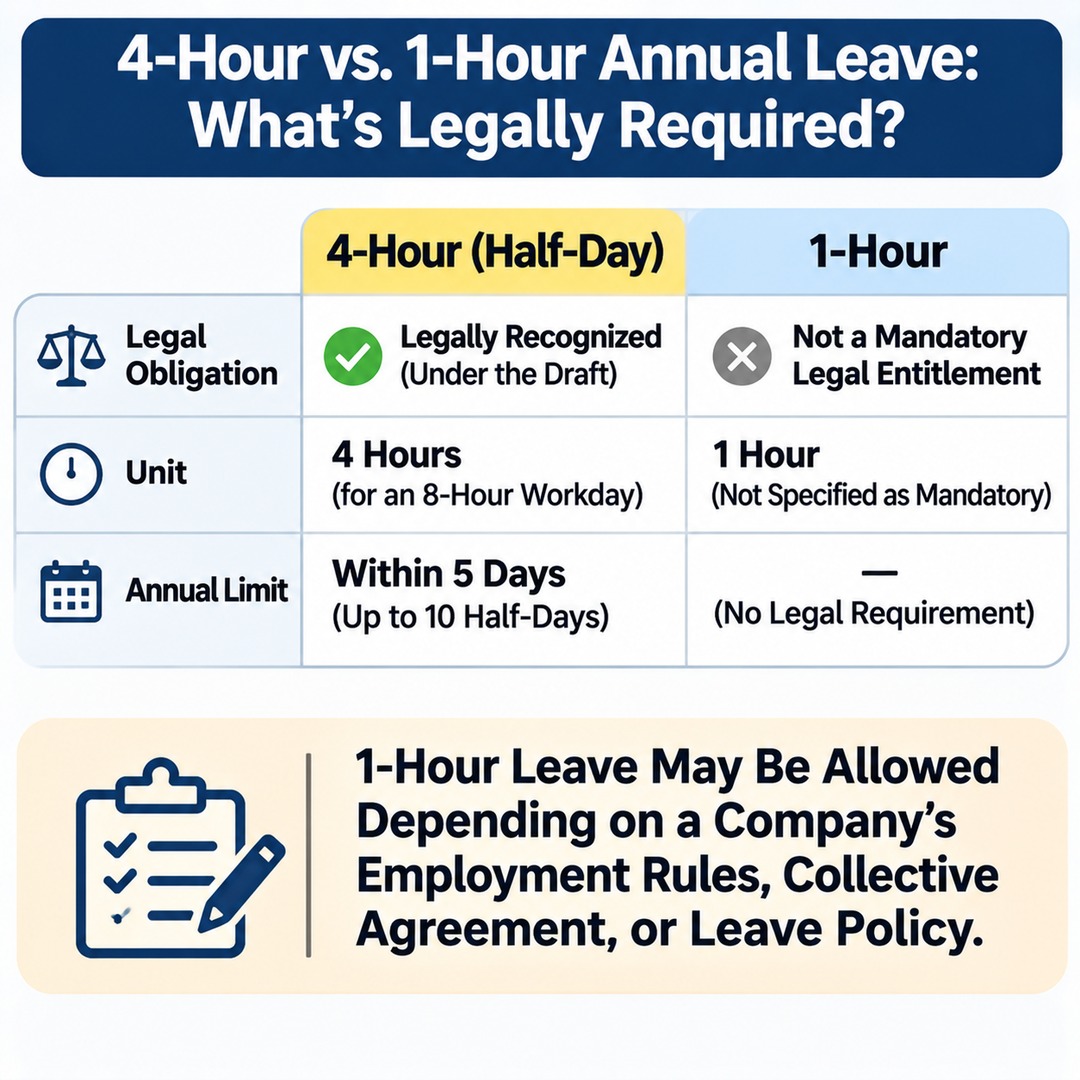
The draft enforcement decree proposes half-day leave as the designated division unit. For employees working a standard 8-hour day, this corresponds to 4 hours.
By contrast, the draft does not specify 1-hour leave as a mandatory division unit that employers must provide.
The differences between the two arrangements are as follows.
4-Hour Half-Day Leave
If the enforcement decree is finalized as proposed alongside the law taking effect on June 10, 2027, employees will have a legal basis for requesting half-day leave within an annual limit of 5 days.
1-Hour Annual Leave
The currently available draft enforcement decree does not require all employers to allow employees to take annual leave in 1-hour increments. It is important to distinguish between workplaces that permit 1-hour leave under their employment rules, collective agreements, or separate annual leave policies and situations in which the law itself guarantees that entitlement.
In other words, this does not mean that 1-hour leave is completely prohibited. Nor does it mean that every company is legally required to allow it.
Has the Enforcement Decree Already Been Finalized?
The proposed enforcement decree must not be treated as identical to the final promulgated version.
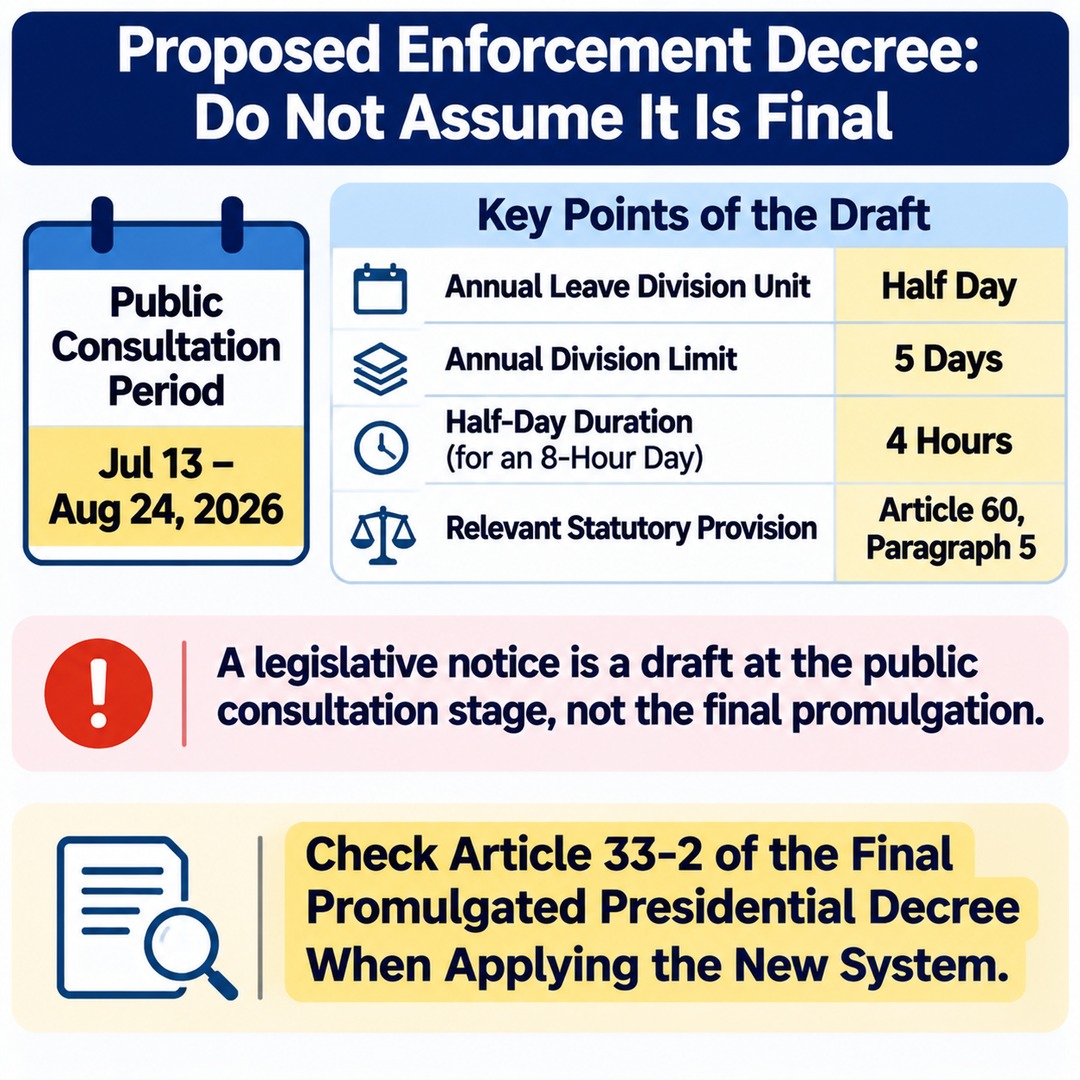
On July 13, 2026, South Korea's Ministry of Employment and Labor announced a proposed partial amendment to the Enforcement Decree of the Labor Standards Act for public consultation. The period for submitting comments ran from July 13 to August 24, 2026.
The main provisions of the draft were as follows:
Annual leave division unit: Half-day
Annual division limit: 5 days
Half-day duration for employees working 8-hour days: 4 hours
Relevant statutory provision: Article 60, Paragraph 5 of the Labor Standards Act
However, a legislative notice is not the same as the final promulgation of legislation. The relevant legislative proposal listed on the National Legislation Participation Center was at the public consultation stage. Its final provisions should not be assumed solely on the basis of the draft.
Therefore, when applying the new system in practice, it is necessary to check the contents of Article 33-2 of the final promulgated Presidential Decree.
What Should Companies and HR Departments Prepare For?
When the new annual leave division system takes effect, companies will need to establish specific procedures for leave requests and deductions from employees' leave balances.
In particular, companies should review the following areas:
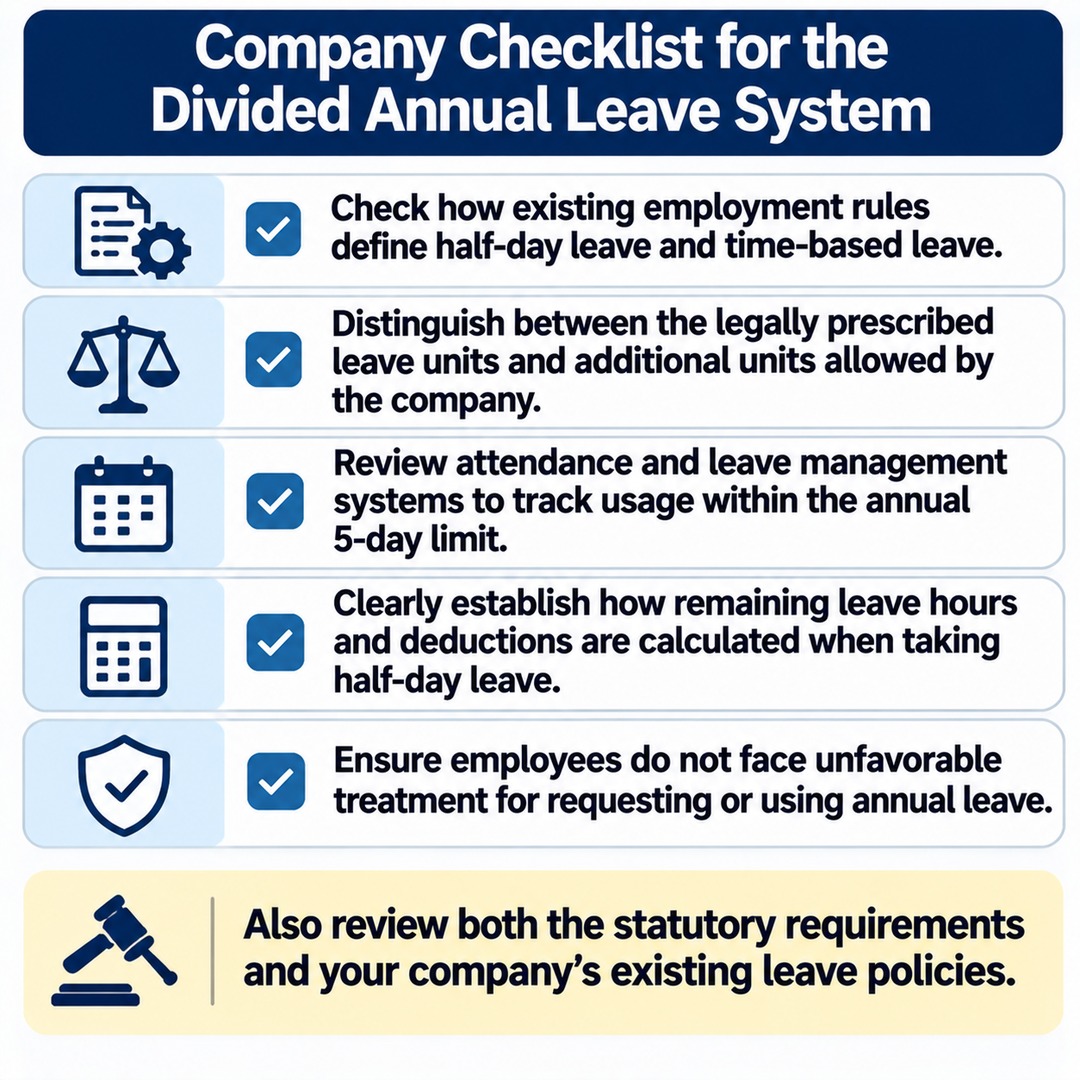
1. Check how existing employment rules define half-day leave and time-based annual leave.
2. Distinguish between the legally prescribed leave division units and additional units that the company independently permits.
3. Review attendance and leave management systems to ensure they can track usage within the annual 5-day limit.
4. Clearly establish how remaining leave hours and deductions will be calculated when employees take half-day leave.
5. Review internal policies to ensure that employees do not face unfavorable treatment because they request or use annual leave.
The amendment to the Labor Standards Act also includes provisions prohibiting employers from dismissing employees or subjecting them to other unfavorable treatment because they requested or used annual leave.
Rather than simply adding a half-day leave button to an attendance management system, HR departments should review both the statutory requirements and their company's existing leave policies.
Key Points to Remember About South Korea's 2027 Annual Leave Changes
The 2027 annual leave reform does not make 1-hour annual leave mandatory for all employers.
The amendment to Article 60 of the Labor Standards Act establishes a legal basis for requesting annual leave in divided time-based units, while the proposed enforcement decree specifies half-day increments within an annual limit of 5 days.
For employees working a standard 8-hour day, the proposal would allow up to 10 periods of 4-hour leave per year. However, until the final enforcement decree is promulgated, these provisions should not be presented as confirmed final regulations.
If you are concerned about whether your employer can prevent you from using annual leave or whether you are entitled to receive unused annual leave compensation, it is also worth reviewing South Korea's statutory procedures for encouraging employees to use annual leave and the rules governing unused leave when employment ends.