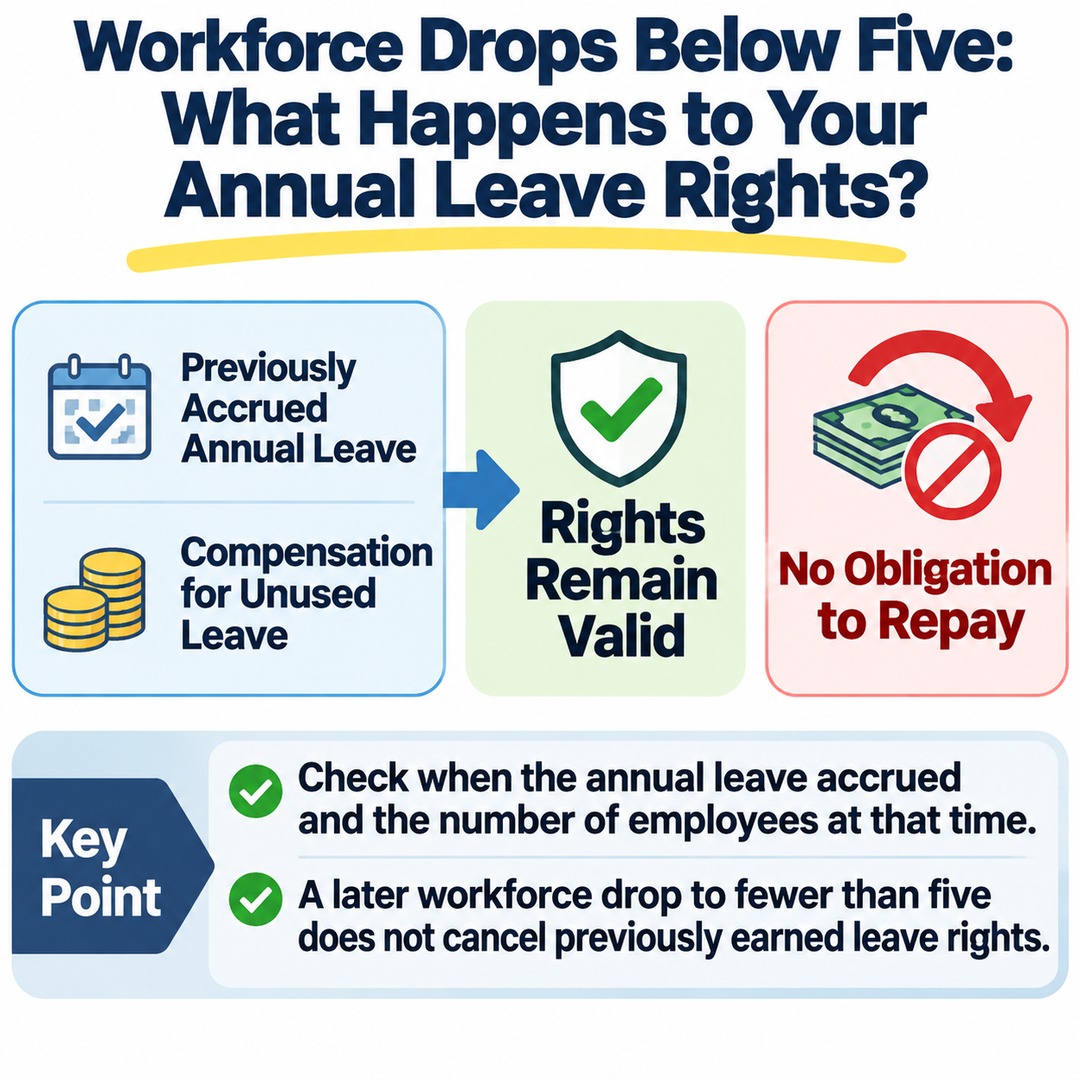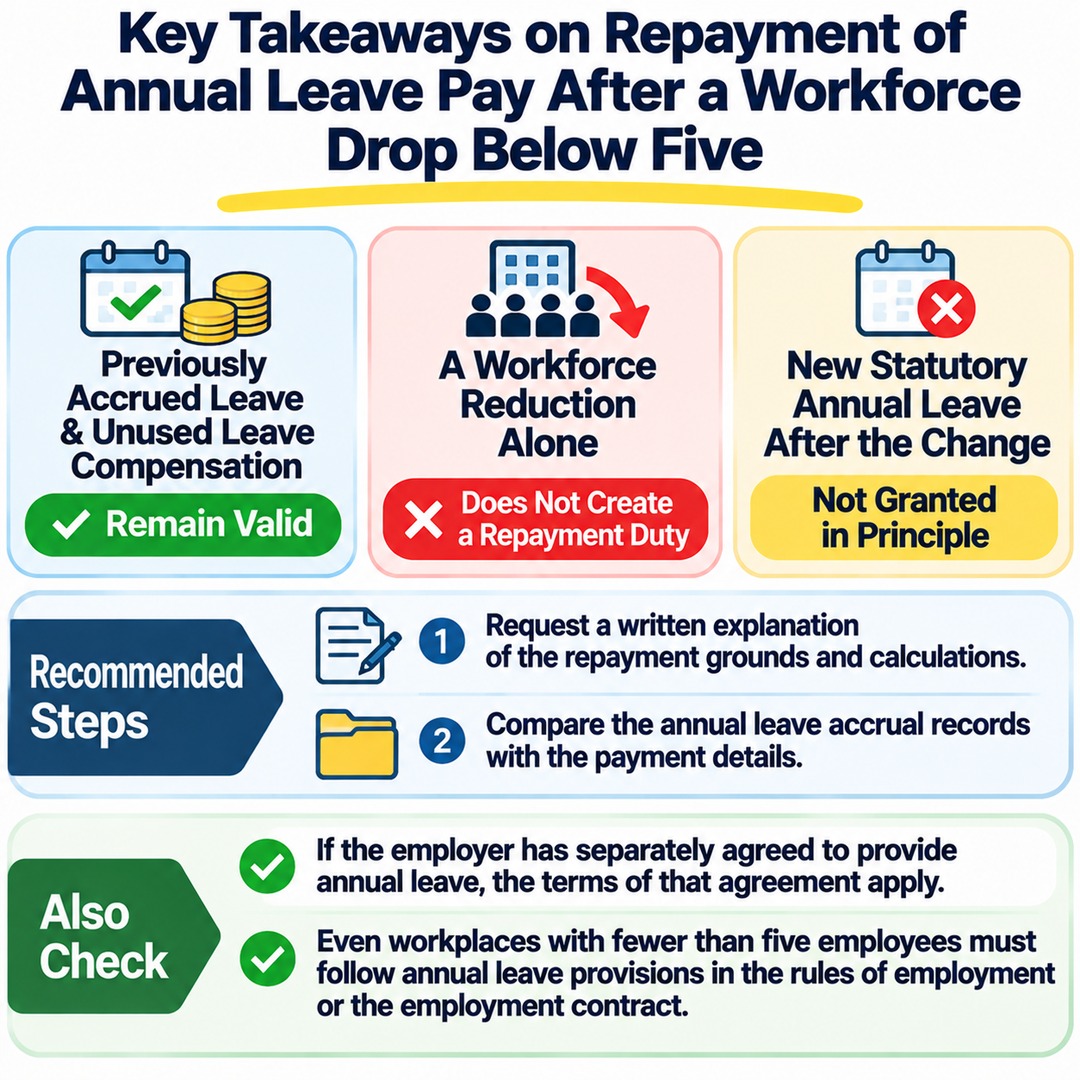
Even if a company reduces its workforce from five or more regular employees to fewer than five, annual leave and unused annual leave compensation that were lawfully accrued before the change do not automatically disappear. Employees retain their rights to previously accrued annual leave and claims for compensation for unused leave. Therefore, you are not required to repay annual leave compensation received after resignation simply because the workplace subsequently falls below the five-employee threshold.
On November 9, 2026, a worker contacted the Ministry of Employment and Labor's 1350 counseling service after receiving annual leave compensation following resignation and being asked by the former employer to return the money on the grounds that the workplace had fewer than five employees. The Ministry responded on the same day, November 9, explaining that previously accrued annual leave rights remained valid.
However, the outcome may depend on when the annual leave accrued and how many regular employees the workplace had at that time. It is important to distinguish the date on which the leave was accrued from the date on which the workforce fell below five employees.
Why Don't You Have to Repay Compensation for Annual Leave That Has Already Accrued?
Even if a company's number of regular employees falls below five after an employee has accrued annual leave, the employee's existing right to take that leave remains valid. According to the response provided through the Ministry of Employment and Labor's 1350 counseling service, the employee's right to claim compensation for unused annual leave also remains valid.
The Ministry explained that, even when a workplace changes to one with fewer than five employees after annual leave has been accrued, it is appropriate to protect the employee's right to use that leave under Article 60(7) of the Labor Standards Act of South Korea.
This can be understood from two perspectives:
It is not reasonable to extinguish leave rights that an employee has already lawfully earned through previous work simply because the size of the workplace has changed.
Paid annual leave is intended not only to provide financial compensation but also to give employees an adequate opportunity to rest.
Accordingly, an employer cannot claim that previously accrued annual leave compensation has become invalid solely because the workplace subsequently became one with fewer than five employees.
What Changes When a Workplace Goes from Five or More Employees to Fewer Than Five?
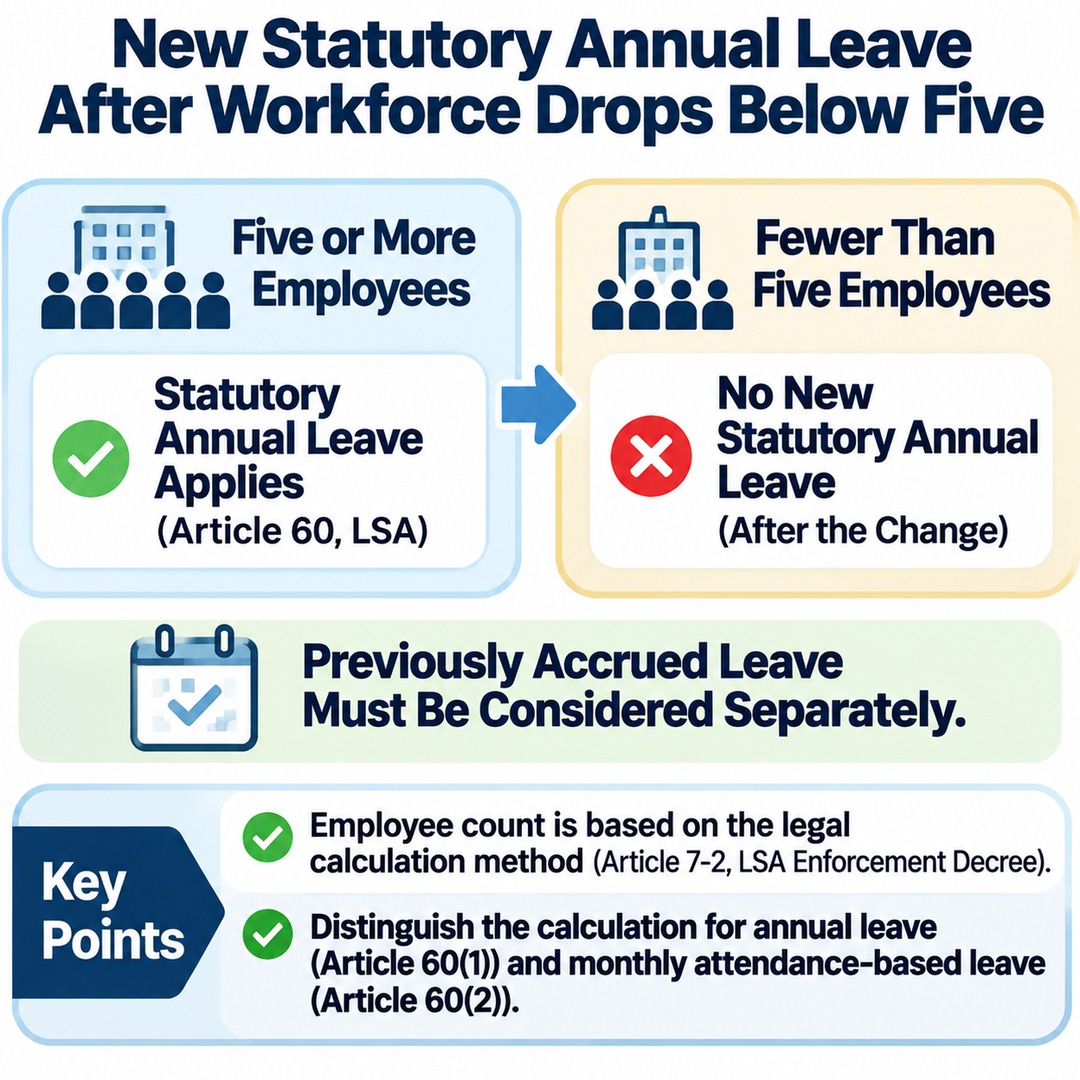
The main change concerns new statutory annual leave that would otherwise accrue after the workplace falls below the five-employee threshold.
Under Article 60 of South Korea's Labor Standards Act, statutory paid annual leave generally applies to workplaces that regularly employ five or more people. If the number of regular employees falls below five, the employer is no longer required to grant new statutory annual leave for periods after that change.
However, annual leave that accrued before the change must be considered separately.
| Category | Applicable treatment |
|---|---|
| Annual leave already accrued while the workplace had five or more employees | The existing right to use the leave remains valid |
| Compensation for previously accrued but unused annual leave | The employee's right to claim compensation remains valid |
| Period after the workplace changes to fewer than five employees | No obligation to grant new statutory annual leave |
| Separate provisions in the employment rules or employment contract | Determined according to the agreed terms |
The important factor is not simply how many employees are currently on the company's staff list. The relevant threshold is the number of regular employees calculated according to the method prescribed by South Korean law.
In particular, Article 7-2 of the Enforcement Decree of the Labor Standards Act establishes separate rules for calculating the number of regular employees. When determining annual leave eligibility, it is also necessary to distinguish the calculation methods applicable to annual leave under Article 60(1) and monthly attendance-based leave under Article 60(2).
Does Previously Accrued Annual Leave Compensation Disappear If the Workplace Has Fewer Than Five Employees on the Resignation Date?
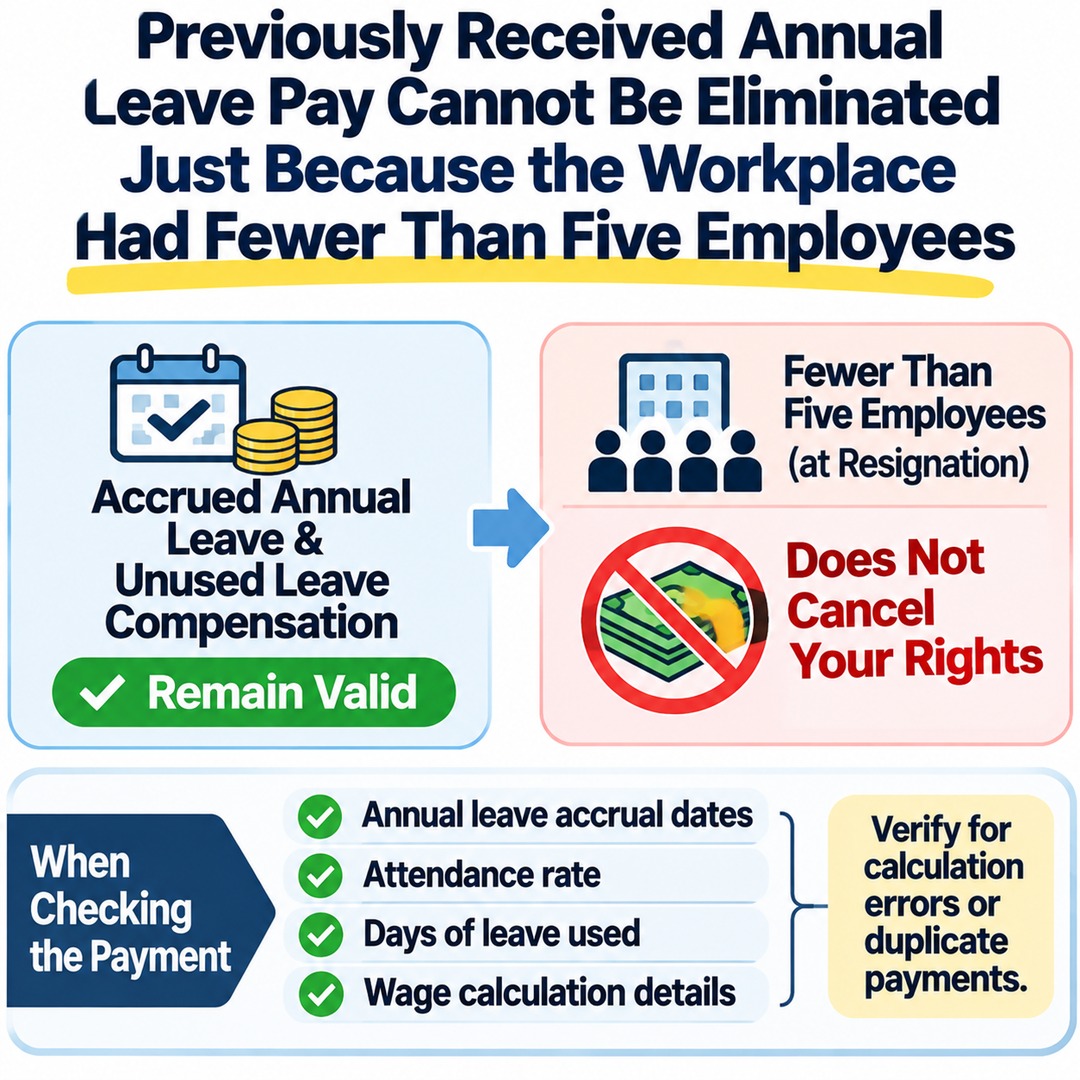
Previously accrued annual leave compensation cannot be eliminated merely because the workplace had fewer than five employees when the employee resigned.
This was the central issue in the counseling case. The employee resigned without using all of their annual leave and received financial compensation for the remaining days. The company subsequently demanded repayment, arguing that it had fewer than five employees.
In response, the Ministry of Employment and Labor explained that the employee's right to claim annual paid leave granted based on the previous year's attendance rate, as well as the right to receive compensation for unused leave, remained valid.
In other words, the relevant consideration is not simply the number of employees on the resignation date. It is whether the legal requirements for accruing the leave were satisfied when the leave was earned.
However, determining whether the actual payment was correct requires checking the annual leave accrual dates, attendance rate, days of leave used, and wage calculation details together. Incorrect calculations or duplicate payments are separate issues that must be considered independently of any change in workforce size.
What Should You Do If Your Employer Demands Repayment of Annual Leave Compensation?
Rather than immediately complying with the employer's repayment demand, first check when the annual leave accrued and the grounds on which the payment was made.
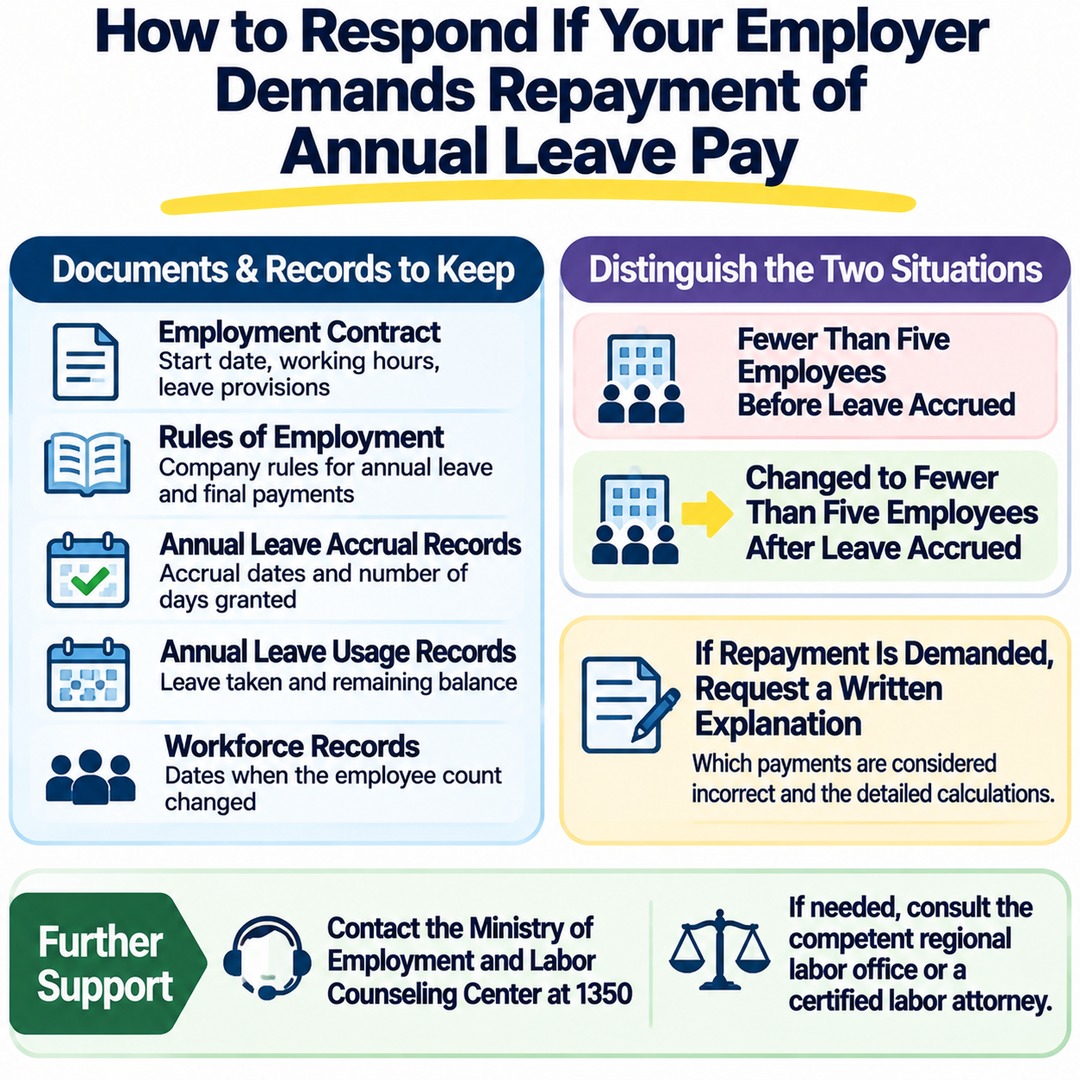
Keep the following documents and records:
1. Employment contract: Employment start date, working hours, and any agreed provisions concerning annual leave.
2. Rules of employment: The company's rules for granting annual leave and calculating final payments.
3. Annual leave accrual records: The dates on which leave accrued and the number of days granted.
4. Annual leave usage records: Leave actually taken and the remaining balance.
5. Workforce records: The date the workplace changed from five or more employees to fewer than five, together with records used to calculate the number of regular employees.
6. Final settlement records: The calculation of compensation for unused annual leave and proof of the actual payment.
If the company demands repayment, it is advisable to request a written explanation specifying which annual leave payments it considers incorrect and providing the detailed calculations supporting its position.
In particular, distinguish between these two situations:
The workplace already had fewer than five employees before the annual leave was accrued.
The workplace changed to having fewer than five employees after the annual leave had already accrued.
These situations may lead to different legal conclusions. In the second situation, you can challenge the repayment demand by referring to the continued validity of previously accrued leave rights and unused leave compensation confirmed in the Ministry of Employment and Labor's response.
If you cannot resolve the disagreement with your employer, contact the Ministry of Employment and Labor's counseling center at 1350 and provide details of your employment period and annual leave accrual records. If an individual legal assessment is necessary, consult the competent regional labor office or a certified labor attorney in South Korea.
How Can You Check Whether the Workplace Had Five or More Employees When the Annual Leave Accrued?
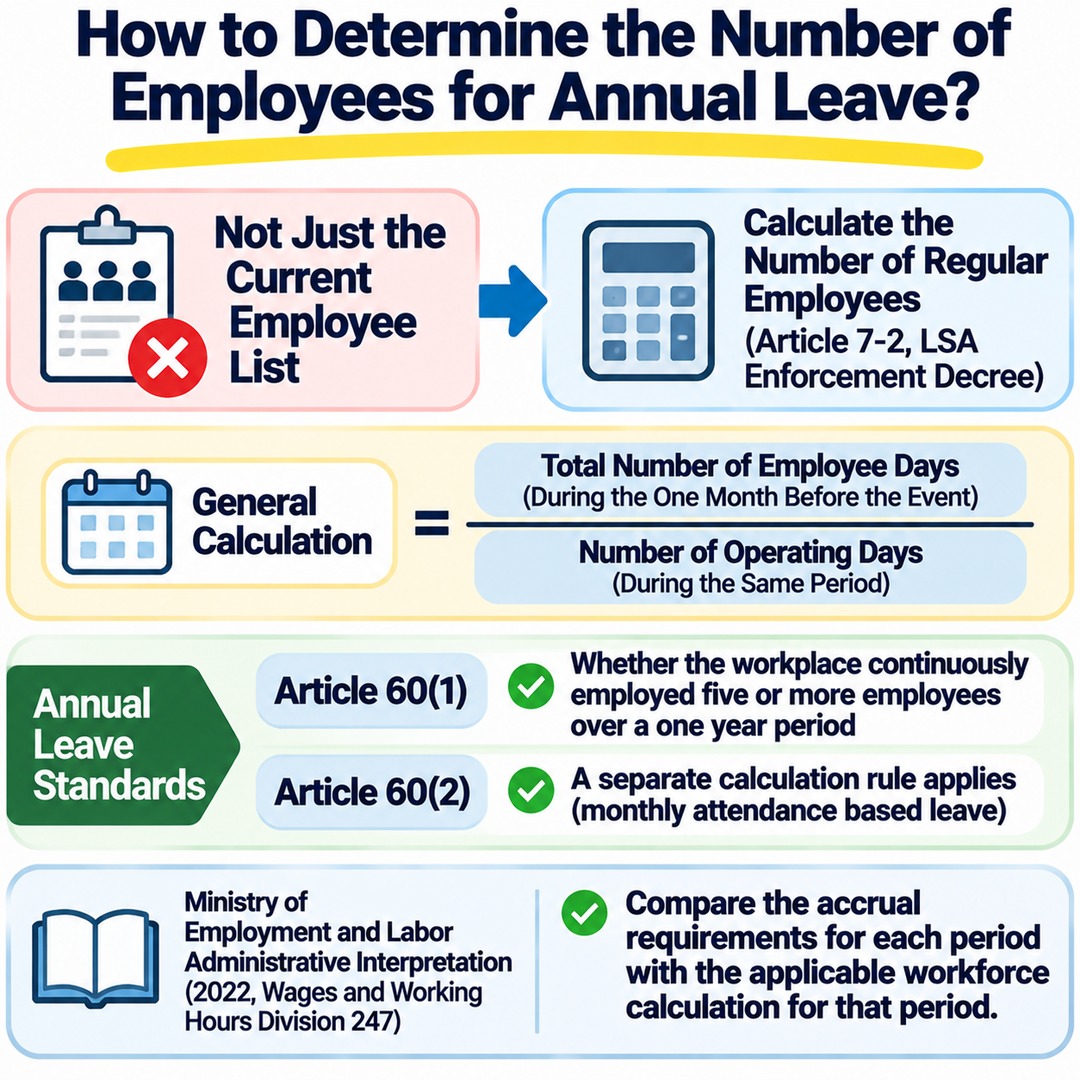
Simply checking whether five people currently appear on the employee list is not sufficient to reach an accurate conclusion. The number of regular employees must be calculated using the standards set out in Article 7-2 of the Enforcement Decree of South Korea's Labor Standards Act.
In general, the calculation is based on the total number of employee-days during the one-month period before the event triggering the application of the law, divided by the number of operating days during that period.
However, additional criteria apply to paid annual leave. For leave under Article 60(1), the relevant standard also concerns whether the workplace continuously employed five or more employees over a one-year period. A separate calculation rule applies to monthly attendance-based leave under Article 60(2).
The Ministry of Employment and Labor also addressed the calculation of annual leave for workplaces that repeatedly alternate between having five or more employees and fewer than five in its 2022 administrative interpretation, reference number Imgeumgeunrosigan-gwa-247 (Wages and Working Hours Division-247).
Therefore, you should not determine whether previously accrued annual leave was valid solely by looking at the date on which the number of employees decreased. Instead, compare the accrual requirements for each period of annual leave with the applicable workforce calculation for that period.
Frequently Asked Questions
Q. Can I receive compensation for previously accrued annual leave if the workplace had fewer than five employees when I resigned?
If you lawfully accrued the annual leave before the change, your right to claim compensation for unused leave does not disappear simply because the workplace had fewer than five employees when you resigned. The Ministry of Employment and Labor's counseling response also confirmed that previously accrued leave and unused leave compensation remain valid.
Q. What should I do if my former employer asks me to return annual leave compensation that has already been deposited into my account?
A reduction in the number of employees does not, by itself, create an obligation to repay the money. First, request a written explanation of the repayment grounds and supporting calculations. Then compare the annual leave accrual records with the payment details.
Q. Can I still use previously accrued annual leave after the workplace changes to fewer than five employees?
According to the Ministry of Employment and Labor's interpretation, the right to use annual leave already accrued while the workplace had five or more employees remains valid. However, this must be distinguished from new statutory annual leave that would otherwise accrue after the workplace changes to fewer than five employees.
Q. Does a company with fewer than five employees have to pay annual leave compensation if annual leave is included in the employment contract?
If the employer has separately agreed to provide annual leave, the terms of that agreement are important. The Ministry of Employment and Labor has also explained that even workplaces with fewer than five employees must follow provisions concerning annual leave contained in their rules of employment or employment contracts.